
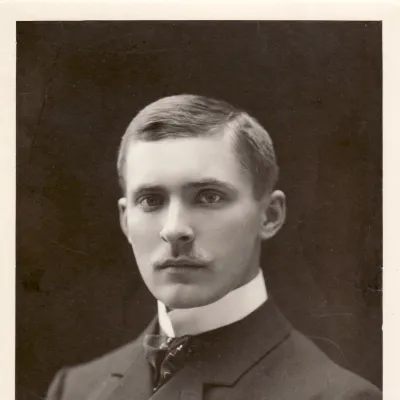
Hans Schmidt
Human Design Chart
Biography
Schmidt spent decades investigating the pathogenesis and immunity of infectious diseases and the relationship between immunity and allergy, anaphylaxis and serum sickness. His books on serology, specific therapy and prophylaxis were then considered standard works. Schmidt was the editor of Fortschritte der Immunitätsforschung (advances in immunology research) and from 1957 to 1975 co-editor of Zeitschrift für Immunitätsforschung (Journal of Immunology).
He died on 1 March 1975 in Wabern bei Bern, aged 92.
What does Generator 3/5 mean for Hans Schmidt?
Generator 3/5 — Design at a Glance
Hans Schmidt revealed himself as someone who did not unleash his strength through constant initiative but rather through quick responses to external signals. His Generator design was characterized by immense, sacral endurance. However, this energy source only worked effectively when he reacted to impulses from his environment, rather than taking the first step independently. The motto 'react, don't initiate' was the key to his efficiency.
His inner compass, the sacral center, gave him clear signals. When it said 'yes', Hans Schmidt could act with full power and endurance. In these moments, he was irreplaceable and efficient. Conversely, ignoring this inner resonance led to two specific risks: either he burned his energy on tasks that did not fulfill him, leading to exhaustion, or he was held back from his heart project, even though he was still full of drive.
Living in harmony with this strategy, that is, through patient waiting for the right signal and subsequent action, his design rewarded him with a deep sense of satisfaction and fulfillment. If he tried to fight against his nature and constantly initiate, or suppress his impulses, he would sooner or later encounter persistent frustration and a noticeable energy shortage. His strength lay not in pushing forward but in the powerful, intuitive response to life.
Emotional Authority
Hans Schmidt showed himself as someone who never made decisions immediately but consciously let them rest. His design carried emotional authority, meaning his defined solar plexus center took over inner leadership – regardless of which other centers were also defined. This authority always took precedence over all other inner impulses.
Hans Schmidt was subject to an emotional wave that manifested in a constant up and down of his feelings. He saw the world always colored by his current mood. In one moment, he could be totally enthusiastic about something, in the next, he could view the same thing completely negatively. His feeling in the moment was, however, only a snapshot, a first impression, which did not necessarily represent his truth. Quick, spontaneous decisions based on emotion often had negative effects on him.
The more time he took to let a decision mature, the deeper and more comprehensive he could understand something. This required patience and repeatedly thinking over a decision. Hans Schmidt should take his time and ask himself multiple times. Over time, the intense feelings subsided, he gained emotional distance, and clarity and calmness set in. Only then had he gone through the process. This was particularly true for long-term decisions that could have a significant impact on his life course.
The 3/5 Profile — Martyr / Heretic
Hans Schmidt lived as someone who first had to try everything himself before helping others. His design as a 3/5 profile combined the experimental line 3 with the heroic line 5. He learned through his own mistakes and accumulated a rich treasure of practical experience that he later made accessible to others. This approach made him attractive to his environment, as others wanted to learn from his insights.
The third line in his design marked a lifelong process of humility through trial and error. Being alone was a central element to protect himself from negative influences and strengthen his willpower. Phases of isolation alternated with times of collaboration. Here, a subtle liberation without show was evident, while arrogance posed the risk of neglecting these necessary rest periods.
At the same time, he carried the aspects of the fifth line, often described as a critical observer or 'spoilsport'. Hans Schmidt tended to not consider himself talented and to reject external recognition. His transformation lay in overcoming this self-criticism and being ready to use his abilities for the collective. He needed encouragement to acknowledge his talents and help others, rather than hiding them from the world out of shame or doubt.
Triple Split Definition — Defined & Open Centers
Hans Schmidt was revealed as someone who constantly faced an internal mental pressure to ask questions and understand connections. This tendency stemmed from his defined connection between the Head and Ajna Centers. He possessed a firm way of conceptual thinking but lacked the energy to directly implement these ideas. Instead, he acted as an inspirational source for others who had the capacity to realize his thoughts.
His design also included a defined G Center, which gave him a reliable sense of self-identity and a clear direction for his personal path. Combined with a defined Heart Center, Hans Schmidt had a strong will and the desire to determine his life and resources independently. He sought recognition for his contribution and preferred to work independently to follow his inner rhythms.
As a Generator with a defined Sacral Center, he was a guardian of immense vitality. His strategy was to not initiate but to wait for questions or offers to respond with an inner answer. Only in this way could he sustainably use his energy and avoid frustration. Additionally, a defined Solar Plexus Center shaped his emotional authority; he learned to trust the emotional wave and make decisions only after clarity had set in. A defined Root Center provided the necessary pressure to move forward in the world and master existential challenges.
In contrast, his Spleen Center was open. This made him vulnerable to conditioned fears and the need to orient himself towards external sources of security. He tended to question whether he was capable of meeting life's demands or feared being abandoned. This openness required him to avoid spontaneous decisions and instead rely on his inner authority to draw healthy boundaries and free himself from unhealthy dependencies.
Channels for structure, community, rhythm, focus and abstraction.
Hans Schmidt was characterized by a profound ability to translate complex experiences into understandable narratives, coupled with a calm, focused endurance. His design tended to not only think but to bring thinking into the world through precise structuring and emotional clarity.
The Abstraction Channel 64-47 drove him to view life through a kaleidoscope of mental images. He sought the story behind the facts, often accompanied by inner confusion until a clear picture emerged. This mental energy flowed into the Channel of Structuring 23-43, which transformed spontaneous insights into clear, efficient expressions. Hans Schmidt could articulate innovative perspectives that expanded collective understanding, provided he trusted the right timing of his expression.
Parallel to this, the Channel of Concentration 52-9 endowed him with the ability to focus intently on details with calm intensity and to screen out distractions. This format energy supported his logical analysis and helped him perfect patterns. He was not restless as long as he pursued something that spoke to his inner authority.
Emotionally and socially, the Channel of Community 37-40 and Gates 16 and 51 shaped him. The Channel of Community conveyed his need for honest, reciprocal agreements. He sought his place in the group not through hierarchy but through loyal contribution. Gate 16 promoted his experimental mastery and identification with new skills, while Gate 51 provided a strong, adaptable willpower that transformed shocks into spiritual or material development.
The Beat Channel 14-2 rounded out his profile. It connected his generative energy with the ability to point out innovative directions. Hans Schmidt had the resources and intuition to drive mutations and open new perspectives for others through his authentic presence, without actively enforcing them.
Individual Circuitry — Circuit Signature
Hans Schmidt was marked by three separate, parallel operating energetic streams that did not flow directly into each other. One stream connected the Ajna with the Throat Center and the Identity with the Sacral Center. This promoted a pulsating creativity and the urge to express personal structures and rhythms. A second, independent stream connected the Sacral with the Root Center. Here, a focused, future-oriented logic aimed to improve things through concentration and strategy. The third stream connected the Head with the Ajna Center. It directed attention to reflecting on past experiences to grasp their meaning and share these emotional insights with others. Finally, there existed a fourth, isolated stream between the Heart and Solar Plexus Centers. It regulated the giving and taking in relationships and the joint resource building, where pauses for regeneration were necessary as there was no direct connection to life force. These four separate areas formed different, side-by-side forces in Hans Schmidt: creative structuring, rational optimization, emotional meaning-making, and social cooperation. They did not act as a cohesive whole but as distinct functional areas that each shaped their own themes and approaches in his life.
Right Angle Cross of Planning 3
Hans Schmidt's design carried the structure of the right cross of the planning 3. This configuration established a specific life dynamics characterized by a close connection between strategic thinking and concrete implementation. In Human Design, this cross marks an energy that does not remain theoretical but aims to translate plans into the real world.
For Hans Schmidt, this meant that his inner compass was directed towards the connection of vision and practice. He was inclined to develop ideas not just for the sake of it, but to make them tangible through structured steps. The energy of this cross promoted an attitude where the 'how' of implementation was as important as the 'what'. It was not about abstract dreaming, but about creating something tangible that rested on a solid foundation.
This mechanism shaped his way of dealing with challenges: He sought ways to break down complex connections into manageable units. His design supported him in functioning as a bridge between the world of concepts and that of material results. Hans Schmidt lived this tendency to turn plans into reality as a central aspect of his energetic alignment. His path was marked by the desire to bring order to chaos and enable sustainable changes through clear structures.
Saturn Return · Uranus Opposition · Chiron Return · 2nd Saturn Return — Life Cycles
Hans Schmidt's design was characterized by a clear, step-by-step consolidation of his professional authority. His path was marked by milestones that signified structural confirmation and increasing responsibility. In 1910, at the age of 28, he earned his Dr. med. This corresponded to his first Saturn return, a cycle in which years of groundwork often condenses into a solid, socially recognized result.
The development continued, driven by the need for deeper anchoring. In 1922, at the age of 40, Hans Schmidt habilitated in the field of hygiene. This step fell during the Uranus opposition, a phase that often requires new perspectives and questions established structures to elevate them to a higher level. Here, his ability to adapt to changing demands without losing the core of his work was evident.
Another peak occurred in 1929, when he became an extraordinary professor at the age of 47. This marked his Chiron return, a fulfillment cycle in which the inner purpose increasingly unfolds in the outer life. For Hans Schmidt, this meant that his professional identity and contribution to science were now experienced as meaningful and purposeful.
The process of consolidation culminated in 1941, at the age of 59, with his appointment as an honorary professor. This was his second Saturn return, often bringing the final confirmation of the lived path. Hans Schmidt's career thus illustrated a design that, through continuous work and structural integration, found a stable and recognized position.
Generator · Emotional Authority — Synthesis
Hans Schmidt was a Generator whose life was marked by a deep, sacral energy. This energy, combined with emotional authority, led him through a wave of feelings that he always had to let mature before making decisions. His profile as an experimenter and hero (3/5) revealed a lifestyle in which he learned through personal experiences and then made this knowledge available to others – a pattern that was evident in professional milestones, from promotion to honorary professorship. The defined mental pressure (Head and Ajna Centers) intensified the constant urge to understand and question things, making him an innovator and inspirator.
A central paradox in Hans Schmidt's design lay in the tension between his generative power and the knowledge circuit. While the Sacral Center drove him into the material world and concrete implementation (Channel 14-2), the knowledge circuit challenged him to constantly discover and transform new things. This dynamic led to a creative melancholy that propelled him to reinvent himself again and again, expressing his unique identity while simultaneously exploring the boundaries of the known.
5 Defined Channels
Incarnation Cross - Right Angle Cross of Planning 3
Solar Return
The Solar Return shows the moment when the sun returns to its exact birth position - your personal solar year.
Life Cycles
Discover the life cycles with a detailed triple view (birth chart, cycle chart, composite).
Human Design Profile
- Type
- Generator
- Strategy
- To respond - wait for something to respond to
- Authority
- Emotional Authority
- Profile
- 3/5 - Martyr / Heretic
- Definition
- Triple Split
- Incarnation Cross
- Right Angle Cross of Planning 3
- Date of Birth
- 31.08.1882 14:00
- Place of Birth
- Düsseldorf, GER
Frequently Asked Questions
What was Hans Schmidt's Human Design type?
What profile did Hans Schmidt have?
What was Hans Schmidt's authority?
What incarnation cross did Hans Schmidt have?
When was Hans Schmidt born?
Discover your own Human Design
Are you also a Generator? Find out in a personal reading how to use your sacral energy correctly and discover deep satisfaction.
More Personalities
Back to overviewAaliyah

Alexia

Angèle

Anne-Marie

Arcángel

Arno
