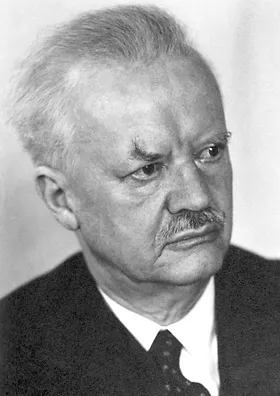
Hans Spemann
Human Design Chart
Biography
For his PhD thesis under Theodor Boveri, Spemann studied cell lineage in the parasitic worm Strongylus paradoxus, for his teaching diploma, the development of the middle ear in the frog. Spemann advocated a holistic approach to biology.
His theory of embryonic induction by organisers is described in his book Embryonic Development and Induction (1938). He died of heart failure on 12 September 1941 at age 72 in Freiburg, Germany.
Human Design Analysis: Hans Spemann as Manifesting Generator 2/4
Manifesting Generator 2/4 — Design at a Glance
Hans Spemann's Design featured a tendency towards hybrid energy: As an Manifesting Generator, he possessed the constant sacral power of a Generator combined with the ability to skip steps when taking action. This allowed him to quickly draw things into his life in ways that differed from pure Generators. Yet this speed carried risks. Often Hans Spemann was too quick and skipped important intermediate steps, which inevitably led him to have to return later to make up for what he had missed. Such setbacks generated frustration as they conflicted with his inner rhythm.
Furthermore, his system tended to pursue multiple projects simultaneously, driven by responding to various impulses. Without clear internal consent, this creative drive could quickly turn into exhaustion. The strategy was not to initiate himself but to react to life and only proceed when his sacral center clearly confirmed: "Yes." Only under these conditions could Hans Spemann draw deep satisfaction from his work. Then parallel working was no problem, but rather it fostered his natural play mode, where variety and fun nourished his creative power best.
Sacral Authority
Hans Spemann's decision-making process was characterized by a direct bodily reaction. As a Generator, he possessed sacral authority, which simplified his process: strategy and inner guidance merged into one. This mechanism manifested as an "inner voice" or a noticeable surge of energy in response to external stimuli. Instead of planning, Hans Spemann reacted intuitively; his body signaled through sounds like grunting or a short "mm-hm," indicating whether an impulse was right.
The prerequisite for this clear guidance was his open Emotional Center, which did not introduce disruptive waves into the decision-making process. When his sacral motor kicked in, he felt vital and energized. He then worked with great enthusiasm and immersed himself fully in activities without needing to search for a higher purpose. Joy and satisfaction were not side effects but rather the natural state of this activation.
Additionally, his activated Spleen Center acted as a supportive instance. Likely directly connected to the Sacral Center, it allowed Hans Spemann quick and spontaneous reactions. He had immediate access to his physical well-being and instinctive perception. This combination of sacral energy and spleen-based intuition enabled him to reliably guide himself with these inner signals, making his actions authentic and efficient.
The 2/4 Profile — Hermit / Opportunist
Hans Spemann's design established a tendency towards tension between withdrawal and connection. As a 2/4 Profile, he constantly fluctuated between the Line 2 need for solitude and concentration as well as the impulse of Line 4 to spend time with familiar people. This dynamic required him to create a safe environment in which he could communicate clearly: when he sought company and when he wanted to be undisturbed. During his "Me-Time", he immersed himself in internal processes to gain clarity. Only after this need was fulfilled did he return from his cave to tend to his network. Line 2 promoted consideration and the talent for focusing on essentials, though it could lead to an extreme case of selfish withdrawal. Line 4 gave him the ability as a "Personal Ship" to recognize deeper motivations in others and integrate them into a meaningful order. This helped him reflect on the knowledge of his network during solitary times and develop new insights from it. However, there was a risk that this organizing power could be perceived as manipulative since Line 4 tries to impose its own opinion on others. Hans Spemann ideally used this shift between isolation and community to generate brilliant ideas through the synthesis of inner reflection and external exchange. His design thus marked him as someone who maintained his own depth by setting clear boundaries in availability while effectively engaging others.
Single Definition — Defined & Open Centers
Hans Spemann revealed himself as someone with a reliable inner compass and clear expression. His defined G Center gave him a firm sense of self-identity and direction in life, independent of external validation. This internal security flowed into his defined Throat Center, serving as a focal point to communicate or act on this identity clearly and consistently, drawing from other areas of the design.
At the same time, Hans Spemann possessed an immense source of vitality through his defined Sacral Center. This energy was available for him to fulfill commitments and find satisfaction provided he responded to life rather than initiating it impulsively. His defined Spleen Center facilitated spontaneous intuition in the present moment, while his defined Root Center supplied the necessary pressure to move forward in the world and nourish existential awareness.
In contrast, Hans Spemann's Head, Ajna, and Heart Centers were open. The open Head Center meant he lacked a consistent source of mental inspiration; he tended to absorb mental stress from others or get stuck in doubt if he did not trust his inner authority. His open Ajna Center allowed for a flexible mind that reflected ideas from the environment without insisting on them as personal truths. The open Heart Center indicated that he was not designed to maintain willpower or promises consistently; he had to learn not to take on commitments under pressure to prove his worth, which would have led to frustration. Instead, he drew strength from reaction and his inner direction.
Channels for rhythm, reflection, logic and maturation.
Hans Spemann revealed himself as someone who was perpetually carried forward by the flow of life and possessed a sense of timing. This attitude stemmed from Channel Rhythm 5-15, connecting the Sacral Center with the G Center. Gate 5 held onto fixed habits while Gate 15 integrated variety into the life stream. This mechanism generated a magnetic energy flow that drew others into his rhythm and propelled groups forward without relying on intellect or emotional waves.
Parallel to this, Hans Spemann gathered life stories and secrets to reflect upon later. Channel Lost Son 13-33 connected the G Center with the Throat Center. Gate 13 listened and stored information while Gate 33 withdrew to contemplate these experiences. This process of patience and memory served to reveal deeper truths and bring continuity into personal as well as collective history.
Another defining trait was his insatiable drive to correct and perfect patterns. Channel Judgment 18-58 connected the Root Center with the Spleen Center. Gate 58 propelled a love for life and consistency, while Gate 18 acted as the corrector pointing out imbalances. Hans Spemann judged whether perceptions hindered or promoted life to find satisfaction in the collective.
Additionally, he experienced cycles until completion before starting new ones. Channel Maturation 42-53 connected Root and Sacral Centers. Gate 53 marked beginnings, while Gate 42 indicated growth. This mechanism ensured that each experience was fully traversed and reflected upon to gain wisdom rather than ending in frustration over unfulfilled expectations.
Furthermore, individual Gates played a role: Gate 52 required focus on pattern correction, Gate 17 logical teaching for the future, Gate 19 focus on resources and territory, Gate 7 leadership hierarchies, Gate 48 deep pattern recognition without implementation, Gate 39 provocative analysis, and Gate 2 receptivity to evolutionary directions.
Collective Circuitry — Circuit Signature
Hans Spemann's design inclined him towards structured, logical action free from emotional distortion. As a person with simple definition, he had an integrated energetic flow through Sacral, Identity, Throat, Root, and Spleen Centers. This allowed him to translate inner impulses directly into outer actions without internal blockages or isolated energy islands.
The Understanding Circuit shaped him through two separate segments: on one hand, it connected the Sacral with the Identity Center, linking his life energy directly to self-image and projection. On the other hand, the connection between Spleen and Root Centers included an intuitive risk assessment that showed in his ability to recognize dangers and strategically plan ahead. This circuit promoted sharing rational insights for future improvement.
Parallel to this, the Meaning Circuit also worked through two independent groups. The link from Throat to Identity Center allowed him to authentically articulate felt experiences from the past and share them with others. Simultaneously, the line between Sacral and Root Centers connected his power source with a drive for security and stability. Here it was about reflecting on past events to draw emotional lessons. Together, both circuits formed a person who utilized cool strategy as well as deep emotional reflection to pass on insights – always supported by the direct connectivity of his simple definition.
Right Angle Cross of Service 2
Hans Spemann's design established a foundational disposition characterized by the 'Right Cross of Service'. This configuration signaled a profound, often unconscious dedication to a goal or task that transcended personal benefit. It was not about arbitrary help but rather a structural impulse to take responsibility and stabilize structures that promoted the common good.
In Human Design, this cross describes a specific energy distribution that tends to link authority with service readiness. Hans Spemann demonstrated someone who did not primarily use his strength for personal recognition but to support others or keep systems running. The term 'Right' points to an outwardly directed, visible expression form: His service was not a hidden act but presented clearly and directly in his interactions.
This mechanism meant that true satisfaction only occurred when he felt his efforts had a measurable positive impact. He did not live for applause but for the confirmation that his work was necessary and actually helped. The design demanded of him to assume this role without losing self-esteem – a balance between dedication and independence, which determined his inner equilibrium.
Saturn Return · Uranus Opposition · Chiron Return · 2nd Saturn Return — Life Cycles
Hans Spemann's design inclined towards structured, scientific anchoring. He showed himself as someone who not only gathered insights but embedded them into established systems and legitimized them. This attitude was made concrete in 1898 at the age of 29: His habilitation in zoology for the medical field marked his first Saturn return. During this life stage, years of groundwork often condensed into a solid result that was socially or professionally recognized. For Hans Spemann, this meant transitioning from pure research to an institutionally secured position. The first Saturn return served as a catalyst for this stabilization. It was not about spontaneous unfolding but about creating a solid foundation upon which further developments could rest. This mechanism illustrates how inner maturity becomes visible through external structures. Hans Spemann used this time to strengthen his professional competence and position himself at the interface between zoology and medicine, in a complex field. The habilitation was thus not an isolated event but the logical consequence of his design-induced inclination towards systematic order and recognition by authorities. This shaped his further career as a foundation for deeper scientific breakthroughs built on this stable platform.
Manifesting Generator · Sacral Authority — Synthesis
Hans Spemann lived a life path marked by an inner drive to rhythmic activity and deeply rooted authority. The connection between sacral energy (Sacral Center) and the G-Center through the channel of rhythm (Gate 5/15) pointed towards a natural talent for recognizing and following life currents – a continuous response to external stimuli, followed by a vital implementation. This pattern was evident in his ability to act quickly and initiate things (Manifesting Generator), yet always in harmony with an internal bodily impulse. The line 2/4 of his profile strengthened the alternation between the need for withdrawal for internal clarification and the desire for exchange and community, indicating a deep capacity for self-reflection and building sustainable relationships.
A central tension field in his design lay in the combination of quick initiation power and the need for sacral confirmation. The Manifestor component allowed him to take rapid steps while the sacral authority continually urged him to listen to his body and only become active when a deep yes was felt. This might have led to an internal conflict between the desire for swift progress and the necessity to align with the natural flow of life – a dynamic that manifested in a documented career phase (habilitation) when he apparently took a decisive step after being moved by an inner impulse.
4 Defined Channels
Incarnation Cross - Right Angle Cross of Service 2
Solar Return
The Solar Return shows the moment when the sun returns to its exact birth position - your personal solar year.
Life Cycles
Discover the life cycles with a detailed triple view (birth chart, cycle chart, composite).
Human Design Profile
- Strategy
- To respond - wait for something to respond to
- Authority
- Sacral Authority
- Profile
- 2/4 - Hermit / Opportunist
- Definition
- Single Definition
- Incarnation Cross
- Right Angle Cross of Service 2
- Date of Birth
- 27.06.1869 03:30
- Place of Birth
- Stuttgart, GER
Frequently Asked Questions
What is the Human Design type of Hans Spemann?
Which Profile did Hans Spemann have in Human Design?
What authority did Hans Spemann possess?
What incarnation cross did Hans Spemann have?
When was Hans Spemann born?
Discover your own Human Design
Are you also a Manifesting Generator? Find out in a personal reading how to unfold your multi-talents and direct your energy wisely.
More Personalities
Back to overviewAldair

Alizée

Angeli

Arletty

Artus
Balthus