
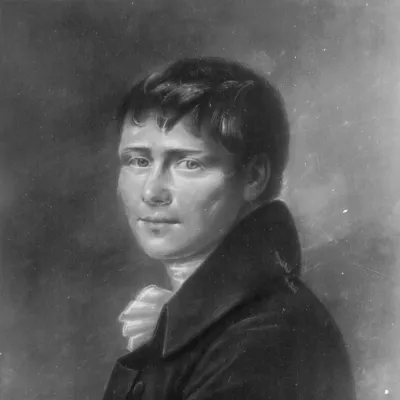
Heinrich Von Kleist
Human Design Chart
Biography
The Human Design of Heinrich Von Kleist: Generator 5/1
Generator 5/1 — Design at a Glance
Heinrich Von Kleist possessed enormous, sacral endurance energy that turned him into a powerful workhorse – provided he used it correctly. His Generator design determined his basic attitude: He was not built to act proactively but rather to react to impulses from the outside world. This reactivity was key to efficient energy use.
The mechanics of his sacral center demanded a clear strategy: Wait for an external signal and only then take action when his inner center gave a clear „Yes!“. This gut feeling impulse signaled the right direction. If he acted accordingly, he felt deeply fulfilled and could push forward with great endurance on his projects.
However, if he violated this strategy, frustration immediately set in. Two main pitfalls shaped his energetic potential: Either he wasted energy on tasks that did not give him inner confirmation – leading to burnout – or he was held back from his heart project even though his energy was still fully present. Both scenarios blocked the natural flow of his sacral power.
Living in alignment with his design, Heinrich Von Kleist emerged as someone who achieved deep satisfaction through consistent reaction rather than initiation. His success depended directly on whether he learned to listen to inner signals and not fight against his natural rhythm but instead embrace it.
Sacral Authority
Heinrich Von Kleist lived as a Generator whose decision-making was shaped by sacral authority. This internal instance replaced intellectual analysis with direct physical signals. His strategy involved reacting to external stimuli rather than initiating himself. Sacral authority manifested in him through gut feelings or bursts of energy. He learned to pay attention to sounds like grunting, humming, or groaning that signaled his resonance as „Hmm“ or „Hm-hm“. These physical responses were his compass.
With proper activation of his sacral motor, he felt vital and alive. An almost inexhaustible energy was at his disposal with which he tackled tasks with great enthusiasm. His design helped him to go through life with joy and satisfaction. He immersed himself in his activities without them being bound to a specific purpose.
Important for him was the pause to differentiate between the initial response and true resonance. Only then could he ensure that his energy flowed sustainably. With his open Emotional Center, sacral authority remained his primary decision-making instance. It simplified his process by delivering clear, physically felt yes or no signals independent of deliberate thought.
The 5/1 Profile — Heretic / Investigator
Heinrich Von Kleist was someone who stood between the magnetic pull towards public problem-solving and the need for private, deep research. His design tended to be asked by others for solutions, which without clear boundaries quickly led to exhaustion. This dynamic stemmed from his Profile 5/1: As a „Hero“ (Line 5), he radiated presence that attracted others, while Line 1 formed the foundation of his profound knowledge base. He lived the contrast between public expectation and intimate research process.
The mechanics of his design demanded flexibility and adaptability in dealing with change (Line 5). At the same time, he needed feedback to secure the quality and value of his expression (Line 1). Without this feedback, there was a risk that his ideas would seem trivial or misunderstood. The challenge lay in maintaining the beneficial balance between sharing knowledge for others and the necessary time for personal research. Heinrich Von Kleist had to learn to say no to avoid being drained by unprotected knowledge dissemination. His path was marked by the attempt to integrate this tension: the urge to adapt to external circumstances with the inner demand for qualitative stimulation and valuable expression in harmony. This required constant calibration of his energy between service to others and nurturing his own foundation.
Single Definition — Defined & Open Centers
Heinrich Von Kleist had an immense defined energy base in the triad. His Sacral Center generated constant vital force, requiring a strategy of waiting for stimuli rather than initiating action. The defined Spleen Center gave him intuitive authority in the present moment and protection through instinct, while the defined Root Center provided continuous stress pressure to maintain existence. This mechanical configuration created a powerful inner engine that had to be steered by reaction and intuition.
At the same time, his design revealed vulnerability to mental and emotional conditioning. The open Head Center did not offer a consistent strategy for mental clarity; he tended to get stuck in doubts and confusion that were not of his own making. The open Ajna Center allowed him to adopt concepts without owning them as his own truth, leading to flexible but inconsistent thinking. His G Center was also open, leaving him without a fixed identity or direction, instead adapting to environmental impulses and seeking love for orientation.
The absence of a consistent will in the open Heart Center meant he avoided making promises he could not keep, suffering from the pressure to prove his worth. The open Solar Plexus Center absorbed emotions from the environment, making him vulnerable to emotional waves that he experienced as his own despite their foreign origin. The open Throat Center made communication spontaneous and unpredictable; he could not control when or what he said but had to wait for invitations.
The conflict lay in the tension between the strong defined triad energy and the openness of mental and emotional centers. Heinrich Von Kleist showed himself as someone who had to channel his immense power through intuitive reaction while simultaneously fighting against internalizing mental confusion or emotional conditioning. His challenge was not to initiate with the mind but to trust the Sacral and Spleen Centers to avoid frustration and exhaustion.
Channels for life purpose, ambition and mature growth.
Heinrich Von Kleist demonstrated a stubborn determination to follow his own path, even when the odds were against him. This attitude rooted in the Life Struggle Channel 38-28, connecting the Root Center with the Spleen Center. Here, Gate 38 drove him to defend his individual integrity against distracting external forces, while Gate 28 helped him intuitively recognize which struggles had value and whether fighting was worthwhile. For him, it was healthy to resist expectations and give up security to fight for something meaningful.
Parallel to this, the Transformation Channel 54-32 shaped his life through a drive for social recognition and advancement. Driven by Gate 54, the ambition to improve his position, he sought validation from his 'tribe.' However, this ambition was moderated by Gate 32, which always checked whether talents were present and if the tribe could survive – often motivated by fear of failure. Heinrich Von Kleist worked hard to prove his worth and saw this mutual dependency as a healthy form of service. The tension between this social ambition and the necessary inner stubbornness to preserve his own truth against distractions defined his energy. He did not only seek success but aimed through constant effort at transformation that was both individually integral and socially recognized.
Individual Circuitry — Circuit Signature
Heinrich Von Kleist revealed himself in a field of tension between the drive for individual identity formation and the necessity of emotional processing. His design connected Spleen and Root Centers in the Knowledge Circuit via the Life Struggle Channel (28-38). This promoted a pulsating, acoustic impulse to go on new paths and bring about change through courage. Parallel to this was the Meaning-Finding Circuit: The Ripe Fruit Channel 42-53 connected Sacral with Root Center. Here, emotional cycles ran in waves driven by the past and the need to share insights from old experience. These two strands – individual transformation and collective meaning-finding – existed side by side as they formed different groups. A third aspect was the Ego Circuit. Here too, the Transformation Channel 32-54 connected Spleen with Root Center. This concerned tribal dynamics of cooperation and resource management in terms of giving and taking. Without a direct connection to the Sacral Center in this circuit, rest periods for regeneration were necessary. Heinrich Von Kleist's path thus required integrating these emotional past cycles with the impulse towards individual re-creation, embedded within cooperative structures based on mutual support. The energy was timeless and conservative in the Ego Circuit while it pulsed or cycled in the Knowledge and Meaning-Finding domains.
Left Angle Cross of Limitation 2
Heinrich von Kleist revealed himself through a fundamental attitude that saw structural boundaries not as obstacles but as necessary definitions of freedom. His design suggested that true clarity and the ability to act often only arise from recognizing and accepting limitations. This configuration corresponds to the left cross of limitation 2, an archetypal pattern in Human Design that describes the tension between the desire for unlimited expansion and the reality of necessary limits.
The mechanics of this cross indicated that Heinrich von Kleist learned not to experience boundaries as a suppression of his nature but rather as a framework within which his energy could be focused and effective. Instead of fighting against limitations, he used them to bring structure into his life and decisions. This created an inner stability that allowed him to act with more precision and less internal resistance. The experience was central: freedom did not arise from the absence of walls but through understanding their function. Without these accepted boundaries, his energy would likely have been scattered or conflicted. Through integrating this lesson, he found a way that honored both his individual nature and external circumstances. It was a process of growing into a form that supported him rather than restricted him.
Saturn Return — Life Cycles
Heinrich von Kleist showed himself in 1804 at the age of 27 as someone who took on a defined, responsible position: he worked as a dietician in the financial department of Karl Freiherr vom Stein zu Altenstein in Königsberg. This marked his first Saturn return, the phase of initial structural maturation and identity formation. In this cycle, he underwent the transition from youthful uncertainty to a clearly outlined role in the world. The mechanics of this return demand structure and anchoring; they compel the design to pour inner potentials into outer, sustainable forms. Kleist's work in finance was not merely an occupation but the concrete expression of this maturation movement. He established himself through this position within a system of order and responsibility. The Saturn Return I functions as a catalyst for self-understanding: what was previously fluid or experimental gains contour and weight. For Kleist, this meant that he now directed his energy into an institutional framework that offered stability. This step not only strengthened his identity professionally but also shaped his entire subsequent work through the demand for seriousness and structural clarity. The connection between personal development and social function became visible here.
Generator · Sacral Authority — Synthesis
He lived a life deeply influenced by his sacral energy (Generator type) and the necessity to respond to external stimuli with an internal physical reaction (sacral authority). This responsiveness fueled his ability to accumulate knowledge and make it useful for others – a researcher in service of the hero (5/1 Profile) – who was constantly in motion as long as there was energy available for a task. The channel of life struggle (38/28) pointed to an inner drive to find meaning and significance in action, always striving to maintain his integrity and resist external influences. This led him to explore his own limits and generate new insights along the way (Knowledge Circuit).
A central paradox lay in the combination of his seemingly inexhaustible energy source and the need for deep satisfaction through work, with a tendency to get lost in problem-solving for others. The potential depletion from constant knowledge transmission (5/1 Profile) stood in contrast to the vital force of the sacral center, which was actually designed for sustained activity. This contradiction also manifested early in his career when he worked within limited boundaries despite having available energy (Saturn Return).
3 Defined Channels
Incarnation Cross - Left Angle Cross of Limitation 2
Solar Return
The Solar Return shows the moment when the sun returns to its exact birth position - your personal solar year.
Life Cycles
Discover the life cycles with a detailed triple view (birth chart, cycle chart, composite).
Human Design Profile
- Type
- Generator
- Strategy
- To respond - wait for something to respond to
- Authority
- Sacral Authority
- Profile
- 5/1 - Heretic / Investigator
- Definition
- Single Definition
- Incarnation Cross
- Left Angle Cross of Limitation 2
- Date of Birth
- 18.10.1777 01:00
- Place of Birth
- Frankfurt an der Oder, Germany
Frequently Asked Questions
What is Heinrich von Kleist's Human Design type?
Which Profile did Heinrich von Kleist have?
What authority did Heinrich von Kleist have?
What incarnation cross did Heinrich von Kleist have?
When was Heinrich Von Kleist born?
Discover your own Human Design
Are you also a Generator? Find out in a personal reading how to use your sacral energy correctly and discover deep satisfaction.
More Personalities
Back to overviewAaliyah

Alain-Fournier

Alexia

Angèle

Angeli

Anne-Marie
