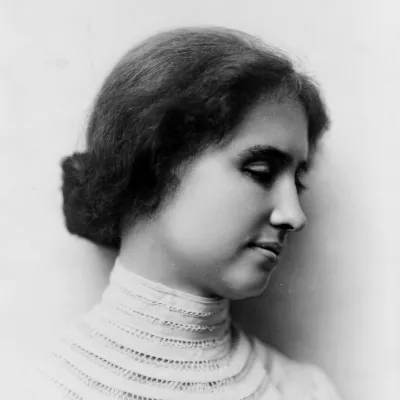
Helen Keller
Human Design Chart
Biography
Helen was the eldest child of Arthur and his second wife Kate, a beauty from Memphis who was 20 years younger. With two older half-brothers, James and Simpson, she later had two younger siblings, Mildred and Phillip. Her dad considered himself a gentleman farmer and had served as a captain in the Confederate Army; at the time of her birth he ran a weekly newspaper. As an infant Helen could see and hear and was much like every other baby. She could mimic and say words when just six months old and began to walk on her first birthday. Her illness at 19 months was called by the doctor "acute congestion of the stomach and brain."
When the baby recovered, she was unable to see, hear, or speak, which she later wrote was "extremely disorienting." She referred to herself as a Phantom during this period. At six she was taken to an eye specialist in Baltimore who could do nothing for her blindness but said she could be educated. He suggested seeing Dr. Alexander Graham Bell in Washington, DC who had also worked with the deaf. She liked Bell immediately and the two maintained a lifelong friendship. Bell recognized her intelligence and advised her dad to contact the Perkins Institution for the Blind, in Boston, to arrange for a tutor.
Helen Keller as a Projector 3/5 in Human Design
Projector 3/5 — Design at a Glance
Helen Keller was a Projector. Her design inclined her to immediately recognize systemic errors and bring 'light into the darkness' for others. She acted like a bright flashlight, illuminating areas that were still in shadow within those around her. This ability to identify system flaws instantly was her natural drive.
However, her dense, focused aura could be perceived as unpleasant by the environment. When she addressed these recognized issues directly, her surroundings often reacted with resistance or anger – similar to a light beam shining directly into someone's eyes. The more elegant solution of her design lay in simply being pleasant and radiant herself, perhaps through setting an example of harmonious relationships. Others would then naturally come to her seeking advice, as a glowing projector is highly attractive.
Therefore, her best strategy was to wait for a respectful invitation from others rather than confronting them head-on. As a Projector, Helen Keller did not have a defined Sacral Center, meaning she lacked constant intrinsic life energy. She went through phases of high activity followed by necessary rest periods to avoid burning out. Living according to this design rewarded her with success. Ignoring it and acting without invitation led to her Non-Self theme: Bitterness.
Emotional Authority
Helen Keller carried emotional authority, which significantly shaped her internal decision-making process. Her defined Emotional Center acted as a filter for all perceptions and judgments. This meant not only deep sensitivity but also being subject to a constant rhythm of mood waves. The world appeared colored by her current mood state. At one moment she could be totally enthused about something or someone, in the next moment the same situation was assessed radically negatively.
These fluctuations were not signs of unreliability but mechanical aspects of her configuration. The feeling in the immediate moment merely represented a snapshot – a first impression that did not necessarily reflect her deeper truth yet. Quick, spontaneous decisions made directly from this transient emotion often proved misleading or disadvantageous.
The mechanics of her authority therefore required temporal distance for decision-making. By taking time and letting important questions mature overnight, the initial emotional heat could subside. With this delay, intense feelings abated, and a necessary emotional distance emerged. Only then did Helen Keller regain clarity and calmness. This process of multiple 'overnights' was essential to make long-term life decisions on a stable basis rather than becoming a victim of impulsive extreme moods.
The 3/5 Profile — Martyr / Heretic
Helen Kellers design inclined her towards active experimentation to generate practical wisdom. As Profile 3/5, the Explorer/Hero, she initially believed nothing given and had to test everything herself. This learning path through trial and error was central to her development. The Sun in Gate 52 on Line 3 dictated this process: Failure was an integral part to find solutions later. Often, this line required concentration activated only by external pressure or imposed inactivity. Helen Keller welcomed such constraints as they led to necessary focus.
These individual experiences translated into societal relevance through her mechanics. Line 5 emphasized hierarchies and mutual dependency. Knowledge learned from personal mistakes became a solution for others. This made Helen Keller attractive; people sought her advice, reinforcing the role of the Hero. At the same time, public failure in experiments could be painful. Additionally, Line 5 demanded acknowledgment of one's position within the hierarchy to maintain order and harmony. Refusal led to tensions. Thus, Helen Kellers design transformed personal disappointments and struggles against external obstacles into a synthesis that helped others find their place in the whole. The mechanics thus connected private experimentation with public responsibility, passing on knowledge gained from experience.
Split Definition — Defined & Open Centers
Helen Keller demonstrated a stable identity and clear life direction, independent of external validation. Her defined G Center gave her deep self-worth and the ability to show others their path without needing to push them. This contrasted with her open mental configuration: Head and Ajna Centers were open, meaning that mental inspiration and answers did not come consistently from within but were perceived as environmental signals. She tended to get caught in other people's thought whirlpools or seek answers that weren't truly her own.
Her defined Heart Center provided autonomous willpower and self-responsibility. She controlled her resources and kept promises, which strengthened her self-worth. At the same time, her defined Solar Plexus dictated that emotional clarity was only achieved through patience; she had to wait for the emotional wave before making decisions to avoid impulsive action. Her defined Spleen Center provided spontaneous intuition for health and survival, which could not be rationalized, while her defined Root Center constantly pressured existential handling.
In contrast to this inner structure, her Sacral Center was open. She did not have a consistent generative energy; it was often borrowed, leading to exhaustion from constant overcommitment. Rest periods were essential as her energy was unstable. Her Throat Center was also open: communication happened only on invitation, avoiding the pressure of forcing attention. This configuration shaped a personality that combined inner authority with situational dependence on environmental stimuli.
Channels for logic, pioneering spirit and communal connection.
Helen Keller's design was characterized by logical precision coupled with building stable community structures. Her internal compass oriented itself towards questioning patterns while simultaneously establishing emotional clarity in relationships.
This foundation was laid by the Judgment Channel 58-18, linking the drive for life energy to the instinct for correction. Helen Keller possessed the logical ability to check if something was balanced or needed improvement. This process served not just criticism but perfection of systems so they remained functional for the collective. She sought solutions that were practically applicable and remedied shortcomings.
Parallel to this, the Initiation Channel 51-25 worked. It connected competitive initiative power with spiritual potential for individuation. Helen Keller naturally revealed new levels of consciousness through challenges and 'shocks'. This channel promoted the courage to distinguish oneself from the general and live one's uniqueness, often as an example for others seeking to expand their individual boundaries.
The third pillar was the Community Channel 37-40, linking emotional affection with willpower for provision. For Helen Keller, this meant that relationships and belonging were based on clear mutual agreements. She did not seek spontaneous contacts but deep, time-tested bonds where everyone contributed. This mechanism supported her in building bridges between individuals and maintaining stable networks based on trust and joint effort.
Additionally, Gates like 52 (Concentration) and 17 (Logical Teaching) underlined her ability for pattern correction and organizing for the future. Elements of openness (Gate 22) and collective rhythm (Gate 15) also flowed into how she interacted with her environment without losing focus.
Individual Circuitry — Circuit Signature
Helen Keller exhibited a fortified, courageous personality with strong individual convictions. The Centering Circuit significantly shaped her design: the Initiation Channel directly connected Identity and Heart Centers. This connection strengthened both her self-worth and others' recognition of her uniqueness – an attitude of 'I am who I am'. Since this circuit did not connect to the Throat Center, these firm beliefs often remained unspoken; they worked internally, not verbally.
Parallel to this was a separate energetic structure in the Understanding Circuit. Here, the Judgment Channel linked Spleen and Root Centers, fostering focused rational perception and the ability to share logical insights – free from emotional coloring. This energy operated in the background but supported her strategic approach to challenges.
A third aspect was the Ego Circuit. The Community Channel connected Heart and Solar Plexus Centers, emphasizing cooperation and mutual support – a balance of giving and taking ('Today I give, tomorrow you give'). Since there was no connection to the Sacral Center, rest periods were necessary to regenerate resources for these social interactions.
Overall, three parallel forces worked in Helen Keller: inner fortitude through the Centering Circuit, rational clarity through the Understanding Circuit, and cooperative bonding through the Ego Circuit. None of these energies flowed directly into each other; they existed as separate but equally valid aspects of her personality.
Right Angle Cross of Service 2
Helen Keller's design established a fundamental orientation towards serving others. Her life was experienced as a field of giving and helping, where the well-being of others often took precedence over her own. This attitude stemmed from the configuration 'The Right Service Cross 2'.
This specific Human Design constellation characterizes people whose deepest motivation lies in supporting communities or groups. It is not a conscious choice in the traditional sense but an energetic foundation that drives the individual to serve others. The energy primarily flows outward, directed towards the collective and its needs.
For Helen Keller, this was a defining characteristic of her inner dynamics. She did not seek fulfillment in isolated self-actualization but rather in actively contributing to the well-being of the community. The design fostered an attitude of dedication where personal interests often took a back seat to helping or supporting others. It was a living practice of giving that shaped her actions and presence. Through this configuration, her life became an expression of deep connection with the whole, focusing clearly on support and the welfare of fellow humans.
Saturn Return · Uranus Opposition · Chiron Return · 2nd Saturn Return — Life Cycles
Helen Keller's design established a tendency towards deep inner structuring and building long-term identity, especially during phases marked by responsibility. This inclination was evident in 1905 when she was 25 years old, upon the publication of her autobiography 'The Story of My Life' in German translation. For her Human Design, this moment marked the first Saturn Return, a phase where years of inner work and personal development often coalesce into a tangible external result.
The first Saturn Return is the first major maturation phase in the life cycle. It does not signify spontaneous impulses but rather the solidification of character and the assumption of lasting responsibility. During this time, the system learns what it permanently carries within and which structures it can sustain for the rest of its life. Helen Keller's publication of her personal story was no random event but an expression of this cyclical process: inner order found form in a public, tangible structure. It was about affirming one's existence and creating a foundation upon which future steps could be based. This moment served as proof that the previously lived strategy and authority led to a stable outcome that transcended mere experience into the world.
Projector · Emotional Authority — Synthesis
Helen Keller lived a life marked by a profound ability to recognize patterns and make corrections (Channel 58-18). This was evident in how she perceived the world – always searching for imbalances and opportunities for improvement. Her defined G Center gave her an inner compass and strong sense of direction, which she could also impart to others. This combination of judgment and inner guidance formed the red thread of her work by constantly trying to shed light on darkness and support others on their path.
At the same time, a central paradox in her design was revealed: projection (Type Determination) met an emotional authority that required maturation time for decisions. While her natural gift lay in immediate evaluations and pointing out problems, her emotional process needed patience and reflection. This led to tension between the urge to correct immediately and the necessity of allowing the emotional wave to gain true wisdom.
3 Defined Channels
Incarnation Cross - Right Angle Cross of Service 2
Solar Return
The Solar Return shows the moment when the sun returns to its exact birth position - your personal solar year.
Life Cycles
Discover the life cycles with a detailed triple view (birth chart, cycle chart, composite).
Human Design Profile
- Type
- Projector
- Strategy
- Wait for the respectful invitation
- Authority
- Emotional Authority
- Profile
- 3/5 - Martyr / Heretic
- Definition
- Split Definition
- Incarnation Cross
- Right Angle Cross of Service 2
- Date of Birth
- 27.06.1880 16:00
- Place of Birth
- Tuscumbia, AL, United States
Frequently Asked Questions
What was Helen Keller's Human Design type?
What Profile did Helen Keller have in Human Design?
What Authority did Helen Keller have?
What incarnation cross did Helen Keller have?
When was Helen Keller born?
Discover your own Human Design
Are you also a Projector? Find out in a personal reading how to unfold your leadership qualities and recognize the right invitations.
More Personalities
Back to overviewSissy Spacek

Alain-Fournier

Anémone

Ann-Margret

Bourvil
Hergé