
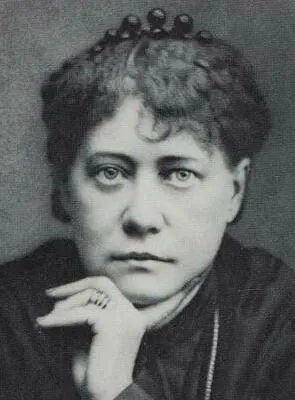
Helena Blavatsky
Human Design Chart
Biography
Born into an aristocratic family in Yekaterinoslav, Blavatsky traveled widely around the empire as a child. Largely self-educated, she developed an interest in Western esotericism during her teenage years. According to her later claims, in 1849 she embarked on a series of world travels, visiting Europe, the Americas, and India. She also claimed that during this period she encountered a group of spiritual adepts, the "Masters of the Ancient Wisdom", who sent her to Shigatse, Tibet, where they trained her to develop a deeper understanding of the synthesis of religion, philosophy, and science.
Both contemporary critics and later biographers have argued that some or all of these foreign visits were fictitious, and that she spent this period in Europe. By the early 1870s, Blavatsky was involved in the Spiritualist movement. But while defending the genuine existence of Spiritualist phenomena, she argued against the mainstream Spiritualist idea that the entities contacted were the spirits of the dead. Relocating to the United States in 1873, she befriended Henry Steel Olcott. She rose to public attention as a spirit medium and drew accusations that she was a charlatan.
The Human Design of Helena Blavatsky: Generator 6/2
Generator 6/2 — Design at a Glance
Helena Blavatsky's design inclined her towards high endurance, comparable to that of a workhorse. She had abundant sacral energy but released it not through spontaneous initiatives but primarily by reacting to impulses from her environment. The motto of her design was 'react rather than initiate'.
Her life force became effective when she responded to signals from life and gave an inner clear 'yes'. In these moments, no one could stop her; she acted with full strength and generated deep satisfaction as well as a sense of fulfillment.
Two central stumbling blocks shaped her dynamics. The first occurred when she persistently did things that did not come with internal enthusiasm. Here, she wasted energy uselessly and was prone to burnout despite her high potential. The second danger lay in being prevented from working on her heart project even though she still wanted to continue full of power. If interrupted or forced to stop while in this flow, her energy base suffered.
If Helena Blavatsky did not live according to this design – for example, by constantly initiating instead of waiting and reacting – she sooner or later encountered persistent frustration and a lack of energy. Her path to deep satisfaction therefore led exclusively through trust in the inner response to external stimuli, not through constant pushing against the current.
Emotional Authority
Helena Blavatsky's design inclined her towards premature judgments that had to be corrected later on. She appeared as someone who could not make decisions in the moment but had to wait for emotional waves to subside. This resulted from her emotional authority: The defined Solar Plexus Center carried her inner voice. In Human-Design, this rule is absolute – once this center is colored, it takes precedence over all other defined areas. Helena Blavatsky was caught in a permanent oscillation between enthusiasm and rejection. What seemed as the deepest truth at one moment could appear false hours later. Her immediate feeling was merely an initial impression, not a final insight. Spontaneous reactions often led to errors or regret later on. The mechanics required patience: She had to 'sleep over' decisions to gain the emotional distance needed for clarity. Only when the wave subsided and calmness set in did her true answer emerge. This process of delay was not a lack of resolve but the necessary strategy of her configuration. She learned to be hesitant, allowing questions to be asked repeatedly until the initial brightness or darkness of feeling faded. Only then could she discern whether something truly suited her or was merely a passing mood. This cyclical nature of perception shaped her approach to significant life steps and required deep trust in time as a filter for one's truth.
The 6/2 Profile — Role Model / Hermit
Helena Blavatsky experienced a two-phase development, marked by Line 6 in the Profile. In her youth, she operated according to the principle of Line 3: She experimented intensively, learned through trial and error, and withdrew upon failure to gather experiences. This phase served the appropriation of diverse life experiences without a fixed role image.
After about thirty years, the dynamics shifted. Line 6 became active, triggering a tendency towards withdrawal. Helena Blavatsky metaphorically retreated into a 'cave on the mountain' to look back at her earlier experiments with distance. This period was characterized by intense reflection, healing, and deep self-awareness. She processed past mistakes internally before stepping out again.
From this phase of isolation and integration emerged a wise authority. Helena Blavatsky returned as an exemplary role model for others to learn from her life wisdoms. Her design emphasized not classical leadership power but the ability to distribute and delegate power justly – a learning theme of Line 6. At the same time, she strictly protected her individuality against interference since the survival of her own truth was prioritized. The transformation from the restless experimental phase to distant wisdom shaped her path as a teacher who only took on his role after intense inner processing.
Triple Split Definition — Defined & Open Centers
Helena Blavatsky's Human Design profile indicated a tendency towards constant mental activity and clear communication. Her defined Ajna Center provided continuous conceptual thinking, while the connected Throat Center reliably translated these concepts into words. She had a firm identity through her defined G Center, which gave her clarity about her own direction. Her energy source came from her defined Sacral Center, a continuous vitality that awaited reactions. Emotional depth and intuition characterized her through her defined Solar Plexus Center; here lay her inner authority, requiring time to let the emotional wave pass before making decisions. Her defined Spleen Center endowed her with spontaneous intuition in the present moment, while the Root Center provided the necessary pressure for physical survival.
In contrast, her Head Center was open. Inspiration did not come from within but situational from outside; she tended to get lost in other people's confusion or seek answers that were not hers. Similarly, her Heart Center was also open. Willpower and the need to keep promises or prove value did not belong to her mechanical nature. She merely reflected the will of her environment. The risk lay in getting caught up in a cycle of overcompensation to prove her worth, although her energy could not sustain this indefinitely. Her strength lay in trusting her inner emotional clarity and sacral response rather than adopting mental pressure or ego-driven expectations.
Channels for intuition, synthesis, clarity and persistent discovery.
Helena Blavatsky's Human Design profile indicated a tendency towards projective leadership that designed patterns for the future and tested them through experiments. However, this identity from Gate 7 stood in tension with the defined channels of her body, which she had to adapt to rather than control.
The Channel of wavelength 48-16 connected intuitive depth with technical skillfulness. It required repetition and recognition to perfect skills; talent only bloomed when rewarded by resources. Parallel to this, the Synthesis Channel 19-49 drove a need for tribal belonging and emotional security. Here loyalty was the glue that held the community together, where emotional waves determined who belonged and who was rejected.
Innovative insights came from the Structuring Channel 23-43. It processed spontaneous breakthroughs of the mind and expressed them, often at the risk of being misunderstood as an outsider if the timing did not match. Finally, the Discovery Channel 29-46 required blind trust in the process. Through positive responses to invitations and unwavering commitment, it allowed her to lose herself in experiences to ultimately discover new truths for the collective. This mechanism shaped how she structured and passed on knowledge.
Collective Circuitry — Circuit Signature
Helena Blavatsky's Human Design profile presented three separate, coexisting energetic streams. The Knowledge Circuit connected her Ajna with her Throat Center (Channel 43-23). This created a pulsating, acoustic energy for structuring and expressing her unique identity through new knowledge. Parallel to this, the Understanding Circuit worked over her Throat and Spleen Centers (Channel 16-48). Here focused visual ratio dominated: logical thinking and strategic planning for the future, free from emotional coloring. A third independent stream flowed in the Meaning-Making Circuit between Identity and Sacral Centers (Channel 46-29). This channel processed cyclical emotional waves from the past to derive meaning.
Although her Throat Center appeared in two circuits, these streams were not energetically fused. Helena Blavatsky moved between the impulsive, creative structuring of knowledge and the cool analytical logic of understanding. Simultaneously, she experienced wave-like emotional phases of meaning-making in the third stream. The triple definition meant that these forces acted as separate units: acoustic creativity, visual analysis, and cyclical emotions did not form a cohesive unit but rather parallel processes. The Ego Circuit was undefined; resource cooperation did not belong to her natural mechanics. Instead, she focused her energy on internally generating structure, logic, and emotional reflection in these three isolated areas.
Left Angle Cross of Masks 2
Helena Blavatsky's Human Design shows the imprint of the left cross of masks. This configuration sets a fundamental tendency towards complex role-playing and hidden identities. In Human Design, this cross describes an energetic focus on playing with facades, deception, and hiding one's true nature behind different faces or personas. It is not about simple lying but rather a deeper dynamic where the outer appearance is often consciously detached from inner reality for protection, manipulation, or existential uncertainty about oneself.
For Helena Blavatsky, this meant that her personality and work were strongly marked by this mechanism of hiding and pretending. The 'left' cross emphasizes the active construction of these masks, which were strategically used to create certain impressions or obscure true intentions. It is an energy that seeks out and uses the mysterious and ambiguous. Through this design, Helena Blavatsky appeared as someone whose true essence was always hidden behind a layer of staging. These masks served not only for defense but were integral parts of her interaction with the world. She lived in a state where the boundary between authenticity and performance was fluid, characterizing her relationships and public appearance.
Saturn Return · Uranus Opposition · Chiron Return · 2nd Saturn Return — Life Cycles
Helena Blavatsky's life followed a clear cyclical structure marked by four significant astrological turning points. The first Saturn return around age 25 marked a transition into a new phase of self-discovery; in 1856 she converted to Spiritualism, reordering her spiritual foundations.
The Uranus opposition at about age 39 often brought sudden breaks and the end of old bonds. This was evident in 1870 when her partner Metrowitsch died in a shipwreck – a defining event that dissolved her previous life structures.
The Chiron return between ages 49 and 51 functioned as an actualization cycle in Human Design, where the inner purpose increasingly unfolded in outer life. For Blavatsky, this moment came in 1880: she began her second major book project, and *The Theosophist* magazine was first published in October. This was no mere coincidence but a concrete manifestation of a cycle that made sense and life's mission tangible.
The second Saturn return around age 57 solidified these new structures. In 1888, Blavatsky and Olcott converted to Buddhism on Ceylon. This action in May underscored the stability often brought by the second Saturn return: the previously found insights were now cast into a firm, long-term framework. Each of these cycles structured her biographical turning points not as isolated incidents but as steps towards coherent development in the exercise of her specific life task.
Generator · Emotional Authority — Synthesis
Helena Blavatsky lived a life deeply marked by the ability to receive energy and transform it into concrete forms of expression. As a Generator, she primarily reacted to impulses from life (sacral center), with emotional authority requiring careful weighing before decisions were made. This combination led to profound inner wisdom channeled through channels like structuring (Gate 43/23) and synthesis (Gate 19/49) – an ongoing refinement of knowledge and the ability to pour complex ideas into tangible forms. The discovery channel (Gate 29/46) underscored this tendency towards long processes to create something new, while the connection between root and solar plexus centers revealed a strong drive for self-realization and building a stable foundation.
4 Defined Channels
Incarnation Cross - Left Angle Cross of Masks 2
Solar Return
The Solar Return shows the moment when the sun returns to its exact birth position - your personal solar year.
Life Cycles
Discover the life cycles with a detailed triple view (birth chart, cycle chart, composite).
Human Design Profile
- Type
- Generator
- Strategy
- To respond - wait for something to respond to
- Authority
- Emotional Authority
- Profile
- 6/2 - Role Model / Hermit
- Definition
- Triple Split
- Incarnation Cross
- Left Angle Cross of Masks 2
- Date of Birth
- 12.08.1831 02:17
- Place of Birth
- Ekaterinoslav, Dnipro, Ukraine
Frequently Asked Questions
What was Helena Blavatsky's Human Design type?
Which Profile did Helena Blavatsky have?
What Authority did Helena Blavatsky have?
What incarnation cross did Helena Blavatsky have?
When was Helena Blavatsky born?
Discover your own Human Design
Are you also a Generator? Find out in a personal reading how to use your sacral energy correctly and discover deep satisfaction.
More Personalities
Back to overviewAaliyah

Alexia

Angèle

Anne-Marie

Arcángel

Arno
