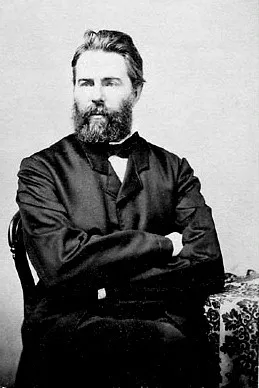
Herman Melville
Human Design Chart
Biography
Herman Melville was born the third of eight children. His father loved his family, but was not able with business savvy, and his death when Melville was 12 plunged the family into bankruptcy and debt. Young Herman was considered a slow learner. By the time he was 15 he was through with school and worked at a series of jobs for the next two years. At 17, he signed up as a cabin boy aboard the "St. Lawrence," heading for Liverpool, England. He fell in love with the sea.
In 1841, Melville became an ordinary seaman on the whaler "Acushnet." The ship's long trip around Cape Horn and into the South Pacific gave him a view of how harsh sea life can be. After 18 months, he jumped ship at the Marquesas Islands, where he lived with the natives, then signed up with an Australian whaler. At Tahiti, he stopped and went to work as a laborer, then signed on to the frigate "United States," being discharged 14 months later when the ship returned to Boston.
Those seafaring experiences became the basis of many of his works. Within six years, he published "Typee," "Omoo," "Mardi," "Redburn," and "White-Jacket." Later, he moved to a farm, "Arrowhead," near Pittsfield, MA, and it was here that he wrote "Moby Dick." He collapsed from exhaustion upon finishing it, and it was published in 1851. He published "Pierre" the following year. While his first books were popular, these latter two were not well received and largely ignored by the public.
Melville could not support his family from his writing and farming, so he became a lecturer. In 1863, he moved his family to New York where he became a customs inspector in New York City, a post he held for 19 years. He wrote several volumes of war poems in 1866 and a number of short stories.
Herman Melville — Manifestor with Profile 2/4
Manifestor 2/4 — Design at a Glance
Herman Melville proved to be a pioneer and visionary whose design predisposed him to lead the world into new futures. His configuration matched that of a Roman emperor: He had the great vision but did not wage the necessary wars himself; instead, he sent others out to achieve his goals. This broader way of thinking inevitably led to misunderstandings and polarization. While some people loved his big dreams and followed him, others rejected or even hated him because they could not comprehend the scope of his visions.
To manage this dynamic, it was crucial for him to apply the strategy of informing. Only through timely and accurate communication about his intentions could he find the right followers who were willing to follow him. If Herman Melville lived according to this strategy and his inner authority, his design rewarded him with a deep sense of inner peace. Deviations from this resulted in persistent, deep anger. His leadership trait was thus inseparable from the necessity to clarify his environment about his motives to minimize misunderstandings and secure the necessary support for his visionary projects.
Splenic Authority
Herman Melville demonstrated decision-making based on immediate inner knowledge. His design indicated that he did not guide himself through long-term planning but acted in the moment. This tendency resulted from his spleen authority. For this authority to be effective, his emotional and sacral centers were open; a configuration only projectors or manifestors exhibit.
The defined spleen center functioned as his health and alarm system. It provided him with precise survival intelligence that manifested as spontaneous feelings about whether a situation or environment was right for him. His physical well-being served as a reliable indicator. The first impulse was always correct and immediately protected his health. This allowed him to rigorously isolate harmful influences.
Since this impulse was subtle and unique, it required high vigilance not to overlook it or let other voices drown it out. Plans could change for him at short notice since he only knew what fit in the moment. Therefore, Herman Melville needed much flexibility and freedom rather than commitment. A temporary withdrawal supported him in clearly perceiving this fine inner tone and acting accordingly.
The 2/4 Profile — Hermit / Opportunist
Herman Melville was marked by a fundamental tension between his deep need for retreat and the simultaneous attraction of social networks. His design indicated that he constantly oscillated between two poles: Line 2, which demanded solitude as necessary space for internal clarity, and Line 4, which sought connection to a familiar circle. For him, it was crucial to set clear boundaries and communicate externally when he needed company or wanted to be left alone. During his phases of retreat, he immersed himself in internal processes to reflect on experiences and build strengths. This time of 'solitude' was not isolating in the negative sense but served the processing of what he had taken in from his environment. Once this inner order was restored, he returned to his network. There, he could evaluate the collected knowledge and transform it into new insights. Line 4 mediated a selective externalization; he shared his thoughts slowly and only with those he deemed trustworthy. This cycle of withdrawal for reflection and re-emergence in the circle of trusted individuals formed the core of his functioning. He did not use solitude as an escape from the world but as a workshop to filter, condense impulses from the network, and ultimately pass them on with integrity. The ability to consciously control and make transparent this shift was indispensable for his inner balance.
Single Definition — Defined & Open Centers
Herman Melville had a solid foundation of defined identity, willpower, and intuition. His defined G Center gave him a firm sense of self-perception and a clear direction, independent of external expectations. Combined with his defined Heart Center, he possessed constant willpower to keep promises and use resources autonomously. His defined Spleen enabled spontaneous, intuitive judgments in the present moment, while his defined Throat allowed for reliable expression and manifestation.
This inner strength contrasted with his high permeability in the open centers. His open Head Center made him receptive to mental inspirations but also vulnerable to doubts and confusion that he could not personalize as his own truth. His open Ajna Center absorbed concepts and opinions from the environment; he tended to collect these ideas without needing to hold them or interpret them as final answers.
His open Sacral Center meant no constant energy flow, but situational availability. He could absorb and amplify others' life force, which left him exhausted when overburdened; he had to learn to set boundaries and recharge rather than run on "borrowed" energy. His open Solar Plexus absorbed emotional waves from the environment. Rather than valuing these feelings as his own instability, this center served as a barometer for the emotional climate; he learned to let go of emotions once they passed. Finally, his open Root Center took in external stress and adrenalized pressure. Instead of escaping this pressure through hyperactivity, he could observe and use it without being overwhelmed or conditioned by it. This configuration required seeing absorbed environmental energies as information while the defined centers formed a stable core.
Channels & Gates
Herman Melville exhibited a fundamental stance based on intuitive self-sufficiency. His design inclined him to move unconsciously as an example by adapting his behavior momentarily to the physical well-being and intuitive insight from the Spleen Center, securing his survival in the "now" and radiating an inner peace that drew others subconsciously.
This mechanism was shaped by Channel of Perfect Form 57-10. It linked the acoustic sensitivity for the quality of the environment (Gate 57) with self-behavior (Gate 10). Herman Melville did not act out of future fears but followed deep impulses, leading to a radiant, unburdened presence that invited others to live authentically without seeking external recognition.
At the same time, a reflexive distance was at work. Channel of Lost Son 13-33 connected listening and storing information (Gate 13) with retreating for reflection (Gate 33). Herman Melville gathered experiences and secrets, sorting them patiently before revealing deeper truths. This process of maturation stood in tension to the immediate intuitive reaction of channel 57-10.
The personality aimed at technical perfection through repetition. Channel of Wavelength 48-16 linked intuitive depth (Gate 48) with experimenting and refining skills (Gate 16). Herman Melville identified with certain patterns, transforming them into talent through engagement.
As a mirror, adjacent channels acted: Channel of Initiation 51-25 reflected initiation through shock and competition, while Channel of Devotion 44-26 represented instinctive tribal market dynamics and the ability to persuasively convey messages. These configurations formed a complex interaction between intuitive adaptation, reflexive distance, and the drive for perfection.
Circuit Signature
Herman Melville showed a fortified, courageous personality with strong individuality. His design featured the Identity Center and Heart Center directly connected in the Focusing Circuit. This connection fostered deep self-worth and firm convictions that reinforced his belief: "I am who I am." Since this circuit did not connect to the Throat Center, these inner certainties often remained difficult to express in words; communicating his identity was limited.
Parallel to this, other circuits were at work. The Understanding Circuit connected his Throat and Spleen Centers via Channel "The Wavelength," allowing him to share logical, rational insights free from emotion and look into the future. In contrast, the Meaning Circuit focused on the past. By connecting the Throat and Identity Centers ("The Lost Son"), he reflected on emotional waves of earlier experiences to understand their meaning and share these felt insights with others.
Additionally, the Ego Circuit connected his Heart and Spleen Centers ("Devotion"). Here it was about cooperation and creating resources together through mediation gifts. Since there was no connection to the Sacral Center, rest periods were necessary to regenerate energy for this support. Finally, the Integration Circuit linked Identity and Spleen Centers ("Perfect Form"). This helped him draw strength from reacting to life and act intuitively in the present, thereby reinforcing his highest individuality. All these energies existed as separate but parallel streams in his design.
Right Angle Cross of the Four Ways 2
Herman Melville's design carried the architectural structure of the right cross of the four paths 2. This configuration established a specific life architecture characterized by the interplay of four distinct pathways or mechanisms. It was a central structural element in his Human Design, shaping his inner order. Without further detailed descriptions of these pathways, the impact on this fundamental geometric arrangement remained limited. The cross itself formed the core of his energetic structure. It defined a framework within which his experiences and reactions unfolded. The four paths did not operate in isolation but as an integrated system. This architecture provided a stable foundation for his inner experience. It determined how Herman Melville received and processed impulses. The right cross of the four paths 2 was thus no mere detail, but the supporting framework of his design. It created a distinct identity through its specific form and orientation. The interaction of the four elements generated a unique dynamics that characterized him. Without additional information about individual components, this overall structure remained the primary reference point for understanding his nature. The cross stood as a complex unity of various aspects of his essence. It appeared as a fixed entity in his chart, independent of external circumstances or temporal changes. This structure significantly determined his inner landscape and the way he engaged with the world.
Saturn Return · Uranus Opposition · Chiron Return · 2nd Saturn Return — Life Cycles
Herman Melville followed a clear cyclical structure that led from established career to radical experimental freedom and finally to an isolated late peak. His design set out a sequence in which professional anchoring alternated with internal transformation.
In 1847, at age 28, his novel 'Mardi' appeared. This marked the first Saturn Return, a life stage where years of groundwork often condenses into a solid result and establishes career stability. Melville used this phase for clear positioning.
Ten years later in 1857, aged 38, he published 'The Confidence-Man', his last novel of its kind. This fell during the Uranus Opposition, a time of radical freedom and breaking with established forms. Here his tendency towards anonymous experimental work far from conventional expectations was evident.
His second Saturn Return around 1876 at age 57 brought forth the epic poem 'Clarel'. This work was printed in only 300 copies during his lifetime and found little public resonance. This cycle described an isolated peak where personal expression was complete but no longer reached mainstream audiences. The mechanics of his design thus showed a development from public recognition to private, less noticed fulfillment.
Manifestor · Splenic Authority — Synthesis
Herman Melville lived a life marked by deep inner guidance and the drive for self-realization. As a Manifestor (Design View) with Spleen Authority (Authority), he acted impulse-driven and instinctively, always mindful of his own health – behavior reinforced by the Channel of Completed Form (Channels/Gates), which combined intuitive insight with autonomous action. His profile as a natural talent and networker (Profile Role) suggests that he oscillated between the need for withdrawal and the desire for connection, dynamics that allowed him to gain clarity in isolation and then share it with others.
A central paradox in Melville's design lay in the tension between his manifesting impulse (Design View) and the inner processes of the Centering Circuit (Circuit). While he was destined to initiate and shape the world with his visions, his Spleen Authority required spontaneous waiting and intuitive assessment of circumstances. This internal struggle between the urge for action and the necessity of self-care mirrored in the turning points of his career (Cycles), where creative peaks were replaced by phases of retreat and crisis.
5 Defined Channels
Incarnation Cross - Right Angle Cross of the Four Ways 2
Solar Return
The Solar Return shows the moment when the sun returns to its exact birth position - your personal solar year.
Life Cycles
Discover the life cycles with a detailed triple view (birth chart, cycle chart, composite).
Human Design Profile
- Type
- Manifestor
- Strategy
- To inform others before acting
- Authority
- Splenic Authority
- Profile
- 2/4 - Hermit / Opportunist
- Definition
- Single Definition
- Incarnation Cross
- Right Angle Cross of the Four Ways 2
- Date of Birth
- 01.08.1819 23:30
- Place of Birth
- New York, NY, United States
Frequently Asked Questions
What was Herman Melville's Human Design type?
Which Profile did Herman Melville have in Human Design?
What Authority guided Herman Melville?
What incarnation cross did Herman Melville have?
When was Herman Melville born?
Discover your own Human Design
Are you also a Manifestor? Find out in a personal reading how to use your initiation power peacefully and dissolve resistance.
More Personalities
Back to overviewChristian-Jaque

Kesha

Laurent-Eynac
Lucebert

Masaccio
Papus