
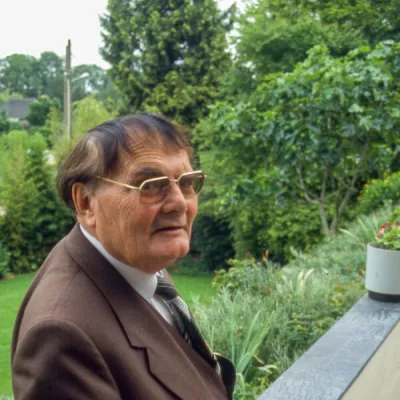
Hervé Bazin
Human Design Chart
Biography
After solid academic training, years of family conflict, and financial and professional failure, Hervé, a rebel and bohemian approaching middle age, finally achieved literary fame in 1948 with the autobiographical novel "Vipère au Poing." In the book, he portrayed his unhappy childhood as an unrelenting battle with his mother, who assumed near-mythic proportions through the concentrated energy of her own virulence. His relentless attacks upon the institutions of family, church, and motherhood seemed to many a blasphemy. The revolt continued in "La Tête Contre les Murs," 1949, a novel about penal institutions and the judicial system that supports them, and in a second autobiographical novel, "La Mort du Petit Cheval," 1950.
Having exorcised the demons of his youth in his writings, Bazin underwent a spiritual metamorphosis, from which he emerged a moralist. He discovered paternal love, spiritual fortitude, and conjugal responsibility.
Bazin received numerous awards, including the Lenin Prize in 1979. He was the critic for "Journal du Dimanche" from 1981 and a Member, Vice-President and President of the Goncourt Academy starting from 1958.
Bazin married on 3 February 1934; one child; divorced 13 February 1948. He made a second marriage on 30 April 1948; four kids; divorced 8 February 1967. His third marriage was on 9 May 1967; one child; divorced 14 April 1987, and fourth marriage on 8 August 1987; one child.
Bazin died of a stroke in Angers on 17 February 1996. He was 84.
The Human Design of Hervé Bazin: Generator 6/2
Generator 6/2 — Design at a Glance
Hervé Bazin possessed tremendous endurance and had a powerful sacral energy source. His design was geared towards functioning as a Generator: someone with high capacity for sustained activity, comparable to a strong workhorse that only runs effectively when it has the right motivation. The central mechanism of his system did not lie in initiating actions but rather in reacting to impulses from the environment. His energy unleashed itself best when he responded to signals from life and gave an inner clear 'yes'.
This principle carried two significant risks for him. On one hand, frustration and energy depletion threatened if he engaged in activities that did not bring him internal joy - a waste of his resources that could lead to burnout. On the other hand, he suffered suppression when prevented from pursuing his heart's project, even though his inner drive was still fully present. If Hervé Bazin lived in harmony with this strategy of waiting and reacting, his design rewarded him with a deep sense of fulfillment. However, if he initiated actions actively without internal confirmation or ignored his sacral response, he faced persistent frustration. His success thus depended on whether he managed to act from the gut and not fight against his inner resistance.
Sacral Authority
Hervé Bazin showed decision-making that did not occur in the head but in the body. His design established that sacral authority was his primary instance - a mechanism exclusive to Generators, uniting their strategy with internal guidance. This simplified his process: instead of intellectual analysis, he waited for physical resonance as a reaction to external stimuli.
This inner voice did not manifest through thoughts but through concrete bodily sounds like grunting, humming or a loud 'mm'. Such spontaneous responses signaled the correctness of a path. Once his sacral motor kicked in, his vitality immediately rose; he felt alive and had inexhaustible energy. This physical confirmation allowed him to act with great enthusiasm.
A prerequisite for this clear guidance was his open emotional center, ensuring that emotional waves did not distort the sacral response. Thus, Hervé Bazin lived in the possibility of fully immersing himself in action. His work was no obligation or utilitarian burden but a joyful immersion in activities driven by this immediately perceptible power. He followed the impulse of the gut, which allowed him to go through life with fundamental satisfaction arising from the alignment of inner resonance and external action.
The 6/2 Profile — Role Model / Hermit
Hervé Bazin's design laid out a clear developmental arc: marked in his youth by experimental actions and necessary retreats after failures, followed by an intensive reflection phase starting around age 30. As a carrier of Profile Role Model / Natural Talent, the sixth line before Saturn return initially appeared as a third line. This meant for Hervé Bazin that his early years were determined by the principle 'trial and error'. Failures did not serve as endpoints but triggers for retreats to learn from experiences.
Around age 30, the sixth line fully activated. Then, Hervé Bazin showed a tendency to metaphorically withdraw into a 'cave' to look back on his previous life with distance. This isolation was not an escape but a space for healing and deep self-reflection. In this phase, he reflected which patterns could be abstracted from earlier experiments and whether he could trust in his own life process.
The mechanics of line 6 emphasized the necessity of maintaining an overall overview to check who can successfully conclude processes. Simultaneously, the design posed the risk that Hervé Bazin might fall into self-alienation or aggression if he did not allow others to participate in his growth. The second generation of his profile challenged him to ultimately pass on this gained wisdom as an example. He should teach others how to arrange themselves with limitations and let go of old habits, even when the original constraints had long disappeared. Thus, individual experience became a shared ability for introspection.
Quadruple Split Definition — Defined & Open Centers
Hervé Bazin's Design establishes a tendency towards high, constant energy presence and a firm self-image. Eight of his nine centers are defined: Head, Ajna, Throat, G Center, Heart, Sacral, Spleen, and Root. This creates a permanent mental pressure through the connection between Head and Ajna Centers, pushing him to ask questions and find answers. However, this inspiration does not serve direct implementation but rather inspires others. His defined G Center gives him clear identity and direction, while the Heart Center provides willpower and control over resources. As a Generator with a defined Sacral Center, his strategy is to react to impulses rather than initiate them in order to use his vital energy efficiently. The open Solar Plexus Center makes him an emotional barometer: He absorbs the mood of his environment and tends to question whether these feelings are truly his own or merely conditioned. To gain clarity, he must learn to withdraw when necessary and not identify emotions as his own. This configuration marks him as someone who is internally stable and goal-oriented but externally sensitive to the emotional climate of his surroundings. The defined centers offer him a reliable structure from intuition (Spleen), stress management (Root), and communication (Throat), while the open Solar Plexus Center challenges him to distinguish between his own and others' emotions so as not to become conditioned by them.
Channels for inspiration, change, clarity, devotion and maturation.
Hervé Bazin's Design established a tendency towards cyclical experience formation, interrupted by sudden evolutionary leaps. This dynamic was shaped by the Maturity Channel 53-42, which represented the heart of the abstract experiential process: entering new cycles until completion, followed by reflection to gain wisdom. Parallel to this, the Mutation Channel 60-3, an energetic format between Root and Sacral Centers, enabled evolutionary change through acceptance of limitation (Gate 60) and a fresh start despite confusion (Gate 3). This energy was pulsing, often accompanied by melancholy when the inner pulse paused, driving disruptive innovation rather than linear development.
His expression did not come through mere explanation but as a creative example via the Inspiration Channel 1-8. This connected G with Throat Center (Gates 1 and 8) and allowed Hervé Bazin to live his individual direction exemplarily. Through this authentic presence, he drew attention to himself and inspired others to unfold their own uniqueness without seeking social adaptation.
Intellectually, the Awareness Channel 61-24, connecting Head with Ajna Center (Gates 61 and 24), showed up. Here knowledge did not come through logical deduction but as sudden intuitive insight ("Satori"), breaking old patterns. His mind sought silence to absorb these mutative insights and clearly distinguished between what was worth knowing and what wasn't.
Socially, the Devotion Channel 44-26, a direct connection from Spleen to Heart Center (Gates 44 and 26), gave him the ability to instinctively recognize tribal needs and convincingly "sell" appropriate solutions. This was not just business but a deep-rooted sense of what kept the tribe viable combined with the willpower to effectively contribute resources.
The Personality Gates emphasize these tensions: Gate 32 sought continuity and material success for the tribe, yet brought about radical changes when stability was threatened. Gate 56 enabled abstraction of mental processes into pictorial narratives. Gate 9 focused on precise refinement in the Sacral Center, while Gate 38 set boundaries to preserve individual integrity. Gate 19 searched for secure resources and territorial connection, Gate 2 was receptive to new evolutionary directions, and Gate 12 brought a reserved poetic creativity that infused emotional moods into expression.
Individual Circuitry — Circuit Signature
Hervé Bazin's Design showed a complex structure of separate energetic streams. The Knowledge Circuit formed three independent segments: Head and Ajna Centers connected Inspiration; Throat and Identity Center carried awareness for the expression of individuality; Sacral and Root Centers provided the pulsating energy of mutation, that is, deviation from the existing. These areas worked alongside each other, not as a single flow.
Parallel to this, Hervé Bazin's Meaning Circuit consisted solely of the channel between Sacral and Root Centers (Maturity). This was about the cyclical processing of past and emotions, for insights to mature and be shared with others. Although both circuits utilized the Sacral and Root Centers, these were separate functions: once for creative innovation, once for emotional reflection.
A third, isolated stream was the Ego Circuit. It connected Heart and Spleen Centers through the channel of Devotion. This stood for cooperation, mutual support, and resource creation in a social environment, without direct connection to individual life force or creative mind. Hervé Bazin thus moved within these four separate groups: between inspired thinking, individual expression, vital mutation, emotional maturity, and social cooperation – each as independent energy fields that did not directly overlap with one another.
Left Angle Cross of Limitation 1
Hervé Bazin's design laid an architectural dynamism of self-limitation and structuring. He appeared as someone for whom boundaries were not seen as a lack or limitation, but rather as the necessary form-giving of his existence. This configuration, the left cross of limitation 1, describes a life task where the experience of limitations is the defining element of identity.
In this Human Design mechanism, limitation does not act negatively but structurally. It provides the framework within which personality unfolds and defines itself. For Hervé Bazin, this meant that he experienced his boundaries as an integral part of his being. Without these clear edges, his identity would have remained diffuse; through them it gained contour and substance.
The mechanics of this cross imply that consciousness for the self only arises through the demarcation from the foreign. Hervé Bazin lived in a dynamic where the definition of
Saturn Return · Uranus Opposition · Chiron Return · 2nd Saturn Return — Life Cycles
was inseparably connected with the recognition of what he was not or could not do. This created an inner stability based on clarity rather than infinite expansion. His identity formed precisely through this self-limitation, thereby creating a coherent and stable structure. The limitation thus served as a foundation upon which he built his individual reality instead of acting as a barrier that held him back.
Generator · Sacral Authority — Synthesis
Hervé Bazin's design was marked by a sudden, disruptive success that broke his previous structures. This occurred in 1948 when he published
5 Defined Channels
Incarnation Cross - Left Angle Cross of Limitation 1
Solar Return
The Solar Return shows the moment when the sun returns to its exact birth position - your personal solar year.
Life Cycles
Discover the life cycles with a detailed triple view (birth chart, cycle chart, composite).
Human Design Profile
- Type
- Generator
- Strategy
- To respond - wait for something to respond to
- Authority
- Sacral Authority
- Profile
- 6/2 - Role Model / Hermit
- Definition
- Quadruple Split
- Incarnation Cross
- Left Angle Cross of Limitation 1
- Date of Birth
- 17.04.1911 07:15
- Place of Birth
- Angers, France
Frequently Asked Questions
What was Hervé Bazin's Human Design type?
What Profile did Hervé Bazin have in Human Design?
Which Authority guided Hervé Bazin?
Which incarnation cross was active for Hervé Bazin?
When was Hervé Bazin born?
Discover your own Human Design
Are you also a Generator? Find out in a personal reading how to use your sacral energy correctly and discover deep satisfaction.
More Personalities
Back to overviewAaliyah

Alain-Fournier

Alexia

Angèle

Angeli

Anne-Marie
