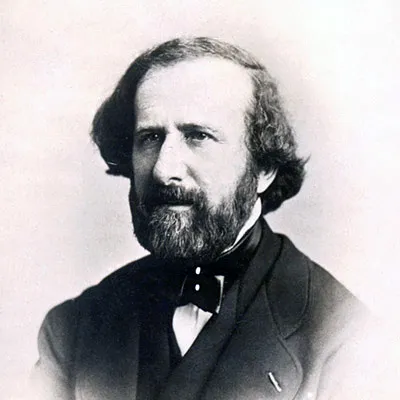
Hippolyte Fizeau
Human Design Chart
Biography
His earliest work was concerned with improvements in photographic processes. Following suggestions by François Arago, Léon Foucault and Fizeau collaborated in a series of investigations on the interference of light and heat. In 1848, he predicted the red shifting of electromagnetic waves. In 1849, Fizeau calculated a value for the speed of light more precise than the previous value determined by Ole Rømer in 1676. He used a beam of light reflected from a mirror eight kilometers away. The beam passed through the gaps between teeth of a rapidly rotating wheel. The speed of the wheel was increased until the returning light passed through the next gap and could be seen.
Fizeau made the first suggestion in 1864 that the "length of a light wave be used as a length standard".
Fizeau was involved in the discovery of the Doppler effect.
In 1853, Fizeau described the use of the capacitor (sometimes called a "condenser") as a means to increase the efficiency of the induction coil. Later on, he studied the thermal expansion of solids, and applied the phenomenon of interference of light to the measurement of the dilatations of crystals. He became a member of the Académie des Sciences in 1860 and a member of the Bureau des Longitudes in 1878.
He died at Venteuil on 18 September 1896.
"Fizeau" is one of the 72 names inscribed at the base of Eiffel Tower.
The Human Design of Hippolyte Fizeau: Manifestor 2/4
Manifestor 2/4 — Design at a Glance
Hippolyte Fizeau proved to be a pioneer and visionary whose design predisposed him to lead the world into a new future. His character resembled that of an emperor in ancient Rome: He possessed the vision of a great whole, but instead of leading the necessary wars and battles himself, he sent others to conquer foreign lands for him. This approach often led to misunderstandings, as he thought beyond his surroundings. His great dreams polarized strongly; some loved and followed him, while others hated him precisely because of these visions. To find the right followers, it was crucial for him to inform others about his plans in a timely and precise manner. This strategy of informing was the key to his inner balance. Living by this guideline rewarded him with a sense of inner peace. Ignoring his design and authority, however, left him with a persistent, deep-seated anger. His life was thus characterized by this tension between the necessity to clearly communicate his visions and the emotional reactions to acceptance or rejection by others.
Splenic Authority
Hippolyte Fizeau showed that he did not make decisions through long-term planning but relied on a fine, immediate impulse in the present moment. His inner authority lay in the defined Spleen Center, a system that functions as a health and alarm sensor. This configuration endowed him with a pronounced survival intelligence: His body and intuition signaled spontaneously whether a situation or environment was healthy and right for him.
For this Spleen authority to work, his Emotional and Sacral Centers were open. This structure limited this authority to Projectors or Manifestors. The key mechanism was that the first, spontaneous impulse was the right one. This impulse served immediately to protect his health and helped him rigorously to distance himself from harmful influences.
Since this Spleen impulse was very fine and only occurred once in the moment, it required high vigilance from Hippolyte Fizeau not to overlook it or have it drowned out by other influences. A short retreat could be helpful in decision-making. Because he could only know what was right in the moment, his plans often changed at the last minute. Long-term commitments were difficult for him; instead, he needed a lot of freedom and flexibility to spontaneously embrace the new and thus best care for himself.
The 2/4 Profile — Hermit / Opportunist
Hippolyte Fizeau showed himself to be someone who oscillated between a deep need for withdrawal and a desire for close connection. His 2/4 Profile shaped this dynamic: Line 2, the 'Hermit', demanded isolated time to order inner processes and gain clarity. Line 4, the 'Community', drew him into the circle of his trusted companions. This tension required clear communication of his needs – when he sought company and when he wanted to be left alone. Only in this way could he reflect on the knowledge of his network in solitude and process it into brilliant ideas.
Parallel to this, he carried the qualities of the 'Primadonna' (Line 2). This meant a natural talent that often remained unconscious. Success and determination were sources of strength for him when they were confirmed. Yet this determination could also cause irritation in others, as it seemed to fulfill unrealistic demands. At the same time, the fourth line acted as a 'Wallflower', using modesty as protection against felt inadequacies. This outsider status, combined with the feeling of constantly having to defend oneself, stood in contrast to the noticeable attention that the Primadonna qualities attracted. Fizeau's design thus described a person who learned to live with their inadequacies in the flow and fulfill their obligations to others without losing their inner balance between withdrawal and community.
Single Definition — Defined & Open Centers
Hippolyte Fizeau's Human Design profile suggests a tendency towards clear, self-determined expression, supported by a defined Throat Center. This gave him a reliable voice that transformed messages from his inner self into the world. This clarity was reinforced by a defined G Center, which gave him a firm sense of self-identity and direction. He knew who he was and could guide others on their path without being dependent on them. His defined Heart Center provided willpower and ego strength, enabling him to keep his promises and control his own resources. Additionally, he had a defined Spleen Center, which granted him spontaneous intuition and a strong immune system; he acted in the 'now' from a deep bodily awareness.
At the same time, Fizeau was vulnerable to external influences due to several open centers. His open Head Center allowed him to absorb mental pressure, which could lead to doubts when trying to answer questions that were not his own. His open Ajna Center made him susceptible to foreign concepts and opinions, which he could misinterpret as his own truth. His open Sacral Center meant an inconsistent energy flow; he risked overextending himself with 'borrowed' energy from others, as he had no natural limit to his availability. His open Solar Plexus Center absorbed emotional waves from the environment, making him vulnerable to others' moods and prone to making emotional decisions that he later regretted. Finally, his open Root Center took on external stress, leading to cycles of avoidance or unnecessary panic to relieve the pressure. Fizeau lived in the tension between his inner strength and the need to protect these open fields from conditioning.
Channels for intuitive action, success and devoted strength.
Hippolyte Fizeau acted and spoke with spontaneous, intuitive clarity in the present moment. This attitude stemmed from the Awakening Channel 10-20, which connected his G Center with his Throat Center. It allowed him to transform personal knowledge directly into correct action, guided by an underlying code that secured interactions. His presence radiated inner awareness, inspiring others unconsciously to be themselves.
This intuitive foundation was deepened by the Perfect Form Channel 57-10, which linked his Spleen Center with his G Center. Here, deep, acoustic awareness guided his behavior. Instead of focusing solely on words, he perceived the quality of tones and the mood, helping him to release unfounded future fears and perfect his survival in the present. His behavior was an art of survival based on self-love and the ability to move through the world existentially and unburdened.
The connection of this intuition to direct communication occurred through the Lightning Flash Channel 57-20. It connected his Spleen Center with his Throat Center, giving his intuitive insight the clearest voice in the present. His verbal outbursts often reached the core of an issue faster than the rational thinking of others, as he relied on his inner survival intelligence.
In the realm of will and the material plane, the Money Line Channel 21-45, which connected his Heart Center with his Throat Center, was active. It carried the energy of the hunter and the gatherer, driving him to take responsibility and maintain control over his resources. Simultaneously, the Initiation Channel 51-25 showed a competitive nature aimed at strengthening the individual through shocks and challenges and mutating the collective. The Channel of Devotion 44-26 finally connected Spleen and Heart, allowing him to instinctively assess what the tribe needed and present his gifts convincingly.
Additionally, Gate 46 shaped his full devotion and body love, while Gate 15 bound him to natural rhythms and collective behavior. Gate 48 in his personality gave him the ability to recognize patterns and understand deep connections, even if the implementation was sometimes frustrating. Gate 13 in his design ensured continuity and reflected experiences in the context of time.
Individual Circuitry — Circuit Signature
Hippolyte Fizeau's Human Design profile indicated a tendency towards inner strength and impulsive creativity. As a simple defined type, he had a continuous energetic flow connecting his Throat, Heart, Spleen, and G Centers. This unity created coherent life energy that did not break into separate, conflicting streams but worked as a whole.
The Knowledge Circuit gave him the Lightning Flash Channel (20-57), which connected his Throat with his Spleen Center. This promoted innovative, intuitive insights that he could directly translate into language. Parallel to this, the Centering Circuit worked through the Initiation Channel (25-51), which linked his Identity with his Heart Center. This resulted in strengthened convictions and a strong self-worth, even if these inner certainties were not always communicated outwardly.
The Ego Circuit supported him through the Money Line Channels (45-21) and Devotion (26-44), which connected his Throat, Heart, and Spleen Centers. This encouraged cooperation and the exchange of resources, with rest periods necessary as there was no direct connection to the Sacral Center. Finally, the Integration Circuit integrated his Throat, Identity, and Spleen Centers through the Awakening Channel (20-10) and the Perfect Form Channel (10-57). This helped him to draw strength from reacting to life, channel it through correct behavior, and make it effective in the present moment.
Right Angle Cross of the Vessel of Love 3
Hippolyte Fizeau's design indicated a tendency towards a specific, profound kind of dedication. His chart contained the configuration of the right cross of the Love Vessel. This did not describe general romance but a precise, often unspoken commitment, evident in the willingness to sacrifice for a cause or person without losing one's own identity. It was an energy that worked in the background, providing stability, not loud engagement. This structure shaped a stance of silent loyalty and protection, seeking no recognition but arising from an inner, almost fateful connection. For Hippolyte Fizeau, this meant that his greatest strength lay in creating a safe space for others to flourish, while he himself remained the supporting pillar. This mechanism required no grand gestures but a constant, reliable presence that formed the foundation for deep relationships. His design showed that true strength often lies in the ability to hold and support without breaking.
Saturn Return · Uranus Opposition · Chiron Return · 2nd Saturn Return — Life Cycles
Hippolyte Fizeau's design indicated a tendency towards precise, empirical work that condensed into clear, measurable results. This structure promoted a process based on facts and repeatable observation rather than abstract speculation.
In 1849, at the age of 30, Fizeau conducted measurements of the speed of light in different media. This fell during his first Saturn Return. In Human Design mechanics, this cycle often marks the point where years of groundwork and inner maturity lead to a tangible, external result. For Fizeau, this was the moment when his methodical precision became concrete and scientifically recognized.
Ten years later, in 1860, he was admitted to the Académie des sciences. This occurred during the Uranus Opposition, a cycle often associated with sudden changes or recognition by established institutions. His admission confirmed his status and integrated him into the scientific establishment, institutionalizing his previous achievements.
In 1878, at the age of 59, Fizeau was elected President of the Bureau des Longitudes. This corresponded to his second Saturn Return. This cycle often cements life's work and leads to a position of authority and responsibility. His election to the presidency was the logical consequence of his long-term, reliable contributions to science and marked the culmination of his professional path within the institutional structures he had shaped.
Manifestor · Splenic Authority — Synthesis
He was a Generator type whose life was marked by a deep-rooted drive for initiation and the advancement of change (Manifestor). This energy found expression through the Spleen Center as inner authority, enabling spontaneous, instinctive decisions aligned with personal well-being. The profile as a natural talent and networker points to a dance between the need for withdrawal and the search for connection – a rhythm that strengthened the ability to gain clarity in isolation and then share this knowledge with others. The Channel of Awakening (Gate 10/20) underscored presence in the moment and the commitment to turn one's knowledge into action.
A central paradox lay in the tension between the ability to lead as a pioneer in new paths (Knowledge Circuit) and the natural oscillation between the desire for solitude and community (Profile 2/4). His repeated professional successes (Saturn Returns, Uranus Opposition) showed that he developed innovative solutions during phases of concentration and withdrawal, which he then manifested in exchange with others – a cycle that shaped both his inner world and his interaction with the outside world.
6 Defined Channels
Incarnation Cross - Right Angle Cross of the Vessel of Love 3
Solar Return
The Solar Return shows the moment when the sun returns to its exact birth position - your personal solar year.
Life Cycles
Discover the life cycles with a detailed triple view (birth chart, cycle chart, composite).
Human Design Profile
- Type
- Manifestor
- Strategy
- To inform others before acting
- Authority
- Splenic Authority
- Profile
- 2/4 - Hermit / Opportunist
- Definition
- Single Definition
- Incarnation Cross
- Right Angle Cross of the Vessel of Love 3
- Date of Birth
- 23.09.1819 04:00
- Place of Birth
- Paris, France
Frequently Asked Questions
What was Hippolyte Fizeau's Human Design type?
What Profile did Hippolyte Fizeau have in Human Design?
What Authority did Hippolyte Fizeau have?
What incarnation cross did Hippolyte Fizeau have?
When was Hippolyte Fizeau born?
Discover your own Human Design
Are you also a Manifestor? Find out in a personal reading how to use your initiation power peacefully and dissolve resistance.
More Personalities
Back to overviewChristian-Jaque
Kesha

Lucebert
Masaccio
Nadar
Papus