
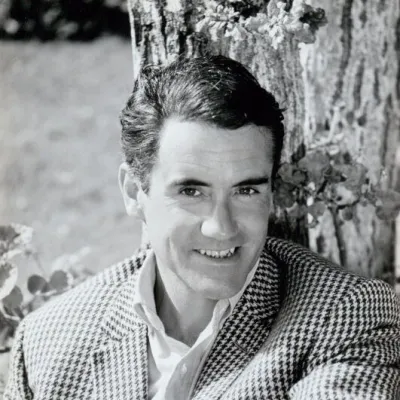
Ian Bannen
Human Design Chart
Biography
Bannen died in a car accident on 3 November 1999 in Scotland, age 71. His wife who evidently was driving, escaped with minor injuries.
Human Design Analysis: Ian Bannen as Generator 4/6
Generator 4/6 — Design at a Glance
Ian Bannen was a Generator. His design featured tremendous sacral endurance, comparable to that of a workhorse, but he could only be effective when drawing on inner energy. This power was not available for arbitrary initiatives but became active only in response to external impulses. The central mechanics of his system required reaction rather than action: Only when life gave a signal and his sacral center responded with a clear "Yes! Let's get started!" could he unleash his full potential.
This principle brought two specific challenges. If Ian Bannen attempted to do things that did not resonate internally, he wasted his valuable energy and risked exhaustion. Conversely, he suffered frustration when external circumstances prevented him from working on projects for which he still had plenty of power. Living in harmony with this strategy of waiting for the inner signal rewarded his design with deep satisfaction and a sense of fulfillment. If he initiated things continuously without waiting to see if there was a response, it inevitably led to ongoing frustration and a noticeable lack of energy. His success thus depended less on constant activity than on the ability to respond intuitively to the right offer.
Sacral Authority
Ian Bannen lived as a Generator, whose decision-making was shaped by sacral authority. This inner instance served as his primary source of action, with the Responding strategy closely linked to this authority. Instead of cognitively analyzing or planning decisions, he sought physical feedback from external stimuli. His "gut feeling" manifested in immediate physical signals like grunting, humming, or an internal surge of energy.
This mechanism meant that Ian Bannen learned to listen to these bodily noises. A positive signal—a loud “mm-hm” or a sense of vitality and enthusiasm—confirmed the right direction. In such moments, he had access to inexhaustible energy, allowing him to immerse himself fully in tasks with great satisfaction, free from constant purposefulness.
The definition of this authority greatly simplified his process, as he did not need to distinguish between strategy and inner compass; both were rooted in the Sacral Center. Crucial for him was distinguishing between impulsive action and waiting for clear physical feedback. Only when the sacral motor actually engaged would he act with his characteristic life force. This helped him find a path that gave him energy rather than drained it, by orienting himself to authentic bodily answers, not expectations of his thoughts.
The 4/6 Profile — Opportunist / Role Model
Ian Bannen revealed himself through an inner conflict between a deep desire for social belonging and his later role as a distant role model. In the first thirty years of his life, before Saturn returned, his sixth profile line still appeared like a third line. This phase was marked by intense experimentation, especially in friendships and relationships, which is typical for the 4/6 Profile.
With the activation of the sixth line, a tension field emerged: The Heart sought community (Line 4) while the Head searched for philosophical distance to reflect on the meaning of life (Line 6). This contradiction between emotional connection and intellectual wisdom shaped his inner stance. In his later years, he was expected to function as a wise role model and lead through cooperation. His self-discipline, a characteristic of the fourth line in Gate 52, helped him maintain these social contacts without losing focus. At the same time, his Heart had to be cautious to avoid being hurt by false people. The sixth line represented a perfected leadership perspective, similar to the stance of a Bodhisattva who only speaks when asked. This configuration described a path from early experimentation to a mature, cooperative leadership role within the collective.
Single Definition — Defined & Open Centers
Ian Bannen possessed a constant vital energy and existential intuition as a stable inner authority. His defined Sacral Center generated a reliable daily energy reserve that felt like a steady hum and urged him to be active. This power was fully available only when he responded to requests – an immediate gut reaction decided on the availability of his resources. Simultaneously, his defined Spleen Center guided his actions through spontaneous, momentary intuition. It threw warning signals in the present that he had to trust to maintain health and well-being; rational considerations could easily overshadow these subtle instincts. His defined Root Center also provided a steady inner pressure that propelled him forward and helped him cope with stress as well as material challenges.
At the same time, Ian Bannen was influenced situatively by several open centers. His open Head Center had no constant mental presence; it absorbed inspiration but tended to get lost in doubts or the search for answers when he did not listen to his inner authority. Similarly, his open Ajna Center allowed him to flexibly take on various concepts and opinions without having to hold them as personal truth – which, however, carried the risk of feeling insecure through conditioning or pretending to know more than one actually did. His open Throat Center meant that he had no fixed identity or life direction; rather, he reflected the energy of his environment and found his path only in the right context and through external initiation. Additionally, his open Solar Plexus absorbed emotions from others and amplified them, making him vulnerable to emotional waves that were not his own. His open Heart Center lacked consistent willpower; he tended to want to prove his worth through promises or competition rather than just being himself. Finally, his communication in the open Throat Center was spontaneous and reactive; he naturally attracted attention when he waited instead of actively seeking it out. This configuration marked him as someone who trusted inner reactions while carefully filtering external mental, emotional, and identity-related influences.
Channels for focused intensity and sharp analysis.
Ian Bannen exhibited a deep logical pattern recognition and a need for perfectionism. His design was dominated by Channel of Concentration 52-9, a format energy between Root and Sacral Centers. This structure generated a constant calm pressure towards stillness and focus on details – a tension that held him in place like a yoga pose. Multitasking or distractions were rejected as an energetic loss; his energy was only used when the Sacral Center reacted. Without a suitable project, this led to restlessness.
This concentrated attention was supported by the juxtaposed Channel of Judgment 58-18. This channel connected Root and Spleen Centers and worked correctively by checking patterns for their health and balance. Ian Bannen exercised this judgment only on invitation, however, to conserve valuable energy and offer solutions that others were open to.
His design also included Gate 17 of Succession and Logical Teaching, which saw genuine understanding as a prerequisite for future organization. Gate 27 of Care improved activities through altruistic warmth and served to maintain arteries. Gate 53 of Freedom allowed him to pioneer new development cycles while Gate 39 contributed to mutation through provocation and analysis. The fundamental rhythm of all life processes was determined by Gate 5, which promoted fixed habits to build energy. Finally, Gate 29 of the Sacral Center represented persistence and saying yes to challenges, where the reward for correct action was inevitable.
Collective Circuitry — Circuit Signature
Ian Bannen showed a clear, strategic approach to complex problems. His design connected the Sacral Center with the Root and Spleen Centers in one continuous flow. This configuration formed the basis for a focused mind aimed at improving through logic and structure.
The Understanding Circuit shaped this attitude. He used rational insights to lead society or his immediate context towards a better future. In Ian Bannen, two concrete channels within this circuit were active. The Channel of Concentration (Gates 9/52) provided visual clarity and the ability to focus on what was essential. Simultaneously, the Channel of Judgment Ability (Gates 18/58) allowed for strategic assessment of situations and well-founded decisions.
As all three connected centers – Sacral, Root, and Spleen – lay in a single group, energy flowed seamlessly between them. The power of the Sacral drove action forward while the Root Center provided necessary pressure or impulse. The Spleen Center steered the intuitive selection of what was relevant. This resulted in a style that combined emotionless ratio with practical application. Ian Bannen shared these logical insights free from unnecessary conditioning to create clarity. Energy remained focused and aimed at future-oriented solutions, supported by an inner visual precision.
Right Angle Cross of Service 2
Ian Bannen lived under the influence of the Right Authority 2 cross. This configuration shaped a fundamental attitude of quiet but consistent support for others. His design indicated that his greatest value did not lie in loudly asserting his own ambitions, but rather in his ability to effect positive change through reliable service and help.
The Right Authority 2 describes an energy characterized by patience and endurance. It is less about standing in the spotlight than it is about creating a stable foundation for other people. Ian Bannen often worked behind the scenes, his contributions indispensable though not always visible. His strength lay in recognizing others' needs and addressing them without losing sight of his own identity.
This mechanism requires an attitude of trust in one's path. Those who follow this pattern learn that true fulfillment does not come from external recognition but arises from inner satisfaction when helping others authentically. Ian Bannen used this energy to deepen relationships and strengthen communities. His work was marked by deep empathy and a desire to bring out the best in others. Through his service, he found his place in the world and helped others realize their full potential.
Saturn Return · Uranus Opposition · Chiron Return · 2nd Saturn Return — Life Cycles
Ian Bannen's life journey was marked by two clear turning points that served as anchors for his personal development. In 1965, at the age of 37, he received an Oscar nomination for "Flight of the Phoenix." This success fell during the Uranus opposition phase. During this configuration, sudden changes or breakthroughs often occur, challenging the existing life path and forcing new perspectives. For Ian Bannen, it marked a moment of public recognition that coincided with internal restructuring.
Another crucial event was his marriage to Marilyn Salisbury in 1976 when he was 48 years old. This corresponded to his Chiron return, a cycle between the ages of 49 and 51, though it often begins shortly before this period. In Human Design mechanics, this is not a time for healing wounds but rather a fulfillment cycle. Here, one's incarnation cross increasingly unfolds in everyday life. If the person has followed their strategy and authority, meaning and purpose become tangible. Ian Bannen's step into a committed partnership signaled this blooming period: Life condensed into a form that aligned with his deepest intentions. Both events—the professional breakthrough and the personal commitment—illustrate how astrological cycles can shape concrete life stations without imposing external constraints. It was about aligning with one’s true essence.
Generator · Sacral Authority — Synthesis
Ian Bannen was a Generator whose life was marked by the ability to respond to the gut-level Yes and act upon it. This sacral authority formed the core of his decision-making, enabling him to find energy for activities that brought deep satisfaction. His Profile as a Networker and Role Model indicates an initial phase of gathering diverse experiences followed by finding a way later in life to share his wisdom with others – a process marked by an internal conflict between social connectedness and the need for reflection. The focus (Channel 52-9) and judgment (Channel 18-58) strengthened his ability to recognize patterns, correct them, and concentrate on details, making him a perfectionist who always sought improvement.
A central paradox in Ian Bannen’s design lay in the interplay of open emotional expression (Solar Plexus Center) and defined sacral authority. While the open center made him susceptible to the energies of others, his defined sacral center allowed him to respond authentically to impulses that aligned with his inner truth and find energy when they did so. This combination led to a dynamic tension between adaptability and the need for self-determination – a life in which he both absorbed the world around him and found his own direction through gut instinct.
2 Defined Channels
Incarnation Cross - Right Angle Cross of Service 2
Solar Return
The Solar Return shows the moment when the sun returns to its exact birth position - your personal solar year.
Life Cycles
Discover the life cycles with a detailed triple view (birth chart, cycle chart, composite).
Human Design Profile
- Type
- Generator
- Strategy
- To respond - wait for something to respond to
- Authority
- Sacral Authority
- Profile
- 4/6 - Opportunist / Role Model
- Definition
- Single Definition
- Incarnation Cross
- Right Angle Cross of Service 2
- Date of Birth
- 29.06.1928 05:00
- Place of Birth
- Airdrie, United Kingdom
Frequently Asked Questions
What was Ian Bannen's Human Design type?
What Profile did Ian Bannen have?
Which Authority guided Ian Bannen?
What incarnation cross did Ian Bannen have?
When was Ian Bannen born?
Discover your own Human Design
Are you also a Generator? Find out in a personal reading how to use your sacral energy correctly and discover deep satisfaction.
More Personalities
Back to overviewSissy Spacek

Aaliyah

Alexia

Anémone

Angèle

Ann-Margret
