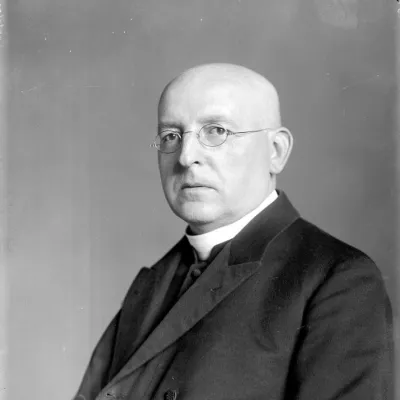
Ignaz Seipel
Human Design Chart
Biography
He died at 7:30 AM on 2 August 1932 during a stay at a sanatorium in the Vienna Woods.
What does Manifesting Generator 1/3 mean for Ignaz Seipel?
Manifesting Generator 1/3 — Design at a Glance
Ignaz Seipel's design showed a tendency towards hybrid energy: as an Manifesting Generator, he possessed the constant, sacral power of a generator paired with the ability to skip steps and quickly draw things into his life. This configuration created a tension field between the necessity to react to impulses – instead of starting on his own initiative – and the urge for quick implementation.
His structure allowed him to pursue several projects simultaneously, which only led to deep satisfaction when his inner authority agreed. If the sacral center responded with a clear 'Yes', he could fall into a productive play mode and use variety. If strategy or authority did not do this, his creative enthusiasm quickly turned into frustration. The danger was that through excessive speed, important steps would be skipped, forcing him to backtrack and make up for lost ground – a process touching on his non-self theme.
Ignaz Seipel thus showed himself as someone whose efficiency depended on whether he respected the reactive strategy. Only when he responded to life and regularly checked if his projects still resonated could he fully unleash his potential without falling into the trap of haste or fragmentation. His energy was powerful but required discipline in handling its speed.
Emotional Authority
Ignaz Seipel's inner authority was emotionally marked, carried by his defined Solar Plexus Center. In Human Design mechanics, this configuration is considered absolutely prioritized: as soon as the Emotional Center is activated, it takes charge in decision-making, regardless of which other centers are also defined. This priority meant for Ignaz Seipel that he did not seek his inner compass through logical analysis or external advice but exclusively through the course of his own feelings.
He was subject to a natural emotional wave that showed itself in constant ups and downs of his moods. His perception of the world was always colored by this current state; what appeared inspiring at one moment could seem negative the next. For Ignaz Seipel, however, such an initial impression was only a snapshot, not a final truth. Quick, spontaneous decisions directly from an emotional peak often had negative consequences for his design since emotional clarity had not yet been reached.
Instead, his mechanics required patience and time. By letting decisions rest and reviewing them multiple times – ideally even sleeping on them – he could let intense feelings subside. Only when emotional distance was established did calmness set in for Ignaz Seipel. This process of maturation was particularly crucial for long-term, life-defining questions since only then his true inner truth would emerge.
The 1/3 Profile — Investigator / Martyr
Ignaz Seipel's design inclined towards intensive research and experimental learning. As a person with the Profile 1/3, the Researcher and Experimenter, he showed himself as someone who validated theoretical knowledge (Line 1) through practical application and testing extremes (Line 3). His life revolved around the process of trial and error; self-earned insights formed the basis of his judgment. If he valued something, he had previously examined it both intellectually and through direct experience. The mechanics of Line 1 emphasized the importance of quality in stimulation and the need for feedback to confirm the effectiveness of his ideas. Simultaneously, the energy of Line 3 drove him towards survival by promoting mutations and biological partner selection – a process of testing all extremes to distinguish fertility from infertility. This configuration meant that Ignaz Seipel did not just accumulate knowledge but tested it through concrete life experiences on heart and soul. His judgment was therefore trustworthy as it rested on a synthesis of careful planning and hard practical tests. He lived the tension between wanting to learn more before acting and the inner drive of Line 3 to simply try things out and learn from mistakes.
Single Definition — Defined & Open Centers
Ignaz Seipel's design showed a tendency towards consequent clarity of thought. His defined Ajna Center ensured constant mental processes; he always thought and was hard to influence from the outside in his concepts. This internal logic flowed directly into his defined Throat Center: He spoke what he conceived, making his communication reliable yet limited to his own perspective.
At the same time, he had a firm identity and direction through his defined G Center. He knew who he was and where he was going without imposing this on others – as long as he did not act against his strategy. His energy source lay in his defined Sacral Center: As a Generator, he possessed vital power that was only available with the correct reaction to external initiatives. Initiating led to resistance; waiting and responding ensured him the necessary endurance for long-term engagement.
This stability was complemented by his defined Solar Plexus Center, which required emotional authority. Truth revealed itself to him only after going through the emotional wave; impulsive decisions on wave peaks or troughs were prone to error. Here patience was mechanically necessary to achieve clarity. His defined Spleen Center provided spontaneous, intuitive warning signals in the present that protected his survival and well-being, while his defined Root Center maintained a constant pressure for movement and material progress.
In contrast, his vulnerability showed in the undefined centers. The open Head Center had no own inspiration; it was vulnerable to external mental pressure and confusion if he did not follow his inner authority. He tended to identify with others' questions or seek solutions to problems that were not his. Particularly the open Heart Center lacked consistent willpower. Here there was a danger of proving oneself through promises in order to demonstrate value, leading often to failure and frustration rather than confirmation of worth when lacking this mechanical energy.
Channels for change, leadership, action, insight, values, emotions and maturation.
Ignaz Seipel's design showed a tendency towards evolutionary change accompanied by deep inner tension. The Channel of Mutation 60-3 connected the Root Center with the Sacral Center and generated a pulsing on/off rhythm. This energy required accepting limitation (Gate 60) to move beyond the confusion of a new beginning (Gate 3). The resulting melancholy was not a lack but the groundwork in which new possibilities matured. Seipel had to learn to trust this mechanical moodiness and not fight against it while waiting for the correct reaction from his Sacral Center.
At the same time, he possessed potential for collective leadership through the Channel of Alpha 7-31. This channel connected the G Center with the Throat Center based on logical, tested pattern recognition (Gate 7) as well as the ability to speak representatively (Gate 31). His authority was not absolute but dependent upon being invited by a majority. He could only lead successfully if he gained their trust and understood existing social patterns.
The power for implementation came from the Channel of Charisma 34-20. Here raw physiological power (Gate 34) met the urge to express immediately in the present (Gate 20). This energy allowed him to act quickly and inspire others through his vitality, provided he followed his inner sacral guidance. Without this alignment, however, the energy threatened to shift into obsession or chaotic manifestation.
Completing the picture was the Channel of Structuring 43-23, which conveyed spontaneous insights (Gate 43) through assimilation and clear explanation (Gate 23). This enabled him to formulate innovative perspectives that promoted efficiency and were accepted by others. The Channel of Preservation 27-50 also ensured a strong need for care and the protection of traditional values (Gate 50), while the Channel of Emotional Release 39-55 generated an emotional wave of provocation (Gate 39) and spirituality (Gate 55) that shaped his interpersonal interactions.
Individual Circuitry — Circuit Signature
Ignaz Seipel's design showed a coherent, simply defined structure. Since all his defined centers were connected by channels, the energies worked as a continuous flow without internal breaks or separate poles. This allowed him to carry his inner impulses directly and undivided outward, since no energy islands existed that worked against each other.
Within this whole, specific circuits shaped his expression. His Knowledge Circuit linked two distinct segments: on one hand Ajna with Throat Center for structured communication, on the other Sacral-, Root- and Solar Plexus Centers for emotional drive force. This separation meant that rational planning and emotional waves did not directly merge but existed parallel. The Understanding Circuit connected Throat and Identity Centers, linking logical strategies with personal self-worth. Simultaneously, the Meaning-Finding Circuit through the connection of Sacral and Root Centers ensured cyclical processing of past experiences. The Protector Circuit bound the Sacral Center to Spleen, connecting instinctive care with life energy. Finally, the Integration Channel linked Throat and Sacral Centers, making charisma directly drawn from life force. This configuration marked him as someone who united various facets – from cool reason to deep instinct – in a single continuous personality without isolating these aspects internally.
Right Angle Cross of Laws 2
Ignaz Seipel's design indicated a tendency towards deep and often painful confrontation with one's own inner laws and moral compasses. This configuration, known as the right cross of Laws 2, did not describe an external authority but rather an intense internal process of self-examination and suffering on the path to enlightenment. It was a life task that involved finding one's own unshakeable truth through personal experiences and often setbacks. The journey was neither linear nor simple; it required constant confrontation with one's essence and the resulting consequences. The energy of this cross drove him to explore his limits, learning along the way that true strength often arises from accepting one's weaknesses and mistakes. It was a process of becoming, in which Ignaz Seipel was compelled to continually question and reaffirm his values. This inner work shaped his entire existence and led him into situations that tested his convictions. The right cross of Laws 2 did not offer quick solutions but demanded deep, often solitary reflection to ultimately arrive at authentic wisdom from within. This path was characterized by the necessity to accept one's shadow and find strength in it rather than avoiding it.
Saturn Return · Uranus Opposition · Chiron Return — Life Cycles
Ignaz Seipel's design was marked by a clear rhythm of professional consolidation followed by profound upheavals later on. His first Saturn return around age 27 marked the phase where years of intellectual groundwork condensed into a stable foundation. This became evident concretely in 1903 when he earned his Dr. theol., a milestone that solidified his academic identity and granted him the authority to structure and impart his knowledge.
Later, the tension of the Uranus return, often associated with sudden changes or breaking old structures, came into play. At age 41 in 1917, Ignaz Seipel became a university professor at the University of Vienna. This step confirmed his expertise on a high level and established him in a position of public influence that went beyond pure study.
The Chiron return around age 49 ushered in the phase of fulfillment, where one's incarnation cross unfolds and deeper meaning becomes experiential. This coincided with 1925 when Hitler renounced his Austrian citizenship. For Ignaz Seipel, this time did not signify healing in a therapeutic sense but rather the maturation of his life task within a radically changing political landscape, where his role and purpose became increasingly clear.
Manifesting Generator · Emotional Authority — Synthesis
Ignaz Seipel lived a path deeply marked by a drive for knowledge and transformation. The combination of sacral energy (Manifesting Generator) and defined mental center (Ajna) points to someone who was both intuitive and conceptual in strength. He responded to impulses, yet his thoughts were consistently active and shaped his perception of the world. This interplay led to an ongoing balance between experiencing the moment and integrating it into a comprehensive understanding – a quest that was amplified by his profile as a Researcher and Experimentor (1/3). The ability to create concepts and inspire others to think deeply was central to his journey.
A fundamental paradox characterized Seipel's design: the tension between the speed of the Manifesting Generator and the emotional wave of his authority. He could initiate things quickly (Channel Mutation), yet he needed time to let decisions mature and fully grasp their implications. This discrepancy likely led to an internal rhythm where swift action was followed by phases of reflection and reconsideration – a dynamic reflected in the Knowledge Circuit and related themes like creativity, melancholy, and individuality.
7 Defined Channels
Incarnation Cross - Right Angle Cross of Laws 2
Solar Return
The Solar Return shows the moment when the sun returns to its exact birth position - your personal solar year.
Life Cycles
Discover the life cycles with a detailed triple view (birth chart, cycle chart, composite).
Human Design Profile
- Strategy
- To respond - wait for something to respond to
- Authority
- Emotional Authority
- Profile
- 1/3 - Investigator / Martyr
- Definition
- Single Definition
- Incarnation Cross
- Right Angle Cross of Laws 2
- Date of Birth
- 19.07.1876 12:15
- Place of Birth
- Wien, AUS
Frequently Asked Questions
What was the Human Design type of Ignaz Seipel?
Which Profile did Ignaz Seipel have in Human Design?
What Authority did Ignaz Seipel have?
What incarnation cross did Ignaz Seipel have?
When was Ignaz Seipel born?
Discover your own Human Design
Are you also a Manifesting Generator? Find out in a personal reading how to unfold your multi-talents and direct your energy wisely.
More Personalities
Back to overviewAldair

Alizée

Angeli

Arletty
Artus

Balthus