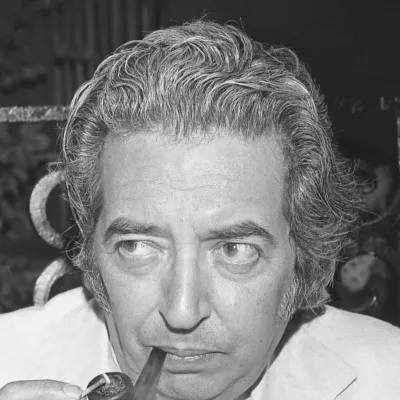
Irving Wallace
Human Design Chart
Biography
Irving had a long apprenticeship, prior to becoming a novelist, in journalism and film writing; however, he was mercilessly attacked by literary critics. From 1955 until his death he wrote 36 books that generated a total of $196 million dollars in sales.
In 1941 he was married to Sylvia Kahn, an editor and author. They had one son, David, and a daughter, Amy, who is a writer and psychic healer.
Wallace died of pancreatic cancer on 29 June 1990, Los Angeles, CA.
What does Manifesting Generator 1/3 mean for Irving Wallace?
Manifesting Generator 1/3 — Design at a Glance
Irving Wallace was someone who quickly drew things into his life. As an Manifesting Generator, he had constant sacral energy similar to that of a classic generator but also possessed the ability to skip steps and greatly accelerate processes. This hybrid nature, combining traits of both Generators and Manifestors, fundamentally shaped his approach to work.
The challenge lay in speed: Wallace tended to overlook important stages or handle multiple projects simultaneously due to reacting to many different impulses. Without strictly adhering to his strategy—waiting until the sacral center gave a clear 'yes' before acting—he risked frustration. His non-self theme often manifested as this restlessness when he tried to go against the natural flow or charge ahead without inner consent.
However, with strategy and authority in harmony, Wallace drew deep satisfaction from his work. In this state, handling multiple tasks simultaneously was not an obstacle but a source of strength. He fell into a 'play mode' where variety and fun were crucial. The advice to focus on one thing at a time would have been detrimental here; his energy flourished precisely when he could flexibly switch between various interests as long as each action was confirmed by his inner center.
Sacral Authority
Irving Wallace was someone who did not channel his life energy through prolonged contemplation but rather through direct physical reactions to life. His design was that of a Generator, whose strategy and internal authority were identical: sacral authority. This fundamentally simplified his decision-making process since he did not need external advisors to know what was right.
With an open emotional center, he could not wait for emotional clarity but had to listen to his 'gut feeling.' This manifested as spontaneous physical responses—a surge of energy or a deep gut feeling—immediately upon being affected by something from the outside. Reacting positively made him feel vital and gave him inexhaustible energy; he approached tasks with great enthusiasm, without them needing an external purpose. The joy in doing was his driving force.
Additionally, his active spleen center served as a supportive instance. It endowed him with quick, instinctive perception and enabled spontaneous decisions. Irving Wallace could reliably orient himself by this physical well-being. He did not live for the result but immersed himself entirely in the activity, guided by this immediate, sacral resonance that showed where his true strength lay.
The 1/3 Profile — Investigator / Martyr
Irving Wallace was someone who collected knowledge not just theoretically but through active experimentation. His design carried the profile of a Researcher and Experimenter (1/3), defining a life task of learning and the principle of trial and error. Often, the energy of the first line took control; then he felt fear about implementation because he felt he did not know enough yet. This conflicted with the third line's urging to practically try things out and learn from mistakes. Self-earned insights were central: when Irving Wallace evaluated something as good, he had thoroughly examined it both theoretically and practically. His judgment was thus trustworthy since it was based on direct experience. Gate 25 promoted spontaneous, unfiltered action without hidden motives, coupled with a stance of selflessness. Simultaneously, the energy of Gate 10 in the third line required adaptation but did not necessitate sacrificing one's essence even if martyrdom or seeking attention arose as themes. Often, a lifetime was insufficient to effect a mutation; it took longer than believed. Irving Wallace lived this dynamic: he researched, experimented, and integrated the results of his mistakes into his understanding of the world.
Single Definition — Defined & Open Centers
Irving Wallace was characterized by a design that combined mental intensity with a clear inner direction. His defined Head and Ajna centers created an ongoing pressure to question, understand things, and form concepts. This mental process was constantly active; he always thought deeply about everything, which kept him under tension but also provided the source of his inspiration. Since these centers did not have their own energy for implementation, his challenge lay in avoiding the urge to immediately turn thoughts into action, as this would often lead to frustration. Instead, he used his defined Throat center to reliably express his mental concepts and answers. His voice served as a channel through which information from his mind entered the world.
Parallel to this, Irving Wallace had a defined G Center, giving him a firm sense of self-identity and direction. He knew where he belonged and could convey this security without being dependent on others. As a Generator with a defined Sacral center, he also possessed an immense source of vitality. His strategy was not to initiate but to respond to questions or offers in order to use his energy correctly. Only through affirmative reactions could he sustainably utilize this power; mental decisions alone were insufficient and would otherwise lead to exhaustion.
His open Heart Center made him vulnerable to the pressure of needing to prove his worth. He tended to place himself in situations seeking recognition, which often ended in promises he couldn't keep due to a lack of consistent willpower. His open Solar Plexus absorbed the emotions of his surroundings. Irving Wallace was programmed to take on and amplify foreign feelings rather than having his own emotional wave. This required him not to identify with these received moods to maintain clarity. Additionally, his Spleen and Root centers were open, making him susceptible to conditioned fears about his well-being as well as the absorption pressure of external stress factors.
Channels for reflection, logic, clarity and inner determination.
Irving Wallace was someone who collected experiences to later translate them into a coherent structure. His design tended towards deep reflection and logical order. The Lost Son channel 13-33 connected his G Center with his Throat Center. Gate 13, the Listener's Gate, patiently stored information and secrets while Gate 33, the Withdrawn Gate, reflected on these data before sharing them. This created a cycle of observation followed by later communication of wisdom.
Parallel to this, his mind organized visual patterns into language. The Accepting channel 17-62 connected his Ajna Center with his Throat Center. Here, Gate 17, the Opinions Gate, visualized connections which Gate 62, the Details Gate, then precisely named and structured. This allowed him to prepare complex information in a way that could be understood.
His mental inspiration followed a mutative process. The Awareness channel 61-24 connected his Head and Ajna Centers. Gate 61 received spontaneous impulses which Gate 24, the Rationalizing Gate, transformed into clear insights when the right moment came. This did not happen arbitrarily but through surrender to the inner rhythm of knowledge.
His drive stemmed from a persistent life force. The Discovery channel 29-46 connected his Sacral and G Centers. Gate 29 responded positively to challenges with endurance while Gate 46 kept him in the right place at the right time. He learned through fully experiencing processes without anticipating expectations.
Additionally, individual gates were active: Gate 25 brought mystical innocence and centeredness. Gate 10 provided genetically anchored behavioral rules and integration. Gate 15 adapted to collective rhythms. Gate 56 stimulated storytelling through figurative abstraction, and Gate 31 energetically transferred leadership to others.
Collective Circuitry — Circuit Signature
Irving Wallace's design inclined towards innovative emotional communication. In simple terms, he had a continuous energetic flow between his Head, Ajna, Throat, Identity, and Sacral centers. This did not form separate islands but an integrated system.
The Knowledge Circuit worked through the Awareness channel (Gates 24-61). This connected his Head Center with his Ajna Center. It was about the ability to generate new ideas and creative flashes of insight and structure them mentally. This energy served to take unique paths and gain new knowledge.
Parallel to this, the Understanding Circuit activated the Accepting channel (Gates 17-62). This directly connected his Ajna Center with his Throat Center. It allowed for clear expression of logical strategies and rational insights. The energy was focused on the future and served to share improvements through clear speech, free from disruptive emotion in this specific channel.
Finally, the Meaning Circuit flowed through two channels: The Lost Son (Gates 33-13) and Discovery (Gates 46-29). These connected his Throat Center with his Identity Center and further to his Sacral center. Here, processing past experiences was in focus. Emotional waves from the past were reflected upon to draw meaning from them and share these insights with others. The combination of these circuits shaped Irving Wallace as someone who translated creative impulses (Head-Ajna) into clear strategies (Ajna-Throat) and deepened and expressively communicated these through the lens of past emotional experiences (Throat-Identity-Sacral).
Right Angle Cross of the Vessel of Love 1
Irving Wallace displayed a fundamental orientation that was aligned with deep emotional connection and the need for mutual care. His design suggested that he sought not just partners in relationships but created spaces where both sides felt carried and valued. This alignment stemmed from the configuration of the right cross of the Love Sacral, a specific Human Design mechanism based on harmonious exchange and sharing resources.
At the heart of this structure was an understanding of love as not a possessive claim but a flowing process of giving and receiving. Irving Wallace lived this dynamic by focusing in his interpersonal connections on establishing an atmosphere of security and mutual trust. The mechanics of this cross described a path where emotional intelligence and the ability to sense others' needs were paramount.
He sought relationships based on respect and shared appreciation rather than power games or one-sided expectations. This orientation shaped how he engaged in partnerships: always aiming to establish a balance between independence and community. Through this approach, he nurtured connections that offered both himself and his partners space for growth and emotional fulfillment. His design challenged him to actively live these values and make them visible in his relationships.
Saturn Return · Uranus Opposition · Chiron Return · 2nd Saturn Return — Life Cycles
Irving Wallace showed himself as someone whose creative expression gained particular intensity during specific life phases. His design indicated a tendency to tie significant career milestones with cyclical energetic shifts. In 1962, at the age of 46, he published 'The Price.' This moment fell into the phase of the Chiron Return cycle (around 49-51 years), which in Human Design is considered an achievement cycle: here the incarnation cross unfolds increasingly if strategy and authority are observed, making purpose and meaning tangible. Although the publication occurred somewhat before the theoretical center of this cycle, it marked the beginning of a phase where his life's mission condensed. Later, in 1974 at the age of 58, 'Fan-Club' was published. This corresponded with his second Saturn Return (around 29-30 and 58-60 years). The second Saturn Return represents the consolidation of long-term work; it condenses years of groundwork into a solid result and strengthens the achieved position. Irving Wallace's career thus did not follow arbitrary fluctuations but reflected the rhythmic structure as foreseen by his chart: cycles of bloom and consolidation shaped his professional journey significantly.
Manifesting Generator · Sacral Authority — Synthesis
Irving Wallace lived a life marked by a constant dynamic between exploration and experimentation, and deep sacral reaction. His profile as Researcher/Explorer (1/3) drove him to accumulate and test knowledge while the defined sacral energy (sacral authority) provided an inexhaustible drive for trying new paths. This combination led to a cyclical process of theoretical engagement and practical action, evident in documented career events – a continuous search for insights through experience. The defined mental pressure (Head Center) further fueled this thirst for knowledge by encouraging him to ask questions and understand things.
A central paradox in his design lay in the interplay between Generator and Manifestor traits. As a Manifesting Generator, he could quickly set things in motion, yet there was also the risk of skipping important steps (Manifesting Generator). This led to an internal tension between the desire for rapid progress and the necessity of thorough examination and reflection on experiences – a dynamic reinforced by the Lost Son Channel (13/33), which emphasized the ability to reflect and gather memories.
4 Defined Channels
Incarnation Cross - Right Angle Cross of the Vessel of Love 1
Solar Return
The Solar Return shows the moment when the sun returns to its exact birth position - your personal solar year.
Life Cycles
Discover the life cycles with a detailed triple view (birth chart, cycle chart, composite).
Human Design Profile
- Strategy
- To respond - wait for something to respond to
- Authority
- Sacral Authority
- Profile
- 1/3 - Investigator / Martyr
- Definition
- Single Definition
- Incarnation Cross
- Right Angle Cross of the Vessel of Love 1
- Date of Birth
- 19.03.1916 11:00
- Place of Birth
- Chicago, IL, United States
Frequently Asked Questions
What was Irving Wallace's Human Design type?
What Profile did Irving Wallace have in Human Design?
What Authority did Irving Wallace have?
What incarnation cross did Irving Wallace have?
When was Irving Wallace born?
Discover your own Human Design
Are you also a Manifesting Generator? Find out in a personal reading how to unfold your multi-talents and direct your energy wisely.
More Personalities
Back to overviewAlain-Fournier

Aldair

Alizée

Angeli

Arletty
Artus