
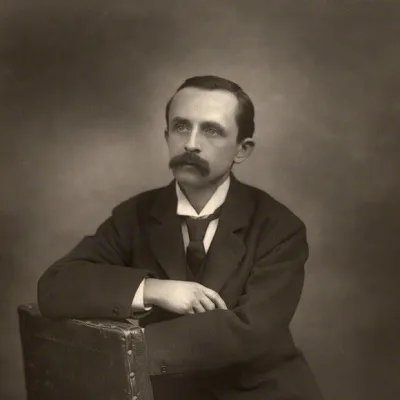
J. M. Barrie
Human Design Chart
Biography
The son of a weaver, he studied at Edinburgh University and settled in London as a free-lance writer in 1885. His collection of Scottish sketches caught public attention in 1889 and his first novel, "The Little Minister," was released in 1891. From that point on Barrie produced a stream of popular plays.
In 1913, Barrie was knighted; he received an Order of Merit in 1922; was rector of St. Andrews University 1919-1922 and became chancellor of Edinburgh University from 1930. He married actress Mary Ansell in 1894 and they divorced in 1910. Reference works state that his marriage was never consummated. J. M. Barrie died of pneumonia on 19 June 1937 at age 77 in London.
The Human Design of J. M. Barrie: Generator 6/3
Generator 6/3 — Design at a Glance
J.M. Barrie's design indicated a tendency towards fundamental endurance and high sacral energy. He showed himself to be someone who used his strength most effectively when reacting to impulses rather than initiating actions on his own. This configuration essentially described him as a strong workhorse: extremely resilient and powerful, provided the energy for the task was available.
The mechanics of his Generator type emphasized clearly the motto „Do not initiate but react“. His sacral energy was primarily released when he responded to signals from life. He acted successfully by waiting for an external trigger and acting upon it as soon as his inner self gave a clear „yes“. This strategy led to deep satisfaction and a sense of fulfillment.
Deviations from this pattern, however, resulted in frustration. His two major stumbling blocks were persistently doing things without internal desire – which wasted energy and led to burnout – and holding back on his heart project while still full of power. If J.M. Barrie did not live by this design, for example through excessive initiating, he encountered ongoing frustration or energy deficiency. In harmony with his nature, no one could stop him; his strength lay in reacting „from the gut“, not in anticipating.
Emotional Authority
J.M. Barrie's design indicated a tendency towards emotional detachment when making decisions; spontaneous reactions seemed to him as deceptive. His inner authority came from the defined Emotional Center. This meant that he was subject to constant ups and downs of his feelings. The world appeared always colored by his current mood: totally enthusiastic about something one moment, completely negative about it the next. However, his feeling in the moment was only a snapshot, a first impression, which did not necessarily represent his truth yet. Quick decisions based on such an emotion could therefore have negative consequences.
The mechanics of his emotional authority required patience and time. The longer he let a decision ripen, the deeper and more comprehensive he could perceive the situation. This meant concretely that he had to „sleep on“ important matters in order to gain distance from the current mood swing. Over time, intense feelings subsided, an emotional distance set in, and clarity as well as calmness emerged. Only then was the process complete. This need for delay was particularly true for long-term decisions with significant influence on his life course. He showed himself to be someone who had to take a lot of time to reach true insight rather than acting immediately.
The 6/3 Profile — Role Model / Martyr
J.M. Barrie appeared as someone seeking an extraordinary life away from standards, driven by inner restlessness and the pursuit of perfection that never fully ended. His design indicated a tendency for the first three decades to be marked by intensive self-experimentation and adventure-seeking – characteristic of Profile 6/3, the Role Model Experimenter. During this phase, he lived like a 3/3er, full of many (self-)experiments.
After Saturn returned around age thirty, this experimenting slowed down but never stopped entirely, as the line of adventure was permanently present in his profile. As an old soul, he often felt internally restless, always searching for the right and perfect thing without ever finding it. He did not strive for „ordinary“ perfection but rather a unique existence.
While he loved adventures, responsibility and wisdom became self-evident to him after age thirty. He used his unusual experiences to become a wise, far-sighted, and humorous role model. The sixth line tried to maintain an overview and see the big picture, which was difficult. Mutation was either accepted or rejected. At the same time, the third line addressed dissatisfaction and wavering between responsibility awareness and irresponsibility. It was about dealing with outdated principles; once objections were cleared away, this enabled their destruction. This often signaled that he no longer belonged there and had to leave, breaking ties.
Triple Split Definition — Defined & Open Centers
J. M. Barrie's design was characterized by an enormous inner density: Eight of the nine centers were defined, creating a constant presence in almost all areas of life, from mental inspiration to vital energy, emotional depth, and stress-driven forward momentum. The challenge lay not in a lack of resources but in integrating these many streams.
The open Heart Center formed the decisive tension field. Here, there was no consistent personal will; instead, J. M. Barrie tended to adopt situational expectations from others. The typical trap of this open center involved wanting to prove oneself through promises, often leading into a spiral of self-doubt when these promises could not be kept. The mantra for this center was: Nothing to prove.
In contrast, the defined Head and Ajna Centers provided constant mental pressure to question and find answers, coupled with clear conceptual thinking. This mental activity flowed into the defined Throat Center, serving as a pivot point for communication and enabling reliable expression of thoughts. Defined G (Identity/Direction), Sacral (vital energy), and Solar Plexus (emotional wave motion) centers provided a firm inner structure while the Spleen Center offered intuitive spontaneity in the present moment. The Root Center drove forward movement with adrenal stress.
Thus, the mechanics described someone who possessed immense tools – energy, thinking, feeling – whose lesson was not to misuse this power for convincing others or proving one's ego in the open Heart Center. Defined centers provided substance; the open Heart demanded humility, avoiding the need to prove oneself.
Channels for inner truth, focus, reflection, logic, mysticism and growth.
J. M. Barrie's design inclined towards precise and patient analysis with clan-oriented binding. His inner rhythm was shaped by a combination of logical focus, reflective distance, corrective criticism, and emotional loyalty.
The Concentration Channel 52-9 connected Root Center with Sacral Center. Gate 52 created passive pressure for silence while Gate 9 focused on details. This formative energy allowed J. M. Barrie to step-by-step examine and perfect patterns by avoiding distractions and collecting his energy until a clear reaction from the Sacral Center followed.
Parallel, the Lost Son Channel 13-33 between G and Throat Centers worked. Gate 13 listened and stored secrets while Gate 33 withdrew for reflection. J. M. Barrie collected life stories and waited patiently until deeper truths emerged before communicating them, fostering an attitude of conscious observation rather than hasty expectations.
Judgment in Channel 58-18 connected Root Center with Spleen Center. Gate 58 drove the will to live while Gate 18 sought corrections. J. M. Barrie showed an insatiable need to question and improve patterns, his criticism aimed at restoring balance but was most effective when invited to suggest solutions.
Finally, Synthesis Channel 19-49 between Root Center and Solar Plexus Center created a strong sense of belonging. Gate 19 promoted approaching the clan while Gate 49 defended principles. J. M. Barrie sought emotional validation through loyalty and protection of the community, wanting to be needed and finding satisfaction in balancing fairness and feasibility within social bonds.
These four channels together formed a foundation linking logical rigor with emotional connection. J. M. Barrie lived from dynamics requiring first silent concentration and reflection on experiences before acting with critical insight or committing to the clan.
Collective Circuitry — Circuit Signature
J. M. Barrie's design showed a Triple Definition, indicating three separate parallel operating energetic blocks that did not flow directly into each other. Within the Knowledge Circuit, he connected Head Center with Ajna Center (Awareness), translating spontaneous mental impulses into focused intuition. The Understanding Circuit linked Sacral, Root, and Spleen Centers (Concentration, Judgment); this created a logical future-oriented structuring force acting free of emotion. In the Meaning Circuit existed two isolated segments: Throat Center with Identity Center (The Lost Son) allowed expressing emotional waves from the past while Sacral and Root Centers (Maturation) carried rhythmic cyclical nature of reflection. Both groups were energetically separate. Finally, the Ego Circuit connected Solar Plexus Center with Root Center (Synthesis), transforming emotional resonance into concrete action impulses – crucial for cooperation but without constant life force of Sacral Center, necessitating pauses for regeneration. This configuration marked J. M. Barrie as someone experiencing mental intuition, cool logic, and emotional past reflection as separate coexisting forces. The separation between groups meant these areas did not automatically interplay; each block operated with its own dynamics. Absence of continuous connection required conscious integration of different energetic qualities in daily life.
Left Angle Cross of Defiance 1
J. M. Barrie's energetic landscape was marked by the presence of the left cross configuration, which did not form an active impulse for action but rather acted as an archetypal background that determined the fundamental tone of his design. It was not a specific strategy or clear path he had to follow, but rather an atmospheric quality that permeated his experiences and perceptions.
In Human Design, such cross configurations often describe deeper, subtler layers of personality that are less visible in overt actions than they are expressed through inner attitudes. For J. M. Barrie, this meant that his life was characterized by a certain challenge or tension that was not primarily defined by external actions. Instead, this mechanism created an energetic stage on which his other design elements unfolded. It suggested that his path was less about concrete goals and more about a fundamental engagement with this underlying dynamic. This structure did not provide direct instructions for action but offered a framework that profoundly influenced his inner state and the way he experienced the world.
Saturn Return · Uranus Opposition · Chiron Return · 2nd Saturn Return — Life Cycles
J. M. Barrie's design shaped a clear rhythm of maturation, crisis, and authority assumption marked by Saturn and Chiron return cycles. The first Saturn Return around age 29 condensed years of groundwork into sustainable results. This was evident in 1889: His collection of Scottish sketches garnered public attention, a concrete success that affirmed his growing competence.
The Chiron Return around the age of 49 served as an achievement cycle where the incarnation cross unfolded and meaning became tangible – provided strategy and authority were observed. Often, however, this period is accompanied by profound upheavals when old structures no longer fit. For J. M. Barrie, his marriage to Mary Ansell ended childless in divorce in 1909. This crisis marked the end of a life phase and created space for further unfolding of his purpose.
The second Saturn Return around age 59 solidified the wisdom and authority he had gained publicly. J. M. Barrie was appointed Rector of the University of St Andrews in 1919. This career development underscored his established position and the respectful influence that his design had built over time. The cycles structured his life not as a random sequence but as a coherent development from recognition through transformation to recognized leadership.
Generator · Emotional Authority — Synthesis
J. M. Barrie moved through life with a deep inner tension between the need to react and let things happen, and a strong urge to recognize patterns, correct them, and create a form of stability (Channel 52-9, 18-58). This dynamic was revealed in his ability to respond to impulses from life – an internal signal that moved him to action – while simultaneously engaging in an unceasing mental process to understand and order the world (defined Head and Ajna Centers). The combination of sacral energy and emotional authority points to a person capable of diving deeply into experiences and then processing them through a filter of logic and principles.
A central paradox lay in Barrie's strong desire for individuality and creative freedom (Gate 1) while also feeling a deep connection to the collective and its expectations (Channel 31-49). This tension field manifested in an ongoing search for authenticity, driven by the desire to offer something valuable to others and leave a lasting impression. The cyclical experiences, especially the transition from success to crisis and back (Saturn Returns), confirmed this inner dissonance and showed a life style marked both by deep engagement and constant reevaluation.
6 Defined Channels
Incarnation Cross - Left Angle Cross of Defiance 1
Solar Return
The Solar Return shows the moment when the sun returns to its exact birth position - your personal solar year.
Life Cycles
Discover the life cycles with a detailed triple view (birth chart, cycle chart, composite).
Human Design Profile
- Type
- Generator
- Strategy
- To respond - wait for something to respond to
- Authority
- Emotional Authority
- Profile
- 6/3 - Role Model / Martyr
- Definition
- Triple Split
- Incarnation Cross
- Left Angle Cross of Defiance 1
- Date of Birth
- 09.05.1860 06:30
- Place of Birth
- Kirriemuir, United Kingdom
Frequently Asked Questions
What was J. M. Barrie's Human Design type?
Which Profile did J. M. Barrie have?
What Authority did J. M. Barrie have?
What incarnation cross did J. M. Barrie have?
When was J. M. Barrie born?
Discover your own Human Design
Are you also a Generator? Find out in a personal reading how to use your sacral energy correctly and discover deep satisfaction.
More Personalities
Back to overviewAaliyah

Alain-Fournier

Alexia

Angèle

Angeli

Anne-Marie
