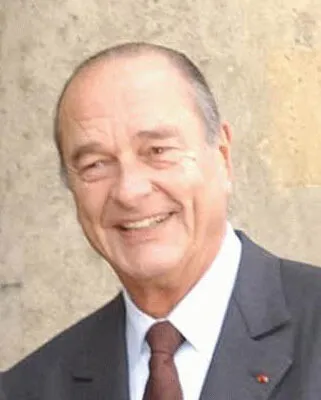
Jacques Chirac
Human Design Chart
Biography
Chirac was the only child of an aircraft company executive and a homemaker. He spent his Summers in the serene southwestern area of France visiting relatives. After working on a cargo ship for a Summer, he earned his degree in political science at the prestigious Institut d'Éudes Politiques.
In 1953, at age 20, he won a scholarship to study at Harvard for the Summer, working part time in a sandwich shop. He read history and poetry, and was fascinated by Chinese and Japanese civilizations. Though he had already met his future wife, Bernadette Chodron de Courcel, he had a romance with an heiress from South Carolina. She called him "honey child," and chauffeured him in a white Cadillac. Chirac returned to Paris to marry Bernadette on 16 March 1956. Until his death, she was his biggest supporter.
After serving in the French army in 1956, he attended L’École Nationale d'Administration, the training ground for the elite of France's civil servants. Thin, nervous and fast-talking, his political career was launched in 1962 when he landed a position in the office of Georges Pompidou, then Charles de Gaulle’s Prime Minister.
In 1967, he was elected to the national assembly and, a year later, was appointed to the Ministry of Economics and Finance. In 1972, he was named to the post of Minister of Agriculture and Rural Development and in 1974 he became Minister of the Interior. Soon after, his patron Georges Pompidou died and Chirac was named Prime Minister by the new President, Valéry Giscard d’Estaing.
The Human Design of Jacques Chirac: Generator 2/4
Generator 2/4 — Design at a Glance
Jacques Chirac, as a Generator, possessed an enormous and enduring sacral energy. His essence was not about initiating or planning from the outside but reacting to internal impulses – often described as acting 'from the gut'. He fully unleashed his strength when he responded to signals from his environment with consequent action.
This configuration worked like a workhorse: extremely strong and durable, provided there was energy for the task at hand. The central life strategy was to react rather than initiate. When Chirac followed this strategy and did things that engaged his sacral energy, he experienced deep satisfaction and fulfillment.
However, the design had two clear pitfalls. If Generators constantly did things they didn't enjoy, their resources would dwindle and burnout loomed. Equally problematic was being prevented from working on their heart project when they still felt full of power to continue. The energy of the sacral center became free primarily when impulses could be answered. Successful living thus meant waiting for a signal and only then acting when his inner center said, 'Yes! Let's get started!' If Chirac did not live according to this design – perhaps by constantly initiating against internal resistance – he would sooner or later face persistent frustration and a lack of energy. In harmony with his chart, however, no one could stop him.
Emotional Authority
Jacques Chirac showed a decision-making stance that required emotional detachment and time; spontaneous impulses were misleading for him. His design featured an Emotional Authority carried by the defined Solar Plexus Center. This configuration was subject to constant emotional waves with continuous ups and downs of feelings. The world appeared colored by his current mood: total enthusiasm in one moment, negative outlook on the same thing in another.
This immediate feeling was only a snapshot, a first impression, not necessarily his truth yet. Quick, spontaneous decisions based on such emotion could therefore have negative consequences. Jacques Chirac needed time to gain clarity. The longer he let a decision mature, the deeper and more comprehensive his understanding became. This required patience and multiple 'overnights' of decisions. He should be hesitant and ask himself several times before acting.
Over time, intense feelings subsided, emotional distance was gained, and calmness set in. Only then had he gone through the process. This mechanism applied regardless of which other centers were defined; Emotional Authority always took precedence. For long-term decisions with significant influence on his life course, this process of emotional clarification was crucial to reach inner truth and not be swayed by transient moods.
The 2/4 Profile — Hermit / Opportunist
Jacques Chirac lived in a constant tension between the deep need for withdrawal into internal clarity and the social urge to spend time with a chosen network. His design as Profile 2/4, the Natural Talent-Networker, shaped this pendulum movement: Line 2 demanded solitude to gain clarity and run through internal processes, while Line 4 awakened the desire for community with familiar people.
For Jacques Chirac, it was crucial to create a safe environment where he could clearly communicate these shifts. He had to make clear when he sought company and when he withdrew undisturbed. This clear exchange protected him from burnout as Line 4 otherwise tended towards overload if quality was sacrificed for quantity. During his withdrawal phases, Jacques Chirac could reflect on and evaluate the knowledge of his network. Only once the need for solitude was satisfied did he return from his 'cave' to meet with his favorite people. This synthesis of individual reflection and social exchange enabled him to develop brilliant ideas. The ability to set these boundaries was key to harmoniously utilizing the energy of both lines without slipping into depression or exhaustion.
Triple Split Definition — Defined & Open Centers
Jacques Chirac's Human Design profile revealed a robust internal structure with six defined centers, providing constant energy for thinking, willing, and feeling. His defined Head and Ajna areas generated a persistent mental pressure to ask questions and understand connections; this process of inspiration and conceptual thinking was his natural way of understanding the world. At the same time, he had a defined Heart Center, which gave him clear willpower and ego strength, enabling him to shape his life independently and keep promises. This inner stability was fueled by a defined Sacral Center, acting as an engine generating vital energy in response to stimuli with yes or no answers, along with a defined Solar Plexus, establishing emotional wave movements as authority. Additionally, there was a defined Root Center providing consistent stress pressure for dealing with challenges.
Opposing this strong internal constitution were three open centers that created situational sensitivity. His open Throat Center meant he did not have a constant source of communication; he tended to feel insecure when not heard and had to learn to wait for invitations to speak rather than forcing attention. His open G Center lacked a fixed identity or direction in life, making him vulnerable to feeling lost in relationships or places that were not right for him, often seeking external validation of his existence. Finally, his open Spleen Center showed vulnerability regarding health and intuition; without spontaneous impulses for safety, he was conditioned to hold onto things giving a false sense of well-being or project fears about survival issues. The challenge lay in not forcing these open areas from the non-self but trusting proper conditioning through the environment and his own strategy.
Channels for logic, community, maturation and abstraction.
Jacques Chirac's personality was rooted in meticulous perfectionism. The Sun at Gate 9 shaped his essence with intense focus on details and taming complexity through repeated experiments. Without this energetic fulfillment, he risked feeling empty; instead, he sought mastery through experimentation, supported by Gate 16, which refined skills through continuous action.
His mind worked with healthy skepticism. Channel Logic 63-4 connected the doubt of the Head Center to the formulation in the Ajna Center. This mechanism constantly filtered patterns for their consistency; only what proved verifiable and consistent was considered true for him. Unfounded belief found no place here – logic had to work logically.
In interpersonal relationships, Jacques Chirac needed trusting agreements. Channel Community 37-40 linked the emotional depth of the Solar Plexus with the willpower of the Heart Center. He sought his place in the whole and built bridges to integrate individuals into a functioning unit. A good deal or alliance could not be made spontaneously; it required time, direct personal contacts, and assurance that both sides benefited from the agreement.
His learning occurred in complete cycles. Channel Maturity 53-42 drove him to go through experiences from start to finish before reflecting on them. Only then could he extract wisdom from a situation and make it useful for others. Premature termination meant repetition; a completed cycle allowed looking back and sharing gained insights.
Finally, his mind sought meaning in the past. Channel Abstraction 64-47 connected the confusion of the head with understanding in the Ajna Center. He filtered every experience through a kaleidoscope of mental images to find an inspiring story or new perspective. This process was often confusing but led to long-term clarity and enabled him to convey complex connections as narrative structures.
Collective Circuitry — Circuit Signature
Jacques Chirac's Human Design profile showed a Triple Definition, meaning he lacked a continuous internal energy source for the themes of Mind, Purpose, or Ego. His activation of these areas was situational and dependent on his environment; he reflected more the strategies or emotions of others than generating them consistently himself. This structure allowed high adaptability: Depending on context, he could act logically-strategically, emotionally-reflectively, or cooperatively without adopting a fixed stance. However, this required pauses for regeneration as there was no internal format-energy driving him.
In the Understanding Circuit, Channel Logic (63-4) connected Head and Ajna Centers. This involved sharing logical insights and strategic focus on the future free from emotional conditioning. As this energy was not continuously defined, it only became effective with appropriate external triggering.
The Purpose Circuit consisted of two separate parts. Channel Abstraction (64-47) linked Head to Ajna while Channel Maturity (42-53) connected Sacral and Root Centers. These groups were not interconnected. The first part related to abstract perception, the second to cyclical emotional waves and learning from the past. Both aspects worked in parallel but independently of each other.
In the Ego Circuit, Channel Community (40-37) linked Heart Center with Solar Plexus. This concerned cooperation, mutual support, and the give-and-take relationship within the tribe. Without connection to Sacral Center, there was no constant life force; resource creation occurred in waves and required rest phases. Jacques Chirac thus mirrored cooperative dynamics of his environment rather than driving them independently.
Right Angle Cross of Planning 4
Jacques Chirac demonstrated a pronounced ability for strategic long-term planning and vision. His design emphasized the capacity to penetrate complex situations and pursue long-term goals with clear foresight. This attitude stemmed from the configuration of the 'right cross of planning 4'.
This specific structure in the Human Design chart signifies an inner orientation towards the essential beyond immediate presence, granting the ability to recognize the big picture and make decisions based on a well-thought-out, far-sighted strategy rather than short-term impulses. Jacques Chirac embodied this characteristic as someone capable of focusing on long-term alignments instead of being swayed by momentary moods. The mechanics of this cross support a clear vision of goals and the patience to follow the necessary path there. It is an energy that brings structure into the unknown, helping to identify the right time for important steps based on a deep understanding of underlying dynamics. Jacques Chirac used this inner compass needle to align his actions with a higher vision, allowing him to maintain a firm point even in unclear times and consistently work towards the desired outcome.
Saturn Return · Uranus Opposition · Chiron Return · 2nd Saturn Return — Life Cycles
Jacques Chirac's design was marked by cyclical turning points where external structures met internal drives. In 1971, at age 39, he became minister for parliamentary relations. This signified an Uranus opposition: a moment of sudden change or liberation that often forces new roles before fully understanding them. Here, the ability to intervene in established systems and set dynamic impulses was shown, even if this came with unpredictability.
Later, in 1988 at age 56, Chirac ran for president, qualified for a runoff but lost to Mitterrand. This fell during his second Saturn return cycle. Such cycles often demand confrontation with limits, responsibility, and positioning within hierarchical structures. The loss was not mechanical failure but a moment of review: what truly underpins the foundation? The Saturn cycle tests the substance of earlier achievements. Chirac faced the task of defining authority through inner constancy rather than external success. Confronting this reality strengthened his understanding of how power and structure interplay – less as triumph, more as necessary clarification of his role in the system.
Generator · Emotional Authority — Synthesis
He was a Generator whose life was marked by deep sacral energy – an unrelenting drive that propelled him to shape things and push forward so long as he felt connected to his inner truth. This force manifested in his engagement with tasks close to his heart, yet it also carried the risk of burnout if he let himself be distracted from his true priorities. The emotional authority combined with defined Head and Ajna Centers pointed towards a profound thought process marked by constant questioning and doubt; logical filtering of patterns (Channel 63-4) to ensure consistency.
A central paradox lay in the interplay between his need for withdrawal and connection. The Profile Natural Talent/Networker revealed an inner conflict between Line 2, which tended toward isolation and internal clarification, and Line 4, which sought community and exchange with like-minded individuals. This tension was evident in phases of intense focus on his goals followed by a desire for exchange and recognition – a rhythm amplified by the cycles (Uranus opposition 1971, Saturn return 1988) that propelled him forward as well as into crises.
4 Defined Channels
Incarnation Cross - Right Angle Cross of Planning 4
Solar Return
The Solar Return shows the moment when the sun returns to its exact birth position - your personal solar year.
Life Cycles
Discover the life cycles with a detailed triple view (birth chart, cycle chart, composite).
Human Design Profile
- Type
- Generator
- Strategy
- To respond - wait for something to respond to
- Authority
- Emotional Authority
- Profile
- 2/4 - Hermit / Opportunist
- Definition
- Triple Split
- Incarnation Cross
- Right Angle Cross of Planning 4
- Date of Birth
- 29.11.1932 12:00
- Place of Birth
- Paris, France
Frequently Asked Questions
What was Jacques Chirac's Human Design type?
What Profile did Jacques Chirac have in Human Design?
Which Authority guided Jacques Chirac?
What incarnation cross did Jacques Chirac have?
When was Jacques Chirac born?
Discover your own Human Design
Are you also a Generator? Find out in a personal reading how to use your sacral energy correctly and discover deep satisfaction.
More Personalities
Back to overviewAaliyah

Alexia

Angèle

Anne-Marie

Arcángel

Arno