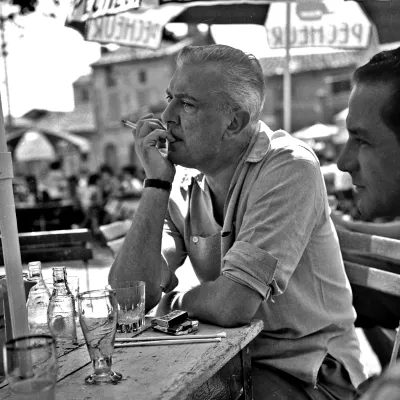
Jacques Tati
Human Design Chart
Biography
Drawn away by sports, Tati played professional rugby with the famous Racing Club team for a short while. He turned music and cabaret into a mime comedy work of art, which became an immediate success. Several of his show pieces turned into short films with Tati writing and producing.
His first milestone film "Jour de Fete" was released in 1949 with comic style and visual humor. Troubled by financial problems and large debts, Tati only produced six films throughout his career but they spanned three decades. Two of his other great successful movies were "Mon Oncle" in 1958 and "Playtime" in 1968.
Tati was noted for his wonderful talents of wit, humor and humanity. As a director, he was devoted to painstaking preparation of all of his films.
He died on 4 November 1982 Paris, France.
The Human Design of Jacques Tati: Manifestor 6/2
Manifestor 6/2 — Design at a Glance
Jacques Tati's Human Design profile laid the foundation for his role as a pioneer and visionary. He was a Manifestor, a type destined to lead the world in new directions without having to take every step himself. This profile worked similarly to an emperor in ancient Rome: The vision of a great empire existed, yet the concrete wars and battles were fought by others. Jacques Tati sent his soldiers out so to speak, to conquer foreign lands for him.
This kind of leadership inevitably polarized people. His big dreams and far-reaching thoughts often led to misunderstandings. Some loved him and followed him as a leader; others disliked or even hated him because of these grand visions. This pain point of being misunderstood was a central aspect of his nature.
To find the right followers and minimize friction, it was crucial for Jacques Tati to inform others about his plans in good time and accurately. This was his strategy. If he followed this strategy and stuck to his inner authority, he was rewarded with an internal sense of peace. Living against his design likely made him feel a persistent, deep-seated anger. His path involved creating space for his leadership through clear communication.
Emotional Authority
Jacques Tati was influenced by an emotional wave that shaped his experience and judgments significantly. His inner authority resided in the defined Emotional Center. This mechanism meant he did not make decisions from rational distance but filtered them through his current mood. What seemed inspiring at one moment could be perceived as negative in the next; the immediate emotion was always just a snapshot, not yet the final truth.
Therefore, it was crucial for Jacques Tati to take time. Quick, spontaneous reactions to emotional impulses often had negative consequences. Instead, his design required patience and consciously sleeping on decisions. Only when intense feelings subsided and emotional distance was gained did clarity set in. This process of calm after the wave's passing was essential for long-term life decisions. Emotional authority always took precedence over other defined centers in his design, regardless of any additional mechanisms present. Jacques Tati had to take time to consider multiple times to ensure that his choice rested on a stable and clear insight rather than a fleeting emotional high or low. This need for temporal distance was not a lack of resolve but the specific strategy of his design to uncover deeper truths.
The 6/2 Profile — Role Model / Hermit
Jacques Tati's life path was marked by a distinct development line. Before turning 30, the energy of Line 2 dominated. This led to a phase of experimenting and learning through trial and error. After setbacks, he withdrew to collect new impulses. This early period was characterized by the necessity to make personal experiences without immediate validation.
Around age 30, his design's Line 6 activated. Jacques Tati now tended to reflect on his past experiments from a distance. This phase served intensive reflection and healing. He sought solitude to gain deep self-knowledge. Emerging from this period of introspection, he developed wisdom that became visible to others. People came to him to partake in these insights. His ability for profound self-reflection became an example. The combination of earlier momentum and later wise distance allowed him to share patterns whose value was confirmed through his own development. Thus, his path evolved from impatient experimenting to calm communication of intuition and clarity.
Split Definition — Defined & Open Centers
Jacques Tati's Human Design profile indicates a tendency towards reliable communication that does not stem from impulsive will or planned strategy. His defined Throat Center served as a focal point for messages he expressed with clarity and honesty once he knew where his true voice came from. This expression was steady but limited in its nature, giving him an authentic presence.
This communication ability was filtered through his defined Solar Plexus Center, which acted as an inner authority. Jacques Tati showed himself to be someone who did not make decisions in the 'now', but rather waited for the emotional wave to pass. He understood that truth reveals itself over time and that emotional clarity is achieved when initial excitement or depression has subsided. This protected him from impulsive reactions and allowed him to gain deeper insights by cycling through different perspectives before acting.
Additionally, his defined Spleen Center shaped his spontaneous intuition in the moment. He had a strong body awareness and an instinct for health and well-being that helped him make trustworthy judgments without having to rationalize them. His defined Root Center provided the necessary pressure to rise materially or correct course, nourishing existential awareness.
In contrast, his Head Center was open, making him vulnerable to mental confusion and pressuring him to find answers that were not his own. He tended to be swayed by others' doubts rather than trusting his inner authority. His open Ajna Center allowed him to take in concepts without interpreting them as personal truth, giving him a flexible mind but also the risk of identifying with foreign opinions.
His open G Center meant a lack of fixed identity; he adapted to his environment and sought the right place to be initiated into the correct direction. The open Heart Center made him sensitive to the pressure to prove his worth, though he lacked consistent willpower. Finally, his Sacral Center was open, making him vulnerable to absorbing others' energy and overworking since he did not have a constant life force available.
Channels for emotional depth, life purpose and ambitious transformation.
Jacques Tati's Human Design profile indicates a tendency towards emotional restraint that only blossoms into social openness at the right moment. The Openness Channel 22-12 connects his Solar Plexus with Throat; his articulation depended on the emotional wave. Gate 12 ensured caution, while Gate 22 carried passion. He waited for the right moment to achieve a transformative effect through voice and words rather than acting impulsively.
At the same time, Jacques Tati was shown as someone who stubbornly followed his own path and found deep meaning in battles. The Life Struggle Channel 38-28 connects Root with Spleen. Gate 38 exerted pressure to maintain integrity while Gate 28 recognized which struggles were worthwhile. This configuration drove him to resist external forces and preserve his individuality through determination, often appearing as stubbornness but necessary for his process of self-discovery.
Furthermore, Jacques Tati exhibited a drive towards transformation through persistent effort. The Transformation Channel 54-32 connects Root with Spleen; Gate 54 brought the ambition to be seen while Gate 32 sought talents to secure the clan's existence. He worked hard to gain recognition and improve his position, driven by fear of failure and a desire to rise through competence.
Additionally, Gates like 48 with its depth and pattern recognition as well as Gate 21 with its focus on control in material life influenced him. Gate 53 enabled him as a pioneer to forge new paths while Gate 60 demanded acceptance of limitations. Gate 33 promoted reflection before new cycles, and Gate 58 brought humor despite pressure into play. Gate 62 valued logical details, Gate 31 on power transmission, Gate 36 on crisis management, and Gate 39 on provocative analysis for mutation. These elements shaped his complex inner workings.
Individual Circuitry — Circuit Signature
Jacques Tati's Human Design profile indicates a tendency towards emotional authenticity and pragmatic endurance. His Knowledge Circuit connects the Throat Center with Solar Plexus, meaning he expressed feelings directly verbally, driven by pulsating creative energy. This occurred parallel to the connection of Spleen-Root in the Life Struggle Channel, which gave him an instinctive perception for what is essential, paired with the strength to overcome resistance. Since Jacques Tati had split definition, these energies existed as two separate, not directly connected streams: on one side, the expressive emotional voice; on the other, the intuitive survival-oriented practice. The Ego Circuit contributed additionally to the Spleen-Root connection, emphasizing here transformation and adaptability in daily life. Overall, Jacques Tati was shown as someone who brought his unique impulses into the world through speaking his true feelings while simultaneously trusting his inner compass for security and efficiency to master challenges. This configuration described a life task of uniting individual creativity with pragmatic resilience without these two areas always being in direct exchange but rather existing side by side.
Left Angle Cross of Endeavour 2
Jacques Tati's Human Design featured the signature of the left cross of effort two. This configuration set a specific life direction: the intense, often laborious process of translating inner visions or ideas into the external reality and anchoring them there sustainably. It was not about spontaneous inspiration alone but rather a path of systematic work and perseverance.
In Human Design, this cross describes a dynamic where the individual is called to build bridges between the spiritual and the material. The focus lay on the quality of implementation and endurance in striving for a higher purpose or deeper truth. Jacques Tati showed himself through this mechanism as someone who directed his energy towards making complex connections tangible. The challenge was to reconcile the pressure of the external world with inner intuition without losing sight of the original vision. It was a path of transformation through effort and precise action.
This structure shaped his way of dealing with his environment: not as a passive observer, but as an active shaper who was willing to put in the necessary work to make his ideas become reality. The energy of this cross supported him in holding fast to his path despite resistance or uncertainties and achieving results that went beyond the immediate moment. It was always about bringing something existing into a new form through one's own efforts.
Saturn Return · Uranus Opposition · Chiron Return · 2nd Saturn Return — Life Cycles
Jacques Tati's Human Design indicated a tendency towards sudden, disruptive breakthroughs followed by phases of deep confirmation of his life mission. His structure showed him often experiencing a turning point in middle age when inner tensions emerged and new paths were forged.
This mechanism became concrete in 1947, at the age of forty: Tati celebrated his breakthrough with “Jour de fête,” his first self-written and directed feature film. This success marked the peak of an Uranus opposition often associated in Human Design with unexpected upheavals where old structures break to make way for individual innovation. It was not a gradual ascent but a sudden emergence from anonymity into public recognition.
Another defining pattern emerged during his Chiron Return, a cycle of fulfillment and bloom that typically occurs between the ages of 49 and 51. Here, one's incarnation cross unfolds increasingly; meaning and purpose become experiential if the person follows their strategy. For Jacques Tati, this phase began in 1958 when he was fifty years old. In this year, “Mon Oncle” won a Special Jury Prize at Cannes Film Festival as well as the prize of French film critics. These accolades were not mere recognition but visible confirmation of his deepest creative intentions. The Chiron Return here did not signify healing from wounds but complete unfolding of his unique artistic purpose on an international stage.
Manifestor · Emotional Authority — Synthesis
Jacques Tati was a Manifestor whose life was marked by a profound drive towards initiation and transformation. His emotional authority (paired with the open channel of openness – Gates 22/12) points to a personality that deeply experienced emotions but did not express them unreflectively. Rather, he let decisions mature and only then expressed himself authentically when his inner truth was clear. This corresponds with the profile as role model/natural talent: after an experimental phase, he withdrew to reflect and eventually impart profound wisdom that attracted others. The focus on knowledge (switch circuit) strengthened this process of internal transformation and expression of new perspectives.
A central paradox in Jacques Tati's design lay in the interplay between manifestation and emotional wave. As a Manifestor, he possessed the energy to initiate things and set them in motion, yet his emotional authority required time for decision-making – a tension between the impulse to act and the necessity to fully experience emotions first. This led to a unique expression marked by creative melancholy (switch circuit keynote) that was evident in moments of success when his visions received recognition (events 1947 & 1958).
3 Defined Channels
Incarnation Cross - Left Angle Cross of Endeavour 2
Solar Return
The Solar Return shows the moment when the sun returns to its exact birth position - your personal solar year.
Life Cycles
Discover the life cycles with a detailed triple view (birth chart, cycle chart, composite).
Human Design Profile
- Type
- Manifestor
- Strategy
- To inform others before acting
- Authority
- Emotional Authority
- Profile
- 6/2 - Role Model / Hermit
- Definition
- Split Definition
- Incarnation Cross
- Left Angle Cross of Endeavour 2
- Date of Birth
- 09.10.1907 03:00
- Place of Birth
- Le Pecq, France
Frequently Asked Questions
What was Jacques Tati's Human Design type?
What profile did Jacques Tati have?
What authority did Jacques Tati possess?
Which incarnation cross was active for Jacques Tati?
When was Jacques Tati born?
Discover your own Human Design
Are you also a Manifestor? Find out in a personal reading how to use your initiation power peacefully and dissolve resistance.
More Personalities
Back to overviewSissy Spacek

Anémone

Ann-Margret

Arletty

Arno

Artus