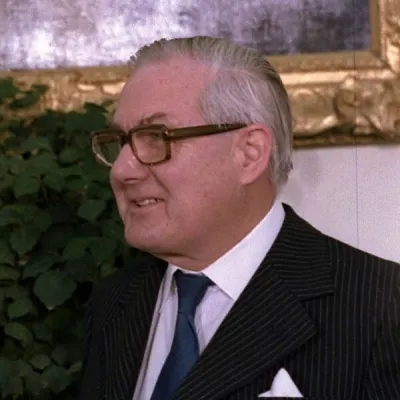
James Callaghan
Human Design Chart
Biography
He died at his home in East Sussex, England on March 26, 2005, the day before his 93rd birthday.
James Callaghan — Generator with Profile 3/6
Generator 3/6 — Design at a Glance
James Callaghan possessed the constitutional endurance of a Generator, whose design presented him as a powerful workhorse. His strength did not lie in independently initiating actions but rather in his ability to react to external signals and internal impulses. Reacting from the gut was the key to his effectiveness and satisfaction.
The mechanics of his design required that he wait until his sacral center gave a clear "yes" before taking action. If he initiated on his own or forced himself into tasks without inner resonance, he wasted energy pointlessly and fell into frustration. His design was constructed in such a way that deep fulfillment could only be achieved by responding to life's offers, not by creating them.
The danger always lay in either wasting energy on unwanted activities, leading to burnout, or being held back from his true heart project even though the strength was still there. James Callaghan showed himself most effective when he followed this strategy of reacting. Then nothing could stop him, and his high energy flowed into materialized results. If he ignored this principle and tried to take control through initiation, he encountered a persistent feeling of exhaustion. His path to effectiveness was thus not an active push forward but a conscious waiting for the right moment before then responding with full force.
Sacral Authority
James Callaghan oriented himself in his decisions by sacral authority. As a Generator, this was his primary inner instance, which coincided with his strategy "wait for the trigger" and thereby simplified his decision-making process. His system did not react through deliberate thinking but rather through an immediate physical resonance to external impulses.
This reaction manifested concretely in the form of gut feelings or a surge of energy. James Callaghan had to learn to pay attention to specific bodily signals: grunting, humming, groaning, or loud affirmations like "Mhm" and "Hmm." Such signals marked the moment when his sacral motor responded to an impulse. In these states, he felt vital and alive; he was endowed with seemingly inexhaustible energy. He tackled his tasks with great enthusiasm and immersed himself in his activities without needing rigid purposefulness. His design helped him to go through life with joy and satisfaction.
Furthermore, his activated spleen center acted as a supportive authority for the sacral center. This gave him the ability to react particularly quickly and spontaneously to impulses. He had an immediate access to his physical well-being as well as his instinctive perception. This combination enabled James Callaghan to reliably be guided by these deep inner signals rather than placing external expectations or rational considerations in the foreground. His energy only truly ignited when the outer trigger was appropriate and this bodily confirmation occurred.
The 3/6 Profile — Martyr / Role Model
James Callaghan showed a development that clearly divided into two phases. In his first half of life, Line 3 experimentation dominated. He learned through trial and error, with detailed work and adaptability taking precedence. Shortcuts were counterproductive here; only the direct path through experience led to real understanding. This phase was characterized by playful testing and building up and breaking down connections.
Around age 29.5, the return of Saturn marked a turning point. Line 6 became active, prompting James Callaghan to withdraw to reflect on his accumulated experiences. The previously playful energy now received wise guidance. He carried both his younger, experimental self and an older, overseeing instance within him from then on. This often led to inner conflict: externally he appeared controlled, but internal uncertainty persisted as he needed space for reflection and play.
Only after the age of 50 did this integration complete itself. Through learning from both perspectives, James Callaghan became a model for others through charm and wisdom. He only gave away his energy when the results of his experiments had societal value. The necessity to maintain identity in practice was coupled with high standards. His design thus described a path from an unbound explorer to a reflective teacher who knew correction and self-sacrifice in service of greater connections.
Split Definition — Defined & Open Centers
James Callaghan's design indicated a tendency towards constant mental structure and reliable identity. His defined Ajna Center provided consistent conceptual thinking, while the defined G Center offered a clear sense of direction and self-love. This inner strength was fueled by immense vital energy from his defined Sacral Center, which was only correctly available in response to external impulses. His communication flowed consistently from this mental or identity-based source, supported by his defined Throat Center.
His personality also showed through spontaneous intuition from the defined Spleen Center and a specific way of handling pressure via the defined Root Center. This formed a strong foundation: he always thought, acted out of clear identity, and had enormous power as long as he did not initiate but waited to react.
At the same time, James Callaghan was exposed to situational influences. His open Head Center meant that he lacked constant inspiration; he tended to be distracted by doubts or questions from others if he didn't trust his inner authority. The open Heart Center lacked consistent willpower; here the trap lay in making promises to prove value, which often led to failure due to a lack of energy for it. Additionally, his open Solar Plexus acted as a barometer: he absorbed and amplified environmental emotions without personalizing them. James Callaghan thus showed himself as someone with a strong inner core who had to be careful with mental overload, the pressure of promises, and foreign emotions to avoid wasting his energy.
Channels for change, curiosity and clear logic.
James Callaghan exhibited a basic attitude of logical structuring: he permanently organized details into a coherent mental system. This was influenced by Channel of Acceptance 17-62, which translated visual patterns (Gate 17) into precise language (Gate 62). Anything that did not fit this logical framework was rejected; his understanding depended on this inner order. The Sun Line 3 quality at Gate 17 gave this process an experimental character that matured over time.
Alongside this dominant logic, Channel of Judgment 58-18 promoted the urge to correct and perfect patterns. This generated an insatiable search for the best answer, with Gate 58 driving life energy and Gate 18 providing a correction instinct. Crucial here was timing: unsolicited corrections often led to resistance, while requested solutions were effective.
Channel of Beat 14-2 connected material resources (Gate 14) with higher knowledge and direction (Gate 2). This enabled him to open innovative new paths by trusting the reaction from his Sacral Center and thus transforming mutations into a concrete life direction.
Channel of Mutation 60-3 brought evolutionary change through acceptance of limitation (Gate 60) and overcoming confusion at the rebirth (Gate 3). This channel worked pulsatingly, sometimes quiet, sometimes active, requiring patience during phases of inner unrest.
Channel of Curiosity 11-56 drove him to seek stimuli to transform ideas (Gate 11) into stories (Gate 56). This served less for his own understanding than for sharing insights and stimulating others through narrative presentations.
Additionally, Gates like Gate 32 (Stability), Gate 42 (Completion Ability), and Gate 50 (Tradition) influenced his actions by focusing on continuity, the completion of processes, and the protection of established values.
Collective Circuitry — Circuit Signature
James Callaghan tended to transform new insights through emotional waves into usable rational logic for the future. His design connected Identity-, Sacral-, and Root Centers in the Knowledge Circuit. This generated a pulsating energy towards mutation – deviation from the old – and beat, the creative rhythm. Here it was about expressing unique individuality through emotional impulses.
Parallel to this, two separate segments of the Understanding Circuit worked. The first linked Ajna and Throat Centers via Channels Acceptance and Judgment. This allowed focused visual thinking and sharing logical insights free from conditioning. The second segment connected Spleen and Root Centers, linking intuitive security with survival necessity. This 'emotionless ratio' contrasted with the emotional wave of the Knowledge Circuit.
Another element was the Ajna-Throat Link in the Meaning-Finding Circuit (Channel Curiosity). This referred to processing past experiences and their meaningful conveyance. The Shared Definition separated these cognitive-communicative forces from the physical-energy basis of Sacral-, Root-, and Spleen Centers. James Callaghan had to integrate these parallel, not directly connected systems: emotional transformation of new identity on one side and strategic rational future-making on the other. The challenge lay in aligning intuitive ratio with the emotional waves of past and present without one system overshadowing the other.
Right Angle Cross of Service 1
James Callaghan's design established a foundational disposition marked by the right Service Cross. This signified a deeply rooted motivation to support and serve others. His life was not seen as a stage for heroic deeds or loud fame, but rather as a process of quiet, steady learning and growth. The focus was on developing wisdom through concrete help in everyday situations. It was less about achieving external goals and more about helping others realize their potential by being a reliable support himself. This configuration described a life task of patient accompaniment: through service to others, his own inner structure was strengthened and deepened. James Callaghan thus showed himself as someone whose energy derived from giving and supporting without losing his essence. The mechanics of this cross underscored that true strength often lies in the ability to give others space for their development while working quietly behind the scenes. It was a stance of humility and engagement aimed at making the good in others visible and promoting it rather than being in the spotlight.
Saturn Return · Uranus Opposition · Chiron Return · 2nd Saturn Return — Life Cycles
James Callaghan's design established a tendency towards structural anchoring, which was particularly evident during his first Saturn return. This cycle marks in Human Design the transition from an exploratory youth phase to conscious identity formation and the assumption of long-term responsibility. It is a moment of testing where internal values must be reconciled with external realities to create a stable life foundation.
In 1938, at age 26, James Callaghan married. This event served as a concrete expression of this mechanical dynamic: The marriage was not just a private step but the institutional and emotional structuring of his identity in a phase that demanded stability and definition. The Saturn return often demands a clarification of what is permanently important to an individual, and James Callaghan responded with the establishment of a family foundation. This reflects the typical energy of this life phase where fleeting possibilities condense into binding structures. Through this decision, he anchored himself in a social fabric serving as a stability anchor while further shaping his role in the world. The mechanics of the Saturn return here act as a catalyst for maturity and acceptance of commitments that extend beyond one's own horizon.
Generator · Sacral Authority — Synthesis
James Callaghan lived deeply within his sacral energy (Generator type, Sacral Authority) and spent his life responding to external stimuli with an inner surge of power. This reaction was not mere activity but an expression of joy in living and the ability to fully immerse oneself in action – as long as it gave him energy. His profile as a experimenter/role model suggests that he initially gathered experiences and later, after a phase of reflection, took on a role-model function. The connection between sacral energy and the Beat channel (Gate 14-2) underscored his ability to drive innovations through the use of available resources and explore new paths, always driven by an inner urge for change.
Callaghan seemed to spend his life oscillating between researching and experimenting (Line 3) and the need for reflection and alignment with his inner wisdom (Line 6). This tension was evident in how he generated knowledge – through active engagement with the world (Knowledge Circuit) – but also through the necessity of processing this knowledge into a larger context. The right Service Cross 1 indicates that this process was always connected to the desire to give something to others and make a contribution.
5 Defined Channels
Incarnation Cross - Right Angle Cross of Service 1
Solar Return
The Solar Return shows the moment when the sun returns to its exact birth position - your personal solar year.
Life Cycles
Discover the life cycles with a detailed triple view (birth chart, cycle chart, composite).
Human Design Profile
- Type
- Generator
- Strategy
- To respond - wait for something to respond to
- Authority
- Sacral Authority
- Profile
- 3/6 - Martyr / Role Model
- Definition
- Split Definition
- Incarnation Cross
- Right Angle Cross of Service 1
- Date of Birth
- 27.03.1912 16:20
- Place of Birth
- Portsmouth, United Kingdom
Frequently Asked Questions
What is James Callaghan's Human Design type?
What Profile did James Callaghan have in Human Design?
What Authority did James Callaghan have?
What incarnation cross did James Callaghan have?
When was James Callaghan born?
Discover your own Human Design
Are you also a Generator? Find out in a personal reading how to use your sacral energy correctly and discover deep satisfaction.
More Personalities
Back to overviewAaliyah

Alexia

Angèle

Anne-Marie

Arcángel

Arno