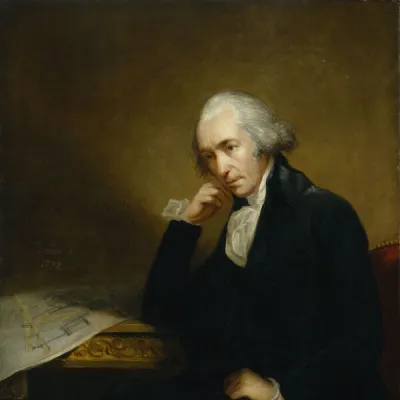
James Watt
Human Design Chart
Biography
While working as an instrument maker at the University of Glasgow, Watt became interested in the technology of steam engines. At the time engineers such as John Smeaton were aware of the inefficiencies of Newcomen's engine and aimed to improve it. Watt's insight was to realise that contemporary engine designs wasted a great deal of energy by repeatedly cooling and reheating the cylinder. Watt introduced a design enhancement, the separate condenser, which avoided this waste of energy and radically improved the power, efficiency, and cost-effectiveness of steam engines. Eventually, he adapted his engine to produce rotary motion, greatly broadening its use beyond pumping water.
Watt attempted to commercialise his invention, but experienced great financial difficulties until he entered a partnership with Matthew Boulton in 1775. The new firm of Boulton and Watt was eventually highly successful and Watt became a wealthy man. In his retirement, Watt continued to develop new inventions though none was as significant as his steam engine work.
As Watt developed the concept of horsepower, the SI unit of power, the watt, was named after him.
Human Design Analysis: James Watt as Generator 3/5
Generator 3/5 — Design at a Glance
James Watts Design shows a tendency towards high endurance, comparable to that of a workhorse. His fundamental energy dynamics originated from the sacral energy source but was not activated through his own initiatives. Instead, this power was released exclusively as a reaction to internal impulses, known as the 'Yes-Signals'.
As a Generator, James Watt had plenty of energy to materialize things. The central life task involved pursuing only those tasks that he intrinsically enjoyed – his heart projects. This led to deep satisfaction and fulfillment. Ignoring these inner signals or exercising initiatives without impulses inevitably resulted in frustration, energy loss, and burnout.
The successful strategy for him was to react to a signal from life and then respond with action once the sacral center confirmed: 'Yes! Let's get started!' Not initiating but reacting was his motto. When James Watt used his energy in harmony with this design, nothing could stop him. If he did not live according to his design, especially if he constantly wanted to initiate something, he likely encountered persistent frustration and a lack of energy sooner or later. His path was characterized by reacting from the gut.
Sacral Authority
James Watt showed himself as someone whose decision-making relied on direct physical reactions. His design tended towards not acting through intellectual analysis but trusting internal signals from his gut. This sacral authority manifested in bursts of power or characteristic sounds like grunting or humming in response to external stimuli. Once his inner motor was engaged, he felt vital and had an inexhaustible energy source that allowed him to perform tasks with great enthusiasm and without obsessive purposefulness.
This mechanism was supported by an active spleen center functioning as an additional level. It gave James Watt the ability for spontaneous and quick reactions along with instinctive awareness of his physical well-being. He could reliably rely on these immediate impulses, which shaped his actions. The combination of waiting for the right moment and reacting to it, paired with this intuitive speed, formed the foundation of his life approach. He lived in harmony with these inner rhythms that showed him where energy came from and how it could be best utilized to experience joy and satisfaction in everyday life.
The 3/5 Profile — Martyr / Heretic
James Watts Design shows a tendency towards individual experimentation coupled with the urge to provide derived solutions for others. As a 3/5 Profile (Explorer/Hero), he initially believed nothing and had to try everything himself. This stance of Line 3 forced him to learn through trial and error as well as personal experiences; belief was impossible, only his own actions mattered. Often this process was accompanied by feelings of melancholic pressure or depression when mutations failed.
However, this personal acquisition of knowledge served not just for himself. The Line 5 transformed his individual mistakes and successes into universal solutions. James Watt acted through this practical wisdom to attract others who wanted to learn from his experiences. He took on a heroic role by solving other people's problems with the self-earned knowledge.
This mechanism, however, contained tension: While Line 5 promoted discipline and continuity, Line 3 demanded rebellion through failure. Failing in public was painful but necessary for the learning process. James Watt thus showed himself as someone who presented his wealth of practical life experiences, where failing was an integral part of his development and later authority.
Split Definition — Defined & Open Centers
James Watts' Human Design profile clearly distinguishes between a constant inner structure and situational openness. His energy was carried by five defined centers: Sacral, Ajna, Throat, Spleen, and Root. The defined Sacral Center acted as the motor for vital force; it generated a daily supply of consistent energy that felt like a steady hum. However, this power was available only through appropriate responses to external impulses, not mental initiatives alone. Simultaneously, his defined Ajna Center structured his mental life: James Watt was in a continuous process of conceptual and theoretical thinking. His thoughts were specific and trustworthy, less susceptible to external influence.
This mental work flowed directly into the defined Throat Center, which served as a pivot point for manifestation. It enabled him to reliably express or act on his conceptualized answers without being dependent on fluctuating emotions. The defined Spleen Center provided intuitive security in the present moment, while the defined Root Center supplied the necessary pressure for implementation and stress management. Together, these centers formed a closed, self-sustaining logic: energy was generated, mentally shaped, and physically manifested.
In contrast, four open centers were present: Head, G, Heart, and Solar Plexus. The open Head Center meant that inspiration was not a constant internal source; James Watt absorbed mental impulses from his environment without owning them as personal truth. Similarly, his identity formed in the open G Center through relationships and places – he reflected the direction of his surroundings rather than having an inner compass needle. The open Heart Center indicated that willpower was not his primary driver; he tended to accept promises from his environment rather than giving them out of ego. Finally, the open Solar Plexus Center absorbed emotions from others, making him sensitive to the emotional climate without these feelings being his own. This openness allowed him to adapt and feel out his surroundings while maintaining a stable core.
Channels for curious search, change, logic, insight and transformation.
James Watt was marked by pulsating, mutative energy that brought innovation into his life. The Channel of Mutation 60-3 connected Root with Sacral Center and generated an on/off rhythm. This power was melancholic and unpredictable; it required accepting limitation through Gate 60 as well as navigating confusion at new beginnings via Gate 3. Instead of continuous production, patience was needed to wait for the right moment for mutative discharge while underground possibilities developed.
Additionally, the Channel of Curiosity 11-56 between Ajna and Throat Center propelled James Watt as a storyteller who wove ideas into narrative parables. This served less for fact-finding than sharing inspirational thoughts for social reflection. The Channel of Judgment 58-18 added logical correction: an insatiable drive to question patterns and perfect them to ensure collective quality of life.
The Channel of Structuring 43-23 enabled him to clearly and efficiently express spontaneous insights from the Ajna Center. This helped communicate innovative perspectives in a way that they could be understood and accepted. Finally, the Channel of Transformation 54-32 facilitated ambitious progress through constant effort. Driven by ambition (Gate 54) and an instinct for continuity (Gate 32), he sought recognition through service to his community to solidify social positions.
Individual Gates like Gate 50 (Protection Reflex/Tradition), Gate 17 (Logical Teaching/Following), Gate 5 (Rhythm/Habits), and Gate 9 (Detail Work/Taming) supported these mechanisms through structured habits, meticulous perfectionism, and the preservation of traditional values. Gate 57 provided intuitive clarity in the present moment, while Gate 41 utilized emotional depth during crises as evolutionary drivers. Gate 48 recognized deep patterns even when frustrating, and Gate 8 promoted individual contribution to the group. Gate 12 brought poetic restraint into expression.
Collective Circuitry — Circuit Signature
James Watts' design set a tendency towards deviant, mutative thinking paired with the ability to express this through structured language. This configuration created two separate energetic poles: one for identity and expression, another for action and intuition.
In the Knowledge Circuit, he connected Ajna and Throat Center (Channel 43-23), which helped him translate inner visions into clear structures. Parallel, Channel 3-60 between Sacral and Root Center provided mutations – deviations from the existing – as driving force. Since these centers were not directly linked, creative impulses and their external formation existed as parallel, complementary forces.
The Understanding Circuit connected Spleen and Root Center (Channel 18-58), giving him a sharp judgment to discern what is essential from what it isn't. This supported a focused, future-oriented stance.
In the Meaning Circuit, he again connected Ajna and Throat Center (Channel 11-56), driven by curiosity. This promoted exploring new connections and their communicative dissemination, often in wave-like patterns with emotional coloring.
Finally, the Ego Circuit connected Spleen and Root Center (Channel 32-54), generating transformative energy in the realm of resources and survival instinct. Here it was about transforming experiences into tangible results, always with the necessary rhythm of activity and rest.
This divided definition meant that James Watt never had a continuous flow but needed to consciously integrate these various, sometimes contradictory energies to express his unique identity.
Right Angle Cross of Laws 4
James Watts Human-Design profile featured the right cross of Law 4. This configuration set a specific and often uncomfortable integrity: the willingness to stand against established norms or collective expectations when perceived as false or unjust. It was not arbitrary defiance but rather a deep inner compass for justice and truth that compelled him to question systems he deemed corrupt or ineffective.
In Human-Design, this cross describes a dynamic tension between the desire for social harmony and the necessity of upholding personal principles. James Watt did not ignore this internal dissonance but used it as a driving force. He lived in constant confrontation with the question of how to remain authentic without being excluded from the community. This shaped his actions through a clear, though sometimes isolating, stance: he followed his own law even if it meant giving up the path of least resistance. His energy was directed at breaking down or redefining structures not to gain power but to restore true alignment. This mechanism often created friction in interpersonal relationships as his standards could be difficult for others to understand. Nevertheless, it was this unwavering inner logic that allowed him to make clear decisions during moments of uncertainty based on a deeply rooted ethical conviction he did not negotiate.
Saturn Return · Uranus Opposition · Chiron Return · 2nd Saturn Return — Life Cycles
James Watts life was marked by a sudden rupture in the established rhythm, revealing the previous order as fragile. This discontinuity served as a catalyst for a radical realignment. In 1773, at age 37, he lost his first wife Margaret Miller during the birth of their sixth child. This shock violently interrupted habitual cycles and forced confrontation with a new reality where old habits no longer sufficed. The Uranus opposition describes precisely this mechanism: an unexpected event that questions stability and forces fundamental change as the existing structure is recognized as inadequate. For James Watt, this loss was not merely a biographical date but the trigger for a profound life turning point requiring him to reorient himself. The sudden rupture showed how delicate the balance had been set and how necessary it became to leave old patterns behind to continue living. This experience shaped his further development through the need to deal with the unexpected and find new paths from the fracture.
Generator · Sacral Authority — Synthesis
James Watt was a Generator whose life was marked by a deep drive towards practical application and transformation. His sacral center (and the associated authority) provided an inexhaustible energy source as long as he engaged in activities that truly invigorated him – a pattern reinforced by his inclination to experiment (Line 3 in Profile) and solve problems for others (Line 5). The Channel of Mutation (3-60) points to a capacity to develop innovations from limitations and initiate changes, supported by the defined mental center which created and further developed concepts.
A central paradox in his design lay in the interplay between pulsating energy and melancholy. The Knowledge Circuit indicates a creative force fed by a constant flow of new ideas and insights, yet the Channel of Mutation also brought a certain gloom – accepting limitations as part of the evolutionary process. This tension field was evident in the swings of his life (Uranus opposition), especially in the loss of a loved one, which however did not divert him from his path but redirected his energy in new ways.
5 Defined Channels
Incarnation Cross - Right Angle Cross of Laws 4
Solar Return
The Solar Return shows the moment when the sun returns to its exact birth position - your personal solar year.
Life Cycles
Discover the life cycles with a detailed triple view (birth chart, cycle chart, composite).
Human Design Profile
- Type
- Generator
- Strategy
- To respond - wait for something to respond to
- Authority
- Sacral Authority
- Profile
- 3/5 - Martyr / Heretic
- Definition
- Split Definition
- Incarnation Cross
- Right Angle Cross of Laws 4
- Date of Birth
- 19.01.1736 02:55
- Place of Birth
- Greenock, Scotland, United Kingdom
Frequently Asked Questions
What is James Watt's Human Design type?
What Profile did James Watt have?
Which authority guided James Watts' decisions?
What was James Watts' incarnation cross?
When was James Watt born?
Discover your own Human Design
Are you also a Generator? Find out in a personal reading how to use your sacral energy correctly and discover deep satisfaction.
More Personalities
Back to overviewAaliyah

Alexia

Angèle

Anne-Marie

Arcángel

Arno