
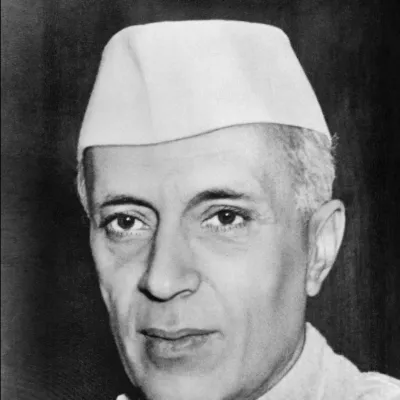
Jawaharlal Nehru
Human Design Chart
Biography
Nehru was the oldest child of three born to Motilal, a wealthy Brahman lawyer from Kashmir, and Swarup Rani, who had ties to Lahore, Nehru attended a Convent School for six months in 1896. By 1900 the family had moved to Allahabad and they resided in a palatial home with a swimming pool and tennis courts. An only child for 11 years, he was a voracious reader with areas of interest in literature, history, science, philosophy and economics. From 1902-1904 he was tutored at home then left for schooling at Harrow, England in 1905. In 1907 he entered Trinity College, Cambridge receiving a degree in natural science and his law degree in 1910, returning to India in 1912 with a British accent. He practiced law for some years and there was fierce competition between his politically moderate father and him. With his interest in politics and nationalistic attitude, he grew from a slightly bored young lawyer into an orator who could move and lead the Indian masses. Although he could have been a Kashmiri prince, he chose to work toward an independent India.
Nehru met Mohandas Gandhi for the first time in 1916 and recognized his amazing ability to rouse the masses. Recognizing the similarity in their ideals for their country, Gandhi treated Nehru like a son.
What does Manifesting Generator 4/1 mean for Jawaharlal Nehru?
Manifesting Generator 4/1 — Design at a Glance
Jawaharlal Nehru's design points to a tendency towards hybrid work: a blend of the direct impact of a Manifestor and the constant energy of a Generator. He had a steady, sacral power source that did not serve for self-initiated action but waited for external impulses. This configuration allowed him to leapfrog steps at opportune moments and draw results into his life swiftly.
However, this potential brought with it a central tension field. His natural speed occasionally led to overlooking important intermediate steps, necessitating backtracking – a source of frustration that did not align with his non-self. Additionally, his system tended to respond to many different stimuli, leading to multiple projects being started simultaneously. Without strict adherence to the strategy 'Respond', this multitasking trap threatened to erode his creative drive.
Success and deep satisfaction came for Jawaharlal Nehru only through constant validation of his sacral center. Each undertaking required a clear 'Yes!' that had to be maintained throughout. Linear completion of individual tasks was counterproductive; instead, he unfolded his power in a playful mode with variety. As long as he responded and felt the inner confirmation, he could use his speed without falling into frustration.
Sacral Authority
Jawaharlal Nehru based his decisions on an internal, bodily resonance. As a Generator, he possessed sacral authority, a decision-making instance exclusive to this type whose strategy was identical to its authority. This simplified his process: instead of mentally planning or seeking purposefulness, he responded to external stimuli.
His inner guidance manifested as 'gut feeling' – audible through grunts, hums, or an affirming hmm. These signals originated from the defined sacral center and only arrived when the emotional center was open, preventing immediate, unreflective reactions. Once this internal motor kicked in, Jawaharlal Nehru entered a state of vital aliveness. He gained access to seemingly inexhaustible energy and carried out his tasks with great enthusiasm.
This design allowed him to immerse himself entirely in the doing without needing an external goal setting. The joy in the activity itself was the driving force. Through this configuration, Jawaharlal Nehru lived not through rational deliberation but by merging into resonant actions. His well-being and effectiveness depended on whether he listened to these bodily signals or ignored them. Thus, sacral authority offered him direct access to his life energy if he allowed the reaction to the stimulus.
The 4/1 Profile — Opportunist / Investigator
Jawaharlal Nehru's profile 4/1 revealed someone whose essence was deeply rooted and hardly changeable. As the only fixed profile, this meant an unshakable basic stance. The transition from 'I' to 'You' required his environment to fully accept his character. Attempts to change him through well-meaning advice failed; such people were quickly excluded from his heart. Externally, this often appeared as rigidity or inability to take criticism, but it was a protective mechanism of a cautious heart that had to preserve its integrity.
This attitude stemmed from Line 4, which describes a transpersonal fixation on deep knowledge. Jawaharlal Nehru possessed this knowledge but struggled to convey it effectively in speech. His method of imparting could be seen as rigid, making understanding by others difficult. Simultaneously, the Line 1 of the Recruit shaped his attitude. He took on commitments and learned from experience when perseverance was necessary and when restraint was called for. This combination created a person who stood like a rock in the storm: stable, secure in their character, but challenging for those expecting flexibility. His strength lay in teaching others once he had fully recognized himself and his life theme.
Single Definition — Defined & Open Centers
Jawaharlal Nehru's Human Design profile indicated a tendency towards constant mental conceptualization and reliable expression. His defined Ajna Center provided consistent conceptual thinking, while the defined Throat Center translated these concepts into clear communication. This structure gave him a firm identity through his defined G Center as well as vital energy from his defined Sacral Center, which was ready to react. Spontaneous intuition also came from his defined Spleen Center.
At the same time, Jawaharlal Nehru showed openness in areas of inspiration, willpower, emotional stability, and stress resistance. His open Head Center meant a lack of personal mental source; he tended to question whether he needed to find inspiring answers rather than generate them himself. The open Heart Center led to a missing constant willpower, making him vulnerable to the pressure of proving his worth through promises – a typical non-self pattern for this center.
The open Solar Plexus Center absorbed and amplified external emotions, causing him to fluctuate between others' moods without recognizing them as separate from himself. Finally, the open Root Center took in adrenaline stress from the environment, leading to a feeling of urgent necessity despite this pressure not originating from within him. This mechanism described a tension: A strong, constant inner structure in thinking and energy contrasted with situational vulnerability to mental confusion, ego-driven proof pressure, emotional flooding, and external stress. Jawaharlal Nehru thus reflected his environment while his defined centers provided a stable foundation.
Channels & Gates
Jawaharlal Nehru was someone who developed unique, innovative perspectives and embodied these through deep intuitive self-love and spontaneous action in the present moment. His design indicated a tendency towards persistent discovery processes driven by strong inner conviction.
The Channel of Structuring 23-43 formed the dominant element. It connected Gate of Assimilation (23) with Gate of Insight (43), allowing inspired knowledge to be received and processed as spontaneous breakthroughs. This enabled clear communication of new perspectives, though often only at the right moment due to innovative thinking initially appearing as an outsider.
Additionally, Channels of Awakening 10-20, Perfect Form 57-10, and Lightning Flash 57-20 worked together. Channel of Awakening 10-20 connected G Center (Gate 10) with Throat Center (Gate 20), expressing the wisdom to act as a living expression of awakened self-love, fostering deep trust in spontaneous decisions in the present moment. The Perfect Form channel 57-10 guided behavior through intuitive insight (Gate 57), ensuring survival through natural adaptation to the environment. The Lightning Flash channel 57-20 gave this intuitive insight from Spleen (Gate 57) a direct voice in Throat Center (Gate 20), leading to profound self-awareness and the ability to strengthen others in their inner survival intelligence.
Energy also flowed through the Discovery Channel 29-46, connecting Sacral Center (Gate 29) with G Center (Gate 46). This supported a persistent dedication to experiences where the significance of these processes often only became clear at the end. This configuration shaped Jawaharlal Nehru's ability to learn from experience while not losing sight of his inner direction.
Circuit Signature
Jawaharlal Nehru's design indicated a tendency towards pulsating, acoustic energy that formed his identity through structuring new ideas. As a person with simple definition, this power flowed in a continuous stream from Head over Ajna and Spleen to Throat Center.
The Knowledge Circuit significantly shaped him. Through Channel 20-57 ("Lightning Flash") he received innovative impulses from the Spleen, which were processed in the Ajna Center. The Sun at Gate 43 emphasized structuring: He sought order principles for these intuitions. Together with Throat Center (Channel 43-23), this allowed the expression of this new identity and transformation through words.
Parallel, the Meaning Circuit worked through Channel 46-29 ("Discovery"). It connected Identity with Sacral Center, generating a cyclical emotional energy. Here it was about sharing experiences from the past and finding meaning in the collective, separate from the cognitive process of the Knowledge Circuit.
Integration completed this picture through Channels 20-10 ("Awakening") and 10-57 ("Perfect Form"). They reconnected Throat, Identity, and Spleen Center but emphasized the "Now." Intuitive knowledge from the Spleen became acoustically effective through proper behavior (Identity) in the present moment. Thus, Jawaharlal Nehru united structured innovation with emotional depth and immediate presence in a single coherent energetic line.
Juxtaposition Cross of Insight
Jawaharlal Nehrus Human-Design trug die Struktur des Juxtaposition Kreuzes der Einsicht. Diese Konfiguration prägte ihn als jemanden, dessen Verständnis von Wahrheit und Realität nicht aus einer einzigen, statischen Perspektive entstand, sondern durch das bewusste Nebeneinanderstellen scheinbar widersprüchlicher Standpunkte gewachsen war. Für Jawaharlal Nehru bedeutete dies, dass tiefe Erkenntnis oft erst dann möglich wurde, wenn er sich mit Gegensätzen auseinandersetzte – ob ideologischer, kultureller oder persönlicher Natur.
Die Mechanik dieses Kreuzes arbeitet durch Juxtaposition: Das Zusammenführen von Extremen oder unterschiedlichen Blickwinkeln schafft einen Spannungsbogen, der zur Klarheit führt. Jawaharlal Nehru zeigte sich in diesem Prozess nicht als jemand, der nach einfacher Harmonie suchte, sondern als einer, der die Reibung zwischen verschiedenen Positionen nutzte, um ein umfassenderes Bild zu erhalten. Diese Fähigkeit, Widersprüche auszuhalten und daraus neue Einsichten zu gewinnen, bildete das Fundament seiner inneren Orientierung. Es handelte sich nicht um eine passive Beobachtung, sondern um einen aktiven Prozess der Synthese, bei dem die Konfrontation mit dem Andersartigen notwendig war, um zur eigentlichen Wahrheit vorzudringen. Jawaharlal Nehrus Weg bestand darin, diese polarisierten Elemente immer wieder zusammenzuführen, bis sie ein kohärentes Ganzes bildeten, das über die Summe seiner Teile hinausging.
Saturn Return · Uranus Opposition · Chiron Return · 2nd Saturn Return — Life Cycles
Jawaharlal Nehrus Leben folgte einer klaren Strukturierung durch die beiden Saturn-Rückkehr-Zyklen, die als Phasen der Reifung und Konsolidierung wirkten. Diese Zyklen markierten Übergänge von der Entwicklung zur etablierten Lebensform. Der erste Saturn-Return trat 1916 ein, als Jawaharlal Nehru 27 Jahre alt war. In diesem Jahr heiratete er Kamala Kaul. Dieser Schritt spiegelt die typische Dynamik des ersten Saturn-Zyklus wider: Das Fundament für das persönliche Leben wird gelegt und Verbindungen werden auf Dauerhaftigkeit geprüft. Es handelte sich um eine konkrete Festigung der privaten Sphäre, die den Rahmen für kommende Jahre bildete.
Der zweite Saturn-Return wirkte 1947, im Alter von 58 Jahren. Hier wurde Jawaharlal Nehru zum ersten Ministerpräsidenten Indiens gewählt. Dieser Zyklus steht für die Vollendung und Autorität in der öffentlichen Rolle. Die jahrelange Vorarbeit verdichtete sich zu einer Position von hoher Verantwortung und struktureller Bedeutung. Während der erste Zyklus das Private stabilisierte, etablierte der zweite Zyklus die öffentliche Führung. Beide Ereignisse zeigen, wie Saturn-Zyklen nicht nur innere Reifung beschreiben, sondern sich in greifbaren Lebensstationen niederschlagen: zunächst im Beziehungsgefüge, später in der gesellschaftlichen Funktion. Jawaharlal Nehru nutzte diese Phasen zur Verankerung seiner Identität und seines Wirkens.
Manifesting Generator · Sacral Authority — Synthesis
Jawaharlal Nehrus Leben war von einer tiefgreifenden inneren Dynamik geprägt: dem Zusammenspiel aus sakraler Energie und mentaler Definition. Sein Design als Manifestierender Generator (mit definiertem Sakralzentrum) deutete auf eine stetige Lebenskraft hin, die jedoch durch die Fähigkeit, Schritte zu überspringen und Dinge schnell anzustoßen, ergänzt wurde. Diese Kombination führte dazu, dass er impulsgesteuert handelte, während sein definiertes mentales Zentrum (Ajna-Zentrum) ihm eine beständige Denkweise verlieh – ein Muster, das sich in der Bereitschaft zeigte, Prinzipien zu erkennen und diese in Handlungen umzusetzen (Kanal Erwachen). Das Profil als Netzwerker/Forscher unterstrich die tiefe Verwurzelung seines Wesens und seine Tendenz, Verbindungen zu knüpfen, während die Fixierung auf das eigene innere Wissen durch den Wissens-Schaltkreis verstärkt wurde.
Nehrus Leben war von einem zentralen Paradox gekennzeichnet: der Spannung zwischen dem Bedürfnis nach innerer Akzeptanz und der Fähigkeit zur Transformation. Als 4/1 Profil schützte er sein Herz vor Einflüssen, die seine tiefe Verwurzelung in Frage stellten, doch gleichzeitig ermöglichte ihm das definierte Ajna-Zentrum und der Wissens-Schaltkreis, neue Konzepte zu entwickeln und Veränderungen anzustoßen. Belegte Ereignisse im Saturn-Return zeigten dies: sowohl eine persönliche Bindung (Heirat) als auch ein Karriereschritt (Ministerpräsident) fielen in Phasen, die von tiefgreifender Veränderung und der Festigung des eigenen Weges geprägt waren – ein Ausdruck seines Designs, das zwischen Beständigkeit und Fortschritt navigierte.
5 Defined Channels
Incarnation Cross - Juxtaposition Cross of Insight
Solar Return
The Solar Return shows the moment when the sun returns to its exact birth position - your personal solar year.
Life Cycles
Discover the life cycles with a detailed triple view (birth chart, cycle chart, composite).
Human Design Profile
- Strategy
- To respond - wait for something to respond to
- Authority
- Sacral Authority
- Profile
- 4/1 - Opportunist / Investigator
- Definition
- Single Definition
- Incarnation Cross
- Juxtaposition Cross of Insight
- Date of Birth
- 14.11.1889 23:30
- Place of Birth
- Allahabad, India
Frequently Asked Questions
What was Jawaharlal Nehru's Human Design type?
What Profile did Jawaharlal Nehru have in Human Design?
What authority did Jawaharlal Nehru possess?
What incarnation cross did Jawaharlal Nehru have?
When was Jawaharlal Nehru born?
Discover your own Human Design
Are you also a Manifesting Generator? Find out in a personal reading how to unfold your multi-talents and direct your energy wisely.
More Personalities
Back to overviewAldair

Alizée

Angeli

Arletty

Artus

Balthus
