
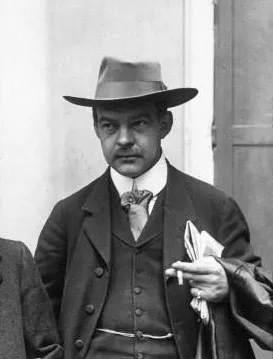
Jean-Jacques Waltz
Human Design Chart
Biography
Waltz died 10 June 1951, Colmar.
What does Manifesting Generator 6/2 mean for Jean-Jacques Waltz?
Manifesting Generator 6/2 — Design at a Glance
Jean-Jacques Waltz revealed himself as a Hybrid being, combining the constant energy of a Generator with the lightning-fast execution power of a Manifestor. His design allowed him to skip steps and quickly pull things into his life, but also carried the risk of missing important phases, leading to frustration when he had to backtrack and make up for missed steps. Additionally, he tended to pursue multiple projects simultaneously, driven by reacting to various impulses.
His strategy was to not initiate but to react to life. Only when his defined Sacral Center gave a clear 'yes' did he apply his energy. This inner confirmation was crucial to maintain his creative drive and avoid frustration. When applied correctly, this strategy brought him deep satisfaction in his work. The advice to focus on one thing did not suit his nature; instead, his creativity flourished in 'play mode', where variety and fun were central. Jean-Jacques Waltz found fulfillment in this dynamic, multifaceted creation as long as he followed his inner authority and respected his impulses. His speed thus became a tool of efficiency, not overburdening.
Sacral Authority
Jean-Jacques Waltz revealed himself as a Generator whose decision-making was shaped by sacral authority. This inner leadership was his central authority, as it represented both his strategy and simplified the process of choice for his type. His reactions to external stimuli manifested physically as a gut feeling or surge of energy, often audible as grunts, hums, or a confirming 'Mhm'. Once his sacral motor kicked in, he felt vital and alive, with an inexhaustible energy that allowed him to dive into activities with great enthusiasm. This happened without compulsive purposefulness; he was born to live with joy and satisfaction and fully immerse himself in his actions.
A crucial aspect of his design was the openness of his Emotional Center, a necessary condition for the function of sacral authority. Additionally, his activated Spleen Center acted as a supportive instance. Through its connection with the Sacral Center, it enabled him to have quick, spontaneous reactions. He had an immediate access to his physical well-being and instinctive perception. This connection allowed him to reliably be guided by these inner signals, further strengthening his ability for quick and intuitive decision-making.
The 6/2 Profile — Role Model / Hermit
Jean-Jacques Waltz revealed himself in his early life phase as someone who learned through intense experimentation and the principle of trial and error. Until around the age of 30, the dynamics of Line 3 in his Profile 6/2 dominated, driving him to collect many personal experiences and withdraw after setbacks to reflect. This period was marked by the necessity to find himself before the deeper wisdom of Line 6 could awaken.
His design also included specific energetic flows. Through Gate 55 on the sixth line, the process of individual development and mutation was in focus. Here, it was about covering material needs to lay the groundwork for later spiritual unfolding; this process initially proceeded without emotional awakening but with the potential for future clarity. Parallel to this, Gate 9 on the second line radiated a natural beam power for problem-solving and detail work. Others noticed this competence, but the full development of these abilities required collaboration and transitioning through the Channel Dynamics 1858. Without this integration, there was a risk that the focus on details could turn into softening and resulting depression. Only after the age of 30, when Line 6 became active, did Jean-Jacques Waltz enter a phase of intensive distancing and self-discovery, from which he emerged as a wise person who allowed others to share in his insights.
Single Definition — Defined & Open Centers
Jean-Jacques Waltz had a reliable inner identity and a clear sense of direction, shaped by his defined G Center. This firm self-love allowed him to show others new perspectives without being dependent on their validation. His energy source came from his defined Sacral Center, which provided him with constant vitality. As a Generator, his strategy was not to initiate but to react to life in order to use his strength effectively. His defined Throat Center served as a pivot point, translating these answers into clear communication and action.
At the same time, he was vulnerable to external conditioning through several open centers. His open Head Center tended to absorb mental pressure and doubt from the environment, which could pull him into a whirlpool of confusion if he did not trust his inner authority. The open Ajna Center amplified this mental flexibility, but also made him susceptible to interpreting foreign concepts as his own truth. His open Heart Center drove him to prove his worth through promises and performance, a cycle that could trap him in self-doubt upon failure. Additionally, his open Solar Plexus absorbed the emotions of his surroundings, leading to emotional instability if he did not recognize these as foreign. The open Spleen and Root Centers made him sensitive to survival fears and external stress, which he often misinterpreted as his own necessities. This configuration challenged him to break free from validation by others and instead listen to his sacral response and inner direction.
Channels for authentic presence, endurance and powerful manifestation.
Jean-Jacques Waltz showed a deep desire to establish his existence as a living expression of self-love and trust. His design was marked by the Awakening Channel 10-20, connecting the G Center with the Throat Center. This configuration pushed him to be awake in the present moment and radiate clarity through authentic behavior without conscious control.
This inner stance was supported by the Exploration Channel 34-10, linking the Sacral Center with the G Center. Here, the powerful energy of Gate 34 allowed him to hold onto his deepest convictions and accept himself independently of external expectations. This created a foundation for independent action guided by his inner authority.
Simultaneously, Jean-Jacques Waltz possessed the Charisma Channel 34-20, channeling his sacral life force directly into the Throat Center. This gave him a charismatic presence and the ability to act quickly and effectively upon external stimuli. However, this energy required patience to avoid slipping into chaotic activity and instead focus on satisfying tasks.
Additionally, his life was shaped by the Discovery Channel 29-46, connecting the Sacral Center with the G Center. Through Gate 29, he possessed immense persistence and the ability to fully immerse himself in experiences, while Gate 46 connected him with the right direction of his life. This allowed him to make discoveries that often took years but ultimately led to profound insights.
Further influences came from Gate 55, promoting extreme emotional fluctuations and genetic mutations, and Gate 9, supporting detailed work and perfection in the Sacral Center. Gate 16 contributed to the development of skills through experimentation, while Gate 59 represented a genetic strategy for binding and pairing without personal feelings. Gate 8 promoted the individual as a model for group goals, and Gate 14 assisted in the adept handling of power and direction. Gate 42 emphasized the importance of experience and completion for new commitments, while Gate 31 represented the transmission of power and leadership. Finally, Gate 23 facilitated understanding and assimilation by translating inner sound into speech and enabling the freedom to be different.
Individual Circuitry — Circuit Signature
Jean-Jacques Waltz appeared as a person with a deep, inner firmness. His design connected the Sacral Center – the source of his life energy and intuition – directly with the Identity Center, the seat of his self-feeling. This connection, carried by the Centering Circuit and Integration, created a strong, individual foundation. He acted not from external pressure but from a clear, internal conviction.
Although this energy was strong, he lacked a direct connection to the Throat Center in this specific circuit. This meant that his firm convictions did not always immediately or loudly carry over to the outside. Instead, his power worked more quietly and centered.
Another aspect was the Meaning Circuit. Here too, he connected Identity and Sacral Center, this time focusing on emotions and the past. Jean-Jacques Waltz reflected on past experiences to draw meaning from them. These emotional waves helped him understand himself, even if they did not primarily serve immediate communication.
Finally, Integration linked Throat, Sacral, and Identity Center. Here, the implementation took place: intuition (Sacral) and self-worth (Identity) flowed into the ability to act and speak in the here and now (Throat). It was a process of awakening and charisma unfolding, where he brought his inner strength into visible, audible forms. His energy was pulsating and individual, marked by the search for confirmation through his own actions and sharing emotional insights.
Left Angle Cross of Spirit 1
Jean-Jacques Waltz carried the left cross of Spirit 1. This configuration marked him as someone deeply rooted in inner truth and who conveyed this truth outwardly with a clear, often intuitive voice. His design inclined him to address spiritual or existential questions not just intellectually, but from a deep personal experience and communicate it to others.
The left cross of Spirit 1 connects the power of individual identity with the ability to inspire others through one's own authenticity. It is an energy aimed at making the invisible visible and encouraging people to find their own inner voice. For Jean-Jacques Waltz, this meant he could serve as a role model not through dogmatic teachings, but by demonstrating a living, authentic existence. His presence had the potential to give others the courage to trust themselves and live their own truth, without falling into self-indulgence. It was an energy of connection that linked the individual with the universal, thus creating a bridge between personal experience and collective consciousness.
Saturn Return · Uranus Opposition · Chiron Return · 2nd Saturn Return — Life Cycles
Jean-Jacques Waltz exhibited a fundamental disposition marked by sudden, disruptive shifts. His design bore the signature of the Uranus Opposition, a configuration that resolves inner tensions through external shocks or radical changes. This energy did not manifest as a gentle transition but as a compelling necessity to break free from constraints, often triggered by crises that disrupted the status quo.
In 1914, at the age of 41, this mechanism came to the fore in an acute crisis. Waltz was sentenced to 15 months in prison. Instead of serving the sentence, he evaded custody and fled to Switzerland. This event was not a mere coincidence but the concrete result of his design dynamics: the external threat (the conviction) served as a catalyst for a radical action (the escape), which shattered the existing structure. The Uranus Opposition demands this kind of disruption to break through stagnation and open up new, often unexpected paths. Waltz's response was a direct result of this energetic constellation, which in moments of extreme pressure forced an immediate, resolute break from the familiar.
Manifesting Generator · Sacral Authority — Synthesis
Jean-Jacques Waltz lived a life profoundly marked by an inner dynamic that played out in a constant interplay between initiation and reaction. As a Manifesting Generator (MG), he possessed the ability to quickly initiate things and draw them into his life, yet he was dependent on external stimuli to respond to his inner impulses. This combination of apparent self-determination and the necessity to listen to inner impulses formed the thread of his actions. The Channel of Awakening (Gate 10-20) underscored this tendency to recognize and implement principles in the present moment, with the G Center and the Throat Center playing a central role.
A central paradox in his design lay in the tension between the desire for autonomy – typical of the manifesting aspect – and the need to adapt to the flow of life, as required for Generators. This discrepancy was particularly evident around 1914, when a documented event triggered a crisis that forced him to act quickly and impulsively, ultimately leading to his escape. The left cross of Spirit 1 points to a deep inner work that continually led him to redefine himself and his role in the world.
4 Defined Channels
Incarnation Cross - Left Angle Cross of Spirit 1
Solar Return
The Solar Return shows the moment when the sun returns to its exact birth position - your personal solar year.
Life Cycles
Discover the life cycles with a detailed triple view (birth chart, cycle chart, composite).
Human Design Profile
- Strategy
- To respond - wait for something to respond to
- Authority
- Sacral Authority
- Profile
- 6/2 - Role Model / Hermit
- Definition
- Single Definition
- Incarnation Cross
- Left Angle Cross of Spirit 1
- Date of Birth
- 23.02.1873 13:00
- Place of Birth
- Colmar, France
Frequently Asked Questions
What was Jean-Jacques Waltz's Human Design type?
What Profile did Jean-Jacques Waltz have in Human Design?
What Authority did Jean-Jacques Waltz have?
What incarnation cross was Jean-Jacques Waltz assigned to?
When was Jean-Jacques Waltz born?
Discover your own Human Design
Are you also a Manifesting Generator? Find out in a personal reading how to unfold your multi-talents and direct your energy wisely.
More Personalities
Back to overviewAlain-Fournier

Aldair

Alizée

Angeli

Arletty

Artus
