
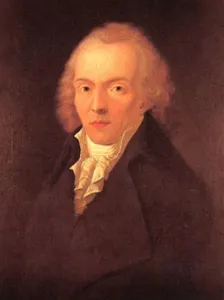
Jean Paul
Human Design Chart
Biography
Jean Paul’s novels are peculiar combinations of sentiment, irony, and humour expressed in a highly subjective and involuted prose style that is marked by rapid transitions of mood. His books are formless, lacking in action, and studded with whimsical digressions, but to some extent they are redeemed by the author’s profuse imagination and equal capacity for realistic detail and dreamlike fantasy. One favourite theme is the tragicomic clash between the soul’s infinite aspirations and the trivial restrictions of everyday life. Jean Paul greatly influenced his contemporaries by his simple piety, humanity and warmth, his religious attitude toward nature, and his beguiling mixture of sentimentality, fantasy, and humour. After the mid-19th century the unevenness and undisciplined form of his novels began to detract rather than add to his reputation, but the deep humanity of his finest works has preserved them from oblivion.
He died on 14 November 1825 at 8 PM in Bayreuth.
Human Design Analysis: Jean Paul as Generator 3/5
Generator 3/5 — Design at a Glance
Jean Paul's design indicates a tendency towards great endurance, comparable to the strength of a workhorse. As a Generator, he had plenty of sacral energy, which was released not through self-initiated action but by responding to impulses from life. His strategy involved waiting for signals and only acting when his inner voice gave a clear "yes."
This mechanism shaped his approach significantly: When dealing with tasks that he did not enjoy, he wasted his energy and tended towards exhaustion. Conversely, he suffered when prevented from working on his heart project, even though he was still full of energy. Successful use of his energy led to deep satisfaction; ignoring this principle—such as by constantly pushing forward without inner confirmation—resulted in frustration and a lack of energy. Thus, Jean Paul showed himself to be someone whose effectiveness depended on responding intuitively to life's offers rather than taking the initiative independently.
Sacral Authority
Jean Paul's decision-making process was based on a direct physical resonance. As a Generator, he had sacral authority, which simplified his process: strategy and inner guidance were identical. This mechanism requires an open emotional center, meaning emotional clarity only comes after some time and is not immediately available.
His responses to external stimuli appeared as immediate gut feelings or powerful impulses. Instead of thinking, he reacted with physical signals like grunting, humming, or vocal affirmations ("Mhm"). When his sacral motor kicked in, he felt vital and alive. Then, he had virtually unlimited energy at his disposal, enabling him to tackle tasks with great enthusiasm. He was born to go through life with joy, fully immersed in his activities without being bound by external purposes.
Additionally, his activated spleen center acted as a supportive authority. This configuration gave him the ability to react quickly and spontaneously. He had direct access to his physical well-being and instinctive perception. This instinct served as a reliable compass guiding him when the emotional center had not yet made clear decisions. The combination of sacral energy and spleen-based intuition shaped his way of acting: directly, lively, and attuned to current stimuli.
The 3/5 Profile — Martyr / Heretic
Jean Paul's design inclined him towards experimental actions that were always accompanied by the risk of failure. As a 3/5 Profile – Explorer and Hero – he had to try everything himself before gaining insights. This line of an adventurer served to gather knowledge through personal experiences, which later could serve as solutions for others' problems. Yet this process was not without pain: Public failures in such attempts could deeply wound him, given the high expectations placed on him as a "Hero."
His Line 3 emphasized sensitivity and living in the present moment without rigid guidelines. Success often appeared here only as a byproduct of authentic actions, while failures and shocks were part of the learning process. At the same time, he carried the burden of the fifth line, the Rebel, who questioned established norms. In times of crisis, his ability to adapt and break traditions proved essential for survival and progress. Thus, he functioned not only as a narrator of his own adventures but also as a guardian, inspiring necessary behavioral changes in society – always based on what he had personally experienced.
Single Definition — Defined & Open Centers
Jean Paul's design shows a tendency towards fixed self-determination and inner vitality. He appeared as someone with a clear sense of his own identity – a characteristic of his defined G Center (Love, Identity, and Direction). This gave him the ability to comfort others through his presence or offer new perspectives without being dependent on their approval. At the same time, he possessed a reliable source of willpower and ego strength through his defined Heart Center. He could keep promises and determine his own resources, which helped him establish himself in life and gain recognition for his contributions.
This stability was reinforced by his defined Sacral Center (vital energy). Jean Paul had a constant motor of life energy that only worked sustainably when he responded to external impulses rather than initiating action on his own. His strategy involved waiting and retrieving inner confirmation ("Yes" tone) before acting, to avoid frustration through overloading. Additionally, his defined Root Center provided a steady internal pressure that propelled him forward and helped him deal with stress in a specific, survival-oriented way.
At the same time, Jean Paul was open in several areas and thus vulnerable to conditioning by the environment. His open Head and Ajna Centers (mental pressure, inspiration) meant he did not have a consistent source of his own intellectual clarity. He tended to engage with foreign questions or doubts rather than trusting his inner authority. Similarly, his open Solar Plexus (emotional awareness) absorbed others' feelings, which could lead him to experience emotional waves as his own and avoid confrontations out of fear of rejection. His open Spleen Center (body consciousness) made him vulnerable to survival fears; he often sought external security or clung to unhealthy situations just to feel a sense of well-being rather than following spontaneous decisions.
Channels for change, pioneering spirit and inner determination.
Jean Paul's design indicated a tendency towards deep and often unexpected transformation. The Channel of Mutation 60-3 connected his Root Center with the Sacral Center. This connection generated a pulsing rhythm of inner tension followed by sudden release. The energy of this channel was melancholic and unpredictable; it required accepting limitation (Gate 60) to move beyond the confusion of a new beginning (Gate 3). Jean Paul lived in cycles of chaos and order, where the pressure from his Root Center during lulls was felt as inner sadness.
Parallel to this, there was a strong inclination towards individualization through the Initiation Channel 51-25 in his Heart Center. Here, the competitive energy of shock (Gate 51) met universal love and higher self (Gate 25). Jean Paul had the ability to initiate others through "shock" and encourage them to develop their uniqueness. However, this process was not a controllable act but a mystical art of empowerment that only worked when he lived authentically and surrendered to initiation rather than seeking it.
A third aspect was his path of discovery via the Discovery Channel 29-46 between Sacral and G Centers. Through saying "yes" (Gate 29), he fully immersed himself in experiences to be at the right place at the right time through persistence (Gate 46). This process required letting go of expectations; the significance of his paths only became clear in retrospect.
Additionally, defined Gates shaped his essence: Gate 15 brought adaptation to natural rhythms and collective behavior, while Gate 10 governed complex behavioral rules and genetically fixed beliefs. On a personality level, Gate 42 focused on completing processes for new commitments, and Gate 21 sought control over material things and respect in the community. In his design, Gate 26 supported innovation through conviction, while Gate 13 gathered experiences in the background and created continuity.
Individual Circuitry — Circuit Signature
Jean Paul revealed himself as someone whose inner strength and identity were intricately intertwined. This was evident from his Simple Definition: The Sacral, Root, G-, and Heart Centers formed a single, interconnected energetic unit. None of these forces stood alone; they flowed directly into one another.
Three circuits shaped this structure. The Knowledge Circuit operated through the Channel of Mutation (Gates 3–60). It connected the Sacral with the Root Center, enabling a pulsating energy for deviation from the known and creation of new paths.
The Projector Circuit activated the Channel of Initiation (Gates 25–51). This linked the Identity with the Heart Center. As a result, strong convictions and self-worth emerged, yet without direct connection to the Throat Center, these were often hard to express in words.
The Reflective Circuit utilized the Channel of Discovery (Gates 46–29). It connected the Identity with the Sacral Center and focused on emotions and experiences from the past. Jean Paul reflected cyclically to find meaning behind past events and process this understanding emotionally.
Since all defined Centers were grouped together, these different aspects—the innovative mutation, inner confirmation, and emotional reflection—did not have separate but integrated effects. Jean Paul’s design suggested that his individual identity was stabilized through this interplay of power, heart, and processing the past.
Right Angle Cross of the Vessel of Love 1
Jean Paul's design carried the signature of the right cross of the Vessel of Love. This was not merely a romantic inclination but a specific energetic configuration that manifested in deep, often painful devotion. The 'Vessel' symbolized here a container for intense emotions and spiritual experiences, while the 'Cross' pointed to the path of suffering or challenges necessary to transform and understand these feelings.
For Jean Paul, this meant that his deepest emotional and creative impulses often arose from situations of vulnerability or sacrifice. He did not live superficially; his energy was fueled by experiencing intense, sometimes painful bonds. The right cross emphasized the active, masculine side of this dynamic – he sought actively to express and integrate these deep feelings rather than merely endure them passively.
This mechanism shaped his way of connecting with others: intensively, demanding, and transformative. It was not about easy harmony but a love that goes through testing and thereby becomes deeper. Jean Paul's design suggested that he drew strength from navigating complex emotional landscapes and incorporating them into his creations or relationships. His energy was thus closely linked to the ability to transform pain and passion into something meaningful, a process both personally and interpersonally challenging.
Saturn Return · Uranus Opposition · Chiron Return · 2nd Saturn Return — Life Cycles
Jean Paul's design showed a structure in which inner maturity and outer recognition condensed over defined planetary cycles. This did not appear as sudden coincidence but followed a rhythmic logic of Human Design, where certain age phases favor the integration of life experience into visible results.
In 1793 at the age of 30, 'The Invisible Lodge' was published. Here Jean Paul used his name publicly for the first time – a typical expression of the first Saturn Return. In this phase, the design often consolidates years of groundwork into a solid foundation; personal identity is anchored through public visibility.
Ten years later in 1803 (age 40), 'Titan' was published. This fell during the Uranus Opposition, a period that Human Design associates with profound upheavals and breaking out of old patterns. The design often channels creative energy into new, unexpected directions here; this work marked a career-relevant milestone.
In 1812 (age 49), 'Life Fibels' was published. This marked the Chiron Return, a cycle of fulfillment and bloom. Having followed his strategy up to that point, Jean Paul's incarnation cross increasingly unfolded in life; meaning and purpose became experiential without focusing on healing old wounds but rather on the ripeness of his own essence.
Finally, he was appointed an external member of the Bavarian Academy of Sciences in 1820 (age 57). This corresponded to the second Saturn Return, where the design often finds a final confirmation and institutional anchoring. The mechanics here show the culmination of a long journey from initial public presence to recognized authority.
Generator · Sacral Authority — Synthesis
Jean Paul was a Generator whose life was marked by deep sacral energy. This showed in his ability to generate knowledge through work and experimentation and make it accessible to others (Channel Mutation 3-60). His profile as an experimenter/hero and savior underscored this tendency: he had to try things himself to draw conclusions and pass on his knowledge. The defined G-Center identity gave him a strong sense of direction and the ability to inspire others – a role he apparently enjoyed and was reinforced by life experiences (Vessel of Love Cross 1).
A central paradox in his design lay in the interplay between his generative life force and the pulsating format of the knowledge circuit. On one hand, he needed constant activity to maintain his energy and avoid burnout; on the other, the melancholy of the mutation channel challenged him to accept limitations and transcend confusion. The recurring successes in his career cycles (Uranus Opposition, Chiron Return, Saturn Return 2) showed that he could constructively use this tension by learning from experiences and initiating transformations.
3 Defined Channels
Incarnation Cross - Right Angle Cross of the Vessel of Love 1
Solar Return
The Solar Return shows the moment when the sun returns to its exact birth position - your personal solar year.
Life Cycles
Discover the life cycles with a detailed triple view (birth chart, cycle chart, composite).
Human Design Profile
- Type
- Generator
- Strategy
- To respond - wait for something to respond to
- Authority
- Sacral Authority
- Profile
- 3/5 - Martyr / Heretic
- Definition
- Single Definition
- Incarnation Cross
- Right Angle Cross of the Vessel of Love 1
- Date of Birth
- 21.03.1763 01:30
- Place of Birth
- Wunsiedel, Germany
Frequently Asked Questions
What is Jean Paul's Human Design type?
What Profile did Jean Paul have in Human Design?
Which authority guided Jean Paul in Human Design?
What incarnation cross did Jean Paul carry in Human Design?
When was Jean Paul born?
Discover your own Human Design
Are you also a Generator? Find out in a personal reading how to use your sacral energy correctly and discover deep satisfaction.
More Personalities
Back to overviewAaliyah

Alain-Fournier

Alexia

Angèle

Angeli

Anne-Marie
