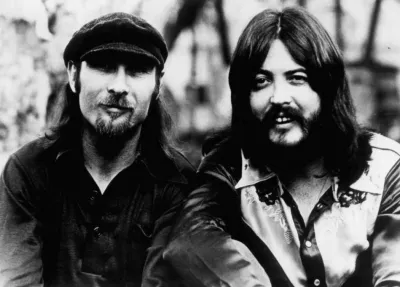
Photo: Wikimedia Commons
Jim Seals
Human Design Chart
Biography
Seals’ father Wayland headed a rockabilly group, and his brother Dan became a well-known country artist. Several uncles and cousins were in the music business as well, so perhaps it was inevitable that Jim should become a musician. In 1958, he met Dash Crofts while playing with singer Dean Beard. When Beard joined the "Champs," both Seals and Crofts went along and stayed with the group until 1965. For the next four years, they worked with a number of different groups, but in 1969, they decided to form a duo and try it on their own. Seals played guitar, saxophone and fiddle while Crofts played drums, mandolin, keyboard and guitar, and they debuted as a fill-in act at the Icehouse in Los Angeles. They recorded their first album in 1969, notable for the song "Ashes in the Snow."
Almost instantly successful, Seals and Crofts became the center of a controversy in 1974. The title track from their Unborn Child album was an anti-abortion song written from the fetus’s point of view. The single outraged right-of-choice advocates, and demonstrations at the duo’s shows became common.
Their appeal began to decline, and after 1976, their albums didn’t sell well. Their last Top 40 hit was 1978’s "You’re the Love," and their last album was The Longest Road (1980).
Although his professional partnership with Crofts ended at that time, Seals still recorded on occasion. In 1991-1992, the two reunited for a tour of North America, recording an unreleased album, and worked together at various Bahá'í events.
Seals and his wife Ruby Jean Anderson had three children, Joshua, Juliette and Sutherland; all three became musicians.
The Human Design of Jim Seals: Generator 4/6
Generator 4/6 — Design at a Glance
Jim Seals was a Generator. His design established a foundational stance of endurance and creation, comparable to a workhorse that could summon immense strength – provided the energy flowed into the right channels. His strategy did not lie in initiating but rather in responding. He sought signals from life to react to them. When his sacral center gave a clear 'yes', when it felt right from the gut, he set himself in action and was hardly stoppable.
This mechanism brought him deep satisfaction and a sense of fulfillment as long as he followed this inner guidance. The danger lay in two specific pitfalls: Either he wasted his energy on things that did not truly fulfill him, leading to exhaustion, or he was held back from his heart project even though he still had plenty of energy left and wanted to continue. If he initiated against his inner impulse, he encountered frustration and a lack of energy. His design showed that his success depended on waiting for life to present opportunities and then reacting rather than taking the first step independently.
Emotional Authority
Jim Seals exhibited a decision-making stance shaped by the necessity of time's progression. His design carried emotional authority, meaning that his defined Emotional Center formed his inner guiding force – regardless of which other centers were also defined. This configuration subjected him to an emotional wave rhythm, manifesting in constant ups and downs of his feelings. The world appeared colored through his current mood; enthusiasm could swiftly turn into sharp rejection within the same moment.
For Jim Seals, immediate feeling was merely a snapshot, a first impression that did not necessarily reflect deeper truth. Quick, spontaneous decisions stemming directly from this emotional heat often proved problematic or even negative in effect. His mechanism required patience: he had to let decisions mature, think them over multiple times, and ideally sleep on them. Only when the intense feelings subsided and emotional distance was gained would clarity and calmness set in, allowing for a well-founded choice. This process of 'taking time' and repeated reflection was essential for him, particularly with long-term decisions that could significantly influence his life course. Emotional authority thus dictated not impulsiveness but its opposite: a conscious delay to reach true inner resonance.
The 4/6 Profile — Opportunist / Role Model
Jim Seals emerged as someone whose early years were marked by experimental action. His Profile 4/6 acted in the first three decades similarly to Line 3: he actively sought paths through relationships and friendships, learning through trial and error. This created a foundation of flexibility that was often opportunistic – principles were maintained only if it remained risk-free.
With the onset of his first Saturn Return, this dynamic fundamentally changed. Line 6 became active and brought forth an inner conflict: the desire for community (Line 4) against the need for distance and higher purpose (Line 6). Jim Seals had to learn to navigate this tension between heart and head.
In later life stages, this developed into a stance of self-discipline. The mechanics of his Line 6 demanded correct communication and precise detail work. It was no longer about mere experimentation but becoming an authentic role model. His design suggested that he should act through cooperation with others while carefully protecting his 'big heart' to avoid injuries from false connections. The focus lay on material implementation and inner strength growing out of unthreatened security. He carried his insights outward, not as rigid dogmas but as flexible principles adaptable to change without losing their core substance.
Split Definition — Defined & Open Centers
Jim Seals was characterized by a design marked by persistent expressive and action power. His defined Throat Center ensured that his communication wasn't arbitrary but rather exhibited a reliable, limited form of self-expression. This voice served as a focal point for messages from within him, which he transmuted into clear actions and speech in the world.
The source of this energy lay in his defined Sacral Center. As a Generator, Jim Seals had an enormous vital force that felt like a constant hum. His truth was revealed not through mental planning but by waiting for a reaction to external impulses. The immediate yes or no response from his Sacral Center determined whether energy would be available for a task. By initiating and waiting rather than taking the first step himself, he avoided frustration and used his enduring power effectively.
This physical foundation was complemented by his defined Spleen Center, which gave him spontaneous, intuitive body awareness. Jim Seals tended to act in the present moment and listen to subtle warning signals or intuitions that secured his survival and well-being. This existential consciousness provided him with trustworthy judgments in the present, independent of rational analysis.
At the same time, he was exposed to emotional depth fluctuations. His defined Solar Plexus functioned as an inner authority requiring patience. Truth revealed itself for him only at the end of the emotional wave cycle. He had to learn not to make decisions based on the highs or lows of his moods but rather wait out the emotional wave to gain clarity.
In contrast, his Head, Ajna, and G Centers were open. Jim Seals lacked a consistent mental inspiration or fixed identity. He tended to lose himself in others' thoughts or seek answers that didn't come from him. Instead of a firm direction, he gathered identities through his environment. An open Heart Center led him often to feel compelled to prove his worth through promises, which could thrust him into a cycle of self-doubt and overextension due to the lack of consistent willpower.
Channels for intimacy, intuition, mastery and emotional depth.
Jim Seals was characterized by his design as someone who combined deep intuition with technical precision and thereby triggered intense emotional dynamics. His Human Design included the channel of wavelength 48-16, linking intuitive depth (Gate 48) with a drive for skill refinement (Gate 16). This marked him as an individual who sharpened their talent through repeated experimentation and engagement, where recognition was crucial for this development. Parallel to this, the lightning bolt channel 57-20 allowed him to articulate intuitive insights (Gate 57) directly in the moment (Gate 20), often appearing as penetrating self-awareness or spontaneous truth.
In interpersonal relationships, Jim Seals was marked by the pairing channel 59-6. This tribal channel connected sacral sexuality (Gate 59) with the emotional wave of pleasure and pain (Gate 6). He sought intimacy that required time to develop; his urge was to merge but he had to wait for emotional clarity to avoid misunderstandings. Additionally, the channel of releasing feelings 39-55 influenced his interactions. Through provocation (Gate 39) and mind (Gate 55), he triggered emotions in others, helping him find the right mood for himself and others based on a pulsating wave between joy and melancholy.
Furthermore, prioritized gates like Gate 32 (continuity), Gate 42 (process completion), and Gate 61 (inner truth) contributed to his structure while Gate 62 promoted logical details and pattern recognition. This configuration created an individual who possessed deep inner knowledge as well as the ability to bring it into their environment through patience and emotional authenticity.
Individual Circuitry — Circuit Signature
Jim Seals' design was characterized by separate, parallel functioning energy blocks. One group connected the Solar Plexus, Sacral, and Root Centers; the other the Throat and Spleen Centers. Between these two groups there was no direct connection, which could lead to internal fragmentation: The deep emotions and instincts (Solar Plexus/Sacral/Root) were not directly linked with the expressive ability and intuition (Throat/Spleen).
The Knowledge Circuit acted here as a bridge but also divided. Through the channel 'lightning bolt', it connected the Throat with the Spleen Center, enabling spontaneous, innovative ideas that could be expressed immediately. Parallel to this, the channel of releasing feelings connected the Solar Plexus with the Root Center, translating emotional waves into immediate action impulses. These two parts of the Knowledge Circuit were not linked in Jim Seals; thus creative ideas and emotional impulses provided separate energy sources.
The Understanding Circuit contributed through the channel 'the wavelength' to connecting Throat and Spleen Centers as well, supported by logical structuring. This promoted clear, focused communication. The Protector Circuit finally connected the Sacral with the Solar Plexus Center via pairing. This gave emotional energy an instinctive protective quality aimed at survival and preserving essentials. Jim Seals thus lived in a tension field between impulsive emotionality and clear intuitive expressiveness, separated by the missing direct bridge between his two main energy groups.
Right Angle Cross of Maya 3
Jim Seals' design bears the imprint of the right Maya 3 cross. This configuration describes a life direction characterized by a profound connection with the material and physical aspects of existence. It was an impulse to understand the world not just intellectually but concretely, tangibly, and in its sheer reality.
The mechanics of this cross emphasize the importance of being present and sensory perception. Jim Seals was marked by a fundamental attitude that recognized the value of the everyday and the physical. This was less about abstract ideologies and more about directly accepting the substance of life. This orientation promoted a pragmatic view, where the physical world is understood as the central expression of human experience.
The right Maya 3 cross often underscores a particular kind of dedication to life itself – not in a religious sense but in the acceptance of given circumstances and possibilities. Jim Seals' chart indicated that his energy lay in taking reality as it was and finding its own completeness within it. It was a design seeking stability through groundedness, setting itself apart from pure illusions or dematerialized dreams. The life task consisted in valuing the physical dimension as a sacred space of experience.
Saturn Return · Uranus Opposition · Chiron Return · 2nd Saturn Return — Life Cycles
Jim Seals' design tended towards strategic patience and the ability to build up inner resources over long periods before carrying them outward. This structure promoted an attitude that did not rely on impulsive reactions but rather on deep, often silent preparation until the right moment for unfolding arrived.
This process crystallized in the first Saturn return, a cycle where years of internal work and learning processes typically formed into a stable, sustainable result. Here, the mechanics of the design were particularly evident: The energy that had previously circulated internally or was stuck in development now found a concrete anchor point in external reality.
In 1971, at age 29, Seals & Crofts released their first hit 'When I Meet Them'. This career event did not mark a sudden start from nothing but the visible fruit of this long phase of internal structuring. Success came when inner maturity and prepared competence aligned with external circumstances. It was the moment when the previous foundation became strong enough to bear public weight, a classic sign of the effectiveness of the first Saturn return in this design.
Generator · Emotional Authority — Synthesis
Jim Seals lived deeply within the tension between inner authenticity and the desire for connection. His Generator type, fueled by sacral energy (Sacral Center), gave him enormous endurance and creative power – as long as he pursued tasks that truly fulfilled him. However, his emotional wave pattern of authority required time to make decisions, a waiting and ripening of feelings before clarity could be gained. This inner dynamic was amplified by the Networker/Role Model profile: The early urge for experimentation gave way later to the need to embody wisdom and align in relationships (Line 4), often conflicting with the internal Line 6 seeking isolation and reflection.
This field of tension between heart and head shaped his path. The defined communication and manifestation channel pointed to a strong inner voice, yet this had to always harmonize with the emotional depth of the Solar Plexus (Channel 59-6). The ability to go new ways (Knowledge Circuit) and transform knowledge culminated in an event – the first success in the creative realm (Saturn Return), which simultaneously initiated a phase of upheaval and reorientation.
4 Defined Channels
Incarnation Cross - Right Angle Cross of Maya 3
Solar Return
The Solar Return shows the moment when the sun returns to its exact birth position - your personal solar year.
Life Cycles
Discover the life cycles with a detailed triple view (birth chart, cycle chart, composite).
Human Design Profile
- Type
- Generator
- Strategy
- To respond - wait for something to respond to
- Authority
- Emotional Authority
- Profile
- 4/6 - Opportunist / Role Model
- Definition
- Split Definition
- Incarnation Cross
- Right Angle Cross of Maya 3
- Date of Birth
- 17.10.1942 14:00
- Place of Birth
- Sidney, TX, United States
Frequently Asked Questions
What was Jim Seals' Human Design type?
What Profile did Jim Seals have?
Which Authority guided Jim Seals?
What incarnation cross did Jim Seals have?
When was Jim Seals born?
Discover your own Human Design
Are you also a Generator? Find out in a personal reading how to use your sacral energy correctly and discover deep satisfaction.
More Personalities
Back to overviewAaliyah

Alexia

Alizée

Angèle

Anne-Marie

Arcángel