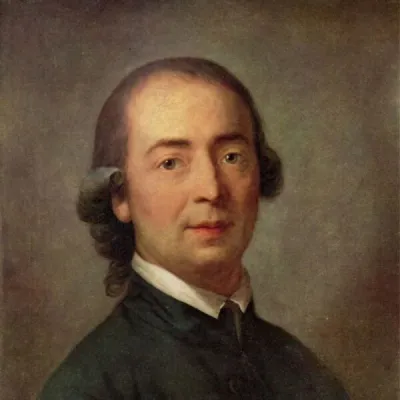
Johann Gottfried Herder
Human Design Chart
Biography
The Human Design of Johann Gottfried Herder: Manifesting Generator 3/6
Manifesting Generator 3/6 — Design at a Glance
Johann Gottfried Herder's design shows a tendency towards hybrid dynamics: He possesses the constant energy of a Manifesting Generator but also has the ability to skip steps and quickly draw things into his life. This configuration combines the need to respond to impulses with an unique acceleration force.
While pure Generators wait until they are approached, Herder could take initiatives and compress processes due to his active connection between Motor Centers and Throat Center. This speed was a double-edged sword: It allowed him to push multiple projects forward simultaneously and fall into a productive 'play mode' when his inner authority agreed. At the same time, there was a risk of overlooking important steps, forcing him to backtrack later and fill in gaps – a potential source of frustration if he did not listen to his sacral center.
His creative power was most ignited by variety and simultaneously handling different tasks. Instead of focusing on one thing at a time, Herder found satisfaction in responding to various life impulses and letting his energy work in multiple directions. The key always lay in inner confirmation: Only when his system gave a clear 'yes' to the respective stimuli did this rapid versatility remain satisfying rather than exhausting.
Emotional Authority
Johann Gottfried Herder's design shows a tendency towards emotional wavering, which significantly shaped his perception and decision-making. As a carrier of Emotional Authority, he was subject to constant ups and downs in his feelings, making the world appear through the filter of his current mood. What seemed inspiring at one moment could be negatively evaluated in the next. However, this emotional wave did not mean that the first impression was true; spontaneous judgments based on temporary emotions often proved misleading and potentially harmful for long-term goals.
The mechanics of his inner authority therefore required patience and time. Instead of acting immediately, he had to let decisions mature ideally through multiple nights' reflection. This process served to calm intense feelings and gain emotional distance. Only when this clarity and composure set in was the internal process complete and a well-founded decision possible. This approach was particularly crucial for life-changing steps as it ensured that not just momentary mood but deeper insight guided action. Emotional Authority always took precedence over other defined centers, regardless of further configurations in his chart.
The 3/6 Profile — Martyr / Role Model
Johann Gottfried Herder's design shows a tendency to structure his life into two clearly distinguishable phases. Until around the age of 30, he primarily acted as an experimenter. During this time, the principle of trial and error was paramount, especially concerning relationships and intimacy. His actions were characterized by playful curiosity that built self-assurance through direct experience. Divorces or changing relationships could appear as expressions of this learning-oriented testing if connections did not allow the desired open exchange.
Only after Saturn's return, around age 30, did his inner orientation fundamentally change. The wise guidance of the sixth line was added, seeking an overview and enabling practical implementation of understanding. Herder withdrew to reflect on previously gathered experiences. This process led him in later years, around age 50, to become a role model through a mix of charm and acquired wisdom. He carried both the innocence of the young experimenter and the depth of the experienced teacher within himself, which helped him convey insights that were useful for others.
Split Definition — Defined & Open Centers
Johann Gottfried Herder's design predisposed him to a constant mental pressure and deep emotional reflection. As a Generator with a defined Sacral Center, he had an immense source of vitality that needed to be activated by reactions to life events rather than initiated actions. His energy was available for tasks that resonated internally; any other commitment led to frustration and exhaustion.
This generative power was directed by his defined Throat Center, which allowed him to express thoughts and concepts reliably. With his Ajna and Head Centers also defined, he was under the constant pressure of inspiration: asking questions and finding answers. This mental process was unavoidable; he thought constantly and could not simply stop this stream. The challenge lay in not transforming mental pressure into hasty actions but patiently waiting for the right moment to communicate.
His defined Solar Plexus Center functioned as an inner authority. Decisions required time; Herder had to go through his emotional wave before clarity emerged. Impulsive judgments were misleading for him. Only after the emotional wave subsided did the truth of a situation become clear. This slow maturation of insights shaped his approach to the world and relationships.
At the same time, he was vulnerable to conditioning due to open centers. His open G Center meant that he lacked a fixed identity or direction; he tended to align with his environment and often sought confirmation of his own worthiness from others. The open Heart Center made him sensitive to questions of self-worth; ideally, he avoided making promises he could not keep because he lacked the constant willpower for it. Instead, he learned to assess the value of other people through their reliability without having to compete himself. His open Spleen Center gave him a sensitivity towards health and well-being but warned against spontaneous decisions often based on fear or false security. Through waiting and reacting rather than initiating, he found his correct path.
Channels for maturation, change, charisma, emotion and abstraction.
Johann Gottfried Herder's design predisposed him to evolutionary change paired with a strong, often melancholic inner life. This configuration was evident through the channel of Mutation 60-3, connecting the Root Center with the Sacral Center. Here, the energy of the Gate of Limitation (60) acted on the Gate of Order (3). This mechanism generated an unpredictable pulse between chaos and structure; Herder had to learn to accept limitations and move beyond the confusion of a new beginning for evolutionary impulses to take effect. The associated moodiness was not a disturbance but a sign that new mutations were maturing beneath the surface.
Parallel to this, the channel of Charisma 34-20 shaped his way into the world. It connected the Sacral Center (Gate of Power, 34) with the Throat Center (Gate of Now, 20). This gave him a powerful capacity for expression where generative energy was directly translated into manifestation. Herder showed himself as someone who acted through self-affirming activity; his influence arose from the ability to act in the moment rather than just plan. However, this speed required discipline, as the energy otherwise easily led to obsession or chaotic outbursts.
Emotionally, he moved within the waves of the channel of Feelings Release 39-55. This channel connected the Root Center (Gate of Provocation, 39) with the Solar Plexus Center (Gate of Mind, 55). It led to an authentic but fluctuating emotional depth that swung between ecstatic joy and melancholic uncertainty. Herder's task was not to rationalize these moods but to accept them as alchemy of individual spirit to let true spirituality arise from correctness.
Thinking through him ran the channel of Abstraction 64-47. This connected the Head Center (Gate of Confusion, 64) with the Ajna Center (Gate of Understanding, 47). Herder filtered every experience through a kaleidoscope of mental images. His mind constantly sought stories and perspectives to give meaning, even if this process initially caused confusion. The reward was later clarity, an inspiring story he could share.
Additionally, Gates like 59 (genetic strategy of pairing), 62 (logical detail work), and 14 (skillful power application) influenced him. Gate 59 drove him towards union without personal preferences; Gate 62 demanded patience in pattern recognition; Gate 14 provided direction through self-control. Further influences came from Gate 12 (emotional poetry), Gate 24 (mental renewal), and Gate 23 (amoral understanding). The channel of Maturation 53-42 emphasized the necessity to fully experience and reflect on experiences to gain collective wisdom.
Individual Circuitry — Circuit Signature
Johann Gottfried Herder's design predisposed him towards pulsating, acoustic creativity coupled with the need to express emotional waves. His Knowledge Circuit directly connected Sacral, Root, and Solar Plexus Centers. This created an internal flow of energy (Sacral) that translated through stress or instinct (Root) into emotional reactions (Solar Plexus), which were then authentically articulated. The channels 'Mutation' and 'Feelings Release' promoted deviations from the known as well as releasing emotions. Parallel to this, a separate stream existed in his Meaning Circuit: Head and Ajna Centers formed one group, Sacral and Root Centers another. Since these were not connected, cognitive impulses (Head-Ajna) and energetic drives (Sacral-Root) existed side by side but did not directly merge as forces. The channels 'Abstraction' and 'Maturation' served here the processing of past experiences and their meaningful reflection. A third aspect appeared in his Integration Circuit: The channel 'Charisma' connected Throat and Sacral Centers, enabling intuitive power to be translated directly into present presence and made effective through speaking. Overall, these divided definitions shaped a profile that oscillated between emotional authenticity, cognitive abstraction, and immediate expressive strength without fusing these areas energetically into one unit.
Right Angle Cross of the Sleeping Phoenix 3
Johann Gottfried Herder's Human Design configuration carried the right cross of the sleeping Phoenix. This shaped a fundamental attitude characterized by profound internal transformations and a continuous shift in life perspectives. In Human Design mechanics, this specific cross constellation does not denote a static trait but rather a dynamic process of becoming. The name 'sleeping Phoenix' symbolically refers to the ability to rise anew from personal experiences and setbacks without losing one's original essence. For Johann Gottfried Herder, this meant that his life was not a linear path but a cycle of constant renewal. Each phase brought new insights that dissolved old patterns and made room for expanded perspectives. This mechanism does not manifest as external action but rather as an inner compass that helps to understand changes not as loss but as necessary stages in development. The energy of this configuration fostered deep resilience; even during times of uncertainty or change, a core identity remained intact while outer circumstances and self-understanding evolved. Johann Gottfried Herder lived this dynamic by embracing changes and using them as opportunities for deeper understanding of his own nature rather than fighting against them.
Saturn Return · Uranus Opposition · Chiron Return · 2nd Saturn Return — Life Cycles
Johann Gottfried Herder's design indicated a tendency towards structural anchoring that crystallized into clear life phases. In 1771, at the age of 27, he took up his new position as Oberprediger and Konsistorialrat in Bückeburg. This marked his first Saturn return, a time when years of groundwork often culminate in a solid result and identity stabilizes within a stable role.
Later, his chart showed dynamics of change and initiation. In 1783, at the age of 39, he followed this inner logic by joining the Illuminati order under the name 'Damasus Pontifex'. This aligned with the Uranus opposition, a phase often requiring deep upheavals and breaking old structures.
The peak of his incarnation purpose became visible during his Chiron return. In 1792, at age 48, Herder published his essay 'On an Eastern Drama'. This fulfillment cycle brought meaning and purpose to experience without aiming for healing past wounds but rather as the unfolding of one's essence.
Finally, his life mission crystallized again during his second Saturn return. In 1802, at age 58, he received a noble diploma from the Elector of Bavaria Maximilian Joseph. This recognition underscored the long-term stabilization of his position and final embedding in societal structures as foreseen by his design for this later phase.
Manifesting Generator · Emotional Authority — Synthesis
Johann Gottfried Herder lived a life path marked by an inner drive towards exploration and transformation. The combination of manifesting generator energy and emotional authority points to someone who pursued quick impulses while also needing time to filter these through emotional waves (emotional center). The defined mental pressure (Head Center) further intensified this process, demanding constant questioning and understanding, making him an unrelenting seeker. The energy of the knowledge circuit, particularly Channel Mutation (3-60), pushed him to break existing structures and create new ones while accepting the melancholy that accompanies change. His profile as an experimenter, which later developed into a role model, reflected this process: first experimenting, then sharing wisdom.
Central to Herder's essence was a paradox between the need for rapid progress and the necessity of emotional maturity. Manifesting generator energy allowed him to seize opportunities swiftly (sacral center), yet emotional authority required patience and reflection before decisions. This tension is evident in documented events: career steps were taken (1771) while profound ideological initiations occurred simultaneously (1783) and creative works emerged (1792). The awarding of the noble diploma (1802) could be interpreted as recognition for a life path driven by inner drive and emotional depth.
5 Defined Channels
Incarnation Cross - Right Angle Cross of the Sleeping Phoenix 3
Solar Return
The Solar Return shows the moment when the sun returns to its exact birth position - your personal solar year.
Life Cycles
Discover the life cycles with a detailed triple view (birth chart, cycle chart, composite).
Human Design Profile
- Strategy
- To respond - wait for something to respond to
- Authority
- Emotional Authority
- Profile
- 3/6 - Martyr / Role Model
- Definition
- Split Definition
- Incarnation Cross
- Right Angle Cross of the Sleeping Phoenix 3
- Date of Birth
- 25.08.1744 23:30
- Place of Birth
- Mohrungen, Poland
Frequently Asked Questions
What was Johann Gottfried Herder's Human Design type?
Which Profile did Johann Gottfried Herder have in his Human Design?
Which authority guided Johann Gottfried Herder's decisions?
Which incarnation cross was active for Johann Gottfried Herder?
When was Johann Gottfried Herder born?
Discover your own Human Design
Are you also a Manifesting Generator? Find out in a personal reading how to unfold your multi-talents and direct your energy wisely.
More Personalities
Back to overviewAldair

Alizée

Angeli
Arletty
Artus

Balthus