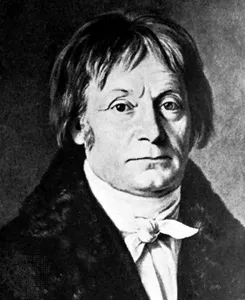
Johann Joseph Von Görres
Human Design Chart
Biography
Görres was sympathetic to the ideals of the French Revolution and published a republican journal, Das rote Blatt (“The Red Page”; renamed Rübezahl), in 1799. After an unsuccessful visit to Paris in 1799 as a political negotiator for the Rhenish provinces, he became disillusioned and withdrew from active politics. He taught natural science in Koblenz and then lectured at Heidelberg (1806–07), where he became acquainted with the leaders of the second phase of German Romanticism, He edited the Zeitung für Einsiedler (“Journal for Hermits,” renamed Tröst Einsamkeit; “Consolation Solitude”), which became the organ for the Heidelberg Romantics. His study of German folk literature, which had been awakened by this contact with the Romantic movement, produced Die teutschen Volksbücher (1807; “The German Chapbooks”), a collection of late medieval narrative prose that became a significant work of the Romantic movement. He also expressed the characteristically Romantic fascination with Asia in his Mythengeschichte der asiatischen Welt (1810; “Mythical Stories of the Asiatic World”).
In 1808 Görres returned to Koblenz, where he lived quietly until the national struggle against Napoleon led him to found the newspaper Rheinische Merkur (1814). Considered to be the most influential journal of the time, it turned first against Napoleon and, after his fall, against the reactionary politics of the German states, which led to its suppression in 1816. With the publication of his pamphlet “Teutschland und die Revolution” (1819; “Germany and the Revolution”), he was forced to flee to Strasbourg and to Switzerland, where he lived in poverty for several years. In 1824 he formally returned to the Roman Catholic Church and in 1827 became professor of history at the University of Munich, where he formed a circle of liberal Roman Catholic scholars.
Johann Joseph Von Görres — Manifesting Generator with Profile 4/6
Manifesting Generator 4/6 — Design at a Glance
Johann Joseph Von Görres revealed himself as someone who operated through a hybrid energy configuration. His design combined the constant power of the sacral center with the ability to skip steps. This structure allowed him to quickly pull things into his life, but differed from pure generators through these manifestor qualities.
The challenge lay in the speed. Often, impulses were too fast, causing important intermediate steps to be overlooked. This occasionally required going back and catching up on missed steps, which could otherwise lead to frustration. Additionally, his system tended to pursue multiple projects simultaneously rather than focusing on one thing at a time.
For this creative force to be effective, the strategy was not to initiate things himself but to react to external impulses. Only when the sacral center responded with a clear "yes" should he act. With the correct application of this reactive strategy and regular checks of inner consent, he could draw deep satisfaction from his work. The compulsion to finish one thing before starting the next did not suit his nature. Instead, he found his strength in the play mode and variety, as long as his inner authority was on board.
Emotional Authority
Johann Joseph Von Görres showed himself to be someone who did not make decisions in the moment but allowed them to mature. His Human-Design profile indicated Emotional Authority, meaning his defined Emotional Center was the inner decision-making authority – regardless of which other centers were also defined. This configuration was subject to an emotional wave with permanent ups and downs. The world appeared to him always colored by the current mood: a moment of enthusiasm could quickly shift into negative perspectives. His immediate feeling was only a snapshot, a first impression, which did not necessarily represent his truth. Quick, spontaneous decisions made in this emotional heat often had negative consequences. Instead, his design required patience. He took time to carry decisions over several days and to reconsider them multiple times. Through this hesitation and the multiple nights of reflection, intense feelings subsided. Emotional distance was gained, leading to clarity and calm. Only then was the decision-making process complete. This mechanism was particularly crucial for long-term, life-defining steps, as it ensured that not just the passing emotion, but the deeper emotional truth would guide the direction.
The 4/6 Profile — Opportunist / Role Model
Johann Joseph Von Görres revealed himself as someone who acted experimentally in the first three decades of his life, driven by the early dynamics of his Profile Line 6, which initially behaved like a Line 3. This phase was characterized by intensive social exchange processes and the search for friendships, as his fourth Line of design only allowed success through shared experiences and collective involvement. With the return of Saturn, his orientation fundamentally changed. An internal conflict emerged between the deep desire to belong to a community and the growing urge to withdraw to contemplate the meaning of life. This tension between heart and head shaped his later years. He was expected to take on the role of a wise mentor, which worked through cooperation with others. At the same time, he carried the burden of the sixth Line, which prepared him to take extreme risks to find out if life was worth it. For him, this meant not only striving for glory but also being willing to sacrifice himself if necessary to avoid falling into the law of decline. His design challenged him to navigate between protecting his great heart from false people and bravely stepping out into the world, where every risk was felt as an existential question of gain or loss.
Split Definition — Defined & Open Centers
Johann Joseph von Görres was someone who exhibited a firm inner direction and a reliable identity. His defined G Center gave him a deep sense of self-love and a clear sense of his life mission, allowing him to naturally attract others without being dependent on them. This inner stability contrasted with his open mental structure: With an open Head and Ajna Center, he was prone to mental confusion and the pressure to find answers to questions that were not his own. He tended to get lost in intellectual monologues or to take on the uncertainties of others as his own, rather than trusting his inner authority.
His energy source lay in his defined Sacral Center, which provided him with a constant vital force. However, this energy was only correctly available through reactions to external stimuli; initiated actions without prior confirmation often led to frustration and exhaustion. This was complemented by his defined Solar Plexus Center, which required emotional clarity. Görres had to learn to wait out the waves of his emotions before making decisions, as impulsive action in emotional highs or lows led to chaos. His defined Spleen Center provided spontaneous intuitive perception in the present, while the defined Root Center supplied a constant pressure to maintain the life impulse.
The open Heart Center marked a central weakness: Görres was not designed to exercise willpower in the sense of competition or promises. He tended to want to prove his worth by overfulfilling expectations, which could lead to a cycle of making promises and failing to keep them. The challenge was to compensate for this urge and instead accept the freedom of not having to prove anything. His defined Throat allowed him to communicate his truth clearly and honestly, as long as he used the source of his voice – whether from the G Center or the Sacral Response – correctly and was not disturbed by mental overload or emotional impulsivity.
Channels for logical leadership, synthesis, charisma and preservation.
Johann Joseph von Görres was someone who sought logical, collective leadership with an eye to the future. This attitude came from the Alpha Animal Channel 7-31, which connected the G Center with the Throat Center. Gate 7 provided the logical role to lead society, while Gate 31 acted as a collective leader. His voice had influence, but he needed the trust of the majority to be effective. He did not lead through absolute authority, but gained recognition before acting.
At the same time, the Synthesis Channel 19-49 drove him, embodying tribal forms of mysticism. Gate 19 pushed for togetherness and closeness, while Gate 49 rejected anything that went against the highest ideals. This created an emotional glue for loyalty and territorial protection. He sought balance between feasibility and fairness within his community.
His energy was shaped by the Charisma Channel 20-34. Here, the raw, physiological power of Gate 34 met the immediate expressive force of Gate 20. This generated a charismatic life force, but it required a sacral reaction to not become chaotic. Without inner guidance, this energy could be misdirected.
The Preservation Channel 27-50 provided care and values. Gate 27 brought selfless interest in nurturing others, while Gate 50 guarded traditional values and laws. He automatically drew trust and took responsibility for protecting the tribe.
Additionally, Gates like 41 (Evolution through Crisis), 28 (Risks in the Here and Now), and 13 (Collective Memory) were at work. Gate 35 promoted change through interaction, Gate 32 sought material stability, and Gate 60 accepted limitations for transcendence. In his design, Gates 5 (Rhythm), 45 (Tribe Hierarchy), 48 (Pattern Recognition), and 6 (Friction) supported these structures.
Tribal Circuitry — Circuit Signature
Johann Joseph von Görres showed through his design as someone who combined rational clarity with instinctive preservation, with these forces working separately. His Mind Circuit connected the Throat with the Identity Center (Channel 'The Alpha Animal'). This gave him the ability to formulate logical, emotionless strategies for improving the future and to articulate them clearly. Parallel to this, his Ego Circuit connected the Solar Plexus with the Root Center (Channel 'Synthesis'). Here, an emotional wave was created, regulated by pauses of calm to unlock resources in the social context – a process without direct connection to life force. A third, independent stream was the Archer Circuit, which connected the Sacral with the Spleen Center (Channel 'Preservation'). This connection provided a primal, instinctive energy for protection and preservation of his own genetics and family, fueled by the constant life force. Finally, the Integration Circuit connected the Throat with the Sacral Center (Channel 'Charisma'). This allowed him to draw power from the reaction to life and to manifest it in the present through correct action. Due to the split definition, these four circuits existed as two separate groups: on one side, the connection of identity, voice, life force, and instinct; on the other side, the separate connection of emotion and root tension. This structure characterized his work as a combination of clear future visions and deeply rooted, protective instincts, which, however, did not energetically overlap directly.
Right Angle Cross of the Unexpected 4
Johann Joseph Von Görres lived in a constant tension between what he recognized as his inner truth and the external circumstances that often contradicted it. His design indicated a tendency towards unexpected turns that arose not through logical planning but through intuitive insights. This configuration, the Right Cross of the Unexpected 4, described a life dynamic in which the individual was often confronted with situations outside of their control and had to cope with them using a specific kind of resilience.
The mechanics of this cross show that Johann Joseph Von Görres relied on trusting what felt right, even if it appeared irrational from the outside. He was someone who, in moments of uncertainty, did not seek fixed rules but responded to his inner timing. This did not mean that his life was chaotic, but that his stability came from the ability to adapt to changing circumstances without losing his core. The challenge lay in not suppressing these inner impulses but using them as a guide when the external world did not offer clear answers. Thus, his life was characterized by a continuous adaptation to the unexpected, allowing him to find his own, often surprising solutions in complex situations.
Saturn Return · Uranus Opposition · Chiron Return · 2nd Saturn Return — Life Cycles
Johann Joseph Von Görres revealed himself as someone whose life path was marked by clear cyclical turning points deeply rooted in his energetic structure. His design indicated a tendency towards structural consolidation that was completed with his first Saturn return. In 1806, at the age of 30, he taught natural sciences in Koblenz and gave lectures in Heidelberg. This period marked the moment when years of groundwork matured into a stable, institutional result – typical for this cycle, which creates stability and concrete anchoring in the professional field.
A fundamental turning point occurred with the Uranus opposition, a period often associated with sudden breaks or the dissolution of old structures. In 1816, at the age of 40, the "Rheinische Merkur" was banned and the last issue printed. This crisis was not a random disturbance but the external reflection of an internal, necessary process of letting go, severing old ties to make way for new developments.
The Chiron return, a fulfillment cycle in which the personal life purpose increasingly unfolds, marked his later years. In 1824, at the age of 48, Görres formally withdrew from the Roman Catholic Church. This was not an act of despair but the visible bloom of his incarnation task: the final alignment with a deeper, authentic truth he had previously sought. His design thus revealed a path from structural foundation through a necessary break to spiritual fulfillment.
Manifesting Generator · Emotional Authority — Synthesis
Johann Joseph Von Görres lived a life marked by a profound inner drive to communicate and influence. The connection of sacral energy (defined Sacral Center) and the ability to quickly initiate things (Manifesting Generator) points to a person who was constantly in motion and transformed through their interactions with the world. This was evident in a tendency to rely on logical patterns and convey them (Alpha Animal Channel), making him a figure who both took leadership and shared knowledge. Recurring events in his life that coincided with Saturn Return and Uranus Opposition confirm a pattern of career boosts followed by crises and necessary turning points.
Central to his essence, however, was a paradox between the desire for community (Line 4 in Profile) and the need for independent reflection (Line 6). Emotional authority required time to gain clarity, while manifesting energy pushed him towards quick decisions. This tension between inner maturity and the urge to shape the world led to a life marked by deep engagement, but also conflicts and the constant need to realign.
4 Defined Channels
Incarnation Cross - Right Angle Cross of the Unexpected 4
Solar Return
The Solar Return shows the moment when the sun returns to its exact birth position - your personal solar year.
Life Cycles
Discover the life cycles with a detailed triple view (birth chart, cycle chart, composite).
Human Design Profile
- Strategy
- To respond - wait for something to respond to
- Authority
- Emotional Authority
- Profile
- 4/6 - Opportunist / Role Model
- Definition
- Split Definition
- Incarnation Cross
- Right Angle Cross of the Unexpected 4
- Date of Birth
- 25.01.1776 12:00
- Place of Birth
- Koblenz, GER
Frequently Asked Questions
What is the Human Design type of Johann Joseph von Görres?
What Profiles did Johann Joseph von Görres have?
Which Authority guided Johann Joseph von Görres?
What incarnation cross did Johann Joseph von Görres have?
When was Johann Joseph von Görres born?
Discover your own Human Design
Are you also a Manifesting Generator? Find out in a personal reading how to unfold your multi-talents and direct your energy wisely.
More Personalities
Back to overviewAlain-Fournier

Aldair

Alizée

Angeli

Arletty

Artus