
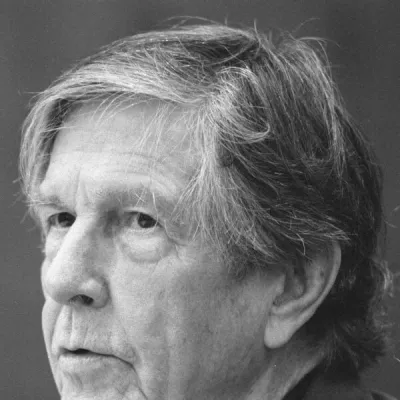
John Cage
Human Design Chart
Biography
The son of an inventor, he was raised in Los Angeles and attended Pomona college before dropping out to go to Europe. While there, he began to write music, much of which he threw away. Back in Los Angeles, he began to compose, a period in which he was very enthusiastic about both modern painting and music. It was at the time of the Depression, and he worked as a gardener in exchange for housing.
His first piano teacher was Richard Buhlig, a great pianist, and he also studied with Henry Cowell. When Cage wrote a solo for clarinet, Cowell arranged to have it played at a small concert in San Francisco. Cage hitchhiked to San Francisco, and when the musician said it was too difficult for him to play, Cage played his piece on the piano for the audience.
Moving to Carmel with no money and no job, he lived on wild mushrooms for his first week before taking a job washing dishes in the Blueberry Tea Room. The food was welcome but the work boring, so he left for New York to study with Adolph Weiss. After his lesson, he and Weiss played bridge with another couple every night. For work, he was washing walls at the YWCA.
Cage spent the last 50 years of his life in New York City, often in the company of his lifelong companion, dancer Merce Cunningham, for whom he wrote many pieces. As his creativity developed, he moved into his role as an extraordinarily important American composer. A documentary, "Cage/Cunningham," about the long collaboration between the composer and the choreographer was filmed by Elliot Caplan and featured interviews, archival dance footage and music from the various project the two artist created.
John Cage — Generator with Profile 2/4
Generator 2/4 — Design at a Glance
John Cage revealed himself as someone who possessed immense, enduring strength, comparable to a workhorse that does not initiate energy from within but rather releases it in response to external impulses. As a Generator, he had a lot of sacral energy, which only became effective when he responded to signals from his environment. His strategy was to wait until his gut feeling gave a clear 'yes', and then to react with concrete action. This stance of reacting rather than initiating was central to his functioning.
However, his design also contained specific pitfalls. If he persistently threw himself into tasks that did not bring him inner joy, he wasted his energy and tended to become exhausted. Conversely, he suffered greatly when he was prevented from working on his heart projects, even though he was still full of power. This blockage often led to a feeling of persistent frustration or a lack of energy.
Living in harmony with his design - by reacting to impulses and following his inner 'yes' - he was rewarded with a deep sense of satisfaction and a feeling of fulfillment. In these moments, no one could stop him. His energy was thus not generated by constant pushing forward, but by consciously responding to life itself, which gave him the necessary endurance for his long-term goals.
Sacral Authority
John Cage was a Generator whose decision-making was shaped by Sacral Authority. This configuration simplified his process, as strategy and inner guidance were identical: reacting to life impulses. A prerequisite for this was his open Emotional Center, ensuring that he was not guided by fleeting moods but could listen to deeper, physical signals.
His authority manifested in a direct physical reaction to external stimuli. This often expressed itself as an inner 'gut feeling', a surge of energy, or acoustic signals like grunting or a confirming 'mm-hm'. When his Sacral Center responded to a topic, he felt vital and had inexhaustible energy. He could then immerse himself in activities with great enthusiasm, completely free of compulsion or purposefulness, but purely out of joy.
Additionally, his activated Spleen Center acted as a supportive authority. This connection allowed him to react quickly and spontaneously and to have immediate access to his instinctive perception. He could rely on his physical well-being and intuition, further strengthening his ability to make quick decisions. John Cage lived this mechanism by trusting these inner, physical impulses that led him to a life full of energy and satisfaction, far from intellectual deliberations or emotional fluctuations.
The 2/4 Profile — Hermit / Opportunist
John Cage revealed himself through his Profile 2/4 as someone who oscillated between two strong poles: the deep need for withdrawal and the simultaneous attraction to his close environment. This design created an internal tension between Line 2, which demanded solitude and intensive self-reflection, and Line 4, which sought community and exchange with familiar people. For him, it was crucial to set clear boundaries and communicate externally when he needed company and when he wanted to be left alone.
During his solitary time, he immersed himself in internal processes to gain clarity. Once this phase was completed, he returned to his network to share the gathered impressions. This dynamic allowed him to reflect on the knowledge of his environment in silence and to develop new ideas from it.
Gate 64 in the second line contributed to him often being perceived as confusing from the outside, even though he himself was working internally on his development. This energy helped others to resolve their own mental entanglements through his objective distance. At the same time, Gate 35 in the fourth line influenced him, triggering a strong desire for change and experience collection. This transpersonal impulse drove him to continuously explore new paths, accepting misunderstandings as part of this process without taking them personally. His life was thus characterized by the alternation between introspective depth and active, transformative exchange with his community.
Split Definition — Defined & Open Centers
John Cage revealed through his design as someone whose expression and actions were guided by a deep, bodily intuition. His defined Throat Center, connected with the defined Sacral Center, meant that his communication and actions did not stem from mental concepts but directly from the reactive energy of his life force. He spoke and acted based on the 'responding tones' of his Sacral - an immediate, non-rational affirmation or rejection. This configuration shaped a consistent, reliable way of expressing himself, yet it was strictly bound to the condition of not initiating but reacting to life.
Additionally, John Cage possessed a defined G Center, which gave him a firm, reliable self-identity and a clear sense of his own direction. This allowed him to be secure in his love for himself and to love others without dependency, as well as to show others new directions without needing to control their paths. His defined Spleen Center complemented this by providing strong body awareness and spontaneous intuition in the 'now', enabling him to make trustworthy, existential judgments that bypassed consciousness.
In contrast, John Cage was vulnerable to conditioning through several open centers. His open Head Center tended to absorb mental pressure and questions from others, which could draw him into a whirlpool of confusion and doubt if he did not trust his inner authority. The open Ajna Center meant that his conceptual thinking was flexible but not a consistent source of personal truth; he could take on ideas without identifying them as his own truth. His open Heart Center made him vulnerable to the pressure of proving his worth through promises and willpower, a cycle that led to frustration if not broken by reaction rather than initiation. Moreover, his open Solar Plexus absorbed the emotions of his surroundings, making him prone to feeling emotionally uncomfortable when lingering in conditioned spaces, and challenging him to distinguish between his own and others' feelings. Finally, his open Root Center took in external stress and adrenaline, prompting him to seek ways to either avoid or appropriately use this pressure without being overwhelmed.
Channels for discovery, rhythm, intuition and clear expression.
John Cage revealed himself as someone whose inner compass was steered by a deep, biological rhythm that propelled him forward independent of intellectual constraints. This fundamental stance resulted from the Rhythm Channel 5-15, connecting the Sacral Center with the G Center. Gate 5 held onto firm habits and rituals, while Gate 15 integrated the diversity of society into the life flow through his love for extremes. This channel served as a cornerstone of all biological processes and closely connected Cage with the flow of the natural world. His timing was determined by this inner rhythm; when aligned with this flow, everything felt effortless and drew others magnetically into his energy flow without him having to actively direct it.
Parallel to this, Cage possessed an intuitive depth that he transformed through repeated experimentation into concrete skillfulness. The Wave Length Channel 48-16 connected the Spleen Center with the Throat Center. Gate 48 sought life-critical information, while Gate 16 experimented with new possibilities and perfected skills. This mechanism required engagement and repetition to achieve mastery. Cage was designed to combine intuitive insight with technical control, developing his skillfulness into a talent he could communicate.
Furthermore, he had the ability to know in the moment. The Brain Wave Channel 57-20 gave his intuitive insight from Gate 57 the clearest voice through Gate 20 in the moment. This allowed him to express spontaneous verbal outbursts of pure intuition that found the core of a matter faster than reflective analysis.
His design also promoted the letting go of expectations. The Discovery Channel 29-46 connected the Yes-Saying of the Sacral Center (Gate 29) with the determination of the Self (Gate 46). Cage had to delve into the depths of his experience to reveal its meaning. Through persistence and positive reaction, he could make discoveries that changed collective perception by sharing what was worth repeating at the end of the process.
Collective Circuitry — Circuit Signature
John Cage's design inclined towards impulsive, creative insights that flowed directly into communication. This was evident through the Flash of Insight Channel in the Knowledge Circuit, connecting the Throat Center with the Spleen. This connection enabled the immediate and intuitive expression of innovative ideas without prior logical filtering.
Simultaneously, he had separate, parallel existing energetic streams due to a split definition. On one hand, the Understanding Circuit reconnected the Throat Center with the Spleen, this time through channels for Rhythm and Wave Length. This promoted the sharing of focused, rational insights. On the other hand, the same circuit and the Meaning Circuit connected the Identity Center with the Sacral Center. Here lay a stable, cyclical energy source for personal identity and learning from past experiences.
These two groups - the communicative-intuitive axis (Throat-Spleen) and the identity-forming axis (Identity-Sacral) - were not directly connected in John Cage. They operated as separate energy fields: one for the expression of new, often acoustic or visual impulses, the other for the inner affirmation and emotional resonance of experiences. The mechanics show how new ideas (Spleen/Throat) and deep emotional resonance (Sacral/Identity) coexisted side by side without forming a continuous flow.
Right Angle Cross of Consciousness 3
John Cage's Human Design profile featured a specific architectural structure: the right cross of Consciousness 3. This configuration set a tendency towards a particular kind of perception and interaction with the environment, derived from the specific arrangement of the Gates contained within this cross. In Human Design, the third Consciousness Cross often marks a domain where the personality grapples with themes of identity, social role, or inner security. As it is the right cross, this dynamic primarily concerned the conscious level – aspects that John Cage himself experienced and actively shaped as part of his self-image. The energy did not flow as a diffuse background tension but as a clearly recognizable imprint in his actions. This meant that he did not unconsciously live out certain challenges or strengths, but rather integrated them as an integral part of his conscious experience. The mechanics of this cross promoted a stance based on the conscious engagement with the themes of the involved Gates. It was not a passive receiving station but an active form of self-positioning. John Cage thus appeared as someone whose conscious personality was marked by this specific geometric arrangement in his chart, significantly influencing how he saw and reacted to the world.
Saturn Return · Uranus Opposition · Chiron Return · 2nd Saturn Return — Life Cycles
John Cage's design indicated a tendency towards radical structural breaks, which condensed into clear phases of his creative work. His first Saturn Return, a cycle of consolidation and responsibility, occurred in 1940. At the age of 28, he composed 'Bacchanale,' his first composition for the prepared piano he invented. This marked the transition from experimental sketches to a viable, independent artistic practice.
The Uranus Opposition, a period of rebellion and sudden change, took place in 1952. At 40 years old, Cage staged the first Happening and premiered the piece 4′33″. These events exemplified the typical Uranus dynamics: established conventions were abruptly broken to make way for new, unconventional forms of expression.
The Chiron Return, a fulfillment cycle of bloom, reached its peak in 1962. At the age of 50, Cage founded the Mycological Society. This step reflected the unfolding of his incarnation purpose: integrating personal passions into a public, meaningful structure that transcended pure artistic creation.
His second Saturn Return, which solidifies long-term authority and status, became effective in 1968. At 56 years old, he was inducted into the American Academy of Arts and Letters. This recognition affirmed the maturity of his life's work and anchored his contribution sustainably in the cultural fabric, as is characteristic for this later Saturn cycle.
Generator · Sacral Authority — Synthesis
John Cage lived a process of continuous energetic generation, fueled by a deep, sacral drive (Generator Type, Sacral Authority). This drive manifested in the ability to receive new impulses through interaction with the world (defined Communication/Manifestation Center) and transform them into creative expressions – a rhythm amplified by the Channel of Rhythm (Gates 5/15). The recurring events in his career, marked by cycles, underscored his ability to generate energy and bring it into concrete forms. Simultaneously, he was driven to express his unique identity through exploring new paths (Knowledge Circuit) and allowing for mutation (Channel 3-60).
A central paradox in his design lay in the tension between the need for inner peace and the urge for community (Profile 2/4). Withdrawing into internal processes to gain clarity alternated with the desire to connect with others and share his insights. This dynamic reflected a constant search for a balance between individual inspiration and collective experience, with the open Emotional Center adding an additional layer of complexity.
4 Defined Channels
Incarnation Cross - Right Angle Cross of Consciousness 3
Solar Return
The Solar Return shows the moment when the sun returns to its exact birth position - your personal solar year.
Life Cycles
Discover the life cycles with a detailed triple view (birth chart, cycle chart, composite).
Human Design Profile
- Type
- Generator
- Strategy
- To respond - wait for something to respond to
- Authority
- Sacral Authority
- Profile
- 2/4 - Hermit / Opportunist
- Definition
- Split Definition
- Incarnation Cross
- Right Angle Cross of Consciousness 3
- Date of Birth
- 05.09.1912 05:00
- Place of Birth
- Los Angeles, CA, United States
Frequently Asked Questions
What was John Cage's Human Design type?
What Profile did John Cage have?
What Authority was active for John Cage?
What incarnation cross determined John Cage's design?
When was John Cage born?
Discover your own Human Design
Are you also a Generator? Find out in a personal reading how to use your sacral energy correctly and discover deep satisfaction.
More Personalities
Back to overviewAaliyah

Alexia

Alizée

Angèle

Anne-Marie

Arcángel
