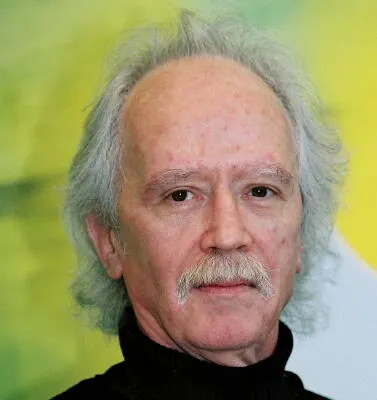
John Carpenter
Human Design Chart
Biography
Carpenter married actress Adrienne Barbeau in 1979. He co-wrote the book "Report from the Besieged City and Other Poems."
The Human Design of John Carpenter: Generator 6/2
Generator 6/2 — Design at a Glance
John Carpenter's design points to a tendency towards great endurance and strength, comparable to a workhorse that uses its energy efficiently. As a Generator, he had plenty of sacral energy but did not initiate it through personal will; instead, it was released by responding to impulses from the environment. His design motto could be: 'Not start, but answer.' When his inner self signaled a clear 'yes,' he could act with full power and successfully materialize projects.
This mechanism contained two central pitfalls. First, persistently doing things without internal desire led to energy waste and burnout, even with high creative potential. Second, frustration arose when he was hindered from pursuing his heart's project despite still being full of drive. Living in harmony with this strategy – waiting for the signal and then acting accordingly – rewarded him with deep satisfaction and a sense of fulfillment. Initiating against this inner compass or ignoring the lack of an impulse led to persistent frustration and a noticeable energy shortage sooner or later. His path to effectiveness thus lay not in pushing forward but in precisely reacting to what truly spoke to him.
Emotional Authority
John Carpenter exhibited a fundamental attitude characterized by emotional wave movements: his perception of the world shifted constantly with his current mood. What appeared inspiring at one moment could seem negative in the next. This fluctuation is an expression of his emotional authority, which he carried in his defined Solar Plexus Center. In Human Design mechanics, this authority always takes precedence over other defined centers; it dictates the rhythm of inner guidance.
Since his feelings often only reflected a snapshot and not necessarily deeper truth at any given moment, spontaneous decisions based on these emotions were risky and could have negative consequences because the initial intensity had yet to be clarified. Instead, patience was positive: by allowing time for a decision to mature, he gained emotional distance. The process of repeatedly sleeping on a question enabled him to let intense feelings subside. Only then did clarity and calm set in. This path of delay was essential for him, especially with long-term decisions that significantly influenced his life course. Through hesitation and waiting, he ensured that his actions were based on stable inner truth rather than transient excitement or depression.
The 6/2 Profile — Role Model / Hermit
John Carpenter's design points to a tendency towards experimental approaches in early years, followed by an intense phase of distancing. Before the age of thirty, his configuration acted as a 3-line: trial and error characterized his behavior, accompanied by necessary retreats after failures. Around age thirty, the sixth line activated. Then he metaphorically retreated into a 'cave on the mountain' to look back at his earlier experiments with great distance. This period served for healing and deep self-knowledge. Finally, he emerged as a wise person from this withdrawal. Others sought him out to partake in his life wisdoms and learn introspection.
This development stems from his Profile Line 6/2. The sixth line of Gate 61 is mutative; it transmits important knowledge into the collective when it has great significance. It checks the practicality of solutions and decides on their confirmation or denial. The individual knows collective clichés, but the collective does not always listen. The second line of Gate 50 represents determination and projects personal content outward. Although intelligent in presentation, there is often a lack of deeper refinement of the foundation. This creates resistance, especially when values still lack a real basis. With strong opposition, there comes a determined retreat. However, with friends, this resistance can be overcome so that others do not necessarily have to turn against these values.
Triple Split Definition — Defined & Open Centers
John Carpenter's design indicates a tendency towards constant conceptual thinking, coupled with strong willpower and the ability to directly implement concepts in communication. His defined Ajna Center ensures continuous mental processes, while his also defined Throat Center reliably expresses these thoughts. This connection enabled him to not only think theories but also carry them outward as opinions or answers.
Additionally, he had a stable energy base through his defined Sacral and Heart Centers. The Sacral Center provided the vital force for endurance, given that he responded to initiatives rather than starting on his own. His defined Heart Center gave him ego strength and the need to keep promises and maintain control over his resources. This combination of mental clarity, direct communication, and willful energy shaped his work as someone who propelled projects forward with inner drive.
At the same time, there was openness in areas of identity and inspiration. His open G Center meant that he did not have a fixed internal direction but rather took it from the environment and relationships. He tended to question who he is or where his true love lies when at wrong places. Moreover, his Head Center being open made him vulnerable to mental pressure and foreign questions. Instead of seeking constant inner inspiration, he often looked for answers externally to resolve confusion. These open centers challenged him not to fall into the trap of conditioned identity search or intellectual solutions for others' problems but rather to trust in his internal authority and strategy.
Channels for clarity, change, insight and dedication.
John Carpenter's design indicates a tendency towards evolutionary change that is not linear but occurs in sudden leaps. This dynamic was shaped by the Mutation Channel 60-3: It connects the Root Center with the Sacral Center, creating a pulsating rhythm of chaos and order. Gate 60 brings necessary limitation while Gate 3 tries to realize new possibilities. This energy felt melancholic and unpredictable; it required patience until internal mutation showed itself rather than trying to force it through arguments.
Parallel to this, John Carpenter had the ability to clearly structure complex connections. The Channel of Structuring 43-23 connects Ajna Center with Throat Center. Here spontaneous insights (Gate 43) meet assimilation and clear articulation (Gate 23). This allowed him to formulate innovative perspectives that promoted efficiency and encouraged others to rethink – provided he waited for the right timing to express them.
Another aspect was his instinctive awareness in interpersonal relations. The Channel of Devotion 44-26 connects Spleen Center with Heart Center. Through Gate 44 (Awareness) and Gate 26 (Ego Strength), he had a sense of what the group needed and the willpower to convey it convincingly. He could sell products or ideas intuitively recognizing unacknowledged needs.
Additionally, the Channel of Recognition 41-30 drove him: The pressure from Gate 41 (Restriction/Restlessness) sought new experiences which were then filtered through the emotional wave of Gate 30. This created a strong desire to deeply feel life and experience longings, where patience was crucial for clarity before action.
Individual Gates like 61 (Inner Truth/Silence) and 62 (Logical Details/Pattern Recognition) supported these processes by distinguishing between acoustic noise in the head and precise fact clarification. Gate 50 fostered traditional values and protective reflexes while Gate 40 combined the will to work with claims for rest and recognition. Gate 33 demanded reflection after experiences to avoid repetitions. Gate 14 handled power with grace, Gate 4 developed logical formulas for future security, Gate 12 emphasized creative restraint and emotional mood in communication, and Gate 48 recognized deep patterns even if their implementation remained frustrating.
Individual Circuitry — Circuit Signature
John Carpenter's design indicates a tendency towards isolated but powerful energetic islands. Through the Triple Definition, three separate groups of forces existed side by side without an ongoing flow between them. One group connected Sacral with Root and Solar Plexus Centers; here worked a cyclical energy reflecting past experiences and generating emotional waves. This configuration promoted sharing felt insights from the past to learn together.
A second independent group connected Ajna with Throat Center as well as Sacral with Root in the Knowledge Circuit. Here showed a drive towards structuring and mutation: Deviations from the known were used to go new ways. The energy pulsing and acoustic, it served to bring unique identity into the world through creative thinking and direct expression.
The third group connected Heart and Spleen Centers in the Ego Circuit. Without direct connection to the life force of Sacral, here pauses for resource production were needed. The Channel of Devotion promoted cooperation and joint creation of prosperity through mutual support – a conservative traditional approach based on the principle of 'give and take'. These three areas worked parallel, not as an interconnected whole but as separate spheres of creation, feeling, and cooperation.
Left Angle Cross of Obscuration 2
John Carpenter's design suggests a tendency towards inner reserve, coupled with a subtle urge to initially preserve true connections for oneself. This configuration, the left cross of veiling 2, describes not active deception but rather a natural protective function: The essential is safeguarded from premature revelation until internal clarity is fully established. It’s a process of growing in secrecy where external visibility is secondary to inner authenticity.
This mechanism acts as a filter against superficial expectations. Instead of proving or convincing immediately, there's an attitude of observation and waiting for the right moment. The energy of this cross supports trust in one's own truths that are not yet visible. It’s about not being forced into revelation by external pressure but using time to sharpen one’s intuition.
For John Carpenter, this means a life task of subtle presence. The strength lies in understanding complex realities without needing to express them immediately in words. This reserve is not a lack of expression but a form of respecting one's own rhythm. It allows deeper patterns to be recognized that might remain hidden from others due to the necessity of immediate communication being absent. Here, veiling serves to protect integrity and the depth of understanding.
Saturn Return · Uranus Opposition · Chiron Return · 2nd Saturn Return — Life Cycles
John Carpenter’s design shows a tendency towards condensing long-term work into marked life phases. In 1978, at age 30, he published “Halloween – The Night of Terror”. This coincided with his first Saturn Return, a cycle often compressing years of groundwork into substantial results and creating structure.
The following phase brought tensions. In 1986, at age 38, he experienced the Uranus Opposition. During this period, he realized “Big Trouble in Little China”, a large-scale fantasy film with horror and kung fu elements. The work was a failure. The Uranus Opposition often brings unexpected breaks or crises that challenge established patterns and force adaptation.
Around his Chiron Return, roughly between ages 49 and 51, a fulfillment cycle begins where the incarnation cross unfolds. In 1996, at age 48, he was nearing this phase. He realized “Escape from L.A.”, a relatively high-budget sequel to “Viper”. The reception by critics and audience was reserved. This marked a transitional period before deeper meaning of his design comes into focus if strategy and authority are observed.
Generator · Emotional Authority — Synthesis
A central red thread runs through this design: the processing and transformation of energy both internally and externally. The Generator type (Design) with strongly pronounced sacral energy (Centers) finds its natural expression in working on themes that truly inspire him – as long as he does not waste unnecessary energy (Design). This energetic dynamic is reinforced by the Channel of Mutation (Channels/Gates), implying constant change and experimentation with new paths. Emotional authority (Authority) however demands a maturing period for decisions to find the right direction for this energy flow, while the defined Mental Center (Centers) develops concepts to understand and express these processes (Circuit).
The design reveals a central paradox between the drive for innovation and the necessity of withdrawal. The Knowledge Circuit (Circuit) drives the search for new insights and forms of expression, which was evident in early successes (Cycles), yet the left cross of veiling 2 suggests a tendency to lose oneself in self-created illusions. Crisis experiences (Cycles) seem connected with attempts to press this creative energy into predetermined forms, leading to disappointment. The Line 6 in Profile (Profile-Role) indicates that only after an intense phase of experience and reflection does a wise voice emerge that inspires others.
4 Defined Channels
Incarnation Cross - Left Angle Cross of Obscuration 2
Solar Return
The Solar Return shows the moment when the sun returns to its exact birth position - your personal solar year.
Life Cycles
Discover the life cycles with a detailed triple view (birth chart, cycle chart, composite).
Human Design Profile
- Type
- Generator
- Strategy
- To respond - wait for something to respond to
- Authority
- Emotional Authority
- Profile
- 6/2 - Role Model / Hermit
- Definition
- Triple Split
- Incarnation Cross
- Left Angle Cross of Obscuration 2
- Date of Birth
- 16.01.1948 21:50
- Place of Birth
- Carthage, NY, United States
Frequently Asked Questions
What is John Carpenter's Human Design type?
What Profile does John Carpenter have in Human Design?
What Authority does John Carpenter possess?
What incarnation cross does John Carpenter have?
When was John Carpenter born?
Discover your own Human Design
Are you also a Generator? Find out in a personal reading how to use your sacral energy correctly and discover deep satisfaction.
More Personalities
Back to overviewAaliyah

Alexia

Angèle

Anne-Marie

Arcángel

Arno