
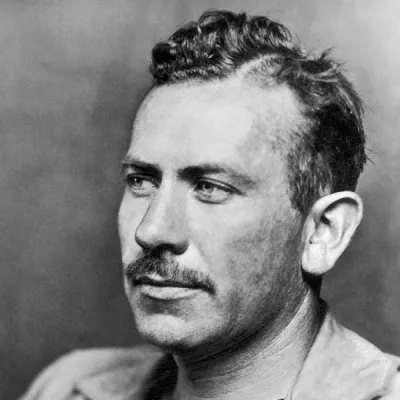
Photo: Wikimedia Commons
John Steinbeck
Human Design Chart
Biography
During his writing career, he authored 33 books, with one book coauthored alongside Edward Ricketts, including 16 novels, 6 non-fiction books, and 2 collections of short stories. He is widely known for the comic novels Tortilla Flat (1935) and Cannery Row (1945), the multigeneration epic East of Eden (1952), and the novellas The Red Pony (1933) and Of Mice and Men (1937). The Pulitzer Prize–winning The Grapes of Wrath (1939) is considered Steinbeck's masterpiece and part of the American literary canon. By the 75th anniversary of its publishing date, it had sold 14 million copies.
Much of Steinbeck's work employs settings in his native central California, particularly in the Salinas Valley and the California Coast Ranges region. His works frequently explored the themes of fate and injustice, especially as applied to downtrodden or everyman protagonists.
John Steinbeck — Generator with Profile 3/5
Generator 3/5 — Design at a Glance
John Steinbeck possessed immense endurance and sacral energy, making him a powerful force in his work. However, his design clearly indicated that he was not built to constantly initiate impulses or projects on his own. Instead, his greatest strength lay in reacting to signals from his environment. When such a signal came and his inner center responded with a clear 'yes', he could effectively utilize this energy through immediate action.
This mechanism of responding was crucial for his well-being. If John Steinbeck acted in accordance with this strategy – only when he was externally prompted and felt internal agreement – it led to deep fulfillment. Deviations from this, however, brought two specific risks. On one hand, there was the threat of burnout if he invested energy into activities that did not give him inner joy and were thus perceived as wasteful. On the other hand, frustration arose when he was prevented from working on his heart projects despite still being full of motivation.
Living against this design and trying to initiate things independently rather than waiting for life impulses led to persistent frustration and a noticeable energy deficiency sooner or later. His success therefore directly depended on whether he left the initiative to others and only acted himself when his gut feeling agreed. This discipline, not initiating but patiently waiting for the right signal and then responding powerfully, significantly shaped his life energy.
Emotional Authority
John Steinbeck's inner compass was emotional authority, a mechanism that fundamentally influenced his decision-making process. His design was subject to a constant emotional wave with steady ups and downs of feelings. The world always appeared colored by his current mood; in one moment there was total enthusiasm, in the next the same thing seemed negative. However, this immediate feeling was only a snapshot, an initial impression that did not necessarily reflect the deeper truth yet. Quick, spontaneous decisions arising directly from this emotional heat carried the risk of negative consequences.
The central rule of his inner authority stated: Once the emotional center was activated, it took precedence over all other defined centers regardless of which further areas of his design were also defined. The solution did not lie in immediate action but in conscious delay. John Steinbeck needed time and patience to let decisions mature. This process required multiple reconsiderations and allowing hesitation as well as repeated questioning. Only when the intense feelings subsided and emotional distance was gained, clarity set in. This cycle through the emotional phase was essential, especially for long-term course settings with significant influence on his life path. Only this way could he achieve calmness and distinguish his true inner truth from the transient mood state.
The 3/5 Profile — Martyr / Heretic
John Steinbeck emerged as someone whose identity was shaped by a process of trial and error. His design tended towards initially believing nothing but trying everything out himself. This attitude stemmed from Line 3 of his profile, making him an experimenter. He learned from practical experiences and failures, which gave him deep, tested wisdom.
These private learning processes transformed into his public presence. Through Line 5, he appeared as a hero or storyteller presenting his treasure trove of life experience to others. People were drawn to him because they valued his practical knowledge and wanted to learn from his experiences. This dynamic created a strong social magnetism.
The combination of experimenter (Line 3) and hero (Line 5), however, also meant vulnerability. When John Steinbeck had to try things out in front of others and failed, it hit him particularly hard because his reputation rested on the perception of his competence. His design required that he learn from his own mistakes to then appear as a trustworthy figure solving other people's problems with self-acquired knowledge. The attractiveness of his person directly depended on how authentic and practical his lived experiences appeared.
Split Definition — Defined & Open Centers
John Steinbeck had a fully defined energy system, which endowed him with an unshakable inner authority. His identity (defined G Center) was stable and self-loving, so he did not rely on external validations. This firm direction combined with constant willpower (defined Heart Center), allowing him to keep promises and independently manage resources. His vital energy (defined Sacral Center) was always available, driven by a deep emotional intelligence (defined Solar Plexus Center). Here lay his strength: He waited patiently until the emotional wave had clarified before acting. His existential consciousness (defined Spleen Center) provided spontaneous, intuitive judgments in the present moment, while the constant pressure of his defined Root Center propelled him forward and kept him healthy.
This massive internal contrast was evident with his open mental centers. His open Head and Ajna Centers meant that he did not possess a constant mental strategy or fixed concepts. He tended to question whether an idea was truly his own or merely an echo of the environment. Instead of seeking continuous inspiration, he used his mind as a mirror for other perspectives. Similarly, his open Throat Center showed: He did not actively seek attention through words. Rather, he waited for invitations to speak. When these came, he spoke spontaneously and authentically without the pressure to control the conversation. This openness protected him from falling into the trap of producing false answers or unnecessary chatter, while his defined centers ensured that his actions were always powerful and identity-forming.
Channels for devotion, community, rhythm and life's meaning.
John Steinbeck's design set a strong internal rhythm that determined his actions and social bonds. He was someone who cultivated his own pace and fought strategically for his integrity. This configuration marked him through four central channels.
The Rhythm Channel 5-15 connected the Sacral Center with the G Center. Gate 5 held onto firm habits, while Gate 15 integrated extremes. This created a magnetic flow that drew others into his timing cycles and propelled them forward without emotionally or intellectually burdening him.
The Devotion Channel 44-26 linked Spleen and Heart. Through Gate 44 (Awareness) and Gate 28 (Ego Strength), he possessed an entrepreneurial sense. He could instinctively recognize what his tribe needed and offer this in fair exchange for reward. He was not a desk worker but a seller who acted in short, intense phases to generate resources for the community.
The Life Struggle Channel 38-28 connected Root and Spleen. Gate 38 exerted pressure to maintain individual integrity against external influences, while Gate 28 assessed the value of struggle. John Steinbeck sought meaning in these struggles; he stubbornly resisted expectations when it served his self-realization and thus found his life purpose.
The Community Channel 37-40 connected Solar Plexus and Heart. Gate 37 searched for recognition as a whole, while Gate 40 demanded reward for care. He did not form alliances spontaneously but carefully weighed them over time. His focus was on mutual benefit and loyalty in the group, building bridges between individuals to secure a functioning community.
Additionally, gates like 9 (Detail Work), 16 (Experiment) and 27 (Care) worked in the background, supporting his ability for perfectionism and experimentation as well as his altruistic engagement for the tribe.
Tribal Circuitry — Circuit Signature
John Steinbeck's design set a tendency towards structured, rational progress embedded within cooperative tribal dynamics. His Understanding Circuit connected the Identity with the Sacral Center (Channel 15-5). This generated a rhythmic flow of logical insights shared free from conditioning to improve societies. This 'emotionless ratio' contrasted with his Knowledge Circuit, which linked Spleen and Root Center (Channel 28-38). Here it was not about creative innovation or emotional transformation through the Solar Plexus but rather about the Life Struggle: strengthening one's individuality against resistance. These two circuits formed separate segments – rational structure on one hand, inner constancy on the other. The Ego Circuit rounded out the picture and connected Heart, Solar Plexus as well as Spleen (Channels 26-44 and 40-37). This promoted cooperation and resource creation in the tribe through devotion and community spirit. Since this group did not have a direct connection to the Sacral Center, giving and taking energy required necessary pauses for regeneration. John Steinbeck thus showed himself as someone who combined logical clarity with tribal support, where inner constancy and rational structure existed side by side without directly flowing into each other.
Right Angle Cross of Planning 1
John Steinbeck's design carried the structure of the right cross in Plan 1. This configuration established a fundamental orientation towards strategic direction, paired with a methodical and planning approach to his life areas. Instead of acting impulsively or surrendering entirely to the moment, his chart showed a tendency to think ahead and prepare a clear path.
The right cross in Plan 1 describes in Human Design an energetic alignment based on preparation and strategic thinking. It is not about spontaneous inspiration but rather about consciously organizing resources and goals. Those who carry this structure tend to place actions within a larger context and form an image of the entire process before starting. This served as an inner compass that helped filter distractions and focus on what was essential.
For John Steinbeck, this meant that his actions were often guided by internal logic seeking stability and predictability. The energy of this cross supported him in making complex situations manageable through structured planning. It was a deeply rooted inclination not only to have the goal in sight but also to carefully map out the path there. This planning discipline was not an external compulsion, but a natural expression of his energetic anatomy that helped him maintain personal order and direct his energy effectively in a chaotic world.
Saturn Return · Uranus Opposition · Chiron Return · 2nd Saturn Return — Life Cycles
John Steinbeck's design indicated a tendency towards structural turning points condensed into four planetary cycles. The first Saturn return marked a phase of maturation and new commitments. In 1930, at the age of 28, he met marine biologist Ed Ricketts, who became his best friend and greatest mentor. This encounter condensed years of groundwork into a sustainable relationship that shaped his future work.
The Uranus opposition around the age of 40 challenged him to break out of old structures. In 1942, the play *The Moon Is Down* was created, a creative impulse that emerged during this phase of upheaval and opened new paths in his career.
The Chiron return between ages 49 and 51 was a fulfillment cycle where his incarnation purpose increasingly unfolded. In 1952, at age 50, he published the novel *East of Eden* and produced the film *Viva Zapata!*. These works were expressions of a blooming phase in which the meaning and purpose of his creation became tangible without focusing on healing old wounds.
The second Saturn return brought further maturation and new commitments. In 1960, at age 58, he embarked on a journey through the United States with his poodle Charley. This trip was a sign of deepened inner stance and acceptance of new life tasks in the later phase of his design.
Generator · Emotional Authority — Synthesis
John Steinbeck primarily lived from his sacral energy (Generator type) and followed an internal rhythm (Channel of Rhythm), deeply connecting him to the flow of life. This drive, combined with a defined self-identity (defined G Center), led to a continuous search for experiences – both through personal experimentation (Line 3) as well as by picking up and passing on insights to others (Line 5). He drew from direct experience to generate knowledge and express it creatively, which was evident throughout his life – such as when meeting an influential mentor or during the creation of significant works.
A central tension lay in Steinbeck's strong desire to try new things and gain knowledge (Knowledge Circuit) while being subject to emotional waves (Emotional Authority). This likely led to internal conflict between a need for quick decisions and the necessity of letting things ripen. The ability to guide others through his own experiences could have been accompanied by phases of intense emotional confrontation as he sought and transformed his path in life.
4 Defined Channels
Incarnation Cross - Right Angle Cross of Planning 1
Solar Return
The Solar Return shows the moment when the sun returns to its exact birth position - your personal solar year.
Life Cycles
Discover the life cycles with a detailed triple view (birth chart, cycle chart, composite).
Human Design Profile
- Type
- Generator
- Strategy
- To respond - wait for something to respond to
- Authority
- Emotional Authority
- Profile
- 3/5 - Martyr / Heretic
- Definition
- Split Definition
- Incarnation Cross
- Right Angle Cross of Planning 1
- Date of Birth
- 27.02.1902 15:00
- Place of Birth
- Salinas, United States
Frequently Asked Questions
What was John Steinbeck's Human Design type?
What Profile did John Steinbeck have in Human Design?
Which Authority guided John Steinbeck's decisions?
What incarnation cross did John Steinbeck have?
When was John Steinbeck born?
Discover your own Human Design
Are you also a Generator? Find out in a personal reading how to use your sacral energy correctly and discover deep satisfaction.
More Personalities
Back to overviewAaliyah

Alain-Fournier
Alexia

Angèle

Angeli
Anne-Marie
