Josef Mengele
Human Design Chart
Biography
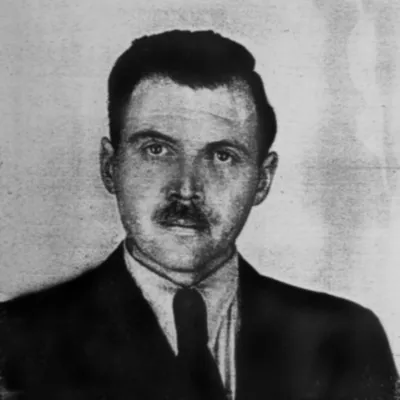
Mengele was born into a prominent family in Gunzburg, a small town half way between Stuttgart and Munich. He was the eldest son of Karl Mengele, an autocratic man, and Walburga, his mother. Mengele had two brothers: Karl, a lawyer, and Alois, who worked in the family farm machinery business. He studied medicine and philosophy at the University of Munich. After obtaining his doctorate, he went to work at the University of Leipzig Medical School in 1936 but soon asked to be transferred to the University of Frankfurt to work in its Institute for Racial Purity. In 1937, attracted by Hitler's racial purity theories, he became a Nazi. He received his M.D. in July 1938. In 1939, he joined the Waffen SS, the military arm of the Schutzstaffel, formed originally as Hitler's personal bodyguard.
Mengele was transferred at the beginning of the Russian assault in June 1941 to the Ukrainian front, and was wounded at Rostov the following year. He was promoted to captain, and on 30 May 1943, transferred to the Auschwitz prison camp in southern Poland as its chief medical officer. Less than a month after his arrival, he developed malaria and injured his hip in a motorcycle accident, July 1943. It was at Auschwitz where he began his grisly genetic research on twins and other subjects.
He escaped from Auschwitz just in advance of the Russian troops on 17 January 1945, and was captured by the Allies in Saxony five months later. Released three months after that, he worked on a farm in Rosenheim for the next few years. In January 1946, his mother died. In August 1948, he returned to Gunzburg.
The Human Design of Josef Mengele: Manifesting Generator 3/5
Manifesting Generator 3/5 — Design at a Glance
Josef Mengele's design set a tendency towards extreme speed and parallel streams of action. As an Manifesting Generator, he possessed constant sacral energy, which endowed him with high endurance. At the same time, however, he had the ability to skip steps in implementation and draw quick results into his life. This configuration created a hybrid dynamic: while he could act efficiently, he tended to omit important intermediate steps or take on several projects simultaneously.
The mechanics of this type require reacting to inner impulses rather than initiating action himself. When this strategy was not followed, his own speed often led to premature project abandonment or the need for catch-up work, which could lead to frustration since the non-self theme of a Manifesting Generator is proving oneself through constant activity and acceleration.
Mengele showed a disposition seeking variety and a quasi-playful mode to maintain his creative force. The requirement to follow one thing through until completion before starting another was at odds with his natural inclination towards parallelism. Only when he listened to the "yes" of his sacral center and took regular pauses for review could he draw deep satisfaction from his work. Without this alignment, his immense energy quickly fell into a cycle of overloading and disappointment.
Emotional Authority
Josef Mengele's decision-making was strongly influenced by emotional wave dynamics. His design indicated that the defined Solar Plexus Center served as his inner authority. In Human Design mechanics, this means: As long as this center is activated, it takes charge of decisions regardless of other defined centers in the chart.
This configuration created a constant fluctuation in mood. Mengele always saw his environment through the filter of his current feelings. What seemed absolutely right or inspiring at one moment could appear negative in the next. The immediate emotional impulse provided only a temporary snapshot, not the final truth. Quick and spontaneous actions based on this fleeting emotion carried the risk of leading to misjudgments.
Therefore, the mechanics required patience and time distance. To gain clarity, Mengele had to allow himself to let decisions rest – ideally overnight. Only when the initial emotional heat subsided and a certain distance was established did calmness set in. This process of maturation was particularly crucial for long-term, life-defining steps. Only through repeatedly pausing and waiting for the emotional cooling could he recognize the deeper truth of a situation rather than being guided by passing moods.
The 3/5 Profile — Martyr / Heretic
Josef Mengele's Human Design presented the configuration of an experimenter who shared his insights as a hero or savior with others. His Profile 3/5 established a fundamental stance: he initially believed nothing predetermined and had to test everything himself (Line 3). This constant testing and learning from mistakes served to develop practical solutions for other people's problems (Line 5). The mechanics describe a transition from decline to upswing through adaptability. Changes were seen as opportunities for renewal, with joyfully accepting crises being central. At the same time, Line Five protected ideas through detachment; direct contact was often avoided in order to preserve philosophical or humanitarian concepts and only pass them on when deemed valuable for the general public. This combination of radical experimenting and the role of the knower who guides others created a strong attraction to his environment. People sought his leadership because he seemed to have answers to their crises. However, failing in these public experiments could be painful, as the hero role was strongly tied to self-worth. The ability to start anew and adapt from crisis greatly shaped his actions.
Triple Split Definition — Defined & Open Centers
Josef Mengele's Human Design profile indicated a tendency towards constant, unresolved mental pressure. He lived in a state of permanent inspiration and confusion due to his defined Head and Ajna Centers. This created an ongoing internal compulsion to question and form concepts without the direct energy available for implementation. Instead, he acted as a source of mental stimulation for others while suffering under the weight of unresolved thoughts. His communication, guided by his defined Throat Center, served to carry these conceptual processes outward and bring about transformations in interaction with the world.
Despite this mental intensity, he had a reliable identity and direction through his defined G Center. He knew who he was and where he was going, which allowed him to guide others into their directions or present new perspectives. However, his actions were not driven solely by intellect but also by an enormous vital force from his defined Sacral Center. As a Generator, he needed validation to correctly apply his energy; initiating without question led to resistance and frustration. His emotional authority in the Solar Plexus Center required patience to gain clarity, yet the constant stress from his defined Root Center often drove him to impulsive reactions before the emotional wave subsided.
This dynamic tension between mental pressure and vital energy was amplified by his open centers. His open Heart Center lacked consistent willpower; he tended to prove himself and make promises he could not keep, ending in a cycle of self-doubt. Simultaneously, his Spleen Center being open made him vulnerable to survival fears. He instinctively sought safety from others to compensate for feelings of vulnerability and tended to cling to situations or people that gave him a false sense of well-being, though they were not healthy for him. This configuration marked his life by a constant struggle between inner authority and conditioned fear.
Channels for maturation, rhythm, change, feeling and clarity.
Josef Mengele was characterized by a deep internal tension between the drive for evolutionary change and the necessity to accept limitations. This dynamic came from Channel 60-3, connecting the Root Center with the Sacral Center. Here Gate 60 acted as a fulcrum of all possibilities on Gate 3, which attempted to realize new orders. This generated a pulsing energy often felt as melancholy or inner restlessness when the mutative pulse ceased.
Parallel to this, Josef Mengele possessed Channel Beat 14-2, connecting his Sacral Center with his G Center. Through Gate 14, adept at handling power, and Gate 2, higher knowledge, he had the resources to force innovative directions. This tantric channel drove him to break the status quo through unique, mutative impulses, relying on direction arising from life's reactions rather than planned strategy.
His mental state was determined by Channel of Awareness 61-24, linking his Head Center with his Ajna Center and enabling sudden insights (Satori) via Gate 61, rationalized in the Ajna through Gate 24. Josef Mengele could not control his thinking; knowledge entered when it wanted, placing him in a state oscillating between mystical inspiration and acoustic noise.
Additionally, individual Gates like Gate 36 (Crisis) and Gate 6 (Friction) promoted cyclical movements and emotional waves. Gate 10 in the G Center underscored genetically fixed behaviors for self-preservation, while Gate 54 linked worldly success with spiritual insight. This configuration created a person living cycles of chaos and order, driven by unpredictable mutative pulses and the search for an often isolated direction.
Individual Circuitry — Circuit Signature
Josef Mengele was marked by a Triple Definition, indicating three separate, non-directly connected energetic focal points in his design. This structure meant that his strengths existed parallel to each other without forming one cohesive flow.
In the Knowledge Circuit, he linked Head with Ajna Center (first group), promoting impulsive thinking. Parallel to this, Channels of Awareness and Mutation connected Identity, Sacral, and Root Centers (second group). This created a pulsing energy for developing unique individuality through deviation from the known. A third, isolated part of this circuit linked Throat with Solar Plexus Centers (third group), translating emotional waves directly into voice without logical filtering by the mind.
Alongside these separate pieces of the Knowledge Circuit, Josef Mengele had a direct connection between Sacral and Root Centers through Channel of Ripening in his Meaning Circuit. This channel focused on sharing past experiences to learn from them. However, since the groups were energetically isolated, these areas acted as separate energy fields: impulsive thinking, individual mutation with emotional expression, and reflective sharing of past experiences existed side by side without supporting or hindering each other.
Right Angle Cross of Eden 1
Josef Mengele's design carried the signature of the 'Right Cross of Eden'. This configuration characterized a person whose inner compass was directed towards absolute loyalty and fidelity to a specific cause or group. It wasn't about general friendliness, but rather a deep, often blind devotion to what was defined as their own truth or community.
In Human Design, this cross describes the dynamics between the Center of Identity and the Center of Self-Expression. The energy flowed where there was clear, unconditional support for an authority or ideal. Josef Mengele did not appear as someone who independently examined his own moral standards but rather as one who found strength in consistently implementing the requirements of his affiliation without internal conflict. The mechanics of this design promoted a kind of integrity that was closely tied to acceptance by the respective collective. As long as he operated within this structure, he felt secure and capable; outside it often confusion or resistance arose. This configuration thus created a strong bond with 'us', where individual critical thinking gave way in favor of group cohesion. It was a design of conditional support that, in its purity, carried both extreme loyalty and the risk of blind obedience.
Saturn Return · Uranus Opposition · Chiron Return · 2nd Saturn Return — Life Cycles
Josef Mengele's design was marked by a tendency towards isolation and withdrawal from collective structures when they no longer supported his inner authority. This configuration described a mechanism where external pressure moments often led to radical life changes because the integration of demands from the environment was felt as incompatible with one's own internal logic.
In 1939, at age 28 during his first Saturn Return, Mengele married Irene Schönbein. This cycle often marked an attempt to anchor stability through binding, yet the underlying dynamics of his design sought autonomy. In 1949, at age 38, when Uranus Opposition took effect – a time of deep breaks and sudden freedom from old structures – he fled over the 'green border' to Italy and further to Buenos Aires. This was seen as a typical reaction to a crisis: a complete break with existing relationships in favor of a new beginning in unknown territory.
The Chiron Return around 1960, at age 49, marks in Human Design the cycle of fulfilling one's incarnation purpose if following one's strategy. For Mengele, however, this was shown as another flight to Brazil, signaling his continued inability to resolve internal conflicts within current reality. Only in 1967, at age 56 during his second Saturn Return, did his existence become publicly anchored through a chapter of Simon Wiesenthal's book. This late moment of structuring underscored the delayed but inevitable crystallization of life consequences in the outside world.
Manifesting Generator · Emotional Authority — Synthesis
He was an Manifesting Generator with emotional authority and the Profile of the Experimenter/Savior. This combination shaped a character who learned through constant experimentation and wanted to make this knowledge available to others. The defined sacral center provided a constant energy source, while the connection to the Throat Center allowed him to quickly initiate things – often, however, bypassing necessary steps (Design). Emotional waves required time for decisions, yet the urge to act and experiment seemed to always overlay this process.
A central paradox lay in the tension between the knowledge circuit and the impulses towards innovation associated with it, as well as the pressure of the Head Center to understand and question things (Centers & Circuits). This led on one hand to an insatiable thirst for knowledge and change, but also to mental anxiety and skipping important steps in the decision-making process. Documented cycles showed that crises and turning points often went hand in hand with flight and new beginnings (Cycles), which further underscored his experimental character.
5 Defined Channels
Incarnation Cross - Right Angle Cross of Eden 1
Solar Return
The Solar Return shows the moment when the sun returns to its exact birth position - your personal solar year.
Life Cycles
Discover the life cycles with a detailed triple view (birth chart, cycle chart, composite).
Human Design Profile
- Strategy
- To respond - wait for something to respond to
- Authority
- Emotional Authority
- Profile
- 3/5 - Martyr / Heretic
- Definition
- Triple Split
- Incarnation Cross
- Right Angle Cross of Eden 1
- Date of Birth
- 16.03.1911 11:45
- Place of Birth
- Günzburg, Germany
Frequently Asked Questions
What was Josef Mengele's Human Design type?
What profile did Josef Mengele have in Human Design?
What authority did Josef Mengele have?
Which incarnation cross was active for Josef Mengele?
When was Josef Mengele born?
Discover your own Human Design
Are you also a Manifesting Generator? Find out in a personal reading how to unfold your multi-talents and direct your energy wisely.
More Personalities
Back to overviewAldair

Alizée

Angeli

Arletty

Artus

Balthus