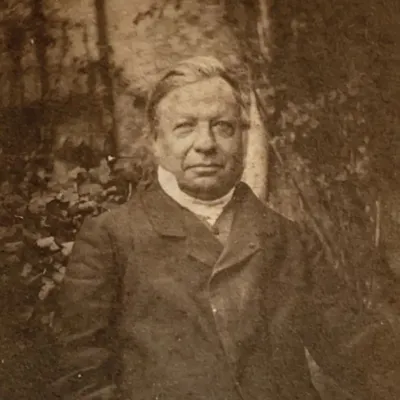
Joseph Liouville
Human Design Chart
Biography
Liouville studied mathematics at the Collège St. Louis in Paris, and then in 1825, he entered Ecole Polytechnique where he studied with Ampère and Arago. He graduated in 1827 and embarked upon a career in academics. In 1831, he was appointed to several private schools and to the Ecole Centrale, where he lectured regularly, oftentimes speaking on subjects so complex that he left his students bewildered.
He founded the Journal de Mathématiques Pures et Appliquées in 1836, and as editor, he published papers that are credited with raising the standards of French mathematics during the 19th century. In 1838, he was appointed Professor of Analysis and Mechanics at the Ecole Polytechnique, and one year later, he was elected to the astronomy section of the Académie des Sciences. He was elected to the Bureau des Longitudes in 1840. By this time, his reputation had spread worldwide, and he was busy with his research and writing as well as his teaching and administrative duties.
In the 1840s, he became involved in the political arena, and in 1848, he was elected to the Constituting Assembly. Running for office again the following year, he was defeated, and as a result of this defeat, his personality changed, leaving him bitter toward the world, even toward his old friends. He continued his work in mathematics with more vigor after his encounter with politics, and the years of 1856 and 1857 were exceptionally productive. He wrote over 400 papers throughout his lifetime, but much of his boldly original work was published without proof of how he obtained his results.
Although his health deteriorated during the 1850s, he was able to continue his work. Liouville died on 8 September 1882 in Paris.
Joseph Liouville — Generator with Profile 6/2
Generator 6/2 — Design at a Glance
Joseph Liouville revealed himself as someone who unleashed his strength not through spontaneous initiatives but through consistent responses to inner signals. His Generator design endowed him with immense, enduring energy, comparable to that of a workhorse, which only became effective when it responded to impulses from the environment. The motto of his character was not “initiate” but “react.” This mechanism largely determined his approach to work: As long as he listened to a clear “yes” from his sacral center and acted accordingly, nothing could stop him. In these moments of alignment with his inner compass, his design rewarded him with a deep sense of fulfillment. Conversely, ignoring these signals or forcing himself to do things he did not feel an inner desire to do inevitably led to frustration and energy loss. Joseph Liouville had to learn that his success depended on not fighting against the current of his own nature but waiting for the right moments when life challenged him and his gut feeling pointed the way. Only through this strategy of reacting could he tap into his full potential without falling into the typical traps of burnout or suppressing his heart projects. His strength lay in the patient yet powerful response to what spoke to him.
Sacral Authority
Joseph Liouville revealed himself as a Generator whose decision-making was shaped by sacral authority. This inner guidance did not manifest as an abstract consideration but as a direct physical reaction to external stimuli. His design required him to listen to these signals from the abdominal area—often audible as grunts, hums, or a nodding “mhm.” Such reactions marked the moment when his sacral motor kicked in. In these states, he felt vital and alive, with seemingly inexhaustible energy and great enthusiasm for the task at hand. This enabled him to immerse himself in his work without the need for external purpose. The joy of the activity itself drove him forward.
A crucial factor for this mechanism was that his Emotional Center was open. This openness prevented emotional waves from overshadowing the clear perception of the sacral response, simplifying the decision-making process. Additionally, his activated Spleen Center acted as a supportive authority. This connection endowed him with the ability to react particularly quickly and spontaneously. He possessed an immediate access to his instinctive perception and physical well-being, which he could rely on to guide him. This combination of sacral confirmation and spleen-supported speed shaped his way of acting and making decisions in life.
The 6/2 Profile — Role Model / Hermit
Joseph Liouville's design was characterized by a clear division in his life phases, driven by the dynamics of his Profile Line 6/2. In his youth, before the return of Saturn, he primarily acted as an experimenter. The 6-line behaved here like a 3-line, which led him to a life of trial and error. He gathered experiences through direct action, learned from mistakes, and withdrew after setbacks to assimilate. This phase was marked by the necessity of losing innocence through his own, often inappropriate actions and learning from them.
After the age of 30, the 6-line fully activated. Joseph Liouville then metaphorically retreated into a “hole,” gaining distance. This period served for intense reflection on his earlier experiments. It was a phase of healing and deep self-awareness, in which he processed the spiritual fractures from his youth. From this isolation, he developed profound wisdom. Others recognized this maturity and sought his advice to learn from his introspective abilities. His Line 25-6 enabled mutations through action-oriented here and now, while the 58.2-Line helped him challenge authorities and promote unconventional ideas. Thus, he transformed from a searching experimenter into a wise exemplar, sharing his insights.
Single Definition — Defined & Open Centers
Joseph Liouville revealed himself as someone who knew his inner strength and willpower through self-determination. His defined Heart Center provided him with a constant source of determination and the need to steer his life and resources independently. He had a natural authority to make and keep promises, which strengthened his self-esteem. At the same time, he possessed immense vital energy through his defined Sacral Center. This energy source required him to wait for external impulses to react correctly, rather than initiating on his own. Only in this way could he use his energy for fulfilling activities and avoid frustration.
His defined Spleen Center ensured a sharp, intuitive perception in the present moment. He trusted spontaneous instincts and physical intelligence to survive and find well-being without having to rationalize these signals. Additionally, his defined Root Center provided a constant inner pressure that propelled him forward and helped him cope with stress to thrive materially and nourish existential awareness.
At the same time, Joseph Liouville was open to external influences in other areas. His open Head Center meant that he did not have a constant access to inspiration and could easily fall into mental confusion or doubt when trying to solve his own questions. His open Ajna Center also showed that his conceptual thinking was flexible but prone to interpreting foreign opinions as his own truth or feigning uncertainty.
His open Throat Center made him vulnerable to the pressure to gain attention by trying to speak or act instead of waiting for the right invitation. His open G Center meant that he did not have a fixed identity or life direction and felt initiated through relationships and places rather than seeking meaning himself. Finally, his open Solar Plexus absorbed the emotions of his environment, making him vulnerable to foreign moods and causing him to avoid emotional decisions to prevent being overwhelmed by waves of others.
Channels for focus, logical scrutiny and instinctive devotion.
Joseph Liouville demonstrated a deep, almost meditative ability to concentrate, paired with a sharp, correcting instinct. His design included the Channel of Concentration 52-9, a format energy connecting the Root Center with the Sacral Center. This connection generated a calm, passive pressure (Gate 52) that kept him in place, while Gate 9 focused his attention on details and facts. He could only act effectively when he was still enough to evaluate all relevant aspects before his Sacral Center reacted. This energy shaped his entire design, urging him to challenge, correct, and perfect patterns.
Parallel to this, the Channel of Judgment 58-18, connecting the Root Center with the Spleen Center, was at work. Here, Gate 58, the Gate of Vitality, drove an insatiable urge for 'better and more', while Gate 18, the Gate of Correcting, restrained this impulse by checking what was healthy or balanced. This gave him the art of mastery and the ability to continuously review and perfect patterns to ensure collective satisfaction.
Additionally, he possessed the Channel of Devotion 44-26, connecting the Spleen Center with the Heart Center. Gate 44 offered instinctive vigilance and a sense of what the tribe needed, while Gate 26 provided the willpower and ego strength to convincingly advocate these insights. This combination allowed him to instinctively assess others and find appropriate solutions or ideologies, which he then marketed with creative business acumen.
These channels were complemented by additional gates: Gate 25 promoted an attitude of innocence and mystical individualization, while Gate 46 stood for full devotion and presence in the here and now. Gate 28 steered the taking of risks in the present, Gate 27 provided caring warmth and self-preservation, and Gate 32 aimed for material continuity and stability. In his design, Gate 3 with its mutating change power, Gate 19 with a focus on resources and territory, Gate 14 with skillful power application, and Gate 34 with integrative, individual strength also played a role.
Collective Circuitry — Circuit Signature
Joseph Liouville's design laid a tendency towards structured, rational analysis that operated free from emotional influence. As a simply defined person, he had a continuous energetic flow between the Sacral, Root, Spleen, and Heart Centers. This created a stable foundation for consistent action and strategic planning.
The Understanding Circuit worked through him via the Channels of Concentration and Judgment. These connected the Sacral Center with the Root Center and the Spleen. It was about sharing logical insights and using focus to improve things or lead society towards a better future. Since the Solar Plexus was not involved, it was a pure, emotionless ratio.
Parallel to this, the Ego Circuit was evident, which belonged to the tribe group and emphasized cooperation and joint resource creation. In Joseph Liouville, only the Channel of Devotion was active, connecting the Heart with the Spleen Center. This promoted the ability to mediate and communicate. Since there was no connection to the Sacral Center in this specific circuit, rest periods were necessary to regenerate resources for the tribe. Both circuits worked side by side: one for rational structure and future vision, the other for supportive communication and mutual aid in social contexts.
Left Angle Cross of Healing 1
Joseph Liouville's design carried the signature of the left Healing Cross. This configuration set a specific life direction characterized by a deep connection to the material world and physical existence. In Human Design, this cross represents the process of transformation through engagement with the physical and the transient. It was not an abstract spiritual quest but a very earth-bound experience where healing and insight occurred through direct contact with reality.
The energy of this cross acted like a catalyst, transforming inner wounds or imperfections into sources of strength and understanding. Joseph Liouville moved within this framework, not ignoring the dark sides of life but integrating them as necessary parts of the whole. This created an attitude of acceptance and empathy that arose from his own experience of vulnerability. The mechanics promoted the ability to reach deeper wisdom through experiencing pain or loss, which could serve others. It was a path of cleansing, where letting go of the old was necessary to make space for a more authentic form of being. This dynamic shaped his interaction with the world as a continuous process of purification and rebuilding on a healthier foundation.
Saturn Return · Uranus Opposition · Chiron Return · 2nd Saturn Return — Life Cycles
Joseph Liouville was someone whose inner structure aimed at a clear, authoritative positioning in the public sphere. This tendency became visible in 1838, at the age of 29, when he was appointed Professor of Analysis and Mechanics at the École Polytechnique. This marked his first Saturn Return, an astrological event often symbolizing the transition from a learning phase to established responsibility in Human Design. The appointment condensed years of groundwork into a sustainable, institutional role.
Later, in 1848 at the age of 39, Joseph Liouville was elected to the constituent assembly. This coincided with the Uranus Opposition, a cycle in Human Design associated with sudden changes, questioning old structures, and the search for new freedom. His election to a political body showed how this energetic shift influenced his life path: it shifted the focus from pure academic analysis to actively shaping societal orders. The mechanics of these cycles underscore that Joseph Liouville's design aimed not only at intellectual depth but also at the ability to take structural responsibility in moments of upheaval and to chart new paths in the community.
Generator · Sacral Authority — Synthesis
Joseph Liouville was a Generator whose life was marked by a profound, sacral energy. This energy, drawn from the defined Sacral Center and the Channel of Concentration (Gate 52/9), endowed him with extraordinary endurance and the ability to focus intensely on details. His authority lay in gut instinct, an immediate reaction to external stimuli that led him to activities that filled him with joy and vitality. The profile as a role model and natural talent points to a process where early experiments and life experiences were followed by a phase of reflection and wisdom – wisdom that attracted and influenced others. The definition in the Will Center further emphasized a capacity to keep promises and self-determinedly use resources.
A central paradox in his design lay in the combination of the formative energy of the Concentration Channel and the cyclical pattern of the left Healing Cross. On one hand, he strove to improve the world and share insights through logical analysis and structuring. On the other hand, the cycles indicated that he was repeatedly confronted with themes of vulnerability and letting go – a tension between the urge to shape and control and the necessity to surrender to the flow of life and learn from experiences.
3 Defined Channels
Incarnation Cross - Left Angle Cross of Healing 1
Solar Return
The Solar Return shows the moment when the sun returns to its exact birth position - your personal solar year.
Life Cycles
Discover the life cycles with a detailed triple view (birth chart, cycle chart, composite).
Human Design Profile
- Type
- Generator
- Strategy
- To respond - wait for something to respond to
- Authority
- Sacral Authority
- Profile
- 6/2 - Role Model / Hermit
- Definition
- Single Definition
- Incarnation Cross
- Left Angle Cross of Healing 1
- Date of Birth
- 24.03.1809 08:00
- Place of Birth
- St.Omer, France
Frequently Asked Questions
What was Joseph Liouville's Human Design type?
What profile did Joseph Liouville have in Human Design?
What authority guided Joseph Liouville?
What incarnation cross did Joseph Liouville have?
When was Joseph Liouville born?
Discover your own Human Design
Are you also a Generator? Find out in a personal reading how to use your sacral energy correctly and discover deep satisfaction.
More Personalities
Back to overviewAaliyah

Alexia

Angèle

Anne-Marie

Arcángel

Arno