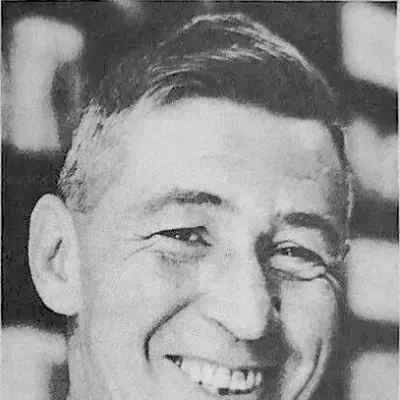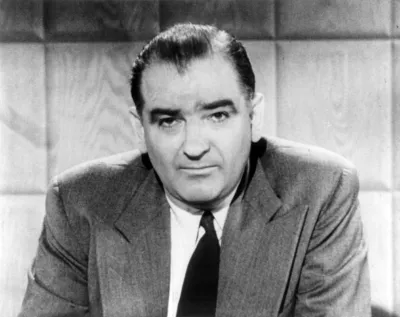
Joseph McCarthy
Human Design Chart
Biography
A Wisconsin farm-boy who became a country judge and Marine office, he was elected to the Senate in the Republican landslide of 1946 where he was known mainly for being a genial drinking companion and a soft touch for the real estate lobby. McCarthy's rise from obscurity to become a power to fear came almost overnight. Still an unknown at the start of 1950, he burst into prominence on 9 February 1950 in Wheeling, W. VA, when he uttered those now famous words: "I have here in my hand a list of 205, a list of names made known to the Secretary of State as being members of the Communist Party, who are nevertheless still working and shaping policy in the State Department." The numbers began the change in a matter of days to "207 bad risks", "57 card-carrying Communists," and "81 loyalty risks." Not one was a "card-carrying Communist" in the State Department and all those listed were from outdated files on government employees who had been investigated for offenses ranging from alleged communist and fascist sympathies to drinking problems and homosexuality. The bluff worked and the polls showed that half of the American public applauded while only 29 percent disapproved.
In the spring of 1950 McCarthy announced he'd uncovered "the top Soviet espionage agent," a man who was "Alger Hiss' boss in the espionage ring in the State Department." The "spy" turned out to be Owen Lattimore, a bespectacled John Hopkins University professor and East Asia expert whose only "crime" was predicting the fall of the Chinese Nationalist government and urging the U.S. to deal rationally with Mao Tse Tung. Even politicians who opposed McCarthy were not immune.
What does Projector 4/6 mean for Joseph McCarthy?
Projector 4/6 — Design at a Glance
Joseph McCarthy appeared with a dense, focusing aura that his environment often perceived as unpleasant. His design inclined him to immediately identify weaknesses in systems – comparable to a bright flashlight shining directly into the darkness. This ability to uncover flaws in others or structures could quickly be perceived as aggressive when he addressed these flaws directly rather than patiently illuminating them.
As a Projector, McCarthy lacked a defined Sacral, meaning he did not have a constant, intrinsic life force. Instead, he worked in phases of high intensity followed by necessary rest phases for regeneration. The conventional system, which expects constant productivity, ignored this need for pauses, making him vulnerable to burnout.
His strategy was to wait for a respectful and honest invitation from his environment before exercising his leadership role. If this invitation was accepted and his leadership respected, he was rewarded successfully. If he violated this strategy or acted without appropriate recognition, bitterness developed in his Non-Self. Thus, his design set a pattern that fluctuated between effective, inviting leadership and the risk of bitterness, depending on whether his specific rhythm of energy and pause was respected.
Splenic Authority
Joseph McCarthy demonstrated decision-making based on a fine, spontaneous inner impulse. His inner authority lay in the defined Spleen Center, signaling a pronounced survival intelligence. This mechanism acted as an immediate alarm system: His body and intuition served as reliable indicators of whether a situation or environment was healthy and right for him. Decisions therefore had to be made in the moment; the first spontaneous impulse was considered the correct path, directly serving his well-being. This allowed him to rigorously distance himself from harmful influences and take good care of himself.
However, since this spleen voice was a very subtle impulse that only occurred once in the moment, there was a risk that it could be drowned out or ignored by external influences. This required him to maintain a high level of vigilance. A temporary retreat could be helpful to clearly hear this soft inner sound. Because knowledge of the right thing was always only available in the concrete moment, long-term plans were often difficult for him to maintain or were vulnerable to short-term changes. His design therefore demanded a lot of flexibility and freedom; fixed commitments suited his nature less than spontaneous decisions made in the here and now. The openness of his Emotional and Sacral Centers was the prerequisite for this specific spleen authority to be effective.
The 4/6 Profile — Opportunist / Role Model
Joseph McCarthy emerged as someone who, in his youth, acted with an experimental spirit before his focus shifted to a deeper, almost transpersonal fixation on knowledge. His design as a 4/6er 'Networker/Role Model' set a fundamental tension: the conflict between the need to belong to a community and the later urge to withdraw to contemplate the meaning of life. In the first half of his life, he acted more like a 4/3er, intensely seeking connections. With the activation of the 6-line, however, a developmental line emerged characterized by repeated rule-breaking and punishment. This served the acquisition of self-control and patience. McCarthy possessed Gate 43 in the 4-line, describing a deep but often rigidly transmitted knowledge base. His linguistic skills were crucial for his effectiveness, yet the rigidity in knowledge transmission often made it difficult for others to understand. The large heart of a 4/6er opened cautiously to avoid being hurt by false people. Later, he was expected to meet the high standards of a wise role model, stand out through cooperation, and find the right answers despite earlier excesses.
Split Definition — Defined & Open Centers
Joseph McCarthy was someone whose thinking and speaking were inseparably intertwined. His defined Ajna Center ensured a constant mental activity; he was always in the process of conceptualizing. These thoughts flowed directly into his defined Throat Center, allowing him to express what he thought immediately and with a specific, trustworthy voice. His mental preference was stable and hard to influence from the outside, thereby shaping the mental field of his environment.
Additionally, he had a defined Spleen Center, which gave him a spontaneous, intuitive perception in the present moment. This existential intelligence served as a protective mechanism and allowed him to make quick, instinctive judgments that could not be rationalized. His defined Root Center provided a constant, adrenalized pressure that propelled him forward and helped him deal with stress to pursue material goals or enforce corrections.
In contrast, his open Head Center revealed a vulnerability to external mental pressure. McCarthy tended to identify with the questions and doubts of others when he did not trust his inner authority. The open G Center meant that he did not have a fixed, unchanging identity but adapted to his environment; he intuitively sensed whether a place or relationship was right for him. His open Heart Center made him vulnerable to trying to prove his worth through promises or competitive thinking, which could lead to a cycle of self-doubt if he failed. Furthermore, his open Sacral Center was sensitive to the energy of others, leading him to easily feel overwhelmed if he did not pay attention to his own boundaries. Finally, his open Solar Plexus absorbed the emotions of his environment, causing him to amplify and personalize emotional waves of others rather than experiencing them as his own.
Channels for structured insight and meaningful life struggle.
Joseph McCarthy was someone whose thinking often felt light-years ahead, coupled with a stubborn determination to follow his own path. His design tended towards innovative but initially hard-to-digest perspectives. The Channel of Structuring 43-23 connected the Ajna Center with the Throat Center. This allowed for spontaneous insights through Gate 43, which then had to be processed and clearly expressed through Gate 23. McCarthy had to learn to let go of control and allow his mind to process knowledge at its own pace rather than planning ahead. When he explained his unique insights simply and clearly, his genius was recognized; otherwise, he was dismissed as an outsider at the wrong time.
Simultaneously, the Channel of Life Struggle 38-28 drove him forward. This channel connected the Root Center with the Spleen Center and gave him the energy to fight for his individual integrity. Gate 7 urged him to resist distracting forces, while Gate 28 sharpened his awareness of which struggles were worth fighting. McCarthy sought meaning in these confrontations and risked security to fight for what he believed was right. This adrenalized energy required inner authority to avoid falling into blind resistance.
Additionally, Gates like 4 (Formulation for Future Security) and 48 (Pattern Recognition, often frustrating) shaped his analytical depth. Gate 11 promoted visual memories for situational assessment, while Gate 33 supported the process of reflection and withdrawal to process experiences. Gate 32 sought continuity and material stability for the tribe, allowing radical changes only when necessary. This configuration described a person who acted through clear communication and persistent struggle for their principles, with the acceptance of his ideas strongly dependent on the right timing and clear explanation.
Individual Circuitry — Circuit Signature
Joseph McCarthy's design revealed that he carried separate, parallel energetic streams within himself that did not directly communicate with each other. His chart showed a split definition, meaning that his inner forces worked in isolated blocks rather than flowing as a cohesive whole.
The Knowledge Circuit shaped two independent segments. On one hand, it connected the Ajna Center with the Throat Center. This connection promoted the ability to articulate mental concepts and structures verbally and outwardly. It was about the articulation of thoughts, not their emotional coloring. On the other hand, there was a separate connection between the Spleen Center and the Root Center. This channel, known as the Life Struggle, generated a pulsating, acoustic energy aimed at survival instincts and immediate reactions.
Since these two groups were not connected, Joseph McCarthy lacked a direct energetic bridge between his intellectual structuring and his emotional or instinctive drive. The ability to clearly express ideas thus existed parallel to the urgent, often impulsive energy of the survival struggle, without these two aspects automatically transitioning into or stabilizing each other. This resulted in a profile where rational formulation and instinctive urgency existed as separate, coexisting forces.
Right Angle Cross of Explanation 4
Joseph McCarthy was marked by the 'right cross of the Declaration 4', a configuration that points to a deep, often unconscious search for clarity and truth. This design element endows the individual with an internal tension between the desire to lay things open and the necessity to fully understand these insights before carrying them outwards. It is a dynamic force that tends to uncover hidden structures or inconsistencies, not necessarily with the intention to manipulate others, but out of a pressing need to complete one's own search for truth.
The mechanics of this cross mean that Joseph McCarthy was particularly sensitive in situations where uncertainties or deceptions prevailed. His design promoted a stance aimed at bringing the hidden to light to create inner order. This did not always happen as a conscious strategic decision but rather as an automated reaction to external stimuli that triggered his inner unrest. The energy of this cross drove him to ask questions and find answers that made sense to him personally, with the process of explanation often more intense than the result itself. This configuration suggested that his actions were always guided by a deep inner compass seeking authenticity and transparency, even if this was sometimes perceived as aggressive or impatient in the outside world.
Saturn Return · Uranus Opposition — Life Cycles
Joseph McCarthy was someone who sought and found structural confirmation in his thirties. In 1939, at the age of 31, he was elected as a circuit judge in Wisconsin. This marked his first Saturn Return, a cycle where years of groundwork often condenses into a solid result, reinforcing one's life structure. For his design, this moment was a turning point where inner ambitions were translated into external authority.
Later, in 1946 at the age of 38, he won the Senate election with 61.2% of the vote. This fell into the phase of the Uranus Opposition, a period often marked by sudden breaks and unexpected new possibilities. Here, his design's reaction to societal tensions was shown: not through gradual adaptation, but through explosive, disruptive energy challenging established structures. The high approval rate highlighted that this unorthodox approach found strong resonance in this specific life phase. Both events underscore how Joseph McCarthy used the archetypal urges of his planetary cycles to consolidate political power – first through structural anchoring, then through revolutionary ascent.
Projector · Splenic Authority — Synthesis
Joseph McCarthy was a projector, defined by his mental center (Ajna) and the Channel of Structuring (43/23), destined to recognize patterns and communicate them clearly. He quickly saw what was not working for others (Gate 43) and processed these insights to express them (Gate 23). This ability to 'shed light on the dark' was, however, marked by his Spleen Authority: spontaneous, instinctive knowledge of what was right or wrong guided his decisions.
A central paradox in his design was the tension between the desire for belonging (Line 4 in the Profile) and the need to act as an independent role model (Line 6). This led to an internal conflict between the wish to be part of a community and the drive to distance oneself and advocate for one's own insights. The defined structure of the Knowledge Circuit reinforced this drive to form and express new perspectives, while the Spleen Authority pushed him to rely on his instincts and distance himself from harmful influences.
2 Defined Channels
Incarnation Cross - Right Angle Cross of Explanation 4
Solar Return
The Solar Return shows the moment when the sun returns to its exact birth position - your personal solar year.
Life Cycles
Discover the life cycles with a detailed triple view (birth chart, cycle chart, composite).
Human Design Profile
- Type
- Projector
- Strategy
- Wait for the respectful invitation
- Authority
- Splenic Authority
- Profile
- 4/6 - Opportunist / Role Model
- Definition
- Split Definition
- Incarnation Cross
- Right Angle Cross of Explanation 4
- Date of Birth
- 14.11.1908 15:00
- Place of Birth
- Grand Chute, WI, United States
Frequently Asked Questions
What was Joseph McCarthy's Human Design type?
What Profiles did Joseph McCarthy have?
What Authority did Joseph McCarthy have?
What incarnation cross did Joseph McCarthy have?
When was Joseph McCarthy born?
Discover your own Human Design
Are you also a Projector? Find out in a personal reading how to unfold your leadership qualities and recognize the right invitations.
More Personalities
Back to overviewSissy Spacek

Alain-Fournier

Anémone

Ann-Margret

Bourvil
Hergé