
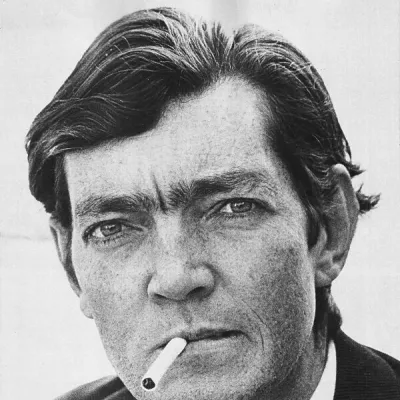
Julio Cortázar
Human Design Chart
Biography
Cortázar influenced an entire generation of Spanish-speaking readers and writers in the Americas and Europe. He has been called a modern master of the short story. Cortázar also published several novels, including Los premios (The Winners, 1960), Hopscotch (Rayuela, 1963), 62: A Model Kit (62 Modelo para Armar, 1968), and Libro de Manuel (A Manual for Manuel, 1973).
This great writer left us such beautiful timeless phrases as: Come sleep with me: We won't make Love,Love will make us.
The Human Design of Julio Cortázar: Manifesting Generator 3/5
Manifesting Generator 3/5 — Design at a Glance
Julio Cortázar revealed himself as a hybrid being that combined the constant energy of a Generator with the lightning-fast implementation power of a Manifestor. His design inclined him to draw things into his life by skipping steps and pursuing multiple projects simultaneously. However, this speed was a double-edged sword: Often, his actions were too quick, causing important stages to be missed, forcing him to return later to fill gaps. This quickly led to frustration with his specific non-self theme.
As a Manifesting Generator, Julio Cortázar had a defined Sacral Center that provided him constant energy. The strategy was not to initiate himself but to react to impulses. Only when this inner resonance signaled a clear 'yes' should he act. He was successful when he fell into a playful mode and sought variety. The demand to finish one thing before starting another stood in opposition to his nature. Instead, he drew deep satisfaction from parallel creation as long as his inner authority consented. Without this alignment, his creative joy quickly tipped over into overburdening and dissatisfaction. His design thus demanded a balance between impulsive reaction and the acceptance of his hybrid, fast pace.
Emotional Authority
Julio Cortázar's design inclined him to emotional wave movements that significantly shaped his perception and decision-making. His inner authority lay in the defined Emotional Center - a mechanism that takes precedence over all other defined centers for every type except Reflectors. This meant that his feelings were not just accompaniments but the actual source of directional decisions.
The world appeared colored by his current mood: At one moment, he could be totally enthused about an idea or person; in the next, the same thing would be negatively evaluated. His design indicated that such a first impression was merely a snapshot and not necessarily the truth. Quick, spontaneous decisions from such an emotional peak often had negative repercussions.
Instead of acting immediately, his configuration required patience and time. He needed to let decisions mature, ideally multiple times overnight. Over time, intense feelings subsided, emotional distance grew, and clarity and calmness set in. This process was particularly relevant for long-term, life-changing steps. Only after this emotional cycle had run its course could he make a well-founded choice that aligned with his deep truth rather than following only a passing mood.
The 3/5 Profile — Martyr / Heretic
Julio Cortázar revealed himself through Profile 3/5 as someone who derived knowledge not from dogma but from direct, often chaotic practice. As an experimenter of Line 3, he initially believed in little and had to test connections himself. This path of trial and error shaped his attitude: He amassed a rich trove of practical life experiences that he then presented as a hero or savior (Line 5) to others. His attractiveness to his environment arose from his ability to elucidate complex realities - including their beauty and ugliness - from his own perspective. Others projected expectations onto him because they wanted to learn how to recognize the true spectrum of here and now. Yet, this role carried a shadow side: Failing in public was painful, especially in areas of relationships and intimacy where Line 3 attempts often appeared promiscuous or unstable. Cortázar lived this duality; he helped others understand their dissatisfaction with reality by sharing his own failures and insights. His strength did not lie in theoretical perfection but in survival through experience. He was a storyteller whose authority rested solely on what he had personally experienced. This configuration created a figure who combined humor and rebellion with the burden of public expectations - a hero who found truth only through failure.
Split Definition — Defined & Open Centers
Julio Cortázar's Human Design profile indicated a tendency towards a powerful, independent expression style based on inner security and vital energy. His defined G Center gave him a firm sense of self-identity and clarity about his own direction; he knew who he was without being determined by others' expectations. This internal consistency was supported by his defined Heart Center, which provided the willpower to fulfill promises and actively assert his own worth. He tended to act autonomously and control his resources independently.
His motor center, the defined Sacral Center, supplied him with a constant source of vitality. His energy was released not through initiatives but in response to external stimuli; he found satisfaction in engaging with things that triggered his sacral resonance. His defined Throat Center served as a reliable channel for these energies: He communicated and acted directly from his identity (G), will (Heart), and generative power (Sacral). Thus, his voice was authentic, clear, and marked by a consistent inner truth.
In contrast, his open Head and Ajna Centers lacked a firm mental structure; he was vulnerable to the pressure of having to find answers or getting stuck in doubts that were not his own. Instead of losing himself in intellectual monologues, he used this openness to absorb ideas from his environment and filter them through his defined centers. He tended to question whether he needed to understand something but ultimately relied on his emotional clarity (defined Solar Plexus Center) and intuitive moment instinct (defined Spleen Center) for decision-making. His defined Root Center ensured that this process was accompanied by a healthy existential drive, keeping him alive and in motion.
Channels for intuitive power, synthesis and connected community.
Julio Cortázar demonstrated patience with himself to collect experiences and later transform them into coherent narratives. This approach stemmed from the Lost Son Channel 13-33: Gate 13 actively listened and stored secrets while Gate 33 withdrew to reflect on these impressions before sharing them. It was a process of maturation where he learned to trust events as an aware observer rather than distorting them through personal expectations.
Simultaneously, Julio Cortázar possessed immediate intuitive power. The Charisma Channel 34-20 connected his generative life energy from the Sacral Center directly with the ability for momentary expression in the Throat Center. This gave him the capacity for quick, powerful actions if he waited for internal triggers. Complementing this was the Brainwave Channel 57-20, which immediately translated intuitive insights from the Spleen Center into words. Here, the knowledge 'I know that I am living now' spoke directly out, supported by the survival intelligence of the Power Channel 34-57, keeping him alert and selective towards his environment.
In interpersonal relationships, Julio Cortázar sought deep connection. The Synthesis Channel 19-49 drove him to feel belonging and define principles that held the 'tribe' together. He was sensitive to emotional waves of acceptance or rejection. Parallel to this, he built bridges through the Community Channel 37-40, based on fair agreements: Gate 40 willingly worked for those he loved but also demanded recognition and breaks while Gate 37 sought his place in the whole. This configuration shaped his pursuit of relationships that were both emotionally grounded and supported by mutual respect and clear agreements.
Individual Circuitry — Circuit Signature
Julio Cortázar's design inclined towards impulsive, creative insights that directly translated into expression. This configuration was evident through the Knowledge Circuit connecting his Throat Center with the Spleen Center via the 'Flash of Insight' Channel (20-57), promoting innovative ideas immediately verbalized – a pulsating energy of the present moment. Simultaneously, the Integration Circuit also included the Throat Center and linked it to the Sacral Center as well as the Spleen. Here, charisma (20-34) and power (34-57) were connected, translating intuitive perception into powerful action. Both circuits shared the Throat Center, generating a high density of expression: Creativity and instinctive knowledge flowed together.
A separate area of his design concerned emotional meaning-making. The Meaning-Making Circuit linked Julio Cortázar's Throat Center with the Identity Center via the 'Lost Son' Channel (33-13), indicating a cyclical processing of past experiences, reflecting on them to affirm his identity. However, this emotional wave did not directly flow energetically with other groups as Julio Cortázar had a split definition.
The third group included Heart, Solar Plexus, and Root Centers in the Ego Circuit. Channels 'Community' (40-37) and 'Synthesis' (49-19) promoted cooperation and mutual support within the tribe here. As this group was separate from others, two parallel forces existed: on one hand, individual creative expression strength; on the other, collective emotional attachment to the environment. This separation prevented a single continuous flow but instead created distinct areas of individual creation and group interaction.
Right Angle Cross of the Sleeping Phoenix 3
Julio Cortázar's Human Design configuration was the 'Right Sleeping Phoenix Cross 3'. This structure established a specific internal dynamics characterized by the potential for profound transformations, which often remained in states of rest or waiting. The cross symbolized inactive radiation but latent power that waited for the right moment or external activation. The term 'sleeping' highlighted that this energy was not constantly available, but periodically awakened to set new perspectives or creative impulses free. For Julio Cortázar, this meant a lifestyle marked by inner collection, connected with sudden moments of clarity and renewal. The mechanics of this cross described not linear development, but cyclical phases of slumber and awakening in which hidden talents or insights could only fully unfold when external conditions were right. This configuration demanded patience and trust in one's own internal rhythm rather than forcing constant activity. It shaped an attitude of observation and waiting for the right impulse to awaken and make use of this sleeping energy.
Saturn Return · Uranus Opposition · Chiron Return · 2nd Saturn Return — Life Cycles
Julio Cortázar's Human Design laid a tendency towards deep structural upheavals, often manifesting as professional reorientation. This dynamic was marked by the Uranus Return cycle, breaking established patterns and forcing new paths. In 1952 at age 38, he worked for UNESCO as a translator – a concrete example of how this planetary influence questioned existing roles and led to a new, often more international orientation.
Later came the second Saturn Return phase, one of maturation and consolidation where earlier efforts found their final form. This cycle demands discipline and completion of long-held projects. In 1971 at age 57, Julio Cortázar published 'Pameos y meopas'. This was no mere coincidence but a logical consequence of a design that in this life phase leans towards synthesis and conclusion. The mechanics here clearly show: while the Uranus Return opens doors to new possibilities, the Saturn Return secures these achievements through concrete, lasting works. Julio Cortázar lived this range between revolutionary change and structured anchoring, where both cycles were crucial for his professional journey.
Manifesting Generator · Emotional Authority — Synthesis
Julio Cortázar lived an inner continuous drive to collect experiences and transform them into new forms. His Human Design as a Manifesting Generator (with defined Sacral Center) points to a constant energy source that accelerated through the ability to skip steps. This dynamic was reflected in the Knowledge Circuit – constantly taking in impressions (Gate 13), reflecting on them (Channel 33), and then passing them on in new forms. The connection to the Throat Center underscored the importance of communication as an expression of this inner transformation, with experimenting and testing out (Profile 3/5) playing a central role. A key event at age 38 – working for UNESCO as a translator – pointed to an early expression of this need for mediation and change.
A central paradox in Cortázar's design lay in the tension between emotional authority and the impulsive nature of the Manifesting Generator. The defined Emotional Center required time to let decisions mature, while the energy to quickly initiate things often stood in opposition. This may have led to an inner struggle between the need for thorough reflection and the temptation to act immediately – a field of tension that showed itself in cycles, such as with the publication of 'Pameos y meopas' at age 57 after a phase of deeper confrontation.
6 Defined Channels
Incarnation Cross - Right Angle Cross of the Sleeping Phoenix 3
Solar Return
The Solar Return shows the moment when the sun returns to its exact birth position - your personal solar year.
Life Cycles
Discover the life cycles with a detailed triple view (birth chart, cycle chart, composite).
Human Design Profile
- Strategy
- To respond - wait for something to respond to
- Authority
- Emotional Authority
- Profile
- 3/5 - Martyr / Heretic
- Definition
- Split Definition
- Incarnation Cross
- Right Angle Cross of the Sleeping Phoenix 3
- Date of Birth
- 26.08.1914 11:50
- Place of Birth
- Ixelles, Belgium
Frequently Asked Questions
What was Julio Cortázar's Human Design type?
What profile did Julio Cortázar have?
What authority did Julio Cortázar have?
What incarnation cross did Julio Cortázar have?
When was Julio Cortázar born?
Discover your own Human Design
Are you also a Manifesting Generator? Find out in a personal reading how to unfold your multi-talents and direct your energy wisely.
More Personalities
Back to overviewAlain-Fournier

Aldair

Alizée

Angeli

Arletty

Artus
