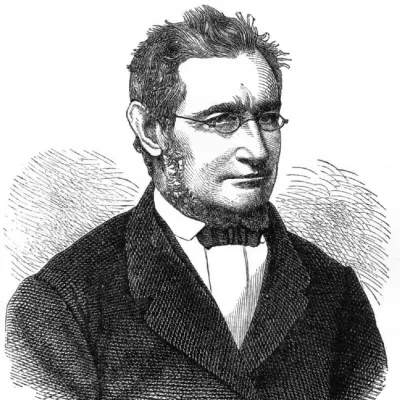
Julius von Mayer
Human Design Chart
Biography
He studied medicine at Tübingen, Munich and Paris, and while serving as a surgeon on a ship, Mayer studied the color difference between arterial and venous blood. Working independently of Joule, he concluded that the human body produces less energy by combustion when temperatures are elevated; this led him to determine the general relationship between heat and work. In 1842, he published his announcement regarding these findings in "Bemerkungen über die Kräfte der unbelebten Natur," and in 1845, he made a more general statement of the principle that came to be known as the first law of thermodynamics.
Mayer died on 20 March 1878 at age 63 in Heilbronn.
The Human Design of Julius von Mayer: Manifesting Generator 3/5
Manifesting Generator 3/5 — Design at a Glance
Julius von Mayer revealed himself as a Hybrid being: He had the constant energy source of a Generator, yet he also possessed the ability to swiftly initiate actions. This design combined endurance with an unique speed that allowed him to skip steps and quickly draw things into his environment.
The challenge lay in this speed. Often, his impulses were so quick that important intermediate steps were overlooked. In such cases, he had to backtrack to make up for what was missed – a process that easily led to frustration as it aligned with the Non-Self theme of his configuration. Additionally, he tended to pursue multiple projects simultaneously, driven by various impulses. Without inner consent, this creative drive threatened to slip into chaos.
The key to his satisfaction lay in responding to life correctly. Only when his Sacral Center gave a clear "yes" did he invest his energy. With this proper alignment, the potential frustration transformed into deep contentment. He then enjoyed working on various tasks simultaneously and entered a playful mode. Variety was not a distraction for him but rather the fuel of his creative power.
Emotional Authority
Julius von Mayer exhibited an internal decision-making structure that did not solidify in the moment of first enthusiasm or rejection. His design carried Emotional Authority, meaning his defined emotional center always took precedence over all other aspects of his character – regardless of which additional centers were defined. This mechanism shaped him through a constant emotional wave; his perception of the world was always colored by his current mood. What appeared magnificent in one moment could seem negative in the next. His immediate feeling was, however, only a provisional snapshot, not necessarily the deeper truth yet. Quick, spontaneous decisions made from this emotional heat risked negative consequences as they were based on fleeting impressions. Julius von Mayer needed time to gain clarity. By letting decisions rest and sleeping multiple times overnight, the emotional surge could subside. Only when intense feelings subsided and an emotional distance emerged did calmness set in. This process of waiting was no obstacle for him but rather the necessary path to grounded insights, especially regarding long-term life decisions that significantly influenced his further course. Through this patience, he distinguished between transient mood and true inner direction.
The 3/5 Profile — Martyr / Heretic
Julius von Mayer revealed himself through his 3/5 design as someone who did not acquire knowledge from doctrines but rather through personal experimentation. As an experimenter of the third line, he initially believed little in preconceived truths and instead learned from direct experiences and setbacks. This process of trial and error served to develop practical competencies that later contributed to his awareness of his own power.
His fifth-line profile marked him as a heroic figure who presented these self-acquired insights to others. This role was attractive to those around him because it offered a treasure trove of lived experience. Julius von Mayer drew attention through this authenticity and became a reference point for others who wanted to benefit from his learning processes. Especially in crisis moments, he could use his charm to win people over or offer solutions. The interplay between the necessary failures during experimentation and his later role as a rescuer created a strong yet vulnerable presence. When experiments failed in public, it deeply affected him because his status was based on perceptions of his competence. His design suggested that he solved others' problems by sharing what he had learned from his own mistakes—a dynamic that generated both admiration and high pressure.
Single Definition — Defined & Open Centers
Julius von Mayer revealed himself as someone with a deeply rooted identity and a clear inner compass. His defined G Center endowed him with consistent self-love and the ability to show others new directions without falling into dependencies. This inner security contrasted with the allure of his defined Solar Plexus Center, which taught him not to make decisions impulsively. Instead of reacting immediately, he was designed to wait for emotional waves until clarity emerged – a process that required patience and allowed him to recognize deeper truths in relationships and projects.
His energy source lay in his defined Sacral Center. As a Generator, he possessed immense vital force, but it could only be correctly available through reactions to external stimuli. Initiated actions without prior invitation often led to frustration or exhaustion as they were not supported by this sacral energy. Instead, he found satisfaction in reacting to life and using his energy for tasks that elicited an affirming response from the gut.
Communication occurred via his defined Throat Center, which served as a pivot point to translate messages from other centers into words or actions. This gave his expression a reliable yet limited quality. Supported by his defined Spleen Center, it provided him with a strong instinct for health and well-being. He could spontaneously recognize what was existentially correct and used this intuitive intelligence to protect himself from danger and live in the moment.
In contrast, Head, Ajna, and Heart Centers were open. The open Head and Ajna Centers meant he did not have consistent mental inspiration but rather absorbed ideas from his environment. He tended to engage with foreign questions or concepts instead of generating his own answers. The open Heart Center lacked a persistent willpower; he was not designed to make promises or prove his worth through competition. Instead, he learned to release the need to prove himself and perceive the vibrations of others' egos without being infected by them.
Channels for change, leadership, meaning and emotional depth.
Julius von Mayer exhibited a fundamental orientation towards evolutionary change and collective leadership. His design marked him as someone who sought deeper connections and carried these with a clear voice into the world.
Central to this was Channel of Mutation 60-3. This connection between Root and Sacral Center brought potential for unexpected, mutative impulses. Julius von Mayer had to learn to accept limitation (Gate 60) and move beyond the confusion of a new beginning (Gate 3). This generated a powerful, pulsing energy that pushed him towards innovation, often accompanied by melancholic phases when his inner pulse stilled.
Simultaneously, Channel of Alpha Animal 7-31 was active in his design. This channel connected the G Center with the Throat Center and gave him a logical, collective leadership quality. Through Gate 7 (Role of Self) and Gate 31 (Lead), he sought tested patterns to guide others. His leadership did not rest on authority but rather on gaining community trust and logically pointing out the way into the future.
In his personality also worked Channel of Charisma 34-20 and Channel of Life Struggle 38-28. The Charisma channel endowed him with a direct, manifesting power guided by sacral reaction while the Life Struggle channel pushed him to find meaning in his struggles and stand for his integrity.
Additionally, Gates like Gate 9 (Detail Work), Gate 18 (Correction) and Gate 62 (Logic) shaped how he dealt with facts and patterns. This combination allowed him not only to recognize complex connections but also to communicate them precisely and convincingly.
Individual Circuitry — Circuit Signature
Julius von Mayer revealed himself as someone whose energetic structure was marked by a single, continuous group. This simple definition connected his Sacral, Root, Spleen, and Solar Plexus Centers directly with the Throat and Identity Centers. This created an uninterrupted flow of inner power from emotional intuition to verbal expression and personal identity.
In the Knowledge Circuit, Channels for Mutation, Life Struggle, and Emotional Release were active in him. They connected Sacral, Root, Solar Plexus, and Spleen Centers into a pulsing whole. This promoted a tendency to go new ways and express insights through emotional waves. Parallel to this, the Understanding Circuit with the Alpha Animal Channel determined the connection between Throat and Identity Centers. Here it was about sharing logical, rational insights free from emotional coloring to lead society towards a better future.
The Integration Circuit closed this circle via the Charisma Channel connecting Throat and Sacral Centers. This allowed him to intuitively guide power from reacting to life and make an impact in the present moment. All these energies – from innovative mutation over rational strategy to charismatic implementation – flowed in Julius von Mayer as a single coherent stream. There were no separate or isolated energetic islands; instead, his entire design worked as an integrated unit that seamlessly linked knowledge, identity, and expression.
Right Angle Cross of the Sleeping Phoenix 4
Julius von Mayer carried the design of the right cross of the sleeping phoenix. This configuration conveyed a deep, often unconscious connection to the energetic patterns of his environment. He did not make an impact through loud self-promotion but rather through a quiet, almost magnetic presence that drew others in without actively seeking attention. His influence radiated outward from within; he was a channel for energies that he could not always fully control or understand.
This cross is formed by specific connections in the Human-Design system linking the emotional center with the solar plexus center and other areas, creating an energetic echo: what happened in the world resonated within him. Julius von Mayer intuitively felt these streams of energy. He did not always react rationally to external stimuli but followed an inner compass that was often non-linear. His strength lay in channeling these subtle energies into his actions or thoughts.
The 'sleeping' element indicates that this potential was not always visibly active. It required specific triggers or life phases for it to fully unfold. In quiet moments, it could be silent; during times of change, however, it became effective. Julius von Mayer lived with this ambivalence: on one hand reserved, yet potentially strongly influential when the right conditions were present. His design challenged him to accept these inner streams and not fight against them but integrate them as part of his identity.
Saturn Return · Uranus Opposition · Chiron Return · 2nd Saturn Return — Life Cycles
Julius von Mayers design showed a tendency towards structural consolidation and recognition that manifested in clear life phases. In 1842, at age 28, he published the announcement of his results on the relationship between heat and work. This coincided with his first Saturn return, a cycle where internal convictions often crystallize into public positions. The energy of this time promoted the ability to pour long-term groundwork into a viable, visible result.
Later, in 1871 at age 57, he received the Copley Medal from the Royal Society. This marked his second Saturn return, a phase traditionally associated with confirmation of one's path and integration into existing structures. For his chart, this was a moment of validation: earlier work now found institutional recognition. Both events illustrate how Saturn cycles for him were not just temporal markers but catalysts for anchoring his insights in the scientific community. His design used these periods of maturity and consolidation to transform private discoveries into recognized facts.
Manifesting Generator · Emotional Authority — Synthesis
Julius von Mayer lived a lifestyle deeply influenced by an inner drive towards exploration and transformation. His design as a Manifesting Generator (with defined Sacral Center) points to someone who, while having constant energy, did not use it linearly. Instead, he experimented continuously (Line 3 in Profile), pushed too far and had to return repeatedly – a dynamic amplified by the channel of Mutation (3-60). This constant testing and discarding led to a rich trove of practical experiences that he enjoyed sharing (Line 5) to help others.
Central to his essence was a paradox between the need for rapid progress and the necessity of emotional maturity. The Manifestor component in his Generator design allowed him to quickly initiate things, yet his emotional authority required thorough engagement with his feelings over time. This tension manifested in documented events: the swift publication of results (1842) and later recognition by the Royal Society (1871), both outcomes of a process that was both impulsive and reflective.
5 Defined Channels
Incarnation Cross - Right Angle Cross of the Sleeping Phoenix 4
Solar Return
The Solar Return shows the moment when the sun returns to its exact birth position - your personal solar year.
Life Cycles
Discover the life cycles with a detailed triple view (birth chart, cycle chart, composite).
Human Design Profile
- Strategy
- To respond - wait for something to respond to
- Authority
- Emotional Authority
- Profile
- 3/5 - Martyr / Heretic
- Definition
- Single Definition
- Incarnation Cross
- Right Angle Cross of the Sleeping Phoenix 4
- Date of Birth
- 25.11.1814 00:15
- Place of Birth
- Heilbronn, Germany
Frequently Asked Questions
What was Julius von Mayer's Human Design type?
What Profile did Julius von Mayer have in Human Design?
What authority guided Julius von Mayer?
What incarnation cross did Julius von Mayer have?
When was Julius von Mayer born?
Discover your own Human Design
Are you also a Manifesting Generator? Find out in a personal reading how to unfold your multi-talents and direct your energy wisely.
More Personalities
Back to overviewAldair

Alizée

Angeli

Arletty
Artus

Balthus