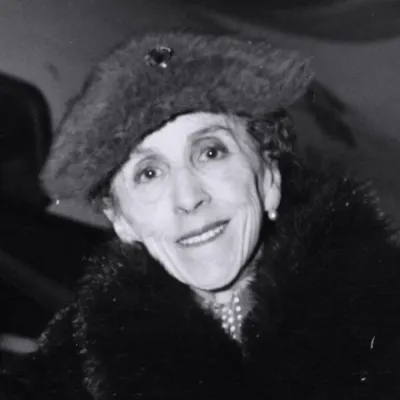
Karen Blixen
Human Design Chart
Biography
One of five kids, she was born into a strict maternal bourgeois family that idolized the aristocratic class. Her father, Wilhelm Blixen, was an adventurer who spent his youth as a trapper in the U.S. Her father killed himself in 1895 when Karen was ten, leaving the young girl feeling alone among her conventional surroundings. She was an intellectual, fun-loving child who felt stifled by the strict upbringing of her mother. Blixen fell in love with her Swedish second cousin and when he didn't return her love, she became betrothed to his twin brother Baron Bror Blixen-Finecke. Soon after her marriage at the age of 28 in 1913, Blixen moved to what was then British East Africa.
With her family's financial backing they purchased a 6,000 acre coffee-farm. Her marriage faltered under her husband's philandering, which left her with syphilis, his incompetence in business and irresponsibility. She fell in love with Denys Finch Hatton, a dashing English army pilot and second son of the Earl of Winchelsea. Despite their love, Hatton refused to commit to their relationship and after eight years of marriage her husband wanted a divorce.
During her 17 years as mistress of a Kenya coffee-farm, Blixen went on adventurous hunting expeditions and spent many times alone. After the farm failed and Hatton was killed in an airplane crash, Blixen left Africa in 1931 and returned to her home, Rungsted overlooking the Oresund Coast. Encouraged by Hatton as a storyteller, Blixen began to write. "Seven Gothic Tales" was her first book published in English, 1933. It was a critical and commercial success in the U.S. but not in her home country.
Her most famous work, "Out of Africa," published in 1937, was her autobiographical account of life in Kenya.
The Human Design of Karen Blixen: Manifesting Generator 2/4
Manifesting Generator 2/4 — Design at a Glance
Karen Blixen revealed herself as someone who carried a hybrid nature of manifesting speed and generative energy. Her design indicated a tendency to skip steps and handle multiple tasks simultaneously. This configuration described a Manifesting Generator: a type that belonged to the Generator family and possessed constant sacral energy, but also had Manifestor qualities due to an active connection between Motor Centers and Throat Center.
This combination allowed for lightning-fast actions in life. However, this speed carried two risks: skipping necessary intermediate steps often required going back later to catch up, which caused frustration – a non-self theme of this type. Additionally, Karen Blixen tended to react simultaneously to many impulses and initiate diverse projects at once. Without regard for strategy and authority, her creative enthusiasm quickly turned into dissatisfaction.
The effective use of this power required responding to life impulses rather than initiating on a whim. Only when the sacral center responded with a clear "Yes!" could she proceed. Regular checks to ensure continued inner agreement were crucial. Under these conditions, Karen Blixen drew deep satisfaction from her work. Parallel work then became no obstacle but instead fostered a productive play mode in which variety and fun nourished creativity rather than fragmenting or exhausting it.
Sacral Authority
Karen Blixen oriented her decisions towards a clear internal resonance. As a Generator, she possessed sacral authority, which unified her strategy and inner guidance and simplified the decision-making process. This instance did not react to mental deliberations but rather responded to external stimuli through physical signals. It manifested as a gut feeling or an unexpected surge of energy. Karen Blixen learned to interpret her body's natural sounds: grunts, hums, or an affirming "Mhm" signaled agreement.
When her sacral motor engaged with something, she felt vital and alive. An inexhaustible flow of energy was available, enabling her to undertake tasks with great enthusiasm. This happened without compulsive purposefulness; the joy in doing was the driving force. She was born to immerse herself fully in her activities and experience contentment.
Additionally, the Spleen Center acted as a supportive instance. Since it was activated and possibly directly connected to the Sacral Center, it allowed for quick, spontaneous reactions. Karen Blixen had immediate access to her instinctive perception and physical well-being. This connection enabled her to make decisions rapidly and reliably guide herself from this deep inner knowledge without prolonged hesitation.
The 2/4 Profile — Hermit / Opportunist
Karen Blixen's design created an existential tension: the deep desire for isolated self-reflection constantly alternated with the urge to connect with a familiar community. As a person of Profile 2/4, the natural networker and talent, she oscillated between Line 2, which called her to withdraw into her "cave," and Line 4, which sought time with favorite people. This configuration required clear communication of her availability limits to avoid confusion—she had to make it clear when she wanted company and when she needed to be left alone.
During her withdrawal phases, Karen Blixen immersed herself in internal processes, clarified issues, and allowed the knowledge from her network to mature. Line 2 brought an unbridled energy that could grow and mutate; however, she had to endure until external impulses organized her inner instability. Once this need for solitude was satisfied, she returned to share what she had learned. Line 4 helped her build potential within her social boundaries and prepare for opportunities of mutation. Through this rhythmic sequence of isolation and exchange, she could effectively process external impressions and develop new insights without falling into depression or fixation. Her design revealed itself as a system that sought security in the alternation between privacy and relationship to make internal processes fruitful.
Single Definition — Defined & Open Centers
Karen Blixen's Human Design profile indicated a tendency towards immense inner stability and direct expressiveness. She had six defined centers, including Sacral, Heart, G Center, Throat, Spleen, and Root. This configuration created a strong foundation of vital energy (Sacral), clear will (Heart) and firm identity (G). Her voice was reliable as her defined Throat Center translated these inner forces directly into communication and action. She did not act impulsively but rather from a deep, mechanical consistency.
This massive internal anchor contrasted with her open centers: Head, Ajna, and Solar Plexus were undefined. While her will and identity remained constant, her emotional field was fluid. The open Solar Plexus Center absorbed the moods of the environment. Karen Blixen tended to interpret these absorbed feelings as her own or feel threatened by perceived conflicts, though her inner structure remained stable. She had to learn to distinguish between her firm truth and transient emotional waves.
The undefined Head and Ajna Centers also meant she did not have a consistent mental inspiration. Instead of getting lost in endless questions or the search for answers that were not hers, she could act as an observer of mental events. Her strength lay in using her defined energy and will without being distracted by external emotional or mental confusion. The challenge was to avoid misusing her strong presence to control the open emotional space but rather maintain the natural separation between her firm identity and fluid environment.
Channels for change, clarity, logic, leadership and determination.
Karen Blixen's Human Design profile indicated a tendency towards evolutionary change, which worked through acceptance of limitation and overcoming confusion. Channel 60-3 connected Root Center with Sacral Center; its pulsing on/off rhythm created inner tension felt as melancholy if no new idea emerged. At the same time, she radiated authentic presence: Channel 10-20 linked G Center with Throat Center and expressed self-love and present-moment awareness, inspiring others through her existence.
Her logical drive to correct patterns showed in Channel 58-18 between Root and Spleen Centers; she sought perfection and joy in solutions but only on invitation. Material responsibility shaped her attitude via the Line of Money 21-45 connecting Heart with Throat Center; this was about will expression and resource management for the tribe, often with tension between work and rest.
Persistence through sacral yes-reaction characterized Channel 29-46 between Sacral and G Centers; she pursued deep experiences to their end by letting go of expectations. Additional nuances came from Gate 50 (protective reflex, traditions), Gate 56 (mental narrative) as well as Gate 8 (contribution to the group). This configuration described an energy oscillating between change, authentic presence, logical correction, material control and persistent experience-seeking.
Individual Circuitry — Circuit Signature
Karen Blixen's Human Design profile indicated a tendency towards unique identity marked by deviation from the known. The Knowledge Circuit connected her Sacral with Root Center. This Channel of Mutation (3-60) fostered innovative flashes of insight and new understanding. Resulting change was articulated through emotional waves from Solar Plexus via Throat Center, making transformation effective for others. This energy showed as pulsating and acoustically.
Parallel to this, the Understanding Circuit connected Spleen and Root Centers. Here logical judgment (Channel 18-58) focused on improving things and rationally looking into the future free from emotional conditioning.
In the Meaning Circuit, Identity and Sacral Centers were linked. The energy of Discovery (Channel 46-29) referred to emotions and experiences from the past. These felt insights should be shared with the collective for mutual learning; here the emotional wave ran cyclically and descending.
The Ego Circuit connected Throat and Heart Centers. Through the Line of Money (Channel 45-21), it was about cooperation and creating resources as well as material prosperity within the tribe without direct connection to the constant life force of Sacral Center.
Finally, the Integration Circuit linked Throat and Identity Centers. Channel 20-10 served security of personal survival through intuitive power and correct behavior that worked in the present moment. These configurations formed separate but parallel existing energetic structures in her design.
Right Angle Cross of Laws 1
Karen Blixen's Human Design profile indicated a tendency towards strategic orientation, characterized by the right cross of Laws 1. This archetypal configuration formed the foundational structure of her life task and consciousness. It was not an accidental trait but rather a deeply rooted mechanical alignment that determined her way of perceiving the world.
The right cross of Laws 1 describes a specific energetic arrangement in the Human Design chart. It points to an inner logic aimed at bringing order into complex situations and making decisions based on clear principles. For Karen Blixen, this meant that her actions always stemmed from this strategic perspective. She sought out the underlying structure of events and relationships rather than being guided solely by surface phenomena.
This imprint worked as a constant backdrop to her personality. It shaped her reactions to challenges and defined the framework within which she deployed her energy. It was an inner compass needle that helped her set priorities and find paths that aligned with her deepest nature. Without external validation, this mechanism oriented itself according to internal laws that created stability and clarity within her.
Saturn Return · Uranus Opposition · Chiron Return · 2nd Saturn Return — Life Cycles
Karen Blixen's life followed a clear cyclical structure that condensed into four distinct phases. In 1913, at the age of 28, Bror purchased the Mbagathi Farm in Kenya. This coincided with her first Saturn Return, a time when inner maturity and external commitment converged to establish a long-term life framework. The farm became the central locus of her existence.
Ten years later, in 1925 at age 40, Karen and Bror divorced. This fell on the Uranus Opposition, a cycle of dissolution of old bonds and necessary change. Here, the mechanism of breaking free from structures that no longer aligned with her current self was evident to create new space.
The peak period of her creative output began in 1934 at age 49 with the publication of “Seven Gothic Tales” in English. This marked her Chiron Return, a fulfillment cycle where her inner purpose and life task increasingly unfolded in her life. It was not a healing process but rather an affirmation of her essence through artistic expression.
Finally, in 1942 at age 57, the publication of “Winter’s Tales” in New York and London followed. This correlated with her second Saturn Return, often bringing realignment or deepening of established life work. In this phase, her position as an author internationally stabilized. Each cycle contributed to exploring and solidifying her identity.
Manifesting Generator · Sacral Authority — Synthesis
Karen Blixen's life was marked by a profound interaction between inner dynamics and external reactions. As a Manifesting Generator with sacral authority, she lived a life characterized by the ability to respond to impulses and swiftly translate them into action – an energy amplified by the connection of Motor Center and Throat Center. Yet this quick access to potential for action always required careful scrutiny through her sacral authority to avoid frustrations and unfinished projects. The profile as a natural talent and networker reflected in a constant interplay between the need for solitude for reflection and the search for connection and exchange.
A central paradox in Karen Blixen's design lies in the tension between her ability to initiate things quickly (Manifestor aspect) and the necessity of reacting to life rather than pushing it forward (Generator aspect). This dualism manifested in a constant struggle between the desire for independence and the need for validation through her network. The combination of defined centers for identity, love, and communication with open centers for mental clarity and emotional awareness points to a personality that united inner drive with external stimuli – a life flowing between self-actualization and connection to the whole.
5 Defined Channels
Incarnation Cross - Right Angle Cross of Laws 1
Solar Return
The Solar Return shows the moment when the sun returns to its exact birth position - your personal solar year.
Life Cycles
Discover the life cycles with a detailed triple view (birth chart, cycle chart, composite).
Human Design Profile
- Strategy
- To respond - wait for something to respond to
- Authority
- Sacral Authority
- Profile
- 2/4 - Hermit / Opportunist
- Definition
- Single Definition
- Incarnation Cross
- Right Angle Cross of Laws 1
- Date of Birth
- 17.04.1885 16:00
- Place of Birth
- Rungsted, Denmark
Frequently Asked Questions
What was Karen Blixen's Human Design type?
What Profile did Karen Blixen have in Human Design?
What Authority did Karen Blixen have?
What incarnation cross did Karen Blixen have?
When was Karen Blixen born?
Discover your own Human Design
Are you also a Manifesting Generator? Find out in a personal reading how to unfold your multi-talents and direct your energy wisely.
More Personalities
Back to overviewAldair

Alizée

Angeli
Arletty

Artus

Balthus