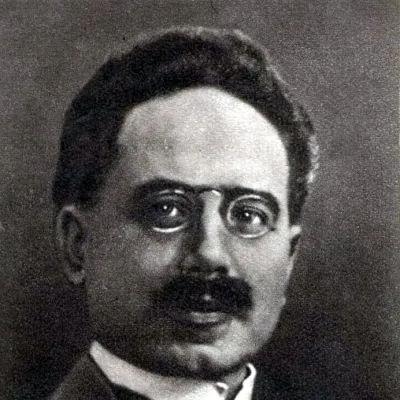
Karl Liebknecht
Human Design Chart
Biography
After serving with the Imperial Pioneer Guards in Potsdam during 1893–94 and subsequently as a junior barrister in Westphalia, Liebknecht returned to Berlin in 1898. In 1904, at a trial at Königsberg (now Kaliningrad, Russia), he defended propertyless peasants accused of infiltrating socialist propaganda from East Prussia into tsarist Russia. His defense of the accused was primarily an apology for social democracy and provided him with a platform for his attacks against militarism. In 1907 he played a principal role in the establishment of the International Union of Socialist Youth Organizations in Stuttgart. His publication of Militarismus und Antimilitarismus in the same year earned him a jail sentence of 18 months in Glatz, Silesia. While still in prison, he won a seat in the Prussian Landtag, and in 1912 he entered the Reichstag as the chief spokesman against the government and against the growing movement within theSocial Democratic Party to revise its Marxist doctrine.
During World War I Liebknecht became a leading figure in the development of opposition movements to the wartime government. He was the first in the Reichstag to vote against war credits and spoke out publicly, as early as January 1915, for the transformation of the national war into a civil or class war. The government conscripted him as a noncombatant but furloughed him to fulfill his duties as a deputy in the Reichstag and the Prussian Assembly. He served on the Düna sector of the Russian front, felling trees, peeling potatoes, and burying the rotting corpses of the dead, until he suffered physical collapse in October 1915. In 1916 he was expelled from the Social Democratic Party for opposing its leadership.
Human Design Analysis: Karl Liebknecht as Generator 2/4
Generator 2/4 — Design at a Glance
Karl Liebknecht was a Generator. This design endowed him with immense, sacral endurance, comparable to that of a workhorse ready to go as long as it received the right energy for its task. His life force did not generate through sheer will but from a deep inner resonance. The central dynamic of his character lay in the necessity to react rather than initiate. His design challenged him to wait for signals from life and only then act when his sacral center gave a clear 'yes'.
This mechanism, however, contained two significant pitfalls. First, burnout threatened if he engaged persistently with tasks that did not find inner resonance – a waste of his limited yet intense energy. Second, frustration arose when external circumstances prevented him from continuing work on his heart project despite his inner strength still being present. If Karl Liebknecht initiated against this principle and acted without the impulsive support from his gut, he faced ongoing exhaustion. Conversely, living in harmony with his strategy – reacting to impulses and then responding through action – rewarded him with a deep sense of fulfillment. His strength thus did not lie in the first movement but in the powerful, enduring response to life.
Sacral Authority
Karl Liebknecht showed a decision-making stance that was not based on intellectual analysis but on immediate physical impulses. As a Generator, his strategy was identical to his inner authority: sacral authority. This mechanism fundamentally simplified his decision-making process as he did not need external advisors or logical deliberations to find the right path. Instead of planning, he reacted to stimuli from his environment.
The prerequisite for this function was his open emotional center, meaning that he could not rely on temporary emotional waves. Rather, he listened to his 'gut feeling'. This manifested as a physical signal – a grunt, hum or spontaneous 'mmh' in agreement and a negative sound in disagreement. When his sacral motor engaged with something, he felt vital and energized. This state endowed him with seemingly inexhaustible power that allowed him to immerse himself enthusiastically in activities.
He lived to go through life with joy and satisfaction, fully absorbed in his tasks without needing an external purpose or benefit in the traditional sense. His energy was not goal-oriented but a self-purpose. Through this configuration, he could reliably be guided by his inner compass directly connected to his physical well-being and instinctive perception. This allowed him quick, spontaneous reactions to life as long as he paid attention to these physical signals without trying to replace or control them.
The 2/4 Profile — Hermit / Opportunist
Karl Liebknecht's design tended to constantly oscillate between the need for withdrawal and the urge towards community. As a 2/4 profile ('Natural Talent / Networker'), he was in tension: Line 2 (Hermit) demanded time alone to reflect on internal processes and gain clarity. Line 4 (Community), however, drove him to use his network and interact with 'favorite people'.
This dynamic required clear communication of boundaries. When the need for solitude was met, Karl Liebknecht emerged from his 'cave' to absorb knowledge from the social environment. Line 4 functioned as a transpersonal process driving through interactions; it sought influence and depended on others. This could lead to isolation if the network did not understand individual expression or misunderstandings occurred.
Line 2 brought themes of timing and tolerance. Incorrect response times often led to misunderstandings that Karl Liebknecht had to learn to accept as time-conditioned rather than an intellectual deficiency in others. During his Me-Time, he processed these experiences, evaluated the accumulated knowledge, and developed new ideas from it. His design thus marked a cycle: withdrawal for reflection followed by social exchange, with balance between solitude and connection crucial for his inner stability.
Split Definition — Defined & Open Centers
Karl Liebknecht's design tends towards a constant mental pressure to question and develop concepts. The definition between the Head Center and Ajna Center creates a perpetual state of inspiration and conceptual thinking. However, this mental process was not directly connected to energy sources, meaning that ideas alone did not have the power to drive action. Instead, his defined Throat served as a pivot point to translate these mental concepts into communication and action. The connection from Ajna to Throat allowed him to consistently articulate what he thought, thereby inspiring others to reflect.
As a Generator, Karl Liebknecht had a defined Sacral Center that provided an enormous source of vital energy. This energy was only available through reactions to external stimuli, not through initiated mental decisions. His defined Root Center also delivered a steady, adrenalized pressure that propelled him forward in the material world and helped him cope with stress.
In contrast, his G Center, Heart Center, Solar Plexus Center, and Spleen Center were open. The open G Center meant he did not have a fixed identity or direction but rather adopted these through interaction with his environment. He tended to question who he really was and where his true direction lay instead of knowing it from within himself. The open Heart Center made him vulnerable to the pressure to prove his worth through promises or willpower, despite lacking the consistent energy for this task. The open Solar Plexus Center caused him to absorb and amplify emotions from his surroundings, potentially leading him to experience foreign feelings as his own. Finally, the open Spleen Center was marked by a fundamental survival anxiety that made him prone to clinging to things that gave him a false sense of security rather than making spontaneous decisions. These open centers made him susceptible to conditioning and required him to listen to his inner authority to avoid resistance or exhaustion.
Channels for logical structure, maturation and abstract comprehension.
Karl Liebknecht's design tends towards analytical skepticism and structured communication. He was someone who questioned patterns before fixing them linguistically, setting a high value on logical consistency and innovative formulation. This attitude resulted from the interplay of several channels in the Head and Ajna Centers.
The Logic Channel 63-4 connects the Head Center to the Ajna Center through the Gate of Doubt (63) and the Gate of Formulating (4). This created a doubting mind that constantly filtered patterns to check if they were consistent. Only when a pattern was deemed consistent and verifiable would it be accepted; unfounded belief found little room here. The pressure of this skepticism often led to questions demanding answers, with the fear of false conclusions driving the process.
Parallel to this, the Abstraction Channel 64-47, also between Head and Ajna Centers, worked through the Gate of Confusion (64) and the Gate of Understanding (47). This channel drove an active, experience-based mind that sifted each situation through a kaleidoscope of mental images. It sought a story or perspective that made sense but was ill-suited to solving personal life problems solely by thinking. The resulting mental unrest could only be resolved by carrying thoughts outward.
The connection from Ajna to Throat Center occurred via the Structuring Channel 23-43, consisting of the Gate of Insight (43) and the Gate of Assimilation (23). Here, spontaneous breakthroughs were received as inspired knowledge and translated into clear, efficient language. This combination enabled unique perspectives to be expressed in a way that changed others' thinking, provided they were articulated at the right time.
Additionally, individual gates shaped this dynamic: Gate 58 in the Root Center supplied energy for experiments and refinement, while Gate 62 in the Ajna Center fostered patience and detail precision in pattern recognition. Also influential were Gates 49 (Transformation/Principles), 56 (Inspiration/Telling), as well as Gates 8 and 12, emphasizing identity, creativity, and mutative leadership. The Ripe Channel 42-53 between Root and Sacral Centers rounded out the picture by transforming experiences into cyclical learning processes from which wisdom was gained for others.
Collective Circuitry — Circuit Signature
Karl Liebknecht's design tends towards structured logical analysis characterized by divided energetic poles. As a person with split definition, he did not have an uninterrupted connection between his defined areas; instead, two independent energy fields existed parallel to each other.
The first pole united the Head Center with the Ajna Center (Mind) and this to the Throat Center. This occurred through the Understanding Circuit, which generated logical strategies for the future, as well as the Knowledge Circuit. The latter connected his Mind and Throat exclusively via the Structuring Channel. Here it was not about emotional waves or individual mutations – these channels were missing – but rather about bringing mental concepts into clear, audible form. The energy was focused and visual, aimed at sharing rational insights.
The second, completely separate pole consisted of the Sacral and Root Centers, connected by the Finding Meaning Circuit. Here, the Abstraction (Head-Ajna) Channels acted – wait, no: His own channels in this circuit were Abstraction and Ripe. Correction according to facts: The Finding Meaning Circuit connected Karl Liebknecht's Sacral Center with his Root Center (Ripe), as well as Head and Ajna Centers (Abstraction). Since Head/Ajna are already defined in the first pole, I must strictly separate these groups.
According to the group ["sacral","root"], his second pole was an independent unit of Sacral and Root Centers. These were connected through the Ripe Channel (Gates 42-53) within the Finding Meaning Circuit. This generated a cyclical, emotional flow that engaged with past experiences and processed them in wave-like fashion. Unlike the cool logic of the first pole, this was an experience-based, felt intelligence.
Between these two poles – the rational-strategic Head-Throat complex and the emotional-sacral torso – there was no direct energetic bridge. Karl Liebknecht thus lived with two separate focal points: on one hand, the ability to clearly articulate complex future strategies; on the other, a deep, cyclical processing of past experience knowledge that operated independently.
Right Angle Cross of Explanation 3
Karl Liebknecht's Human Design profile featured the right cross of the Manifestation. This configuration marked a specific kind of clarity: it did not manifest as constant, all-encompassing insight but emerged at certain moments when internal conflicts or external pressure reached a point of decision-making. During these phases, complex reality was reduced to its essence; there were no ambiguities left, only one undeniable truth that forced itself upon consciousness.
This mechanism meant for Karl Liebknecht that his deepest convictions often arose from the necessity of reconciling contradictory information into a coherent course of action. It was not passive knowledge but an active process of breaking through confusion. Once this clarity emerged, he acted with direct and unmediated certainty. The energy of this design served to translate complex social or political contradictions into clear, actionable positions. Karl Liebknecht did not live in a state of permanent philosophical serenity; his clarity was the result of an internal work that led to decisiveness at the right moment. This shaped his way of positioning himself in conflicts: he sought not compromises but the one line that hit the core of the problem and made action possible.
Saturn Return · Uranus Opposition — Life Cycles
Karl Liebknecht's Human Design profile showed a tendency towards structural consolidation in his late twenties. His first Saturn Return marked the phase where years of groundwork and internal maturation condensed into a viable, public result. This was evident in 1900 when he turned 29 and joined the Social Democratic Party of Germany – a step that transformed previously lived values into a stable institutional form.
Later, his life path was shaped by the Uranus Opposition. This configuration represents unexpected breaks and the end of old bindings, often triggered by external events breaking the status quo. In 1911 at age 40, his first wife Julia died after gallbladder surgery. This loss acted as a catalytic moment that dissolved existing relationship structures and forced him to reorient himself. The mechanics of the Uranus transit here accelerated the shift from private connection to necessary adaptation to changed circumstances, where the sudden separation through death tested the internal dynamics of his design and required new ways of coping.
Generator · Sacral Authority — Synthesis
He was a Generator whose life was marked by a deep-rooted drive towards activity and endurance. His sacral authority guided him through physical reactions to external impulses – an inner 'yes' or 'no', releasing or binding energy (Sacral Center). This principle of responsive decision-making, combined with the profile of a natural talent and networker, points to a personality experiencing both intense phases of withdrawal into internal processes as well as a strong need for connection and exchange. The definition in Head and Ajna Centers reinforced this inner process by establishing constant mental pressure towards analysis and questioning – a search for stability and logical coherence (Channel 63-4).
A central paradox in his design lay in the tension between the need for withdrawal and social interaction (Profile 2/4) and the internal pressure to constantly question (Head/Ajna Centers), while he was simultaneously dependent on his sacral energy to become active at all. This led to a dynamic interplay between seeking clarity through isolation and the desire to share these insights with others – a cycle of inspiration, doubt, and the need to express one's individuality (Knowledge Circuit). Documented events show that both professional decisions (membership) and personal losses (death of his wife) occurred during phases of significant cyclical changes.
4 Defined Channels
Incarnation Cross - Right Angle Cross of Explanation 3
Solar Return
The Solar Return shows the moment when the sun returns to its exact birth position - your personal solar year.
Life Cycles
Discover the life cycles with a detailed triple view (birth chart, cycle chart, composite).
Human Design Profile
- Type
- Generator
- Strategy
- To respond - wait for something to respond to
- Authority
- Sacral Authority
- Profile
- 2/4 - Hermit / Opportunist
- Definition
- Split Definition
- Incarnation Cross
- Right Angle Cross of Explanation 3
- Date of Birth
- 13.08.1871 08:00
- Place of Birth
- Leipzig, Germany
Frequently Asked Questions
What was Karl Liebknecht's Human Design type?
What Profile did Karl Liebknecht have in Human Design?
What Authority guided Karl Liebknecht?
What incarnation cross did Karl Liebknecht have?
When was Karl Liebknecht born?
Discover your own Human Design
Are you also a Generator? Find out in a personal reading how to use your sacral energy correctly and discover deep satisfaction.
More Personalities
Back to overviewAaliyah

Alexia

Angèle

Anne-Marie

Arcángel

Arno