
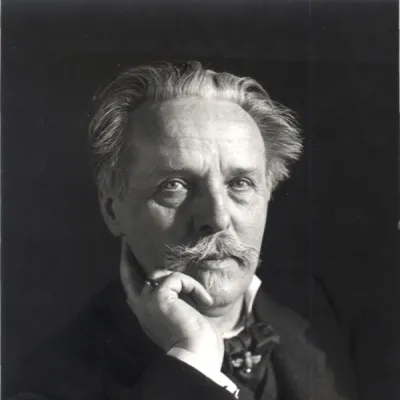
Karl May
Human Design Chart
Biography
May is one of the best-selling German writers of all time, with about 200 million copies sold worldwide. A series of Karl May film adaptations was successful in the 1960s.
The Human Design of Karl May: Projector 2/4
Projector 2/4 — Design at a Glance
Karl May's design showed a tendency towards focused perception. He was someone who could immediately spot errors in systems – comparable to a bright flashlight that is directed precisely on weak points. However, this ability to 'shed light into the dark' was only effective when it wasn't experienced as direct correction. Direct confrontation often triggered resistance in others; more elegant was to attract people through his own harmonious glow. The strategy involved waiting for appreciative invitations rather than pushing forward himself.
This approach was necessary due to his energy structure: As a projector, Karl May had no defined Sacral Center and thus lacked a constant source of intrinsic life energy. He worked in phases of high intensity followed by essential rest periods for regeneration. Ignoring this rhythm led to burnout; adapting to it allowed sustained effectiveness. Living according to this design rewarded him with success. If he yielded to the pressure of being constantly available or active, bitterness emerged as a central non-self theme. His success therefore depended less on constant performance and more on skillfully using his specific aura and waiting for others' invitations before sharing his knowledge.
Emotional Authority
Karl May was subject to an internal decision-making structure that forced him to yield to the fluctuations of his own feelings. His perception was colored by mood and subjective; he always saw the world through the filter of his current emotional state. In one moment, he could be enthusiastic about something, in the next, negatively evaluate it. This emotional wave of constant ups and downs meant that an immediate feeling impression was only a snapshot, not necessarily his truth. Spontaneous actions resulting directly from this initial intensity often proved risky or wrong.
This pattern aligned with the mechanics of his emotional authority. Since his Emotional Center was defined, it served as the central instance for all decisions – regardless of which other centers were also defined in his design. This priority rule was crucial: The emotional authority always took precedence over other internal impulses. To gain clarity, Karl May needed time. He required patience and the process of 'sleeping on' decisions. Only when intense feelings subsided and an emotional distance emerged did calmness set in. This temporal step back was necessary to validate deeper insights, especially for long-term steps that significantly influenced his life course. Through this waiting period, he went through the full process and found his true direction beyond the initial emotional reaction.
The 2/4 Profile — Hermit / Opportunist
Karl May exhibited a fundamental tension between the need for withdrawal and the desire for community. His design suggested that he constantly oscillated between two poles: Line 2 as an hermit and Line 4 as a networker. This configuration of Profile 2/4 created a dynamic balance requiring clear communication. Karl May had to signal outwardly when he needed company and when he wanted to be left alone, in order to create clarity in his 'cave'.
Line 2 emphasized individual responsibility and the need for withdrawal, often within a spiritual or organic community. At the same time, Gate 37 on Line 2 projected an unawareness of his own abilities outwardly. This contrasted with the transpersonal Line 4 at Gate 9, which promoted externalization and influence. Under stress, this line demanded disciplined detail work, while in normal circumstances it had a drive to quickly externalize things.
Only when the need for alone time was fulfilled could Karl May reflect on his network's knowledge. In this rest phase, he processed impressions and developed new ideas from them. Only then did he return to spend time with his favorite people. This alternation between isolated reflection and social externalization shaped how he took in and passed on information. The ability to clearly communicate these needs was crucial for him to benefit from interactions without losing himself.
Split Definition — Defined & Open Centers
Karl Mays Design shows a tendency towards constant mental conception and reliable expression, supported by autonomous willpower. His defined Ajna Center ensures trustworthy mental processes; he thinks continuously and is hard to influence. These thoughts flow into his defined Throat Center, which serves as a reliable anchor point for communication and manifestation. His voice springs clearly from his mind or will, without impulsive speaking. The defined Heart Center gives him strong ego structure and willpower; he likes to control his resources and keep promises. Emotional clarity arises through his defined Solar Plexus Center: He waits patiently for the emotional wave to pass before deciding, rather than acting impulsively. His defined Root Center determines a specific way of dealing with stress and pressure to maintain the life impulse.
In contrast, his open G Center reacts situationally to the environment; it has no fixed identity or direction but mirrors others and seeks correct places and relationships. His open Head Center does not generate constant mental pressure but tends towards confusion through foreign inspirations when he does not follow his inner authority. The open Sacral Center means a lack of constant vital energy; he is vulnerable to overexertion from "borrowed" energy from others and needs breaks as he has no consistent boundaries for work. His open Spleen Center shows an inclination towards existential fears and spontaneous decisions out of uncertainty rather than based on intuitive certainty. This open configuration makes him sensitive to the environment in identity, inspiration, vitality, and intuition, while his inner core system of thinking, expression, will, emotion, and stress remains stable and independent.
Channels for community, curious search and emotional release.
Karl Mays Design shows a tendency towards social integration, driven by the Sun in Gate 37. This energy always seeks recognition and an honourable place within a community or family. This was structured through the Community Channel 37-40: While Gate 37 fostered affection and a desire for belonging, Gate 40 demanded emotional clarity through pauses and fair reciprocity. Karl May understood the necessity of making "good deals" – agreements at eye level where both sides benefit ("I do this for you if you do that for me"). This connection between Solar Plexus (emotion) and Heart (will) required time to carefully negotiate bonds, rather than entering them spontaneously.
Parallel to this, the Channel of Curiosity 11-56 influenced his personality. This channel connected the Ajna Center with the Throat Center and endowed him with the gift of storytelling. Karl May used this mechanism to convey ideas not as dry facts but as living parables. The curiosity drove him constantly to seek new inspirations, which he then transformed into stories that taught or entertained others. This narrative communication served primarily for social bonding: Through sharing experiences and philosophical reflections, he created bridges between individuals. The magic of these stories lay less in their factual accuracy than in their ability to appeal to imagination and feelings.
Additionally, further gates shaped his expression style. Gate 17 promoted logical teaching and future-oriented organisation, with doubt as a healthy part of the process. Gate 38 set boundaries and defended individual integrity through necessary resistance against harmful forces. Gate 36 allowed emotional energy to be released through crises and new experiences developed from them. This combination of the need for community placement (37-40) and the ability to strengthen this belonging through captivating stories (11-56) formed the core pattern of his social interaction.
Tribal Circuitry — Circuit Signature
Karl Mays Design presented a duality of innovative emotional expression and traditional community structure. These separate energetic poles worked in parallel, not as a continuous flow. The Knowledge Circuit connected his Solar Plexus Center with the Root Center, generating pulsating acoustic energy for his unique path and transformation through released emotions. Simultaneously, the Ego Circuit determined his actions within the tribe by connecting Heart and Solar Plexus Centers via the Community Channel. This promoted cooperation and mutual support, though without a direct Sacral connection. Consequently, rest periods were necessary to conserve resources since there was no constant life force flowing. The energy here worked conservatively and rat-like. Additionally, the Meaning Circuit connected his Ajna Center with Throat Center, enabling visual reflection of past experiences and sharing these insights with others. Karl May thus balanced the search for individual mutation and creative expression against the duty to care for collective resources. His pulsating innovative power stood in contrast to the cyclical, traditionally influenced need for rest and giving and taking within the group. His design showed how personal emotional waves could coexist with structured, timeless tribal dynamics without mixing energetically directly.
Right Angle Cross of Planning 1
Karl May's design emphasized a tendency towards strategic orientation and long-term goal setting as a central life motif. This configuration, known as the right cross of planning, shaped his inner attitude: he was less concerned with spontaneous impulses than with clearly structuring his path over extended periods.
In Human Design mechanics, this pattern describes someone whose energy is focused on not only setting goals but pursuing them through consistent planning and perseverance. It represents a force that creates stability and orientation by focusing on the essentials and filtering out distractions. Karl May thus demonstrated himself as someone who consciously chose his steps to achieve a greater whole.
The significance of this design lies in its ability to maintain complex undertakings within focus over years without being distracted by short-term fluctuations. It is an architecture of patience and perseverance, which understands success not as a sudden stroke of luck but as the result of careful preparation. For Karl May, this long-term perspective was not just a background thought but the foundation on which he made his decisions and shaped his life. The mechanics here underscore the importance of clarity in the mind and constancy in action to actually achieve set goals.
Saturn Return · Uranus Opposition · Chiron Return · 2nd Saturn Return — Life Cycles
Karl May's life followed a clear cyclical structure where recurring astrological transits acted as catalysts for existential turning points. These phases did not mark arbitrary breaks but profound reorientations of his life mission.
In 1882, at the age of 40, he experienced the Uranus opposition. This transit often signals a sudden liberation from old structures or an urgent impulse to change. For Karl May, this was evident through renewed contact with H.G. Münchmeyer and the start of work on his first dime novel. It was a moment of upheaval in which new professional paths were either forced or enabled.
Ten years later, in 1891, at age 49, he reached the Chiron return. In Human Design mechanics, this cycle marks a phase of bloom and fulfillment of the incarnation purpose if one has followed their strategy. It was not about healing old wounds but about the concrete realization of his own design. Karl May made contact with Friedrich Ernst Fehsenfeld, who offered him book publication – a step towards material and spiritual consolidation of his work.
The second Saturn return concluded this triad in 1899. At age 57, Karl May began his first Orient journey to Sumatra. This transit often requires reviewing and building new, sustainable structures based on previous life phases. The trip was not just an excursion but a fundamental realignment of his perspective and creative framework.
Projector · Emotional Authority — Synthesis
He was a projector distinguished by the ability to recognize patterns and flaws in existing systems (Gate 11). However, this talent went hand in hand with emotional depth – waves of feelings that required decisions to mature before they could be expressed. The connection between recognizing dysfunction and needing to filter it through emotional maturation shaped his approach: he projected light into darkness but with deliberation and consideration of the emotional climate. His profile as a natural talent and networker reinforced this trait by creating a need for both withdrawal (Line 2) and community (Line 4) – an interplay between inner clarity and exchange with others.
A central paradox lay in the tension between his knowledge circuit and his emotional authority. He was destined to generate new knowledge and initiate changes driven by curiosity (Channel of Curiosity) and creative impulses. Simultaneously, his emotional wave required a thorough engagement with feelings before he could communicate these insights outwardly. This led to an internal field of tension between the immediate urge to share knowledge and the necessity to process it emotionally first – a rhythm that manifested in documented events where career steps were accompanied by phases of withdrawal or emotional preparation.
3 Defined Channels
Incarnation Cross - Right Angle Cross of Planning 1
Solar Return
The Solar Return shows the moment when the sun returns to its exact birth position - your personal solar year.
Life Cycles
Discover the life cycles with a detailed triple view (birth chart, cycle chart, composite).
Human Design Profile
- Type
- Projector
- Strategy
- Wait for the respectful invitation
- Authority
- Emotional Authority
- Profile
- 2/4 - Hermit / Opportunist
- Definition
- Split Definition
- Incarnation Cross
- Right Angle Cross of Planning 1
- Date of Birth
- 25.02.1842 22:00
- Place of Birth
- Hohenstein-Ernstthal, Germany
Frequently Asked Questions
What is Karl May's Human Design type?
Which Profile did Karl May have in Human Design?
What Authority guided Karl May?
What incarnation cross did Karl May have?
When was Karl May born?
Discover your own Human Design
Are you also a Projector? Find out in a personal reading how to unfold your leadership qualities and recognize the right invitations.
More Personalities
Back to overviewSissy Spacek

Alain-Fournier

Anémone

Angeli

Ann-Margret

Bourvil
