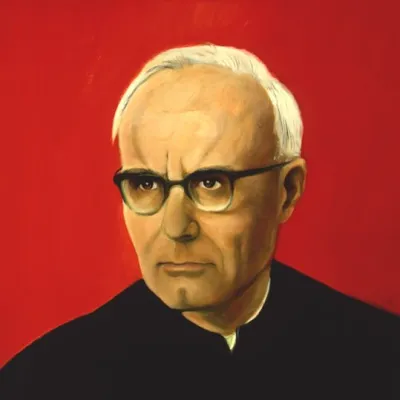
Karl Rahner
Human Design Chart
Biography
Rahner died on 31 March 1984, Innsbruck, Austria.
The Human Design of Karl Rahner: Manifesting Generator 4/6
Manifesting Generator 4/6 — Design at a Glance
Karl Rahner was revealed as someone who possessed a hybrid energy structure: He had the constant power of a Generator, but also exhibited Manifestor qualities through his quick execution capabilities. This design marked him as an individual capable of swiftly pulling things into his life, allowing him to skip steps and advance rapidly. However, this speed carried specific risks. Often, Karl Rahner was too fast and skipped important stages, necessitating a return later to catch up on missing foundations. This could lead to frustration since efficiency did not always come with completeness. Additionally, he tended to pursue multiple projects simultaneously, driven by the impulse to respond to various stimuli. When his inner authority did not clearly agree, this creative drive quickly turned into overextension. His path to satisfaction lay in initially waiting for external life impulses and observing whether his sacral center responded with a clear
Emotional Authority
Karl Rahner was someone who did not make decisions based on initial emotional reactions but subjected them to a necessary maturation period. His inner authority resided in the defined Solar Plexus Center – the emotional authority. This center fundamentally determined his decision-making process: he experienced constant waves of emotional ups and downs. The world appeared colored by his current mood; what was inspiring at one moment could turn negative in another. For Karl Rahner, however, this initial emotional impression was merely a snapshot, not yet the final truth. Quick, spontaneous judgments based on emotion risked negative consequences. Instead, his design required patience and conscious hesitation. He gave himself time for decisions to mature, often by sleeping on them multiple times. Only when intense feelings subsided and emotional distance had been gained did clarity and calmness set in. This cooling process was essential for him, especially with long-term life-changing decisions where a temporal distancing allowed him to see the deeper truth behind transient moods and become action-ready.
The 4/6 Profile — Opportunist / Role Model
Karl Rahner's design tended to define itself through intense experimentation, particularly in the realm of relationships and friendships, during his first decades of life. This phase worked similarly to Line 3 of Profile 4/6: an active exploration of the world before deeper structure came into play. With the onset of the second half of his life, this focus fundamentally shifted. Rahner then showed himself influenced by the inner tension field between a desire for belonging and community (Line 4) as well as the need for distance and contemplative height to reflect on the meaning of life (Line 6). This conflict between heart and head shaped his later orientation.
The mechanics of his design conveyed this through specific line qualities. Line 4 at Gate 63 fostered a strong memory, fixation on details, and precise questioning to clear up uncertainties. Simultaneously, the sixth line brought with it the principle of yielding to unforeseen events. Instead of controlled planning, this configuration required acceptance of uncertainty as a growth factor. Rahner thus lived in a constant balance: on one hand, meticulous, detailed scrutiny and documentation; on the other, letting go for the sake of a universal flow strengthened by unexpected turns. This created an approach based both on precise analysis and flexible adaptation to the unforeseen.
Split Definition — Defined & Open Centers
Karl Rahner's Human Design profile indicated a tendency towards deeply rooted but emotionally filtered expression. His defined Throat Center connected with the Solar Plexus Center, meaning that his communication and actions were always influenced by his feelings and emotional waves; he did not speak only from intellect or will, but articulated what he felt. This emotional depth was supported by his defined Solar Plexus Center as an inner authority: truth revealed itself to him over time as he waited for the waves of his emotions to settle before achieving clarity.
At the same time, Karl Rahner had a defined Sacral Center, the motor of a generator. This provided him with a constant vital energy source that was only correctly usable in response to external impulses. Initiating actions without prior invitation often led to frustration or exhaustion as the sacral power then wasn't available. His defined Root Center also generated a persistent pressure towards movement and survival, pushing him forward if he followed this rhythm.
In contrast, his open centers shaped his vulnerabilities. The open Head and Ajna Centers lacked a stable mental structure; Karl Rahner tended to get entangled in doubts and confusion that did not originate from himself or desperately sought answers to others' questions to achieve mental peace. His open Heart Center led to a missing constant will; he easily fell into the cycle of having to prove himself through promises and performance, often leading to failure and self-doubt. Additionally, his Spleen Center was open, making him vulnerable to survival fears and prone to making spontaneous decisions or clinging to unhealthy situations just to gain a false sense of security and well-being.
Channels for rhythm, perseverance, emotional clarity and change.
Karl Rahner's life was characterized by a deep inner rhythm and persistence in living experiences through to their end. His design featured the Rhythm Channel 5-15, connecting his Sacral Center with the G Center. Through Gate 5, he held onto firm habits, while Gate 15 integrated the diversity of society into this flow of life. This mechanism gave him natural timing and magnetically drew others into his energy flow without needing to actively direct it.
Parallel to this, the Discovery Channel 29-46 was at work. Here, the Yes Saying Gate (29) connected with the Self Determination Gate (46). This configuration challenged him to let go of expectations and fully immerse himself in the depth of an experience. Only through this complete commitment could he make his discoveries and later convey them to the collective. It was not about control but trusting the persistence of his Sacral Center until the meaning of the process revealed itself.
Additionally, other channels shaped his experiences. The Recognition Channel 30-41 connected the Root Pressure from Gate 41 with the emotional recognition of Gate 30. This generated restlessness and a strong desire for new experiences driven by the emotional wave. The Transience Channel 35-36 also linked the Solar Plexus Center to the Throat Center. Through Gate 36 (Crisis) and Gate 35 (Change), he sought new experiences to gain wisdom, sharing these insights through words often based on acceptance of transience.
Individual Gates like 64 and 63 in the Ajna Center further promoted a mental process of clarity and doubt for interpreting past experiences. Gate 19 in the Root Center emphasized the need for resources and a safe environment for spiritual approach. Together, these mechanisms formed a personality that acted through rhythm, deep experience absorption, and sharing emotional wisdom.
Collective Circuitry — Circuit Signature
Karl Rahner's Human Design profile indicated a tendency towards rational future orientation, which did not directly merge with emotional past processes. As someone with split definition, he lived parallel but energetically isolated systems: The first system connected the Identity and Sacral Centers through the Understanding Circuit (Rhythm Channel). Here, an energy-bound logic projected structured insights devoid of emotions into the future. The second system included Throat, Solar Plexus, and Root Centers in the Meaning Finding Circuit. This area processed past emotional waves (Transience Channels) and transformed them into shared experiences. Since these two groups were not connected, there was no direct flow between the cool ratio of the Identity-Sacral system and the felt insights of the Throat-Solar Plexus-Root system. Instead, they acted as separate forces: on one hand strategic, rational future shaping, on the other cyclic, emotional reflection of the past. This separation shaped his inner dynamics through parallel but not integrated experience worlds.
Right Angle Cross of Consciousness 1
Karl Rahner's Human Design profile indicated a tendency towards clear, structured perception. This configuration, the right cross of consciousness, shaped his approach to gathering and processing information. It was not about vague intuitions but rather a system that brought order to the complexity of the world.
This structure allowed him to logically deduce connections and make them understandable for others. The mechanics of this cross promoted clarity and precision in thought. Karl Rahner emerged as someone who valued exact definitions and reduced uncertainties through systematic thinking. His strength lay in translating abstract concepts into tangible structures without losing the depth of content.
The right cross of consciousness acted as an internal compass, helping him navigate complex situations. It gave him the ability to distinguish between relevant and irrelevant information. This selective attention allowed him to focus on what was essential and filter out distractions. In his work, this was evident through a methodical approach that always aimed for clarity and comprehensibility.
The energy of this design did not flow impulsively but followed a specific pattern. Karl Rahner used this structure to organize his thoughts in a way that others could easily grasp. His communication was characterized by this internal logic, enabling him to convey complex ideas simply and directly. This created a foundation for trustful interactions as his statements always stood on solid ground.
Saturn Return · Uranus Opposition · Chiron Return · 2nd Saturn Return — Life Cycles
Karl Rahner's design exhibited a dynamic tension driving repeated realignments during middle life phases. This structure fostered periods of detachment from established structures in favor of new directions. In 1945, at the age of 41, he taught and preached in Munich. This event coincided precisely with his Uranus opposition, a transit-specific point where old bonds often need to be dissolved to make way for an independent realignment. His career development showed the typical response to this pressure: adaptation through environmental or role change.
Later, a cycle of consolidation and recognition marked him. The second Saturn return in Human Design mechanics marks a phase where years of often unremarkable work lead to visible authority and institutional validation. In 1964, at age 60, Karl Rahner received his first of fifteen honorary doctorates. This was not an abrupt stroke of luck but the logical consequence of a life increasingly gaining structure and weight. The mechanics of this transit demand integrating past experiences into a stable, recognized position. His design responded to this energetic condensation with openness for external validation, manifesting in this series of academic honors. Both phases – disruptive realignment and later solidification of authority – illustrate how his chart-specific transits shaped his biographical milestones.
Manifesting Generator · Emotional Authority — Synthesis
He was a Manifestor Generator (MG), whose life was powered by deep, sacral energy – a constant flow that moved him to react rather than initiate (Sacral Center). This foundational constitution combined with the ability to skip steps and attract things quickly, giving him a dynamic, almost unstoppable way of living. Through his defined communication area (Throat Center), he found an outlet for this energy by transforming messages and bringing them into the world – a process that took on a firm rhythm through connection to the G Center (Channel of Rhythm). His profile as a Networker/Role Model suggests he always oscillated between the desire for community and the need for independent thinking.
A central tension field marked his existence: emotional authority, which required deep consideration of decisions (Emotional Center), stood in contrast to the quick energy of the Manifestor Generator. This led him to be capable of reacting swiftly to impulses while simultaneously feeling an inner necessity to let things mature and view them from a filtered perspective. Experiences of success (Saturn Return) and work (Uranus Opposition) showed this shift between rapid action and reflective judgment.
4 Defined Channels
Incarnation Cross - Right Angle Cross of Consciousness 1
Solar Return
The Solar Return shows the moment when the sun returns to its exact birth position - your personal solar year.
Life Cycles
Discover the life cycles with a detailed triple view (birth chart, cycle chart, composite).
Human Design Profile
- Strategy
- To respond - wait for something to respond to
- Authority
- Emotional Authority
- Profile
- 4/6 - Opportunist / Role Model
- Definition
- Split Definition
- Incarnation Cross
- Right Angle Cross of Consciousness 1
- Date of Birth
- 05.03.1904 19:00
- Place of Birth
- Freiburg im Breisgau, GER
Frequently Asked Questions
What was Karl Rahner's Human Design type?
What profile did Karl Rahner have in Human Design?
Which authority guided Karl Rahner's decisions?
Which incarnation cross characterized Karl Rahners Human Design?
When was Karl Rahner born?
Discover your own Human Design
Are you also a Manifesting Generator? Find out in a personal reading how to unfold your multi-talents and direct your energy wisely.
More Personalities
Back to overviewAlain-Fournier

Aldair

Alizée

Angeli

Arletty

Artus