Karl Strölin
Human Design Chart
Biography
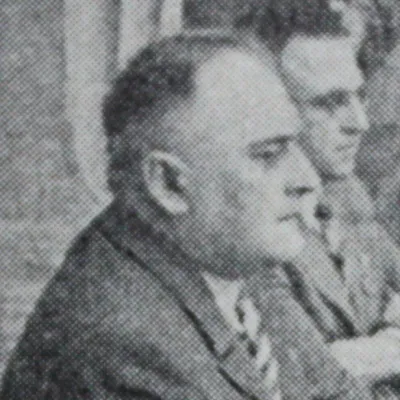
Because Strölin was a prominent Nazi, he was imprisoned by the Allies and spent time in an internment camp at Bad Mondorf, Luxembourg. He was later released after denazification and classified as "less incriminated". However, he never expressed regret about his Nazi past. Rather, until his death Strölin saw Nazism as a good political idea in principle which had only been betrayed by Hitler and his entourage. In 1950, he published a book "Stuttgart in the Final Stages of the War".
He died on 21 January 1963, aged 72, in Stuttgart.
Karl Strölin — Manifesting Generator with Profile 2/4
Manifesting Generator 2/4 — Design at a Glance
Karl Strölin was someone who combined the endurance of a Generator with the direct impact power of a Manifestor through a hybrid energy configuration. His design featured a defined Sacral Center, providing him with a constant, vital source of energy. At the same time, specific connections to his Throat Center allowed him to skip steps and draw things into his life with remarkable speed. This ability for rapid implementation carries two central challenges: First, he tended to overlook important stages, which could lead to corrections and frustration later on – a classic symptom of his non-self experience. Second, his speed led him to pursue multiple projects simultaneously by responding to various impulses at once.
Karl Strölin's strategy was not to initiate himself but to react to external life impulses. Only when his Sacral Center responded with a clear
Sacral Authority
Karl Strölin was a Generator whose decision-making process was shaped by sacral authority. This inner leadership is specific to this type and simplifies the process, as strategy and authority are identical: reacting to life. A prerequisite for this was his open Emotional Center, meaning he could not decide based on emotional fluctuations but had to trust in the immediate physical reaction of his Sacral Center.
This authority manifested as an inner 'gut feeling' or a noticeable surge of energy triggered by external stimuli. Karl Strölin learned to pay attention to these bodily signals – often audible as grunts, hums, or affirming
The 2/4 Profile — Hermit / Opportunist
Karl Strölin was someone who oscillated between the deep need for withdrawal and the urge towards community. His design created a tension: on one hand, he sought the solitude of an 'hermit' to gain inner clarity; on the other hand, he was drawn into the circle of his favorite people to maintain connections. This dynamic required him to communicate clearly about his boundaries – when he needed company and when he wanted to be left alone. In silence, he processed the impressions from his network, reflected upon them, and developed new ideas.
His way of interacting with others was marked by determination and an intelligent presentation of his values. However, this attitude often met resistance, especially if his own value foundations were not yet fully established. Confrontations led him to withdraw temporarily until the situation clarified itself. At the same time, he possessed the talent for storytelling and conveying messages in a way that resonated with others. He waited for opportune moments to introduce his ideas with strategic calculation. Through this combination of tactical withdrawal and targeted networking, he could overcome resistance and effectively utilize his knowledge. His path lay in finding the balance between inner work and outer exchange without losing his authenticity.
Single Definition — Defined & Open Centers
Karl Strölin revealed himself as a person with a persistent mental structure and clear expression. His defined Ajna Center ensured reliable conceptual thinking; he conceived theories in his own unchanging way and was difficult to influence by external opinions. This mental clarity flowed directly into his defined Throat Center, allowing him to always express what he thought. Thus, his communication was a direct manifestation of his inner concepts, steady and trustworthy, though limited to his specific perspective.
The driving force of his design came from the defined Sacral Center. As a Generator, he had an enormous vital energy source that manifested as constant humming or restlessness. His strategy involved not initiating but waiting for life to ask him before reacting with a yes-or-no answer from the gut. Only upon receiving a positive response did full energy become available for satisfaction and persistence; mental decisions without sacral confirmation led to frustration and exhaustion. He was supported by his defined Spleen Center, which gave him spontaneous intuitive intelligence. He could distinguish healthy from unhealthy situations in the present moment and trust these subtle warning signals, providing him with well-being and protection. Additionally, he had a defined Root Pressure, giving him endurance to move forward in the material world and process stress in his specific way.
In contrast, his Head Center was open. Karl Strölin lacked a persistent source for inspiration or mental questions. He tended to take on the mental pressure of others and could get stuck in doubts that were not his own. It was important for him not to act out this pressure but to observe it letting go. His open G Center meant he did not have a fixed identity or life direction. He adapted to his environment and found his path only through the right place and the right people. A wrong place led to feelings of loss or misalignment in him. Likewise, his Heart Center was open; he lacked consistent willpower for competition or promise-keeping. He tended to feel worthless when failing to meet expectations and had to learn not to gain his worth through proof. Finally, his open Solar Plexus absorbed the emotions of his surroundings. He acted as a barometer for others' emotional climate but could easily swing between foreign joy and sorrow if he identified with these feelings rather than recognizing them as non-self.
Channels for change, curiosity, intuition and transformation.
Karl Strölin revealed himself as someone standing between the impulse for deep transformation and the necessity of intimate connection. Channel 60-3 connected his Root Center with his Sacral Center; this generated a pulsating energy of evolutionary change, often accompanied by melancholy when the next impulse failed to materialize. He had to learn to accept this limitation and wait patiently for his body's reaction rather than reducing the pressure through logical arguments.
At the same time, Channel 11-56 shaped his way of processing information: Between Ajna and Throat Centers, he acted as a storyteller who not only collected ideas but transformed them into inspiring narratives to entertain and teach others. His communication served less for dry fact transmission than for sharing discoveries that should awaken the imagination of his listeners.
In terms of abilities, Channel 16-48 between Spleen and Throat Centers came into play. Here he combined intuitive depth with technical skill; through constant practice and refinement of a specific ability, he developed a talent dependent on recognition and resources to flourish further. This process of mastery stood in contrast to Channel 32-54 (Root-Spleen), which motivated him through ambition and the desire for social positioning. This channel spurred him to prove his competence and claim support from "the tribe" – his community or institutions – to realize his ambitions and secure continuity in his career.
Additionally, Gates like 50 (Protection Reflex/Tradition) and 35 (Change Through Experience) contributed to complexity: He sought security in values but was also dependent on new interactions to find meaning. The energetic impulses of Gate 59 (Bonding Strategy) and Gate 12 (Emotional Tone/Creativity) rounded out his Profile by imprinting his interpersonal dynamics through a mix of genetic attraction and poetic expression.
Collective Circuitry — Circuit Signature
Karl Strölin was marked by a simple, coherent definition. His energetic connections ran in a single group: Sacral, Root, Spleen, Throat and Ajna Centers were directly linked to each other. This created an integrated flow of life force from intuition through logical analysis to expression.
The Knowledge Circuit worked through him via the Channel of Mutation (3-60). This connected the Sacral with the Root Center and promoted the power to deviate from the known and create new identities.
In the Understanding Circuit, the Channel "The Wavelength" (16-48) was active. It linked the Throat with the Spleen Center. It supported sharing clear, rational insights and strategic structures.
The Meaning Circuit showed through the Channel "Curiosity" (11-56) between Ajna and Throat Centers. Here it was about reflecting on past experiences to grasp their meaning and share these emotional insights with others.
Finally, the Ego Circuit worked through the Channel "Transformation" (32-54), which connected Spleen and Root Centers. This section concerned cooperative creation of resources and mutual support within a community, where pauses for regeneration were necessary.
All these circuits formed an integral whole in Karl Strölin as they all touched upon centers of the same definitional group. No energy stood isolated; rather, the power flowed from the sacral through intuition and logic into spoken expression and social interaction.
Right Angle Cross of Laws 3
Karl Strölin had the so-called right cross of Law 3 in Human-Design. This specific configuration shaped his inner orientation towards a profound engagement with the structures that determine human action and societal order. It was not a superficial involvement but rather a fundamental impulse to explore the underlying principles of authority, responsibility, and community cohesion. The energy of this cross promoted an understanding of how individual freedom can be reconciled with collective necessities. Karl Strölins design inclined him towards more than just theoretical comprehension of these complex interactions; he sought to experience them as living reality. He searched for ways to connect the often rigid laws of social coexistence with the dynamic power of the human spirit. This was about understanding how true leadership arises and is legitimized. His inner mechanics pointed out that stability can be achieved not through coercion but through a deep understanding of natural order, creating an attitude of sober observation paired with a desire for clarifying insight into the mechanisms of power and law.
Saturn Return · Uranus Opposition · Chiron Return · 2nd Saturn Return — Life Cycles
Karl Strölin emerged as a shaper who took responsibility during phases of structural upheaval. His appointment as Lord Mayor of Stuttgart in 1933 coincided precisely with his Uranus opposition (age 43). This cycle often marks a point where old orders crumble and new, unexpected roles are forced or enabled; Strölins rise was not merely a career step but a reaction to the shifting political landscape.
Ten years later in 1945 at age 55, he carried out the transfer of Stuttgart to French troops and recommended a successor, marking his second Saturn return. This cycle often demands confrontation with the limits of one's power and relinquishment of old identities for a more mature, sustainable structure. Strölin acted not through personal ambition but fulfilled a functional necessity: securing the transition into a new era by giving up his own position. His design marked him as someone who instilled stability in times of change – first by embracing a new order in 1933, then consciously dissolving and passing it on in 1945. His actions reflect how external pressure situations can activate inner maturation processes.
Manifesting Generator · Sacral Authority — Synthesis
Karl Strölin lived a life deeply marked by an internal dynamism. As a Manifesting Generator (MG) with sacral authority, his design pointed to someone who tended towards quick initiation – skipping steps (Channel of Mutation 3-60) – but was also dependent on the reaction to the sacral impulse. This combination of apparent self-determination and need for external validation through the gut created continuity in action: he reacted impulsively, then shaped his decisions into concepts and strategies using the defined mental center (Ajna). His profile line 2/4 strengthened this shift between withdrawal into the inner world for clarification and the need for exchange and connection with others, evident in career events – both in ascent and in transferring responsibility.
Central to Karl Strölins life was the paradox of speed versus thoroughness. As an MG he possessed the ability to quickly initiate things, yet sacral authority demanded a reaction to the moment, waiting on inner gut feeling. This led to tension between the desire for immediate implementation (Knowledge Circuit) and the necessity to take time for internal processes (Line 2). This interaction shaped his decision-making and revealed a personality capable of both innovation and careful consideration.
4 Defined Channels
Incarnation Cross - Right Angle Cross of Laws 3
Solar Return
The Solar Return shows the moment when the sun returns to its exact birth position - your personal solar year.
Life Cycles
Discover the life cycles with a detailed triple view (birth chart, cycle chart, composite).
Human Design Profile
- Strategy
- To respond - wait for something to respond to
- Authority
- Sacral Authority
- Profile
- 2/4 - Hermit / Opportunist
- Definition
- Single Definition
- Incarnation Cross
- Right Angle Cross of Laws 3
- Date of Birth
- 21.10.1890 04:00
- Place of Birth
- Berlin, GER
Frequently Asked Questions
What was Karl Strölin's Human Design type?
What Profile did Karl Strölin have in Human Design?
What Authority did Karl Strölin have?
What incarnation cross did Karl Stroelin have?
When was Karl Strölin born?
Discover your own Human Design
Are you also a Manifesting Generator? Find out in a personal reading how to unfold your multi-talents and direct your energy wisely.
More Personalities
Back to overviewAldair

Alizée

Angeli

Arletty
Artus

Balthus