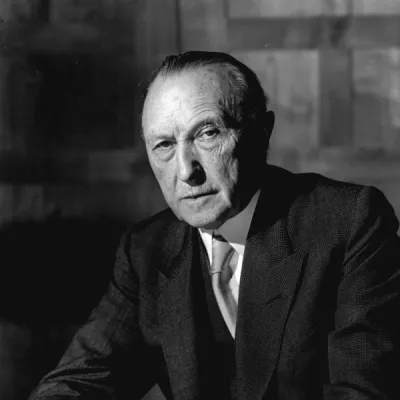
Konrad Adenauer
Human Design Chart
Biography
Konrad Adenauer as a Projector 6/2 in Human Design
Projector 6/2 — Design at a Glance
Konrad Adenauer's design inclined towards focused perception. As a Projector, his aura acted like a bright flashlight systematically revealing dark spots. He immediately identified errors in systems and structures. However, this ability to 'shed light on the darkness' was connected with a specific dynamic: Direct criticism or unrestrained intervention often repelled his environment, much like glaring light into someone's face.
His strategy involved waiting for respectful invitations rather than actively intervening. By showing his own harmony and competence, he became attractive to others who then sought out his advice on their own initiative, maximizing his impact. Since Projectors do not have a constant energy source but work in phases, Konrad Adenauer needed rest periods for regeneration to avoid burnout. Living according to this design led to success as a reward. Deviations from it – such as persistent pushing without invitation – would have resulted in bitterness as an emotional consequence. His design thus required patience and the ability to use his radiant presence purposefully, rather than sending it out uncontrollably.
Emotional Authority
Konrad Adenauer's inner decision-making did not rely on spontaneous impulses but involved navigating through emotional waves. His inner authority lay in the defined Solar Plexus Center, meaning this center always took precedence over all other defined centers regardless of further configurations in his design. This shaped a fundamental attitude of patience: Immediate reactions to current moods were risky as feelings often only represented snapshots, not deeper truths.
The mechanics of his emotional authority showed in constant ups and downs of emotions. At one moment something could appear highly positive, the next it was negative. These fluctuations weren't signs of instability but part of the process to gain clarity. Quick decisions based on temporary moods often had negative consequences for Konrad Adenauer. Instead, he needed time to reflect on his choices multiple times. Through this distancing, intense feelings gradually subsided. Only when emotional distance was gained did calmness and true clarity set in. This process was especially crucial for long-term decision-making as it ensured the final choice rested on a stable inner understanding rather than fleeting enthusiasm or rejection.
The 6/2 Profile — Role Model / Hermit
Konrad Adenauer's design laid out a two-phase development: In the first three decades, experiments and trial-and-error principles dominated. During this phase, retreat after failures was characteristic while he gathered personal life experiences. Line 6 still acted like Line 3 during this time, meaning direct action and learning from experience were paramount before deeper structures emerged.
After turning thirty, the full dynamics of Line 6 activated. This led to a necessary distancing from earlier experiences. Konrad Adenauer metaphorically retreated into a 'cave' to look back at his past with much distance. This period served for intense reflection, healing, and gaining deep self-awareness. Line 6 often brings misunderstandings and requires an unyielding stance until mutation to later exert effective influence.
Parallel to this, Line 2 supported this approach through intuitive clarity regarding appropriate values. This orientation related to survival and power, not moral ideals. It was a resolute determination to acknowledge inner insights and use them for purification. From this combination of distancing and intuitive value clarity emerged a wise role model eventually recognized by others who sought contact to partake in the ability for deep introspection.
Split Definition — Defined & Open Centers
Konrad Adenauer was a person with a robust, self-sustaining identity and clear direction. His defined G Center gave him deep self-worth and the ability to provide guidance to others without being dependent on them. This inner security was reinforced by his defined Heart Center, which provided constant willpower and a desire for personal influence over resources. He was designed to keep promises and consciously use his ego strength, creating a strong leadership presence.
Emotional depth shaped his decision-making process through his defined Solar Plexus Center. Here lay his inner authority: he had to wait out the emotional wave to gain clarity rather than reacting impulsively to highs or lows. This patience served him as a strategic advantage in negotiations and relationships. Additionally, defined Spleen and Root Centers provided intuitive security in the present moment as well as physical endurance under pressure. The connection to the Spleen Center allowed him to recognize existential warning signals immediately, while Root Energy made him resilient against stress.
In contrast, Head, Ajna, Throat, and Sacral Centers were open. These centers did not belong to his constant personality but reflected situational surroundings. Through the open Head and Ajna Centers, he was vulnerable to mental confusion or pressure to find answers that belonged to others. He tended to get entangled in other people's questions rather than trusting his inner authority. The open Throat Center meant he could not communicate consistently; attempts to force attention often led to stress, while true communication only occurred through invitation. Finally, lacking a constant vital energy source in the open Sacral Center put him at risk of overloading with borrowed energy from others and neglecting boundaries, leading to exhaustion if he did not listen to his inner guidance for breaks.
Channels for meaning-making, ambition and spiritual breakthrough.
Konrad Adenauer's design inclined towards stubborn determination, combining tribal loyalty with the drive for individual distinction. This constellation showed a tension between the need for belonging and the necessity of being initiated through competition.
The Synthesis Channel 19-49 formed the emotional foundation. It connected the pressure from the Root Center to the emotional frequency of the Solar Plexus, securing tribal bonds through loyalty and mutual support. This channel determined who belonged to "we" and who was rejected based on a code of love, honor, and obedience. It ensured community cohesion through shared principles and protected common resources.
Simultaneously, the Initiation Channel 51-25 acted as a driving force for individualization. By connecting the Heart Center with the Shock Gate (51) and the Spirit Self (25), it promoted natural competitiveness. This channel urged him to separate from the collective through the "shock" of initiation to recognize his own potential. It conveyed the ability to see beauty in both animate and inanimate objects while also driving a desire for leadership roles and victory.
As a connecting element, the Life Struggle Channel 38-28 endowed him with stubborn determination to follow this path of individualization against resistance. Through the Fighter Gate (38) in the Root Center and the Player Gate (28) in the Spleen Center, Konrad Adenauer found meaning precisely in these struggles. This channel helped him distinguish between appropriate and meaningless conflicts and defend his personal integrity against distracting external forces. The energy of this channel transformed resistance into purpose and propelled mutation forward.
Additionally, prioritized gates like Gate 39 (Mutation through Provocation) and Gate 57 (intuitive clarity) shaped his perception, while gates such as 46 (Devotion) and 22 (Openness) supported his social presence. This mechanism described a person balancing tribal protection with individual integrity.
Individual Circuitry — Circuit Signature
Konrad Adenauer's design showed a tension between personal identity formation and cooperative resource building. The Knowledge Circuit drove transformation through the Life Struggle Channel (Gates 28-38). It connected Spleen and Root Centers, describing an inner struggle for new insights and emotional adaptation.
Parallelly, the Centering Circuit operated through the Initiation Channel (Gates 25-51). It directly linked Identity and Heart Centers. This endowed Konrad Adenauer with fortified, courageous convictions internally. However, lacking a connection to the Throat Center, his external expression of this inner fortitude often faltered.
The Ego Circuit focused on cooperation and collective material resources. For Konrad Adenauer, active were the Transformation Channel (Gates 32-54) and Synthesis Channel (Gates 49-19). These connected Spleen, Root, and Solar Plexus Centers, promoting mutual support and emotional intelligence within the tribe. Since this circuit lacked a connection to the Sacral Center, rest periods for resource regeneration were necessary.
The Shared Definition separated these energies into two groups: on one side, Spleen, Root, and Solar Plexus Centers; on the other side, Identity and Heart Centers. These remained energetically separate, existing parallel to each other. Therefore, Konrad Adenauer had to balance holding onto inner convictions with external, emotionally colored cooperation in the collective.
Left Angle Cross of Individualism 2
Konrad Adenauer's design laid a tendency towards individual autonomy, driven by the need for a personal, non-conformist expression. This inner dynamic acted as a driving force in the background of his actions, independent of external expectations or collective norms.
This structure originated from the 'Left Cross of Individualism 2'. This aspect of Human Design describes a deeper, often unconscious motivational structure that is strongly oriented towards seeking individual validation. The emphasis was on the authenticity of self-expression against societal demands or group pressures. It was about establishing oneself as an independent personality and creating boundaries where conformity was required.
For Konrad Adenauer, this meant that his actions were not primarily motivated by adapting to existing systems but rather by the inner impulse to assert his own identity and perspective. The mechanics of this cross promoted a stance that prioritized individual integrity over social acceptance. This shaped his way of making decisions and positioning himself in his environment: always with the focus on preserving personal autonomy and avoiding self-denial for collective demands. Thus, the energy of this design supported a consistent alignment with his inner compass, even if it stood in opposition to general expectations.
Saturn Return · Uranus Opposition · Chiron Return · 2nd Saturn Return — Life Cycles
Konrad Adenauer's life followed a clear cyclical structure, marked by four distinct astrological phases. His first Saturn return at 28 years old brought about his marriage to Emma Weyer – a moment of condensation and stabilization of private foundations. Ten years later, at the age of 40, he was hit by the Uranus opposition: The death of his first wife after a long illness marked a sudden, disruptive break that dissolved old structures.
Following this, his design showed itself in a phase of inner maturation and validation. His Chiron return around the age of 47 was an achievement cycle; in 1923 he earned his Dr. phil. degree at the University of Cologne, which can be understood as the flowering of his intellectual orientation and sense-making, far from any narrative of healing.
His second Saturn return around the age of 57 brought a severe crisis. In 1933 Konrad Adenauer was temporarily suspended and finally dismissed on July 17th. This corresponds to typical Saturn dynamics that often come with external limitations or loss of established positions in this phase. These four cycles – from foundation through rupture and validation to political exclusion – defined the key turning points of his career.
Projector · Emotional Authority — Synthesis
Konrad Adenauer lived a process of continuous adaptation, fueled by a deep connection to his own inner authority (emotionally) and the drive to influence through action. The linking of Root and Spleen centers in several channels indicates a person who defines themselves through recognizing opportunities and pursuing them with perseverance – an ongoing cycle of perception, engagement, and striving for continuity (Channel 32-54). His ability to recognize what is truly valuable in relationships and situations (Gate 28) enabled him to enter strategic alliances and use resources effectively. This process was reinforced by the connection to the G Center, which provided clear direction and attracted others who looked up to him as a role model (Profile: Role Model).
Adenauer embodied a central paradox between the need for stability and the ability to mutate. On one hand, there was deep loyalty to principles and traditions, underscored by his defined Heart Center and Ego Circuit. On the other hand, he was able to adapt to changing circumstances – often provocatively (Gate 39) – and take new paths to achieve goals. This tension between clinging to the proven and striving for innovation shaped his life path and enabled him to embody both stability and progress.
4 Defined Channels
Incarnation Cross - Left Angle Cross of Individualism 2
Solar Return
The Solar Return shows the moment when the sun returns to its exact birth position - your personal solar year.
Life Cycles
Discover the life cycles with a detailed triple view (birth chart, cycle chart, composite).
Human Design Profile
- Type
- Projector
- Strategy
- Wait for the respectful invitation
- Authority
- Emotional Authority
- Profile
- 6/2 - Role Model / Hermit
- Definition
- Split Definition
- Incarnation Cross
- Left Angle Cross of Individualism 2
- Date of Birth
- 05.01.1876 10:30
- Place of Birth
- Köln (Cologne), Germany
Frequently Asked Questions
What is the Human Design type of Konrad Adenauer?
What Profile did Konrad Adenauer have?
What authority did Konrad Adenauer possess?
What incarnation cross did Konrad Adenauer have?
When was Konrad Adenauer born?
Discover your own Human Design
Are you also a Projector? Find out in a personal reading how to unfold your leadership qualities and recognize the right invitations.
More Personalities
Back to overviewSissy Spacek

Alain-Fournier

Anémone

Ann-Margret

Bourvil
Hergé