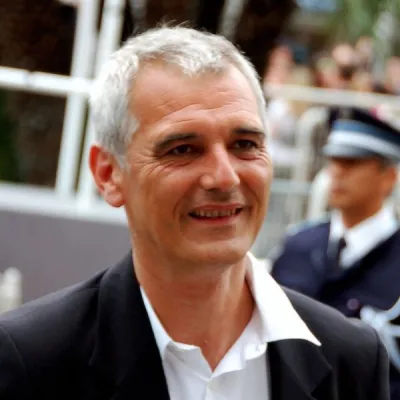
Laurent Cantet
Human Design Chart
Biography
Laurent Cantet died in Paris on 25 April 2024 at the age of 63.
Laurent Cantet — Generator with Profile 1/3
Generator 1/3 — Design at a Glance
Laurent Cantet revealed himself as someone who did not unleash his power through spontaneous initiatives but rather by responding to external impulses. As a Generator, he possessed considerable sacral energy that enabled him to achieve high endurance – comparable to a workhorse that carries on as long as it burns for its task. However, this energy only became effective when it could respond to signals from the environment; the motto was not 'initiate' but 'respond'.
This design carried two specific risks. If Laurent Cantet attempted to do things without inner enthusiasm or was prevented from pursuing his heart project despite still being full of drive, an energetic collapse threatened. The successful use of his energy depended on waiting for a signal from the sacral center – that internal 'yes' which gave the starting shot.
If he followed this strategy and acted from the gut, he was rewarded with a deep sense of fulfillment. Conversely, if he lived against this principle, such as by constantly initiating without an inner signal, it eventually led to persistent frustration and energy deficiency. His life force was thus not an endless reserve but a reactive power that only had lasting impact when responding to real impulses from life.
Emotional Authority
Laurent Cantet displayed an internal decision-making structure based on emotional depth and temporal distance. His inner authority was Emotional Authority carried by the defined Emotional Center. In Human Design mechanics, this center has absolute priority: If it is defined, it is always the leading instance for decisions, regardless of other defined centers in the design.
Cantet's perception was marked by a natural wave movement of feelings. He experienced life not in static neutrality but in constant fluctuations between enthusiasm and skepticism. However, this emotional coloring did not mean that the first impulse was the truth. On the contrary: The immediate feeling impression often served only as an initial trigger which could still be unclear. Quick, spontaneous reactions to these transient moods would have easily led him astray.
Instead, his mechanics required patience and conscious hesitation. Important decisions for him could not be clarified instantly but needed time to mature. Through multiple 'sleeping on things', the initial emotional waves subsided. Only when these intense feelings had died down and he had gained emotional distance did true clarity set in with Laurent Cantet. This process of calmness was no obstacle, but rather the necessary path to grounded, long-term life decisions that shaped his course sustainably.
The 1/3 Profile — Investigator / Martyr
Laurent Cantet revealed himself as someone whose life journey was strongly influenced by the principle of 'trial and error'. His design established a basic stance as a researcher and experimenter: He did not primarily learn through theoretical planning but rather by doing things, failing, and drawing concrete insights from them. This 1/3 dynamic meant that his judgments and decisions only had absolute validity when they were both intellectually understood and practically tested on heart and gut.
The first line of his profile often started with uncertainty; he sometimes felt inadequately prepared to move into implementation. Yet the energy of the third line pushed precisely there – into experimenting. This tension between the desire for secure knowledge and the necessity of action shaped his development. Mistakes were not failures but essential learning steps to rationally explain inner truths and understand mutual dependencies in relationships.
Over time, Cantet recognized that he needed other people to validate his individual insights. Through these interactions, he learned which connections were helpful and which were not. His authority thus rested on self-earned experience: If he assessed something as correct, he had already walked this path and experienced the consequences. This process of diversification and ending cycles through direct practice was the foundation of his personal development.
Split Definition — Defined & Open Centers
Laurent Cantet had a fixed, reliable self-identity and a clear sense of direction. His defined G Center gave him the ability to show others new paths without being dependent on their confirmation. This inner security was complemented by his defined Heart Center, which gave him willpower and the desire to determine his own life and resources. He enjoyed working independently to follow his internal mechanisms and kept promises he made, which strengthened his self-esteem.
As a Generator with a defined Sacral Center, he had an enormous source of vital energy. His strategy was not to initiate but to wait for questions or invitations before responding from the gut with a clear yes or no answer. This ensured him the necessary strength for sustained satisfaction and prevented exhaustion from false initiatives.
However, his decisions were not made immediately but filtered through his defined Solar Plexus Center. As his inner authority, he had to wait out the emotional wave to gain clarity. He avoided impulsive actions based on the highs or lows of his mood in favor of a deeper, time-based truth. Additionally, his defined Spleen Center supported him with existential intuition in "the now," helping him make spontaneous judgments about health and well-being. The constant pressure of his defined Root Center propelled him forward, which he could channel through his strategy.
On the other hand, his Head Center was open. Here there was no consistent mental inspiration; instead, he tended to get caught up in others' doubts and questions or seek answers that were not his own. His open Ajna Center made him receptive to foreign concepts and opinions without solidifying them as his own truth. Also, his Throat Center was open, meaning he did not have constant control over his communication. Rather than actively demanding attention, he drew it naturally when he waited for the right timing to speak.
Channels for pioneering spirit, maturation, ambition and community.
Laurent Cantet revealed himself as someone who acted through competitive impulses and a drive towards individualization. The Initiation Channel 51-25 connected his ego energy of shock with universal love; it encouraged others in their uniqueness when invited, but did not initiate on its own. This dynamic was in tension with the Transformation Channel 34-54 (described as 54-32 in raw content), which drove ambition through constant effort. Here he sought recognition and social advancement, motivated by concern for the tribe's existence, where instincts helped recognize support.
At the same time, he cultivated relationships through the Community Channel 37-40. This channel connected friendship with a need for solitude; it waited for personal invitations to enter into connections and fair agreements based on mutual benefit. His experiential process followed the Ripe Fruit Channel 53-42. He went through cycles to complete them fully and reflect upon them, gaining wisdom and sharing this with others rather than prematurely breaking off results.
Additionally, Gates like Inner Truth (61), which sought silence and self-knowledge, as well as Detail Work (9), which required perfection through repetition, were at play. The Gate of Saying Yes (29) demanded persistence in challenges, while the Gate of Accepting Limitations (60) transformed pressure into creativity. These configurations shaped an attitude that oscillated between individual assertiveness and collective responsibility, always dependent on proper invitation and inner resonance.
Tribal Circuitry — Circuit Signature
Laurent Cantet's Human Design shows a tendency towards solid individuality, paired with a strong inclination towards the past and cooperative resource building. This configuration did not manifest as a continuous flow but rather as separate energetic poles that existed in parallel.
His Centering Circuit connected Identity and Heart Centers through the Initiation Channel. This promoted courageous personalities with strong convictions that affirmed their own individuality. Since there was no connection to the Throat Center, these firm stances often remained unspoken or difficult to verbalize.
Parallel to this, his Manifesto Circuit linked Sacral and Root Centers. Here it involved reflecting on past experiences and finding meaning in emotional waves. This energy served to share insights from the past with the collective and learn from them.
Another area was the Ego Circuit, which however formed two separate segments: one connecting Heart and Solar Plexus Centers (Community), the other Spleen and Root Centers (Transformation). This related to cooperation, mutual support, and the joint creation of resources. Important here was the need for rest pauses since there was no direct connection to the Sacral Center to provide constant life force.
Overall, these separate circuits shaped a Profile that sought inner affirmation, emotional reflection, and cooperative structure without channeling these aspects into one seamless expression.
Right Angle Cross of Maya 1
Laurent Cantet's Human Design shows a tendency towards a deep, often unspoken connection between the material everyday life and spiritual or existential questions. This configuration, known as the right cross of Maya 1, does not describe an active search for answers through external actions but rather an inner experience of meaning and truth in the here and now.
People with this expression were frequently those who perceived the ordinary with a special intensity. The focus was not on changing the world through great deeds, but on recognizing the sacred character in everyday moments. It was a passive yet powerful presence that radiated calm and confirmation without having to actively seek it out.
The mechanics of this cross connect the center of self with the root center via specific channels, leading to decisions and impulses flowing from deep inner knowledge rather than external pressure. Laurent Cantet lived this quality by focusing on immediate experience and showing a kind of authenticity that touched others without words being necessary. It was a path of silent integration where life itself was understood as the greatest lesson.
Saturn Return · Uranus Opposition · Chiron Return · 2nd Saturn Return — Life Cycles
Laurent Cantet's Human Design shows a clear tendency for his deepest inner orientation and life purpose to unfold in phases of maturity and confirmation. This became particularly visible in 2008 when he received the Golden Palm at Cannes with "The Class". At age 47, he was experiencing his Chiron Return, a cycle where one's incarnation cross – assuming a life lived according to strategy and authority – reaches full bloom. Here, the meaning of his work was experienced not as healing but as fulfillment; his work reached its highest artistic and public resonance.
Earlier in 1999 at age 38, an earlier turning point had already been shown: The breakthrough with "The Job Killer" and the César award for best debut film. This success marked the beginning of a phase where his specific style of storytelling found recognition and paved the way for later fulfillment.
Later in 2018 at age 57, he was appointed to the Academy of Motion Picture Arts and Sciences. This fell during his second Saturn Return, a time of final consolidation and institutional anchoring. What had begun as an individual expression became part of a broader cultural fabric. Laurent Cantet's path illustrated thus the mechanics of these cycles: from initial confirmation through central life purpose fulfillment to lasting integration into the collective memory of his discipline.
Generator · Emotional Authority — Synthesis
Laurent Cantet was a Generator whose life was marked by deep sacral energy and the drive for continuous self-examination. His Profile as Researcher/Experimentor (1/3) pointed towards a nature that learned and grew through verifying personal insights – a process that continually pushed him to explore new paths and draw from experiences. Emotional authority, however, demanded patience and maturity in decision-making while his defined G Center gave him a firm self-identity and enabled him to support others in their direction. This combination of energetic endurance and inner orientation shaped his approach to any task.
A central paradox lay in the tension between the need for experimentation (Line 3) and the necessity of emotional clarity. Cantet seemed to seek new insights throughout his life, yet the emotional wave required him not to rush these explorations. The Initiation Channel (51/25) pointed towards a capacity to inspire others and challenge them while the right cross of Maya 1 led him to continually redefine himself – an ongoing interplay between drive and inner reflection. Successes correlated with the Uranus Cycle (1999) and Chiron Return (2008) confirmed this dynamic.
4 Defined Channels
Incarnation Cross - Right Angle Cross of Maya 1
Solar Return
The Solar Return shows the moment when the sun returns to its exact birth position - your personal solar year.
Life Cycles
Discover the life cycles with a detailed triple view (birth chart, cycle chart, composite).
Human Design Profile
- Type
- Generator
- Strategy
- To respond - wait for something to respond to
- Authority
- Emotional Authority
- Profile
- 1/3 - Investigator / Martyr
- Definition
- Split Definition
- Incarnation Cross
- Right Angle Cross of Maya 1
- Date of Birth
- 11.04.1961 14:30
- Place of Birth
- Caudéran, France
Frequently Asked Questions
What was Laurent Cantet's Human Design type?
Which Profile did Laurent Cantet have in Human Design?
What Authority guided Laurent Cantet's decisions?
What incarnation cross did Laurent Cantet have?
When was Laurent Cantet born?
Discover your own Human Design
Are you also a Generator? Find out in a personal reading how to use your sacral energy correctly and discover deep satisfaction.
More Personalities
Back to overviewAaliyah

Alexia

Angèle

Anne-Marie

Arcángel

Arno