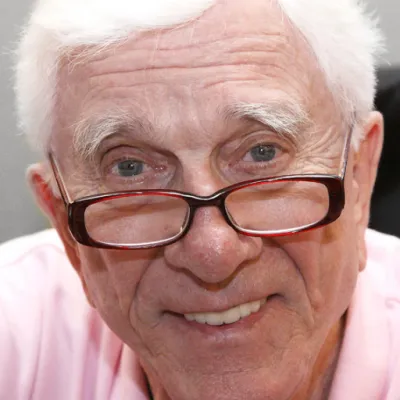
Leslie Nielsen
Human Design Chart
Biography
One of three sons of Ingvard Nielsen, a Royal Canadian Mountie, and mom Maybell, the boy spent his childhood in the isolation of Fort Norman, a tiny trading-post type village just 100 miles below the Arctic Circle. His father had been hired to protect the 15 people who lived there. When his two older brothers became of school age, they moved to Edmonton, Alberta and for the first time, had a home with indoor plumbing.
A childhood case of rickets left his legs bowed at the ankles and briefly darkened his dream of being an actor. His dad, bright and thoughtful in public, was a disciplinarian and a violent man to the family. His dad used to hit his mom but one night when he was punishing Nielsen and his brothers, he accidentally hit his own leg with his strap. Realizing how hard he hit himself, he never hit the kids again.
When Leslie was 17, he joined the Royal Canadian Air Force after graduating from Victoria High School. His brother Erik is a military policeman in the Yukon.
When he was discharged he got a job at a Calgary radio station as an engineer, announcer and DJ before heading to Toronto to study acting at Lorne Greene's Academy of Radio Arts. He then won a scholarship to the Neighborhood Playhouse in New York, studied dance under Martha Graham and did summer stock.
He broke into TV on "Studio One" in 1949. The next year he was in 46 TV shows, usually playing authority figures, and in 1954 moved to Los Angeles to make "Forbidden Planet" with Walter Pidgeon.
What does Projector 4/6 mean for Leslie Nielsen?
Projector 4/6 — Design at a Glance
Leslie Nielsen was someone who immediately recognized weaknesses in systems and others. His Human Design as a Projector gave him a dense, focused aura, comparable to a bright flashlight that shines light into the darkness with precision. He could instantly see where processes were bumpy or errors lay. However, this ability for quick diagnosis was a double-edged sword: Direct criticism often felt like blinding light to those around him and they reacted defensively.
Since Projectors do not have a defined Sacral Center, they lack a constant source of life energy. Instead, Leslie Nielsen experienced phases of high productivity followed by mandatory rest periods for regeneration. Ignoring this rhythm led to exhaustion; aligning with his design rewarded him with success. The central strategy was not to take the initiative himself but to wait for an honest invitation from others. By living his own harmony and competence, he became attractive to those around him. People came to him of their own accord to seek advice rather than feeling attacked by unbridled analysis. If he did not live according to this strategy of patience and waiting for the invitation, bitterness developed as a non-self theme. His design therefore demanded less active engagement and more radiant presence that encouraged others to accept his leadership.
Emotional Authority
Leslie Nielsen showed an internal decision-making structure that didn't clarify immediately but needed time to settle. His design carried Emotional Authority, meaning his defined Emotional Center took charge of his inner truth – regardless of other defined centers. This configuration generated a natural rhythm of emotional waves: moods swung between enthusiasm and distance, with each moment only a provisional coloring of perception, not the final reality.
Quick, spontaneous judgments often fell inaccurately as they were based on this fleeting snapshot. The mechanics of his design required patience: decisions had to 'go overnight' to ripen. Only when initial emotional heat cooled and clarity set in did the true core of a situation become visible. This process of waiting and observing was not a lack of resolve but an essential strategy for avoiding premature action that led to misjudgments. Leslie Nielsen lived with this need to be patient, asking himself repeatedly before making steps toward long-term life decisions. The calmness at the end of this process was the result of conscious negotiation with his feelings rather than blind adherence.
The 4/6 Profile — Opportunist / Role Model
Leslie Nielsen showed as a 4/6er a development line from experimental networker to gentle role model. In his first thirty years, he acted like a pure Line-3 type: actively seeking connections and testing various roles in relationships. This phase was marked by the Line 4 at Gate 49, aiming to carry principles outward and find support for a broader program. It was about human rights and revolutionary changes, where he learned not to make promises lightly.
With entering his second life stage, marked by the Saturn Return, his orientation fundamentally changed. The Line 6 at Gate 43 became active and brought the theme of breakthrough and mutation into play. Nielsen now faced an internal tension between a desire for community (Line 4) and the need to stand above things and recognize new orders (Line 6). He engaged only where he felt his partners supported this deep transformation. His task was to function as a role model: he used his network not just for self-discovery but to pass on wise insights without losing touch with the ground or detaching from the masses.
Split Definition — Defined & Open Centers
Leslie Nielsen was characterized by a steady mental foundation. His defined Ajna Center gave him a trustworthy, specific way of conceptual thinking. He wasn't easily swayed by external opinions and processed data and creativity in a consistent manner. This mental stability often served as an external authority for his environment, where he clearly structured concepts and encouraged others to think along with him.
This cognitive clarity was expressed through his defined Throat Center. His communication was reliable and directly sourced from his mind; he spoke what he conceptualized. This allowed for an honest, clear articulation of his thoughts without the urge for impulsive persuasion.
Deeper decisions, however, followed a different rhythm. His defined Solar Plexus acted as an inner emotional authority. Here, it was necessary to wait out waves of feelings and moods until emotional clarity emerged. Spontaneous reactions to highs or lows in this wave were less sustainable than patient waiting, which allowed him to cultivate deep insights and carefully examine relationships.
At the same time, he possessed defined Spleen and Root Centers. The Spleen provided spontaneous, intuitive signals in the present that were crucial for his well-being and survival. The Root Center generated a constant pressure towards material stabilization and correction, propelling him forward in the world.
In contrast, his vulnerability was evident in the undefined centers. His open Head Center lacked its own inspiration; it tended to absorb foreign questions or mental pressures, leading to confusion if he didn't trust his inner authority. His open G Center meant a lack of firm identity; he adapted and sought the right place to find direction rather than asserting it himself. The open Heart Center lacked consistent willpower; it was vulnerable to pressure to fulfill promises or prove value, which could lead into cycles of self-doubt if he didn't rely on his strategy. Finally, in his open Sacral Center, there was no constant energy source; he absorbed the vital energy of others and had to learn to set boundaries to avoid exhaustion from 'borrowed' energy.
Channels for synthesis, spontaneous insight and meaningful struggle.
Leslie Nielsen showed himself deeply embedded in the cohesion of his community while often oscillating between a drive for belonging and the necessity to set clear boundaries. This attitude shaped his design significantly: The Channel of Synthesis 19-49 connected his Root Center with his Solar Plexus Center. Through Gate 19, he felt the pressure to establish connections and maintain the tribal unit, while Gate 49 pushed him to reject anything that did not align with his highest ideals. This emotional glue determined who belonged in the family and who didn't; loyalty was an intuitive, almost mystical bond based on the exchange of protection and basic needs.
Simultaneously, Leslie Nielsen had the ability to translate complex connections into clear, innovative structures. The Channel of Structuring 23-43 connected his Ajna Center with his Throat Center. Gate 43 provided spontaneous insights and breakthroughs that he assimilated and expressed through Gate 23. His thinking often felt far ahead; he developed techniques and concepts that promoted efficiency and changed others' perspectives. Timing was crucial: When his innovative ideas came at the right moment, they were recognized as genius, otherwise he risked rejection.
Another defining aspect was his relentless will to find personal meaning. The Channel of Life Struggle 28-38 connected his Root Center with his Spleen Center. Gate 38 exerted pressure for him to defend his individual integrity against external forces while Gate 28 helped him intuitively recognize which struggles were worth the effort and sacrifice. This stubborn determination drove him to pursue his own path, even if it meant giving up security. He found fulfillment in fighting for something that mattered to him, becoming an example for others undergoing their individuation process.
Additionally, Gates like Gate 4 (logical formulas for future security) and Gate 62 (detailed pattern recognition) influenced his personality, while his design was shaped by Gates such as Gate 56 (narrative abstraction) and Gate 54 (connection between worldly success and spirituality). This constellation created a person who united the emotional depth of the tribe with the intellectual sharpness for innovation and the fighting spirit of self-realization.
Individual Circuitry — Circuit Signature
Leslie Nielsen's design inclined towards structured communication and resilient survival instincts. As someone with Split Definition, his energetic system comprised two separate, non-directly connected groups: a combination of Spleen, Root, and Solar Plexus Centers along with a distinct connection between Ajna and Throat Centers. This separation meant that his intellectual expression (Ajna-Throat) operated independently from his instinctive reactions (Spleen-Root-Solar Plexus); they did not flow into each other but existed as parallel force fields.
In the Knowledge Circuit, Leslie Nielsen concretely connected Ajna with Throat Center (Channel 43-23, Structuring). This allowed him to articulate thoughts clearly and logically before speaking – a skill for precise formulation of complex ideas. Simultaneously in this circuit, the connection between Spleen and Root Centers (Channel 28-38, Life Struggle) gave him intuitive ability to make the right decision under stress to conserve energy and manage crises effectively. Both aspects of the Knowledge Circuit remained isolated from each other; his creative thinking did not directly drive his survival reflexes but operated independently alongside one another.
The Ego Circuit contributed to Leslie Nielsen's connection between Solar Plexus and Root Centers (Channel 49-19, Synthesis). Here, emotional waves merged with the physical energy of action. This shaped him as someone who aligned actions based on emotional resonance; he often acted impulsively when a situation emotionally touched him and simultaneously generated physical tension. As this channel was part of his defined Root Energy, this emotional urgency seamlessly integrated into his overall stress and survival dynamics while his intellectual expression in another design aspect operated independently.
Right Angle Cross of Explanation 1
Leslie Nielsen exhibited a fundamental stance aimed at clarity and direct communication. His design was marked by the right cross of explanation. This configuration emphasized the ability to translate complex connections into understandable, clear statements. It wasn't about long explanations or theoretical treatises but rather getting to the essence: formulating a message in such a way that it is immediately grasped.
In Human-Design, this cross represents the power of precise communication. Those who carry this structure often have a natural talent for avoiding misunderstandings and getting to the point. It's less an intellectual achievement than an intuitive gift for saying the right thing at the right time. Leslie Nielsen likely used this energy in situations where it was crucial to take a clear, decisive stance or convey information quickly.
The mechanics behind this cross support a kind of authority through clarity. When words are clear, trust is built. Thus, Leslie Nielsens design promoted an aura based on direct, unvarnished truth. He probably avoided obscuring things or making them unnecessarily complicated. Instead, he sought the simplest form of expression to inform and orient his surroundings. This trait shaped his way of interacting with other people and positioning himself in social or professional contexts.
Saturn Return · Uranus Opposition · Chiron Return · 2nd Saturn Return — Life Cycles
Leslie Nielsen's Human Design profile indicated a tendency towards late but lasting turning points. In 1980, at the age of 54, he experienced a significant career boost through the comedy "Airplane!". For his Human Design, this was no coincidence but rather his second Saturn return. This cycle often marks a phase of consolidation and renewed departure after a long period of structuring. What had previously begun as an experiment or side role now solidified into a sustainable success. The second Saturn return acts like a filter: it separates the essential from the inessential and allows for implementing one's strategy on a new, more mature level. During this time, Nielsen no longer appeared as a searching beginner but rather as someone who had found his place and was now acting with clarity. The comedy became a catalyst that put his previous work into a new light. It confirmed that years of groundwork—though initially unnoticed—now bore full fruit at this moment. His design promoted an attitude of perseverance: nothing happened overnight, yet when it did happen, it carried the power of long-term preparation. This moment shaped the course of his life as proof that timing and inner structure must work together to produce visible results.
Projector · Emotional Authority — Synthesis
Leslie Nielsen lived as a Projector, distinguished by an acute ability to recognize the potential and weaknesses of others (Gate 19 & 49). This gift was always accompanied by an emotional wave that colored his perception and required time to mature. He acted as an observer who recognized patterns and developed his own perspective on the interplay between needs and ideals – a process shaped by the Channel of Synthesis. His profile as Networker/Role Model suggests that throughout his life, he oscillated between a desire for community and the need for individual reflection.
A central paradox in his design lay in the tension between his projection ability – bringing 'light into darkness' (Projector type) – and the necessity to digest decisions emotionally (Emotional Authority). He possessed the gift of recognizing flaws in the system, yet an immediate response would have met with resistance. Instead, his path required patience and waiting for the right moment to effectively implement his insights. This shift between recognizing potential and adapting to emotional rhythms shaped his expression and led to a late success (charted event 1980), which was based on a unique combination of observational skill and timing.
3 Defined Channels
Incarnation Cross - Right Angle Cross of Explanation 1
Solar Return
The Solar Return shows the moment when the sun returns to its exact birth position - your personal solar year.
Life Cycles
Discover the life cycles with a detailed triple view (birth chart, cycle chart, composite).
Human Design Profile
- Type
- Projector
- Strategy
- Wait for the respectful invitation
- Authority
- Emotional Authority
- Profile
- 4/6 - Opportunist / Role Model
- Definition
- Split Definition
- Incarnation Cross
- Right Angle Cross of Explanation 1
- Date of Birth
- 11.02.1926 05:00
- Place of Birth
- Regina, CAN
Frequently Asked Questions
What was Leslie Nielsen's Human Design type?
Which Profile did Leslie Nielsen have?
What Authority did Leslie Nielsen possess?
What incarnation cross did Leslie Nielsen have?
When was Leslie Nielsen born?
Discover your own Human Design
Are you also a Projector? Find out in a personal reading how to unfold your leadership qualities and recognize the right invitations.
More Personalities
Back to overviewSissy Spacek

Alain-Fournier

Anémone

Ann-Margret

Bourvil
Christian-Jaque