Louis Braille
Human Design Chart
Biography
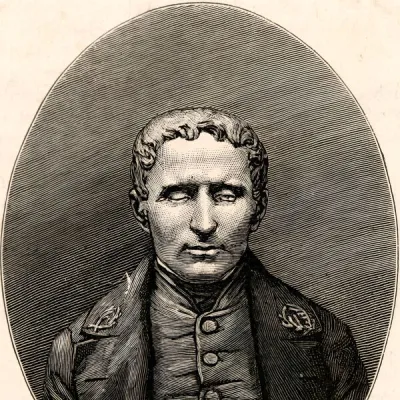
Braille was blinded in one eye at the age of three. This occurred as a result from an accident with a stitching awl in his father's harness-making shop. Consequently, an infection set in and spread to both eyes, resulting in total blindness. At that time, there were not many resources in place for the blind, but he nevertheless excelled in his education and received a scholarship to France's Royal Institute for Blind Youth. While still a student there, he began developing a system of tactile code that could allow blind people to read and write quickly and efficiently. Inspired by a system invented by Charles Barbier, Braille's new method was more compact and lent itself to a range of uses, including music. He presented his work to his peers for the first time in 1824, when he was fifteen years old.
In adulthood, Braille served as a professor at the Institute and had an avocation as a musician, but he largely spent the remainder of his life refining and extending his system. It went unused by most educators for many years after his death, but posterity has recognized braille as a revolutionary invention, and it has been adapted for use in languages worldwide.
The Human Design of Louis Braille: Manifesting Generator 5/1
Manifesting Generator 5/1 — Design at a Glance
Louis Braille was revealed as someone with a hybrid energy structure: He possessed the constant power of a Generator combined with the ability to skip steps and quickly draw results into his life. This design tended towards tackling multiple things simultaneously, driven by various impulses.
As an Manifesting Generator, his strategy wasn't initiating action but reacting to internal signals from the sacral center. Only when this source gave a clear 'yes' should he start acting. This mechanism served to avoid frustration – his specific non-self theme – which often occurred when he acted too quickly and skipped important intermediate steps or spread himself thin across many projects.
With correct application of this strategy, Louis Braille could draw deep satisfaction from his work. His design promoted a 'play mode' where variety and parallel working didn't act as distractions but rather as sources of creative power. Instead of focusing on one thing alone, he found energy in following various stimuli as long as they were confirmed by his inner authority. This configuration marked him as someone who lived through quick implementation and diverse engagement, provided he remained aligned with his sacral drive.
Sacral Authority
Louis Braille lived as a Generator whose decision-making was shaped by the sacral authority. This internal voice didn't manifest in the head but rather as physical reactions to external stimuli: spontaneous bursts of energy or an emphatic 'mmh' upon agreement, dismissive sounds at failures. His design linked this direct gut feeling with an active spleen center functioning as a supportive instinctual authority. This allowed him to make lightning-fast, spontaneous judgments about his bodily well-being and the validity of impulses. With his emotional center open, he remained unaffected by short-term mood swings; his decisions were based solely on immediate physical resonance from the sacral center. This configuration greatly simplified his process: He needed no lengthy analysis but reacted directly to what released energy. When his sacral motor kicked in, he acted with inexhaustible vitality and enthusiasm, entirely free of obsessive purposefulness. Louis Braille navigated life by trusting these bodily signals. He did what his body positively responded to, which brought him deep satisfaction. The combination of sacral foundational authority and spleen-supported speed marked him as someone who intuitively and efficiently reacted to his environment, guided by a reliable inner compass that tolerated no doubts.
The 5/1 Profile — Heretic / Investigator
Louis Braille was revealed as someone working in profound isolation to develop solutions for others. His design as a 5/1 profile shaped this dynamic: He used the depth of his own knowledge base (Line 1) to later provide problem-solving for his surroundings (Line 5). This configuration gave him a magnetic presence; others instinctively sought after answers he possessed due to his intense inner research.
The Line 5, associated with alienation and solitary existence, drove him to find intuitive solutions in his own context. In crisis times, this isolated work proved crucially important for others. Simultaneously, the Line 1, connected with intuition and seeking clarity from confusion, demanded immense internal discipline. The challenge lay in not cutting himself off from others but rather preventing himself from being constantly available. Without clear boundaries, exhaustion through the demands of his environment threatened. Louis Braille learned, however, to maintain this balance: He protected his time for pure research and selectively provided his insights. This way, he avoided the depletion typical of 5/1s when they share their gifts uncontrollably. His ability to say no enabled him to uphold the beneficial tension between personal knowledge gain and service to others. This ensured the sustainability of his work and prevented him from breaking under the weight of constant inquiries from others.
Single Definition — Defined & Open Centers
Louis Braille was characterized by a consistent, reliable way of expression. His defined Throat Center served as a pivot point, transforming information from the body into clear communication and action. This coherence did not stem from arbitrary thinking but rather from a deep connection to his Motor Centers: the Sacral and Spleen Centers.
His defined Sacral Center endowed him with an immense vital energy source that was felt as a constant hum of power. This sacral energy was available only when he responded to questions – waiting for life to speak to him before answering with an inner “yes” or “no”. Simultaneously, his defined Spleen Center acted as the authority of intuition in the present moment. It provided spontaneous, non-verbal warning signals and health impulses that he had to trust without rational analysis to stay protected.
These internal stabilities contrasted with the challenges of his open centers. His open Head Center lacked a consistent way to process mental inspiration; it tended to get entangled in doubts and questions from others or seek answers that were not its own. Similarly, his open Ajna Center was flexible but prone to adopting concepts and opinions from the environment and misinterpreting them as personal truth.
Additionally, his open G Center lacked a fixed identity and direction. He relied on his surroundings to initiate finding the right place and life path; constant searching for a firm “I” definition would have been a sign of non-self. His open Heart Center did not drive him towards willful assertion or proving his worth through promises – a trap he could have fallen into to force recognition. Finally, his open Solar Plexus absorbed emotions from the environment like a barometer. He had to learn not to personalize these foreign feelings as his own or fear emotional confrontations but rather observe them objectively and let go once alone.
Channels for powerful intuition and meaningful life struggle.
Louis Braille exhibited a fundamental disposition based on immediate intuitive reaction. His design inclined him towards rapid action that did not stem from deliberate thought but rather deep inner certainty. This energy was shaped by the Charisma Channel 34-20: raw, physiological life force from the Sacral Center (Gate 34) flowed directly into the ability for instantaneous expression in the Throat Center (Gate 20). This created a charismatic presence where the impulse to manifest was so swift that it left little room for hesitation. Louis Braille found it hard to remain still; his energy demanded expression and movement.
This dynamic power was refined by the Brainwave Channel 57-20. Here, intuitive insight from the Spleen Center (Gate 57) connected with the same Now Gate (Gate 20). This endowed him with the ability to recognize hidden truths instantly and articulate these insights clearly. It was less an analytical process than a spontaneous wave of knowledge that encouraged others to use their own inner intelligence. Louis Braille often knew immediately what needed doing without having to think it through.
The stability of these reactions came from the Power Channel 34-57. This linked generative energy from the Sacral (Gate 34) with existential awareness in the Spleen (Gate 57). It ensured a constant, acoustic attention on his surroundings. Louis Braille was programmed to sense dangers or opportunities through vibrations and react physically immediately to secure his well-being.
Simultaneously, he was driven by the Life Struggle Channel 38-28. This connected individual integrity pressure from the Root Center (Gate 38) with intuitive evaluation of value and meaning in the Spleen Center (Gate 28). It gave him the determination to fight for his own truth and resist distractions. His struggles were not arbitrary but served the purpose of finding a deep life sense and inspiring others through his example towards individuation.
Individual Circuitry — Circuit Signature
Louis Braille had a Simple Definition, meaning all his defined centers – Throat, Sacral, Spleen, and Root Centers – were directly connected by channels without internal conflicts or separate focuses.
His design was marked by the Knowledge Circuit. Here, the Lightning Stroke Channel linked the Throat with the Spleen Center. This enabled intuitive, acoustic insights in the present moment that translated directly into expression. Simultaneously, the Life Struggle Channel between Spleen and Root Centers provided endurance to push these new insights through resistance and root them.
Additionally, energy flowed from the Integration Circuit. The Charisma Channel connected Throat with Sacral Center, transforming powerful impulses from life force into concrete actions here and now. The Power Channel between Sacral and Spleen Centers ensured this power was guided by intuitive knowledge rather than blind reaction.
The stream of consciousness in intuition within the Spleen Center underscored his ability for individual perception. Louis Braille thus emerged as someone who pioneered new paths: he used intuitive flashes and transformed them into tangible reality with sacral strength and rooted endurance. His energy was pulsing and acoustic, driven by the necessity to initiate change through personal expression.
Left Angle Cross of Individualism 2
Louis Braille demonstrated a fundamental orientation that was strongly focused on preserving his own integrity and inner values. His design indicated a tendency to distance himself from external expectations in order to protect a clear, unadulterated core. This alignment stemmed from the influence of the left cross of Individualism 2, a configuration that directs focus towards the individual and authentic self. Rather than losing himself in collective currents, he sought ways to express his own truth without compromising on substance. This did not mean isolation in a negative sense but rather a conscious selection of what was felt as significant. The energy of this cross promoted the ability to assert oneself in a world that often demands conformity by holding fast to one's principles. For Louis Braille, this was not an act of resistance against others but a necessity for maintaining inner coherence. He lived this orientation through a consistent dedication to what he considered true and personally relevant, thereby creating a stable foundation for his actions.
Saturn Return · Uranus Opposition — Life Cycles
Louis Braille showed himself as a person whose internal structure was oriented towards condensing experience into durable results. His design indicated a tendency towards systematic organization and anchoring of new insights that could only fully unfold through time and maturity. This mechanism became evident in 1839, at the age of 30: Braille published his Raphigrafie for reproducing letters by points. This marked his first Saturn Return, a cycle where years of groundwork often condense into a stable, tangible result. It was not an abrupt insight but the maturation of long-term development.
Later, in 1850 at the age of 41, another phase of expansion emerged: The Braille script became officially part of instruction at French schools for the blind. This fell during the Uranus Opposition, a time when individual innovations often integrate into broader societal structures and become established. What began as personal creation now found institutional recognition and became the foundation for many others. Louis Braille's path thus illustrated the transition from individual discovery to general availability, driven by the rhythmic cycles of his design aimed at stability and later dissemination.
Manifesting Generator · Sacral Authority — Synthesis
He was a Generator whose connection between his Sacral Center and Throat Center (Channel Charisma) gave him an unusual speed and assertiveness. This constellation shaped an unstoppable drive to react immediately to external stimuli and set energy in motion – a steady flow that was strengthened by the defined sacral authority. His Profile as Hero/Researcher (5/1) underscored this dynamic, driving him to deepen knowledge and offer solutions while always facing new challenges. The Knowledge Circuit supported this process by fostering the ability to gain and express transformative insights, clearly demonstrated in the publication of his script and its later official recognition.
Simultaneously, a central paradox revealed itself: Although he tended as an Manifesting Generator to tackle things quickly and skip steps, his deep knowledge (Line 5) and the accompanying responsibility towards others required careful preparation and elaboration. He thus lived in the tension between the impulse for immediate reaction and the necessity of taking time for developing solid solutions – a back-and-forth that forced him repeatedly to go back and adjust his approach.
4 Defined Channels
Incarnation Cross - Left Angle Cross of Individualism 2
Solar Return
The Solar Return shows the moment when the sun returns to its exact birth position - your personal solar year.
Life Cycles
Discover the life cycles with a detailed triple view (birth chart, cycle chart, composite).
Human Design Profile
- Strategy
- To respond - wait for something to respond to
- Authority
- Sacral Authority
- Profile
- 5/1 - Heretic / Investigator
- Definition
- Single Definition
- Incarnation Cross
- Left Angle Cross of Individualism 2
- Date of Birth
- 04.01.1809 04:00
- Place of Birth
- Coupvray, France
Frequently Asked Questions
What is the Human Design type of Louis Braille?
What Profile did Louis Braille have in Human Design?
What Authority did Louis Braille have?
What incarnation cross did Louis Braille have?
When was Louis Braille born?
Discover your own Human Design
Are you also a Manifesting Generator? Find out in a personal reading how to unfold your multi-talents and direct your energy wisely.
More Personalities
Back to overviewAldair

Alizée

Angeli

Arletty

Artus

Balthus