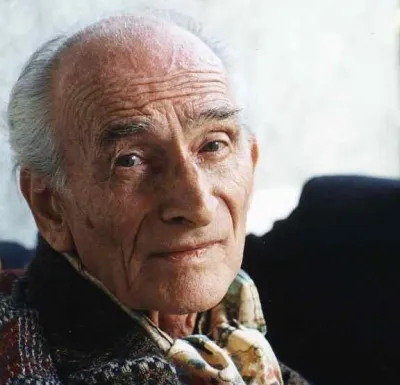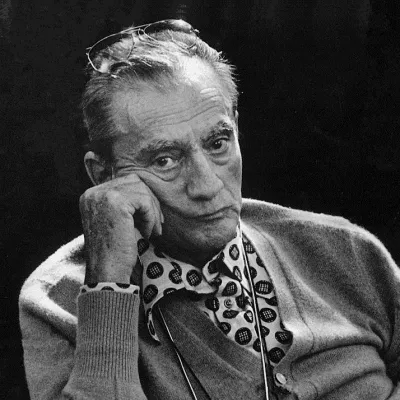
Luchino Visconti
Human Design Chart
Biography
Visconti died of a cardiac problem and influenza on 17 March 1976, Rome, Italy.
The Human Design of Luchino Visconti: Manifesting Generator 2/5
Manifesting Generator 2/5 — Design at a Glance
Luchino Visconti was someone who could achieve quick results by bypassing conventional processes. His manifesting generator design combined the constant energy source of the sacral center with the ability to skip steps. This allowed him a hybrid nature: He had the endurance of a generator and simultaneously the direct impact of a manifestor.
However, this configuration carried specific risks. The inclination towards speed sometimes led to overlooking important intermediate steps. When this happened, he had to return and make up for the missing phases, which could lead to frustration – the central non-self theme of this type. Additionally, his design tended to pick up multiple impulses simultaneously and start diverse projects in parallel. Without clear orientation by inner signals, this multitasking joy quickly turned into overload.
The solution did not lie in linear task completion but rather in reacting to the internal “yes”. Luchino Visconti drew deep satisfaction from his work when he responded to life impulses and checked if his sacral center continued to support this activity. In this state, working on various topics in parallel was no obstacle but a source of energy. His optimal functioning occurred in playful mode, characterized by variety and reliance on the steady flow of his own power rather than fighting against it or forcing himself into rigid structures.
Sacral Authority
Luchino Visconti showed a basic attitude of an immediate, physical response to life. His design dictated that decisions were not made through prolonged deliberation but as direct reactions to external stimuli. This mechanism was based on his sacral authority, which exists only for the generator type and unites its strategy with inner guidance. This greatly simplified his decision-making process: He reacted to environmental impulses with a palpable “gut feeling” or surge of energy. These physical signals – often audible as a low grumble, hum, or an affirming hmm – served him as a reliable compass.
When his sacral motor responded to a stimulus, it filled him with vitality and inexhaustible energy. He could then immerse himself fully in activities driven by enthusiasm and inner satisfaction without the need for external goals or purposefulness. This joy of action was the natural state of his design, provided he followed this internal confirmation.
Additionally, his activated spleen center acted as a supportive instance to sacral authority. This gave him the ability to react particularly quickly and spontaneously. He had immediate access to his instinctive perception and physical well-being. This combination of sacral affirmation and spleen speed allowed Luchino Visconti to rely reliably on his deepest bodily impulses, which enabled him a direct and efficient way of acting.
The 2/5 Profile — Hermit / Heretic
Luchino Viscontis design laid out a tendency towards a fundamental inner conflict: between the urgent need for withdrawal and the external expectation to be immediately available as a competent problem solver. As someone with Profile 2/5, he was marked by this tension. Line 2, the Hermit line, conveyed a strong desire for privacy and introspective reflection. It emphasized the necessity of keeping secrets and waiting for the right moment before acting. This stood in stark contrast to Line 5, the Hero or Illusion line. Others sought solutions from him and expected immediate help during crises.
This configuration described a life task: investing energy only where it was consciously granted after thorough inner examination. Unreflective intervention led to loss of his own substance; excessive withdrawal ignored the natural attraction towards others seeking guidance. Visconti had to strategically use his “alone time” to gain internal clarity about his own yes and no. Only then could he act as a rescuer without forgetting himself in the process. The mechanics required strict selection of engagement. He learned to integrate deeper forces to secure quality rather than mere quantitative success. His design challenged him to avoid confusion through early involvement of others in his reflections and instead carefully weigh the timing of his revelations.
Split Definition — Defined & Open Centers
Luchino Visconti revealed himself as someone who was constantly under internal pressure to ask questions and understand connections. His defined Head and Ajna Centers generated a constant mental activity: inspiration was not for him a sudden flash, but rather an ongoing process of thinking and understanding. These thoughts flowed directly into his defined Throat Center, allowing him to express or act on his concepts clearly and reliably. Thus, his design offered a firm bridge from idea to manifestation.
At the same time, he possessed a stable inner identity through his defined G Center and a massive vital energy source in the Sacral Center. As a Generator, his strategy was not to initiate but rather to wait for the right invitation or question before responding with full sacral energy. This protected him from exhaustion that comes from swimming against the current.
However, his design also revealed high sensitivities through four open centers. His open Heart Center lacked its own consistent willpower; he tended to wonder if he had enough value or needed to make promises to prove his status – a trap that could pull him into spirals of self-doubt. The open Solar Plexus Center absorbed foreign emotions, meaning that he often amplified feelings like anger or joy that belonged to others rather than experiencing them as his own stable mood. Furthermore, his Spleen Center was open, making him vulnerable to survival fears and spontaneous, impulsive decisions that were regretted later. Finally, the open Root Center took on external stress, putting him under pressure that did not come from himself but from his environment. The challenge lay in not personalizing these open fields and instead trusting his defined sacral response.
Channels for doubt, rhythm and quiet reflection.
Luchino Visconti revealed himself through a synthesis of analytical skepticism and deep biological rhythm. His design tended towards constant pattern recognition paired with the ability to patiently mature experiences.
The Logic Channel 63-4 connected the Head Center with the Ajna Center, creating a doubting mind that constantly sought verifiable patterns. Doubt was essential here; logic could be formulated correctly yet still remain false. This channel filtered information until consistent answers emerged, lacking an ungrounded space of belief.
Simultaneously, the Rhythm Channel 5-15 between Sacral and G Centers anchored Luchino Visconti in the vital life flow through firm habits (Gate 5) and integration of social diversity (Gate 15). This magnetic monopoly drew others into a continuous energy flow determined by an inner timing that was neither steered by intellect nor emotional waves.
Completing this was the Lost Son Channel 13-33 between G and Throat Centers. Here he gathered as a listener information and secrets (Gate 13) to then withdraw (Gate 33) and reflect on these experiences. This mechanism fostered patience in maturing truths before sharing them.
The combination of these channels generated an energy that was both critically detached yet intuitively rooted in the life stream. Luchino Visconti used his skepticism for pattern verification while his biological rhythm and reflective nature allowed him to recognize deeper connections and integrate them timely.
Collective Circuitry — Circuit Signature
Luchino Visconti presented himself through a dual tension field: on one side, cool, future-oriented logic; on the other, wave-like, past-related emotionalism. This split definition created two parallel existing, not directly connected energetic poles.
The Understanding Circuit drove rational focus towards structure and improvement. It linked Head with Ajna Center (intellectual clarity) as well as separately Identity with Sacral Center (enduring energy). This enabled formulating logical insights free from conditioning to lead society into a better future – an 'emotionless ratio'.
Simultaneously, the Meaning Circuit acted. It connected Throat with Identity Center. Here, energy flowed from the past: emotions and experiences were cyclically reflected to grasp their meaning. Unlike the linear logic of the first pole, this experience ran wave-like – with beginning, middle, and end.
Both circuits shared the goal of sharing insights with the collective. Yet the sources differed fundamentally: one pole analyzed strategically for tomorrow, the other processed felt truths from yesterday. Visconti's design thus showed a constant internal dialogue between illogical emotion and structuring ratio without these streams directly merging. They existed as separate yet equally powerful forces in his expression style.
Right Angle Cross of the Four Ways 3
Luchino Visconti's Human Design profile featured the archetypal structure of the 'Right Cross of Four Paths'. This configuration shaped a profound, often unconscious life dynamic where destiny and individual expression were constantly at odds. The absence of specific mechanical details in the raw content necessitates an abstract interpretation: it is not about isolated channels or gates but rather the fundamental tension between what was felt as unchangeable and the drive for personal form.
This Cross configuration did not describe a linear progression, but rather a web of internal constraints and external demands. Luchino Visconti moved within a field defined by these four paths – a structure that relied less on conscious choice than on deeply rooted, almost fateful imprinting. The dynamics were not presented as clear strategies but as an ongoing process of negotiation between the individual and the forces surrounding them.
Without concrete events in the raw content, this description remains at the level of the structure itself: it reveals a way of living where 'how' actions unfolded was preordained by the Cross, while the 'what' often remained unclear or contradictory. Luchino Visconti lived within this tension – not as a conflict in a negative sense but as a defining characteristic of his inner architecture. The four paths formed the framework within which his existence unfolded, independent of external circumstances or historical contexts.
Saturn Return · Uranus Opposition · Chiron Return · 2nd Saturn Return — Life Cycles
Luchino Visconti's Human Design profile indicated a tendency towards structural maturation processes marked by transformative crises. His development followed a clear rhythmic pattern of cyclic confrontation with authority and identity fractures. This framework did not serve chaos but created necessary turning points for deep personal evolution.
The first Saturn Return marked the beginning of this structural consolidation. Here, early groundwork solidified into sustainable results, allowing him to anchor his inner authority in the external world. Shortly after came the Uranus Opposition. This cycle often brought sudden breaks or impulses towards liberation that challenged old identity patterns and forced a reorientation. It was a moment of breaking away from the known to make space for more authentic expressions.
With the Chiron Return, Luchino Visconti reached a peak in his development. This cycle did not focus on healing past wounds but rather on fulfillment and flourishing. If he had lived according to his strategy up until this point, his incarnation cross unfolded increasingly. Meaning and purpose became experiential; life revealed its deeper intention. It was a phase of confirmation where previous crises were seen as necessary steps towards self-realization.
The second Saturn Return completed this process. It brought further stabilization and mature responsibility for the path he had worked on. Through this sequence of structuring, breaking, fulfillment, and reconsolidation, Luchino Visconti shaped his personal development not as a linear ascent but as a deep, cyclical maturation process that continually recalibrated identity and authority.
Manifesting Generator · Sacral Authority — Synthesis
Luchino Visconti lived a life marked by a constant flow of energetic reactions. As an Manifesting Generator (MG), he possessed the ability to quickly respond to stimuli and set things in motion – a tendency amplified by his defined sacral energy. This immediate responsiveness was coupled with a deep inner need to filter patterns and formulate questions (Logic Channel), driving him constantly towards understanding and clarity. The profile as a Natural Talent and Hero showed in his readiness to address the needs of others, combined with a strong need for withdrawal and internal reflection.
Visconti's design held a central paradox: between the impulse for quick initiation and the necessity to review steps (MG mechanics) lay a tension. This dynamic was reflected in the connected circuitry – the Understanding Circuit, focused on logic and structure, as well as the Meaning Finding Circuit, seeking significance. He seemed destined both to push things forward and to hesitate, critically questioning the consequences of his actions.
3 Defined Channels
Incarnation Cross - Right Angle Cross of the Four Ways 3
Solar Return
The Solar Return shows the moment when the sun returns to its exact birth position - your personal solar year.
Life Cycles
Discover the life cycles with a detailed triple view (birth chart, cycle chart, composite).
Human Design Profile
- Strategy
- To respond - wait for something to respond to
- Authority
- Sacral Authority
- Profile
- 2/5 - Hermit / Heretic
- Definition
- Split Definition
- Incarnation Cross
- Right Angle Cross of the Four Ways 3
- Date of Birth
- 02.11.1906 19:30
- Place of Birth
- Milan, Italy
Frequently Asked Questions
What was Luchino Visconti's Human Design type?
What Profile did Luchino Visconti have in Human Design?
What Authority did Luchino Visconti possess?
What incarnation cross did Luchino Visconti have?
When was Luchino Visconti born?
Discover your own Human Design
Are you also a Manifesting Generator? Find out in a personal reading how to unfold your multi-talents and direct your energy wisely.
More Personalities
Back to overviewAldair

Alizée

Angeli

Arletty

Artus

Balthus