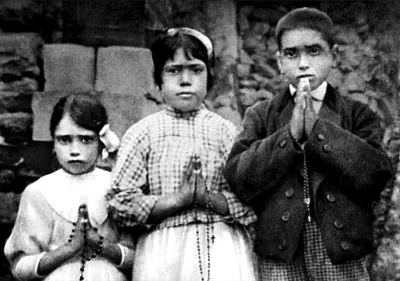
Lucia dos Santos
Human Design Chart
Biography
On 13 May 1917, shortly after noon, the three were watching the sheep at Cova da Iraia when a radiant form appeared above an old oak tree. She told them she had come from Heaven and instructed the three visionaries to return, once each month for six months. The Lady told the children that She had been sent by God with a message for every man, woman and child living in our century. Between 13 May and 13 October 1917, the vision of Our Lady was always on the 13th of the month with one exception, in August when she appeared to them near the village of Valinhos on August 19. The mayor, in an attempt to stop the events, had the youngsters kidnapped and secluded away but when the crowds demanded the return of the children, he soon released them.
At a time when civilization was sickened by war and bloody violence, the Blessed Mother repeated her emphasis on prayer, reparation and consecration during each visit, in return for which She promised that Heaven would grant peace to all the world.
Human Design Analysis: Lucia dos Santos as Generator 4/6
Generator 4/6 — Design at a Glance
Lucia dos Santos revealed herself as someone with remarkable endurance, comparable to a workhorse that only optimally utilized its strength when it received an inner confirmation for the task. As a Generator, she possessed a great deal of sacral energy, which was released not through self-initiative but by responding to signals from life. Her strategy was to wait for impulses and then act when her inner self gave a clear "yes". Living in harmony with this mechanism led to a deep sense of fulfillment. If she was held back by her passion or forced to do things that did not resonate with her, this resulted in frustration and a lack of energy. The risk of burnout lurked where she wasted her strength on tasks that did not suit her or where external circumstances prevented her from working on her heart project. Her design suggested that true strength lay in the ability to react from the gut, rather than anticipating. Through this attitude, she could efficiently use her energy and stand up against resistance as long as she accepted the inner confirmation as a guide for her actions.
Sacral Authority
Lucia dos Santos lived as a Generator, which unified her inner authority with her life strategy. This configuration fundamentally simplified her decision-making process, as she did not have to switch between strategy and authority. Her orientation occurred through sacral authority, which manifested as a physical reaction to external stimuli. Instead of thinking, Lucia dos Santos listened to her "gut feeling". This expressed itself in physical sounds like grunting, humming, or a confirming "mm-hmm" when her sacral motor kicked in.
This physical response signaled vitality and inexhaustible energy. Once she engaged with something, she acted with great enthusiasm and immersed herself in her tasks without the need to pursue a specific goal. She was born to walk through life with joy and contentment.
Additionally, her activated spleen center acted as a supporting authority. Since it was directly connected to the sacral center, it enabled Lucia dos Santos particularly quick and spontaneous reactions. She had an immediate access to her instinctive perception and physical well-being. These instincts served her as reliable guiding principles. The combination of sacral energy and spleen-supported intuition shaped her way of shaping life: she reacted authentically to what spoke to her and let herself be guided by her physical truth, which secured her an efficient and fulfilling path through her life tasks.
The 4/6 Profile — Opportunist / Role Model
Lucia dos Santos revealed herself in her first half of life as an experimental networker, learning through numerous relationships and friendships. Her Profile 4/6 worked similarly to a pure Line 4 in the first thirty years, before her first Saturn return. She sought connection and tested her limits in the social space, without yet possessing the full distance of later wisdom.
With the activation of Line 6, an internal conflict emerged: the desire for belonging (Line 4) was pitted against the need for contemplative distance and meaning (Line 6). This contradiction between heart and head shaped her development. Line 4 addressed the survival of innocence in fixed perspectives and the beauty amidst chaos, which gave her an infectious, socially influential aura. She acted as a spiritual warrior who had to preserve their innocence.
In her later years, it was expected of Lucia dos Santos to take on the role of a wise role model. The sixth line went through phases of martyrdom and a roof phase, in which perfect behavior often seemed like hypocrisy. Only after the age of fifty did she understand this behavior as an individual survival mechanism. Her authenticity grew as she learned to cautiously open her big heart to protect herself from false people, while simultaneously overseeing the integration of her entire switchboard.
Triple Split Definition — Defined & Open Centers
Lucia dos Santos revealed herself through a consistent, trustworthy mental function. Her defined Ajna Center ensured that she created concepts in the same way every time and was not easily influenced by others present. This mind served as an external authority that conditioned the mental field of her environment. At the same time, she had a fixed sense of self-identity and a sense of her correct direction, shaped by her defined G Center. She knew where she belonged and could show others new directions without being dependent on them. Her energy source was her defined Sacral Center, which generated enormous power. Lucia dos Santos had a real vitality that she used by reacting to life rather than initiating it. Her answers from the Sacral determined whether energy was available. This was complemented by her defined Spleen Center, which allowed her spontaneous, intuitive judgments in the present, as well as her defined Root Center, which provided the physical pressure to move forward.
At the same time, Lucia dos Santos was exposed to certain vulnerabilities. Her open Head Center had no consistent way of processing mental information. She tended to get stuck in mental monologues or overwhelmed by doubts and confusion that actually belonged to others. The pressure to answer others' questions could weigh her down. Her open Heart Center led her to often feel driven to assert her will or make promises to prove her worth, even though she did not have the consistent energy for it. This could lead to a cycle of self-disapproval if she failed. Additionally, her open Solar Plexus absorbed the emotions of the environment. She was vulnerable to the moods of others and tended to personalize foreign feelings or avoid confrontation to avoid emotional backlash. These open centers required her not to identify with the absorbed energies but to trust her inner authority.
Channels for inquisitive curiosity, inner rhythms and life's meaning.
Lucia dos Santos lived in a deep, biological flow that propelled her forward independent of intellectual considerations or emotional fluctuations. The Rhythm Channel 5-15 connected her Sacral Center with her G Center. Gate 5 held fast to fixed habits and rituals, while Gate 15 integrated the diversity of society into this life flow. This gave her an inner sense of timing based on recurring, logical patterns and magnetically connected her to others without her having to actively work at it.
At the same time, she revealed herself as a storyteller who not only collected ideas but shaped them into stories to inspire others. The Curiosity Channel 11-56 connected her Ajna Center with her Throat Center. Gate 11 sought new perspectives, while Gate 56 learned through stimulation and experience. Her creativity lay in transforming abstract information into parables that engaged the imagination of listeners and allowed them to test new beliefs.
A third aspect of her design was her stubborn determination to find personal meaning in life's struggles. The Life Struggle Channel 38-28 connected her Root Center with her Spleen Center. Gate 38 exerted pressure to defend individual integrity against external distractions, while Gate 28 intuitively recognized which struggles had value and engagement was worthwhile. This configuration drove her to challenge the status quo and through this resistance to realize her uniqueness.
Additionally, individual gates influenced her: Gate 25 promoted a stance of mystical innocence and self-love, while Gate 46 guided her to full dedication to the physical process and the care of the body as a temple. Gate 10 supported her integration process through genetically predetermined behaviors, and Gate 60 taught her to accept limitations as a prerequisite for transformation. Gate 13 helped her reflect experiences in the context of time to establish collective continuity. Further influences came from Gate 31 (Leadership), Gate 41 (emotional evolution), Gate 24 (mental renewal), Gate 14 (power gain), Gate 52 (concentrated pause), Gate 58 (experimental joy), Gate 39 (selective provocation), and Gate 45 (tribal attraction).
Collective Circuitry — Circuit Signature
Lucia dos Santos was marked by three separate, parallel operating energetic streams. The Understanding Circuit connected her Identity Center with her Sacral Center. This created a focused, rational power that used logical structures to improve the future, free from emotional influence. Parallel to this, the Meaning Circuit connected her Ajna Center with her Throat Center. Here a cyclical process emerged: emotions and experiences from the past were reflected and subsequently communicated to the collective to enable shared learning. The Knowledge Circuit formed the third, independent stream between Spleen and Root Centers. Through the Life Struggle Channel, it ensured a pulsating, acoustic energy that strengthened individuality through mutations and enabled new expression. These three definitions were not connected at Lucia dos Santos; they existed as separate energy fields. Rational future shaping, emotional past reflection, and intuitive strengthening of identity ran alongside each other without forming a common energetic flow. Each of these areas worked autonomously, creating a complex, multi-layered inner self that integrated different aspects of being human – thinking, feeling, and intuition – in separate channels.
Right Angle Cross of the Vessel of Love 1
Lucia dos Santos was marked by the right cross of the Love Vessel 1. This configuration established a specific energetic orientation that was reflected in her way of life. In Human Design, this pattern signifies a deep connection to themes of love and emotional exchange. It was not a superficial affection, but a structural imprint that touched her core.
The right cross of the Love Vessel 1 describes an energy aimed at living emotional connections on an authentic level. For Lucia dos Santos, this meant that her experiences and interactions were strongly influenced by this need for deep, true connection. She lived this dynamic not just theoretically, but as a lived reality. The energy of this cross acted as an inner compass, guiding her to relationships and situations where genuine emotional resonance was possible.
Her design challenged her to not only receive this love but also to actively live and share it. It was a central aspect of her identity in how she connected with others. The structure of her chart showed that this emotional depth was an integral part of her existence. Lucia dos Santos followed this inner logic, which gave her life a certain quality of devotion and emotional engagement. This was not a coincidence, but a direct result of her energetic constellation.
Saturn Return · Uranus Opposition · Chiron Return · 2nd Saturn Return — Life Cycles
Lucia dos Santos showed a life structure marked by cyclical phases of inner clarification and reflection on her true essence. Her Human Design pointed to a dynamic where external life events often acted as catalysts for deep inner restructuring, rather than mere coincidences.
This mechanism became clear in 1934, at the age of 27, when she took her perpetual vows. This step marked her first Saturn Return, a time when long-term commitments and her own identity are recalibrated. For her design, this was not a break but a necessary condensation of her inner authority, allowing her to define her role with greater clarity.
The second major shift occurred in 1946, when she returned to the convent in Tuy at the age of 39. This coincided with the Uranus Opposition, a phase often understood in Human Design as a time of liberation from outdated structures or a return to a more authentic core. Her return was thus not an escape, but a conscious alignment with what her design required as a central life space. Both events illustrate how Lucia dos Santos did not passively endure her life paths but actively adapted them to her inner architecture, thereby stabilizing and deepening her existence over time.
Generator · Sacral Authority — Synthesis
Lucia dos Santos lived deeply in her sacral center (Generator Type, Sacral Authority), which manifested in a constant, powerful energy. The Rhythm Channel (Gate 5/15) defined a natural inclination towards fixed habits and a connection to the life flow, fueled by reactions from the sacral center. This energy was not unbound; the defined Mental Center (Ajna) provided a steady, conceptual way of thinking that shaped concepts and inspired others. Her profile as a Networker/Role Model (4/6) points to a way of life that combined the need for community with deep reflection – a constant interplay between heart and mind.
A central paradox in Lucia dos Santos’ design lay in the tension between the drive to work within the community (Line 4 in the profile) and the desire for detached observation (Line 6). This inner tension was amplified by the Uranus Opposition at the age of 39 and the Saturn Return at the age of 27, both pointing to changes in her life direction. Thus, she seemed to navigate between the need for belonging and the pursuit of individual insight.
3 Defined Channels
Incarnation Cross - Right Angle Cross of the Vessel of Love 1
Solar Return
The Solar Return shows the moment when the sun returns to its exact birth position - your personal solar year.
Life Cycles
Discover the life cycles with a detailed triple view (birth chart, cycle chart, composite).
Human Design Profile
- Type
- Generator
- Strategy
- To respond - wait for something to respond to
- Authority
- Sacral Authority
- Profile
- 4/6 - Opportunist / Role Model
- Definition
- Triple Split
- Incarnation Cross
- Right Angle Cross of the Vessel of Love 1
- Date of Birth
- 22.03.1907 20:00
- Place of Birth
- Aljustrel (Fátima), PORT
Frequently Asked Questions
What was Lucia dos Santos' Human Design type?
What Profile did Lucia dos Santos have in Human Design?
What Authority did Lucia dos Santos have?
What incarnation cross did Lucia dos Santos have?
When was Lucia dos Santos born?
Discover your own Human Design
Are you also a Generator? Find out in a personal reading how to use your sacral energy correctly and discover deep satisfaction.
More Personalities
Back to overviewAaliyah

Alain-Fournier
Alexia

Angèle

Angeli

Anne-Marie