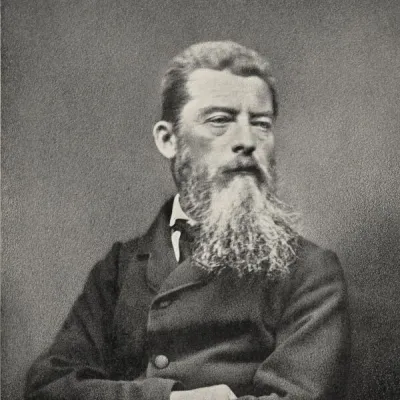
Ludwig Feuerbach
Human Design Chart
Biography
The son of a distinguished jurist, Feuerbach studied theology at Heidelberg before moving to Berlin to study directly under Hegel. His academic career was cut short in 1830 when his anonymously published first book, Thoughts on Death and Immortality, was condemned as scandalous for its attack on the concept of personal immortality. Barred from university posts, Feuerbach lived and worked in rural isolation for much of his life, in which he produced most of his significant writings supported by his wife's share in a porcelain factory.
Feuerbach's philosophy developed as a critique of Hegel's speculative idealism, which he viewed as the last, most abstract form of theology.
Human Design Analysis: Ludwig Feuerbach as Manifesting Generator 3/5
Manifesting Generator 3/5 — Design at a Glance
Ludwig Feuerbach's design set a tendency towards hybrid dynamics: He had the constant energy of a Generator but also possessed the ability to skip steps during initiation and quickly draw results into his life. This configuration as an expressing Generator meant that he had to react to inner impulses – his strategy was to wait for the "yes" from his sacral center –, yet showed remarkable speed in the process of implementation.
However, this speed entailed specific risks for him. Often, he would skip necessary intermediate steps, leading to a need to return later and make up for those gaps. Such setbacks could cause frustration as they went against his natural pace. Additionally, he tended to pursue multiple projects simultaneously, driven by various impulses. If this multitasking strategy did not harmonize with his inner authority, his creative enthusiasm quickly turned into exhaustion.
Despite these challenges, his design was geared towards deriving deep satisfaction from diverse activities. Once he responded to genuine impulses and regularly checked whether the projects still had his approval, he could achieve a productive "play mode." For him, seeking variety and not rigidly sticking to a single task as long as there was inner resonance was not an obstacle but a necessity.
Sacral Authority
Ludwig Feuerbach's design inclined him to make decisions not through intellectual deliberation but by trusting immediate physical resonance. As a Generator, he possessed sacral authority, meaning his strategy and inner guidance were identical: He reacted to external stimuli rather than initiating action himself. This configuration greatly simplified his decision-making process, as he did not have to choose between different internal voices but merely waited for the impulse of his body.
A prerequisite for this clarity was his open Emotional Center, ensuring that no emotional moods overlapped or distorted the sacral response. His authority manifested as a "gut feeling" – an impulsive grunt, a nodding hmm, or an energetic surge when coming into contact with life. When his sacral motor kicked in, he felt vital and acted with great enthusiasm, driven purely by joy in the activity itself, without any need for external purpose. Additionally, his activated Spleen Center served as a supportive instance: It gave him quick, instinctive access to his physical well-being and enabled spontaneous reactions to immediate presence. Feuerbach thus lived from a deep connection to his bodily signals, which reliably guided him through life.
The 3/5 Profile — Martyr / Heretic
Ludwig Feuerbach's design set a tendency for him to appear as someone who first had to try everything himself before conveying the insights gained from these experiences to others. As a person of Profile 3/5 – the experimenter and hero – he believed nothing that was given, but learned through his own experiments and failures. This practical treasure trove of experience became the foundation for his role as rescuer or storyteller for others.
The mechanics of this profile show a clear process: Line 3 of the adventurer demands direct experience, while Line 5 serves to present solutions in the hero's role. Feuerbach’s design also contained specific challenges regarding resources and influence. Gate 27 on Line 5 described an ability to manage other people's means and crisis management, but warned about the risk of losing power or gaining a negative reputation through accusations of fraud. At the same time, Line 3 from Gate 31 demanded high discernment in leadership; here, the quality of the followers mattered more than their quantity. His attractiveness to others directly resulted from this self-acquired knowledge that he shared. Failing publicly in experiments could be painful because it questioned his hero role before everyone's eyes. His path was marked by alternating between personal mistakes and later solving other people’s problems through a very personal, often harsh learning curve.
Single Definition — Defined & Open Centers
Ludwig Feuerbach's design inclined towards clear, identity-strong communication. His defined G Center gave him a reliable sense of self and an intuitive understanding of his direction; he knew instinctively where he belonged. This inner security flowed into his defined Throat Center, serving as the focal point to convey these messages to the world. His voice did not speak from uncertainty but from a constant source of identity and love.
This expression was supported by his defined Heart Center, which gave him willpower and the ability to keep promises as well as self-determinedly use resources. He acted out of a strong sense of 'I', making his statements powerful and convincing. At the same time, his defined Sacral Center provided constant vital energy that propelled him into engaging with what he responded to with inner consent. His defined Spleen Center helped him stay present in the moment and make intuitive judgments about health and well-being.
In contrast, his open Head Center showed a vulnerability to external mental pressure. He tended to engage with others' questions or seek inspiration from outside rather than having constant mental themes of his own. His open Ajna Center allowed him to take on various ideas and concepts but lacked a firm personal way of conceptual thinking; he had to learn not to identify every thought as his own truth.
His open Solar Plexus made him sensitive to the emotions of his environment. He absorbed and amplified foreign feelings, which could lead him to personalize emotional waves from others or fear confrontation to avoid negative reactions. Finally, his open Root Center took on environmental stress, often creating an inner pressure to be active or take on tasks that did not come from him, driving him into cycles of frenzy and exhaustion if he failed to recognize this foreign adrenaline surge.
Channels for logical leadership, rhythm, intuition, will and care.
Ludwig Feuerbach's design inclined towards innovative direction-finding paired with a need for logical leadership. The channel of the Beat 14-2 connected power competence in the Sacral Center (Gate 14) with higher knowledge in the G Center (Gate 2). This configuration drove mutation and novelty; Feuerbach showed himself as someone who generated new perspectives on identity and direction through trustful responses to life. Parallel to this, the channel of the Alpha Animal 7-31 linked selfhood in the G Center (Gate 7) with leading in the Throat Center (Gate 31). This created a mechanism for collective logical leadership based on shared patterns and trust. Feuerbach did not seek his influence through absolute authority but by acting as an alpha animal, guiding others to invite him into this role.
His talent was shown through the channel of wavelength 16-48, which connected intuitive depth from the Spleen Center (Gate 48) with technical skill in the Throat Center (Gate 16). Here repeated practice and perfection transformed a skill into an acknowledged talent that needed support through engagement and material resources. Additionally, the channel of the Money Line 21-45 between Heart and Throat Centers (Gates 21 and 45) emphasized the necessity of material control and willful decision-making to provide for the tribe. Feuerbach had to learn to assert his will in a way that maintained independence while taking on responsibility.
The channel of Preservation 27-50 connected care in the Sacral Center (Gate 27) with values in the Spleen Center (Gate 50). This gave him an aura of trust, drawing others to be supported. His task was to set boundaries and give energy only when asked and his own reaction confirmed it. Additional impulses came from Gate 41 (Evolution through Crisis), Gate 28 (Willingness to Take Risks Now) and Gate 46 (Commitment to the Process). These gates underscored the importance of experience, physical presence, and the ability to remain cool despite emotional fluctuations. Feuerbach's design challenged him to live his own direction honestly, giving others strength through example without having to take on their fate.
Collective Circuitry — Circuit Signature
Ludwig Feuerbach's design inclined towards a coherent, powerful expression style. As a person with simple definition, he showed as someone whose energetic centers – Identity, Sacral, Spleen, Throat and Heart – stood in one continuous flow. This created an integrated experience world where instinct, emotion, and will communicated directly.
The Knowledge Circuit connected his Identity Center to the Sacral Center through rhythmic energies pulsing via 'The Beat' (Gates 2-14), emphasizing individuality and translating creative impulses into constant life force. This promoted a genuine, moment-rooted expression style.
Parallelly, the Understanding Circuit linked Throat, Identity, and Spleen Centers. Channels 'The Wavelength' (16-48) and 'The Alpha Animal' (31-7) allowed clear articulation of logical strategies and focused visions. Here it was about sharing rational insights free from emotional distortion, connecting intuitive selection with identity through Spleen energy.
The Ego Circuit connected Throat and Heart Centers via the 'Money Line' (45-21). This stood for creating resources together through cooperation and exchange of support. It was about material security and mutual aid, where the will of the heart was directly spoken into words.
Finally, the Hunter Circuit linked Sacral and Spleen Centers via 'Preservation' (27-50), emphasizing instinctive protection, care, and preservation of what exists. This ensured that basic needs and survival of one's own genetics were secured through a primal, nurturing energy. All these forces worked in Feuerbach as an integrated whole.
Right Angle Cross of the Unexpected 2
Ludwig Feuerbach's design carried the signature of the right cross of the Unexpected. This configuration shaped a fundamental attitude in which the unpredictable was not seen as a threat, but rather as an essential impulse for change and deeper understanding. His inner compass was set to endure seemingly contradictory or chaotic situations and recognize hidden orders within them.
In Human Design, this cross describes a specific energetic structure often associated with the ability to find clarity during moments of confusion or sudden shifts. It's not about controlling events but adapting to new realities. For Ludwig Feuerbach, this meant that his intellectual process greatly benefited from breaking established patterns. He was challenged by the unexpected to broaden his perspectives and often reached insights that would have been impossible in stable environments. This mechanism fostered a kind of intuition based on trust in the flow of life, even when unpredictable.
Saturn Return · Uranus Opposition · Chiron Return · 2nd Saturn Return — Life Cycles
Ludwig Feuerbach's design showed a tendency towards internal condensation followed by later sharp differentiation. In 1832, at age 28, he ended his lecture activities – marking the first Saturn return cycle. This period often marks the point where years of groundwork condenses into a viable structure or old paths are finally left behind to make room for a more mature orientation.
His design also showed a reaction to external provocations through clear boundaries. In 1844, at age 40, Max Stirner published his book 'The Ego and Its Own'. This fell during the Uranus opposition phase, an astrological aspect often bringing unexpected challenges or ideological confrontations that force one's system to reposition and sharpen.
His true flowering of incarnation purpose came with the Chiron return around 1850. At age 46, Feuerbach published two biting satirical articles against the victorious reaction. This cycle is not a traditional healing process but a phase of fulfillment and meaning-making: one's essence unfolds fully here, often through active, character-driven contributions to public discourse that complete and make visible their personal journey.
Manifesting Generator · Sacral Authority — Synthesis
Ludwig Feuerbach lived a lifestyle marked by a constant interplay between initiation and reaction. As an Manifesting Generator (MG), he possessed the ability to quickly spark things – evident in his early termination of lecture activities (Saturn return, 1832) – yet simultaneously required his sacral center's response to external impulses. This dynamic combination led to a life path characterized by experimentation and the urge to try new things (Line 3), as well as the resulting ability to disseminate knowledge and inspire others (Line 5). The Channel of Beats (14/2) points towards an energy geared toward advancing innovations and initiating changes.
A central paradox in his design lay in the tension between a desire for expression and the necessity to connect with the world. His defined Throat Center, linked with various centers, indicated a strong voice that needed filtering through sacral authority. This led him to be ready to publicly express his ideas – as seen in his satirical articles (Chiron return, 1850) – while also being mindful of the resonance from his environment. The confrontation with dissenting views, manifesting in another's work appearing (Uranus opposition, 1844), revealed this inner conflict.
5 Defined Channels
Incarnation Cross - Right Angle Cross of the Unexpected 2
Solar Return
The Solar Return shows the moment when the sun returns to its exact birth position - your personal solar year.
Life Cycles
Discover the life cycles with a detailed triple view (birth chart, cycle chart, composite).
Human Design Profile
- Strategy
- To respond - wait for something to respond to
- Authority
- Sacral Authority
- Profile
- 3/5 - Martyr / Heretic
- Definition
- Single Definition
- Incarnation Cross
- Right Angle Cross of the Unexpected 2
- Date of Birth
- 28.07.1804 01:30
- Place of Birth
- Landshut, Germany
Frequently Asked Questions
What was Ludwig Feuerbach's Human Design type?
Which Profile did Ludwig Feuerbach have?
What Authority did Ludwig Feuerbach have?
Which incarnation cross was active for Ludwig Feuerbach?
When was Ludwig Feuerbach born?
Discover your own Human Design
Are you also a Manifesting Generator? Find out in a personal reading how to unfold your multi-talents and direct your energy wisely.
More Personalities
Back to overviewAldair

Alizée

Angeli

Arletty
Artus

Balthus