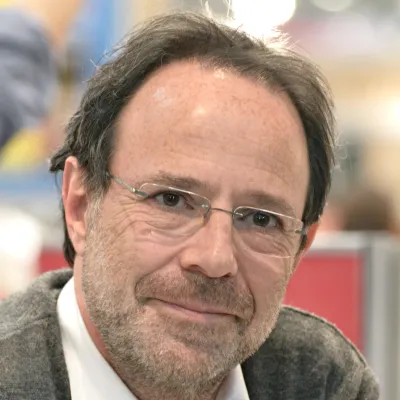
Marc Levy
Human Design Chart
Biography
He is also an entrepreneur. In 1983, he created a company specializing in computer graphics in France and the United States. In 1989, he lost majority control of the group and resigned, starting again from scratch. He then co-founded an interior design and construction company with two friends; the company would become one of the first office architecture firms in France.
Human Design Analysis: Marc Levy as Projector 3/5
Projector 3/5 — Design at a Glance
Marc Levy revealed himself as someone who could immediately spot weaknesses in systems and relationships without having to expend his own energy to fix them directly. His Projector design created an aura that worked like a focused flashlight: it illuminated precisely those areas that were still in the dark or dysfunctional in his surroundings. However, this ability to quickly identify errors in the system was only effective if it was not understood as direct criticism.
The mechanics of his design require that he does not immediately address what he sees, as this often triggers resistance or anger in others – similar to shining a bright light directly into someone's face. Instead, his strongest attraction occurred when he maintained a harmonious presence. In this state, others would come to him of their own accord to seek advice. His strategy involved waiting for a respectful and honest invitation before sharing his insights.
Since his Sacral Center was undefined, he lacked a constant source of life energy. This led to phases of high intensity, followed by necessary rest periods to prevent burnout. When he accepted this invitation and exercised his leadership role, he was rewarded with success. If he ignored this dynamic and tried to swim against the current, he would eventually feel bitterness as a central non-self experience. His path, therefore, did not lie in constant action but in targeted illumination and waiting for the right moment.
Emotional Authority
Marc Levy exhibited an inner authority shaped by his defined Emotional Center. This configuration is subject to an emotional wave that manifests in a constant up and down of feelings. The world is always filtered through the current mood: a moment of excitement can quickly turn into a negative outlook. The immediate feeling is just a snapshot, a first impression that does not yet represent the deeper truth. Quick, spontaneous decisions made directly from such an emotion can therefore have negative consequences.
The strategy of this authority requires patience. The more time is taken to let a decision mature, the deeper and more comprehensive the insight becomes. This involves consciously sleeping on important questions and the willingness to be asked multiple times. Over time, the emotional heat subsides, emotional distance is gained, and clarity and calmness set in. Only then is the process complete. This mechanism is particularly important for long-term decisions that significantly influence the life course. Emotional authority always takes precedence over other defined centers, regardless of additional configurations in the design.
The 3/5 Profile — Martyr / Heretic
Marc Levy was someone who learned through personal experimentation and later supported others with this practical knowledge. His Profile 3/5, that of the experimenter and hero, suggested that he initially did not accept anything predefined but tested everything himself. This Line 3 of the adventurer means that learning from mistakes and experiments is central. The acquired knowledge then served Line 5, the hero line, to solve other people's problems. This combination made him attractive in his environment, as people enjoyed learning from his experiences. The role of the Helper flattered him but could be painful when public attempts failed.
Additionally, specific line influences were at work. The third line of Gate 32 brought themes of indecision and lack of continuity, especially during times of change. This could lead to a loss of instinct or valuable past aspects. At the same time, Gate 62, fifth line, showed a capacity for metamorphosis and crisis resolution through detailed preparation. Here, it was about thinking through details until they were absolutely clear before communicating them publicly. This excellence required patience in the background to then attract attention with well-organized information. Marc Levy's design thus combined the risk of failure in experimentation with the strength to offer clear, rescuing solutions after thorough inner work.
Single Definition — Defined & Open Centers
Marc Levy's design inclines towards deep emotional reflection and instinctive security. His defined Solar Plexus Center acts as an inner authority, making decisions not in the moment but after navigating the emotional wave. Truth revealed itself to him over time; patience was the key to moving from impulsive reactions to clear insight. Simultaneously, his open Spleen Center provided spontaneous, physical intuition. It offered trustworthy signals and a sense of well-being in the present moment that he could follow without rational analysis. This combination of emotional depth and existential clarity shaped his fundamental approach.
At the same time, Marc Levy's openness in several centers made him receptive to external influences. His open Head Center tended to absorb mental questions and doubts from others, which could sometimes pull him into a whirlpool of confusion if he did not trust his inner authority. Similarly, his open Ajna Center made him a flexible thinker, reflecting concepts and opinions like a mirror without needing to hold them as his own truth. This allowed him to be open to new inspirations but required him to distinguish between valuable ideas and mere distractions.
His open G Center meant he did not have a fixed identity or direction. Instead, his sense of love and purpose crystallized only in stable, correct relationships and at the right places. He relied on his environment to initiate him to learn who he is and where he is going. Additionally, his open Heart Center made him vulnerable to the pressure of proving his worth through promises or competitions. By learning to avoid unnecessary commitments, he freed himself from the cycle of self-disapproval. Finally, his open Sacral Center made him sensitive to the energy of others; he had to learn to set boundaries and rest to avoid being drained by "borrowed" vitality.
Channels for life purpose, fighting spirit and intuitive clarity.
Marc Levy showed a fundamental stance of seeking meaning in resistance and displaying a stubborn determination to follow his own path, even when the odds seemed poor. This energy was shaped by the Life Struggle Channel 38-28. This channel connects the Root and Spleen Centers and drives the fight for individual integrity. Gate 38 exerts pressure to resist external forces that could distract from true self-alignment, while Gate 28 provides intuitive awareness of whether a conflict is appropriate and whether fighting is worthwhile. This is not about blind struggle, but about discovering a deeper meaning in daily conflicts and using these struggles as a model for the individualization of others.
Parallel to this, there was a strong desire for new experiences driven by the Recognition Channel 30-41. This channel links the adrenal drive of the Root Center with the emotional waves of the Solar Plexus. Gate 41 initiates as a genetic starting point the process of experience and generates a restlessness that hungers for the completion of cycles. Through the connection with Gate 30, this impulse is emotionally charged, creating a strong desire for the "leap" into the unknown. Marc Levy had to learn to give this emotional wave time to gain clarity before acting on his desires, as otherwise his expectations could be painfully disappointed.
Additionally, other gates shaped his inner world: Gate 32 provided continuity and tested new situations for material stability, while Gate 42 emphasized the completion of processes as a prerequisite for new commitments. Gate 62 demanded logical pattern recognition and patience, Gate 61 sought inner truth amidst inner noise. Gate 6 brought emotional friction as a motor for growth, Gate 52 required concentrated pauses for pattern correction, Gate 44 sought transformational interactions, and Gate 60 accepted limitations as a path to transcendence.
Individual Circuitry — Circuit Signature
Marc Levy is characterized by a direct connection between the Spleen and Root Centers. This configuration, known as the Life Struggle Channel, links the intuitive awareness of the Spleen Center with the energetic endurance of the Root Center. This created a pulsating power that was focused on the present moment and had an acoustic effect. Marc Levy had the ability to immediately transform inner impulses into tangible energy, reinforcing his individual identity.
Parallel to this, the Recognition Channel, which connects the Solar Plexus Center with the Root Center, was also influential. This channel belongs to the Purpose Circuit and emphasizes the emotional wave. Marc Levy reflected on past experiences to understand their meaning. The emotions from the Solar Plexus Center flowed in a wave-like manner into the Root energy, creating a cyclical process. This involved sharing felt insights with others and learning collectively from the past.
Both circuits converge in the Root Center, which serves as a common denominator. However, the Spleen and Solar Plexus energies remained separate, as there was no direct connection between them. Thus, Marc Levy's design shows two parallel streams: on one hand, the immediate, intuitive implementation of ideas through the Spleen-Root connection, and on the other hand, the emotional processing and sharing of the past through the Solar Plexus-Root connection. This simple definition created a clear but separate energetic landscape, where intuition and emotion each took their own paths to actionability.
Right Angle Cross of Maya 3
Marc Levy reveals himself through a specific energetic alignment known as the right cross of the Maya 3. This configuration in the Human-Design chart grants him a unique ability to structure complex information and present it in understandable, tangible forms. This is not just knowledge but a deeply rooted inclination to create order from chaos and make this order accessible to others.
The mechanics of this cross are based on the integration of intuition and logical analysis. Marc Levy tends to not only keep his inner perceptions to himself but actively bring them into the external world to clarify things. This often happens naturally, without much effort, as the energy for this is already present in his design. He acts as a bridge between abstract ideas and concrete application.
This characteristic shapes his way of communicating and acting. Marc Levy seeks not attention but resonance. When he speaks or writes, he aims for the recipient to not only hear the message but also apply it. The right cross of the Maya 3 supports him in formulating his messages in a way that is both emotionally appealing and intellectually sound. This allows him to reach and connect with people on various levels. His strength lies in the ability to present complex connections in a simple and memorable way, helping others find their own clarity.
Saturn Return · Uranus Opposition · Chiron Return · 2nd Saturn Return — Life Cycles
Marc Levy showed himself in his development through a significant turning point in 1989, at the age of 28: He lost majority control of his group and stepped back. For his design, this was not a random failure but a typical expression of the first Saturn return. This cycle often marks the transition from youthful experimentation to adult responsibility. What was previously seen as an opportunity was now tested for its viability. The withdrawal and loss of control were necessary steps to dismantle illusions and create a more realistic foundation for further life. The Saturn return forces one to question structures that no longer align with personal values. Marc Levy's step to give up leadership was thus a form of inner housekeeping. It was about freeing oneself from roles that may have fit once but now became a burden. This process is painful but essential for maturation. It lays the groundwork for a more authentic orientation, no longer based on external expectations but on inner truth. The loss here was the price for gaining clarity and independence.
Projector · Emotional Authority — Synthesis
A central red thread in this design is the dynamic interaction between recognizing patterns and the necessity to communicate these insights with a delay. The projection (as a projector type) and the ability to identify errors in the system (through the defined aura and the channel of the life struggle) go hand in hand with an emotional authority that requires patience and waiting for the emotional wave. This points to a person who possesses deep insights but does not impulsively share them, but rather shares after inner maturation and consideration. The line 3/5 of the profile strengthens this by emphasizing the process of trying and collecting personal experiences before knowledge is passed on – a process that includes time and experiencing highs and lows (Solar Plexus Center).
The central paradox lies in the tension between the urge to act as a hero and savior (line 5) and the inner necessity to surrender to the emotional wave and not make hasty decisions. The quick perception of problems and the ability to find solutions are slowed down by the emotional authority, which requires a temporal delay and waiting for clarity. This could lead to inner frustration as the desire to actively help collides with the necessity to act only when the emotional landscape is stable. A documented event, the withdrawal after losing majority control, could be an expression of this inner dynamic.
2 Defined Channels
Incarnation Cross - Right Angle Cross of Maya 3
Solar Return
The Solar Return shows the moment when the sun returns to its exact birth position - your personal solar year.
Life Cycles
Discover the life cycles with a detailed triple view (birth chart, cycle chart, composite).
Human Design Profile
- Type
- Projector
- Strategy
- Wait for the respectful invitation
- Authority
- Emotional Authority
- Profile
- 3/5 - Martyr / Heretic
- Definition
- Single Definition
- Incarnation Cross
- Right Angle Cross of Maya 3
- Date of Birth
- 16.10.1961 10:05
- Place of Birth
- Boulogne Billancourt, France
Frequently Asked Questions
What is Marc Levy's Human Design type?
What Profile does Marc Levy have in Human Design?
What Authority guides Marc Levy in Human Design?
What incarnation cross does Marc Levy have in Human Design?
When was Marc Levy born?
Discover your own Human Design
Are you also a Projector? Find out in a personal reading how to unfold your leadership qualities and recognize the right invitations.
More Personalities
Back to overviewSissy Spacek

Alain-Fournier

Anémone

Ann-Margret

Bourvil
Christian-Jaque