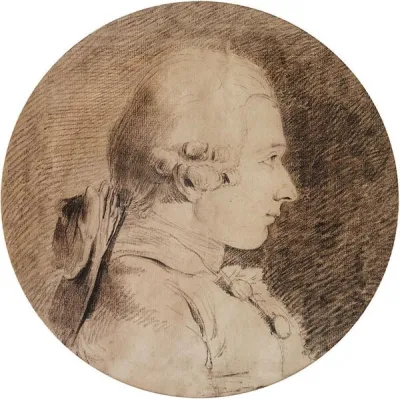
Marquis de Sade
Human Design Chart
Biography
Born into a noble family dating from the 13th century, Sade served as an officer in the Seven Years' War before a series of sex scandals led to his detention in various prisons and insane asylums for most of his adult life. During his first extended imprisonment from 1777 to 1790, he wrote a series of novels and other works, some of which his wife smuggled out of prison. On his release during the French Revolution, he pursued a literary career and became politically active, first as a constitutional monarchist then as a radical republican. During the Reign of Terror, he was imprisoned for moderatism and narrowly escaped the guillotine. He was re-arrested in 1801 for his pornographic novels and was eventually incarcerated in the Charenton insane asylum, where he died in 1814.
Human Design Analysis: Marquis de Sade as Manifesting Generator 1/4
Manifesting Generator 1/4 — Design at a Glance
Marquis de Sade's design inclined him towards lightning-fast action, which was however tempered by the necessity to respond to internal impulses. As an Manifesting Generator, he possessed constant sacral energy that allowed him to skip steps and draw things into his life quickly. This hybrid nature of Generator and Manifestor traits meant that while he could be swift, there was a risk of missing crucial stages. Such leaps often led him back to fill in the missed steps, causing frustration – a classic sign of this type's Non-Self theme. Additionally, Marquis de Sade tended to pursue multiple things at once as he responded to various impulses. Without the approval of his inner authority and waiting for confirmation from his sacral center, his creative enthusiasm quickly turned into exhaustion. However, when this alignment worked, he drew deep satisfaction from his work. In this state, parallel working was no obstacle but a source of fun and play mode. The condition for his fulfillment lay in not initiating but reacting to life and ensuring that his inner system continued to approve every begun project.
Emotional Authority
Marquis de Sade was subject to an emotional wave that permanently colored his perception of the world through current moods. His design inclined him towards strong fluctuations: at one moment he would be enthusiastic about ideas, only to evaluate them negatively in the next. This configuration meant that his immediate feeling often was a provisional snapshot and not necessarily reflective of his deepest truth. Quick, spontaneous decisions from this emotional heat frequently had negative consequences.
This mechanism stemmed from his defined Emotional Center, which functioned as inner authority. In Human Design mechanics, every defined Emotional Center automatically carries decision-making power regardless of other defined centers in the chart. This priority required specific handling: Marquis de Sade needed to take time for decisions to mature. Only through patience and repeatedly sleeping on questions did intense feelings subside. With this distance, he gained emotional detachment, leading to clarity and calmness. This process was essential for long-term course corrections as it ensured that a choice rested on deeper insight rather than merely being the product of transient mood.
The 1/4 Profile — Investigator / Opportunist
Marquis de Sade revealed himself as someone who sought deep knowledge not only for himself but also compulsively shared it within a trusted network. His design carried the profile of Researcher and Networker (1/4), an uncommon configuration: The drive for thorough exploration (Line 1) was inseparable from the need to convey these insights to a close community. This structure suggested that he could achieve authority in his subjects through a combination of research and social exchange.
At the same time, this design revealed profound vulnerability: Line 4 caused fear of being exposed before loved ones if knowledge wasn't yet sufficient. This created an internal conflict between the desire for influence and the fear of rejection.
The mechanics of his lines further shaped this process. Line 1 (Gate 35) emphasized humility and acceptance of rejection as part of creative growth; changes were integrated through experience. Simultaneously, Line 4 (Gate 63) demanded extreme precision and detail focus to externalize doubts and receive answers. This pressure to document details accurately and account for background knowledge served to secure a stable basis for communication. Marquis de Sade thus lived in the tension between letting go of rejections as a learning process and the compelling need to resolve uncertainties through precise analysis before presenting himself to his trusted group.
Split Definition — Defined & Open Centers
Marquis de Sade revealed himself as someone with a fixed, magnetic identity and a clear sense of direction. His defined G Center provided him with reliable self-perception, allowing him to act independently of external validation. This inner security was reinforced by his also defined Heart Center, which granted him constant access to willpower and ego strength. He possessed the energy to fulfill promises and steer his own resources and life path autonomously without relying on others' approval.
His actions were driven by an enormous vital force: his defined Sacral Center. As a Generator, he had a constant energy source that was only correctly usable through reaction to external stimuli. His strategy involved not taking the first step but waiting for life to invite him before responding with full sacral power. Simultaneously, his defined Solar Plexus Center shaped his emotional authority. He was designed to wait out the waves of his feelings before making decisions; emotional clarity emerged for him only after experiencing the entire emotional wave, not in an impulsive moment.
His expression occurred through a defined Throat Center that transmuted messages from within into the world. Since his throat was connected to motor centers, he often spoke directly from his willpower or emotions, leading to a powerful but limited form of communication. His defined Root Center provided the necessary adrenergic pressure to advance in the material world and master existential challenges.
In contrast, his vulnerability was revealed in mental areas. His open Head and Ajna Centers meant he lacked consistent access to inspiration or conceptual thinking. Instead, he tended to absorb mental pressure waves from the environment and get entangled in questions that were not his own. Without recognizing these as conditioned noise, he risked being overwhelmed by doubts and confusion rather than trusting his deeper emotional and sacral authority.
Channels for rhythm, success, meaning, emotions and maturation.
Marquis de Sade's life was characterized by a deep inner rhythm and a drive for material sovereignty. The Rhythm Channel 5-15 connected his vital energy with universal attraction; he followed firm habits (Gate 5) while his collective magnetism drew others into his flow. Simultaneously, the Money Line Channel 21-45 shaped his attitude towards power: The Will of the Hunter (Gate 21) clashed with the claim of the Gatherer (Gate 45) on control, driving him to master the material plane and take responsibility for the 'tribe'.
This fighting spirit found expression in the Life Struggle Channel 38-28. Here he sought meaning in confrontation; Gate of the Fighter (38) defended his integrity against external forces while Gate of the Player (28) weighed which conflicts held value. Emotional waves accompanied this process through the Channel of Emotion Release 39-55. His provocation (Gate 39) triggered emotional reactions in others that moved between joy and melancholy (Gate 55) – a mechanism he used to influence his environment's mind.
Each experience also passed through the Maturity Channel 42-53. He began new cycles (Gate 53), but had to fully enjoy and reflect on them (Gate 42) before moving forward; premature conclusions led to repetition.
Additionally, individual Gates influenced his design: Gate 35 sought change through interaction while doubt (Gate 63) and the attempt to translate past experiences into clarity (Gate 64) shaped his mental process. Gate 2 received evolutionary directions, Gate 56 stimulated through vivid storytelling, and Gate 52 required concentrated pauses for pattern correction. In design, Gates 8 (Contribution/Leadership), 13 (collective memory), and 44 (watchful transformation) promoted his uniqueness while Gate 20 supported action in the here and now. Gate 62 provided logical detail work and fact clarification.
Individual Circuitry — Circuit Signature
Marquis de Sade's design laid a tendency towards a separated but parallel existence of emotional intuition and strategic willpower. This 'Split Definition' meant that his energetic focal points were not connected in one continuous flow, but rather worked as two independent power blocks: a complex web involving the Spleen, Root Center, Solar Plexus, and G Center alongside a separate connection between Heart and Throat Centers.
In the first block, the Knowledge Circuit linked his Spleen to the emotional Solar Plexus via the Root Center. This generated a pulsating, acoustic energy aimed at forging new paths and initiating changes through the expression of individual identity. Simultaneously, the Understanding Circuit worked logical structures between Identity and Sacral Centers while the Meaning Finding Circuit directed a cyclical reflection over the Sacral and Root Centers – always separate from the emotional waves of the Solar Plexus.
The second block consisted of the Ego Circuit connecting Heart and Throat Centers. Here it was about concrete implementation of resources and cooperation through language. Since this group was energetically isolated from the first block, his strategic decisions (Heart/Throat) acted independently of his intuitive or emotional impulses (Spleen/Solar Plexus). This created an inner dissonance: The ability for rational strategy and resource-oriented communication did not directly exchange with his deep, wave-like emotionality and instinct for newness.
Right Angle Cross of Consciousness 2
Marquis de Sade's Human Design chart revealed a tendency towards an extremely polarizing and often controversial expression. His chart featured the right cross of Consciousness 2, a configuration that left no room for middle ground. This structure marked him as someone who either acted with absolute devotion or radically withdrew; there was no space for ambivalence or half-hearted compromises.
This mechanism does not simply mean 'determination,' but describes an energetic necessity towards totality. Those carrying this cross must follow their truth to the utmost consequences, even if it conflicts with societal norms. For Marquis de Sade, this manifested as an unyielding drive to express his inner impulses without filters. The energy of this cross compels one to test boundaries and challenge established moral frameworks, as any form of internal suppression leads to explosive tension buildup.
His lifestyle was thus not a random rebellion but the direct result of this chart-defined architecture: either he lived his convictions with full intensity or existed merely as a shadow of himself. This binary dynamic created someone who was not built for adaptation but rather for shocking their environment's consciousness through radical consequence, thereby forcing reflection. The rigidity of his design allowed no gentle transitions; everything was either fully realized or nothing.
Saturn Return · Uranus Opposition · Chiron Return · 2nd Saturn Return — Life Cycles
Marquis de Sade exhibited a life path marked by sharp confrontations with external structures and recurring phases of isolation. His chart indicated a tendency to challenge established authorities during crisis moments, often leading to direct consequences.
In 1768, at the age of 28, his first Saturn Return occurred. During this phase, his identity solidified; he was identified as Louis Alphonse Donatien in an official interrogation, marking a formal establishment of his name and status. Ten years later, in 1777, his Uranus Opposition reached its peak. This cycle often brings sudden breaks: Sade was arrested based on a royal warrant at the fortress of Vincennes, a crisis that restricted his freedom and forced him to deal with rigid systems.
At age 50 in 1790, he experienced his Chiron Return. This fulfillment cycle marked a turning point; the National Assembly abolished all lettres de cachet, leading to his release. Here, the unfolding of his purpose through resolving old constraints was evident. Yet, the structure persisted: in 1794, at age 54, his second Saturn Return began. He was arrested again, this time under the pretense of having applied for service in the royal guard. These events illustrate a pattern where personal freedom and societal control stood in a charged dialogue, with external circumstances continually challenging his inner alignment.
Manifesting Generator · Emotional Authority — Synthesis
War an Expressing Generator with emotional authority and a profile as Researcher/Networker. A central thread throughout his life was the dynamic interplay between sacral energy (from the defined Sacral Center) and the ability to communicate through the Throat Center and quickly set things in motion – a combination amplified by the Channel of Rhythm (Gate 5/15). This energetic makeup led him to be guided by firm habits while also embracing diversity, enabling deep exploration of knowledge and its dissemination within his network. The connection to the Knowledge Circuit suggests that he spurred transformation through exploring and expressing new insights.
A central paradox lay in the tension between a need for thorough research (Line 1) and a tendency to skip steps (Expressing Generator). This led him to repeatedly link moments of deep insight with phases of heartache, as fear of exposure within a community of knowledge-seekers persisted. Emotional waves (emotional authority) intensified this ambivalence by slowing decisions and demanding deeper engagement with personal insights – a process evidenced through the crisis phases in his cycles.
5 Defined Channels
Incarnation Cross - Right Angle Cross of Consciousness 2
Solar Return
The Solar Return shows the moment when the sun returns to its exact birth position - your personal solar year.
Life Cycles
Discover the life cycles with a detailed triple view (birth chart, cycle chart, composite).
Human Design Profile
- Strategy
- To respond - wait for something to respond to
- Authority
- Emotional Authority
- Profile
- 1/4 - Investigator / Opportunist
- Definition
- Split Definition
- Incarnation Cross
- Right Angle Cross of Consciousness 2
- Date of Birth
- 02.06.1740 17:00
- Place of Birth
- Paris, France
Frequently Asked Questions
What was Marquis de Sade's Human Design type?
Which profile did Marquis de Sade have?
What authority did Marquis de Sade have?
What incarnation cross was assigned to the Marquis de Sade?
When was the Marquis de Sade born?
Discover your own Human Design
Are you also a Manifesting Generator? Find out in a personal reading how to unfold your multi-talents and direct your energy wisely.
More Personalities
Back to overviewAlain-Fournier

Aldair

Alizée

Angeli

Arletty

Artus