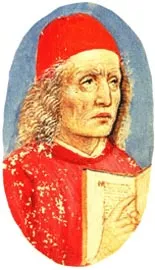
Marsilio Ficino
Human Design Chart
Biography
He was described as mild, refined and gentle, though with a quick flash of anger possible. Content with a simple dress and lifestyle, he was conscientious and frugal. He died on 1 October 1499 OS in Careggio, Italy.
Human Design Analysis: Marsilio Ficino as Projector 6/2
Projector 6/2 — Design at a Glance
Marsilio Ficino's design inclined him towards precise and focused perception. As a projector, he did not have a constant, intrinsic source of life energy through an undefined Sacral Center. Instead, his aura acted like a bright flashlight, directing light to areas in his surroundings that were still in darkness. This mechanism allowed him to immediately recognize errors in systems or relationships of others.
The challenge was to communicate these insights without being direct or intrusive, which often caused resistance in others. Instead, his strategy was to attract others through his own harmony and clarity. When he chose this path, people actively sought him out for advice. This happened not through coercion but through a respectful, heartfelt invitation from others.
If he lived by this principle, he was rewarded with success. However, if he ignored the need to wait for such invitations and used his energy uncontrollably, it led to exhaustion. Since his energy flow was intermittent, he needed regular rest periods to avoid burning out. If he consistently missed this balance, his non-self theme of bitterness would manifest. His design thus required patience and the ability to use his radiant presence as an attraction rather than imposing it as a corrective.
Self-Projected Authority
Marsilio Ficino's design inclined him towards orientation through inner identity. As a projector with the rare authority in the self, his inner truth was primarily expressed through his identity. This configuration came with increased openness, which also brought the risk of being distracted by external influences, especially motoric energies. The central challenge was to not lose himself in this openness and constantly seek external energy.
Decision-making occurred through two pathways. On one hand, through self-dialogues or stimulated conversations, where listening to his own self was crucial. It was important to distinguish spontaneous, unreflected statements as expressions of his true essence from the mind. This self-expression allowed him to make his uniqueness recognizable to others. On the other hand, a physical feeling that drew him geographically or thematically in a certain direction. By following this inner pull, he could become a guide for others. There lay his specific potential for success. This mechanism described a life task of following his own direction and serving as an authentic reference, without being distracted by external stimuli.
The 6/2 Profile — Role Model / Hermit
Marsilio Ficino's design inclined him towards deep introspection and later wisdom. Before the age of 30, the 6/2 line initially acted as a 3-line. This shaped a phase of experimentation, marked by trial and error as well as necessary withdrawals after mistakes. It was a process in which he gathered many of his own life experiences to recognize patterns.
Around the age of 30, the 6-line fully activated. Marsilio Ficino metaphorically retreated into a cave high up on a mountain to look back at his earlier experiments with great distance. This period of intense reflection served for healing and deep self-knowledge. From this phase of isolation and contemplation, he developed into a wise person. Others could recognize this wisdom and came to him to partake in his life wisdom and learn the ability for deep introspection.
The mechanics of this line include Gate 32, which emphasizes inner peace and composure towards impermanence, as well as a strong fear of material failure. It was about accepting changes in the sense of preservation. At the same time, Gate 56, which represents connection and genius, radiated inspiration. Uranus in this gate stood for an isolated genius who reached continuity through recognition. Collaboration with others promoted this development process, while the 6-line highlighted the instinctive acceptance of changes in the second generation.
Split Definition — Defined & Open Centers
Marsilio Ficino's design created a tendency towards constant mental pressure to ask questions and seek answers. This configuration between the Head and Ajna Centers generated a trustworthy, specific mental function, but lacked direct energy for implementation. Instead, his mind served as an inspiration source for others, while he himself had to go through a process of confusion and clarity. His defined Throat Center allowed him to reliably express these conceptual thoughts, often linked with his fixed identity in the G Center. This gave him a clear sense of direction and self-love, enabling him to show others new paths without being dependent on them.
At the same time, Ficino was vulnerable to conditioning through several open centers. His open Heart Center made him sensitive to the pressure to prove his worth and make promises he couldn't keep. He tended to question whether he was not enough when he couldn't keep up. The open Sacral Center led to him absorbing foreign energy and overworking, often without knowing when to stop. Additionally, his open Solar Plexus absorbed the emotions of the environment, making him emotionally vulnerable and prone to avoiding conflicts to avoid negative reactions. His open Spleen Center amplified fears of survival, leading him to cling to uncertain situations to feel a sense of well-being. Finally, his open Root Center took on external stress, which could lead to a cycle of overactivity and exhaustion as he tried to release pressure that wasn't his.
Channels for mental images, reflection and quiet remembrance.
Marsilio Ficino's design inclined him towards deep reflection and the search for hidden connections. He was someone who did not passively accept experiences but patiently sorted them out to extract a coherent truth from them. This attitude was significantly shaped by the Channel of the Lost Son 13-33. This channel connected the G Center with the Throat Center and required him to first listen and store information before withdrawing to think about what he had heard. Ficino had to learn to wait for the right moment to share his insights rather than acting prematurely.
Parallel to this, the Channel of Abstraction 47-64 worked from the Personality. It connected the Head Center with the Ajna Center and created a constant mental pressure to filter every experience through a kaleidoscope of images. This process could lead to confusion as the mind never offered absolute certainty. Yet, Ficino's design showed that this mental unrest was necessary to develop inspiring stories that he could then pass on to the collective.
Additional impulses came from prioritized Gates: Gate 32 emphasized continuity and material stability, while Gate 42 urged the completion of processes to take on new commitments. Gate 56 promoted the figurative narration of mental processes, and Gate 60 demanded the acceptance of limitations as a path to transcendence. In the Personality, Gate 1 with its unique creativity in the here and now and Gate 61, which sought inner truth and silence, were active. Gate 7 projected leadership patterns for the future, Gate 23 translated inner tones into language, and Gate 4 developed logical formulas to clarify suspicious patterns. Together, these elements formed a profile oriented towards patient observation, deep thinking, and the later, clear communication of acquired wisdom.
Collective Circuitry — Circuit Signature
Marsilio Ficino's design inclined him to emotionally relive past experiences and gain collectively shareable insights from them. His shared definition created two parallel, not directly connected energy flows. The first stream connected the Head with the Ajna Center. This generated spontaneous, often illogical intuitions that rose and fell like waves from the past. The second stream linked the Throat with the Identity Center. Here, the Meaning Maker Circuit worked: emotional waves from the Solar Plexus Center shaped his identity. Through the Channel of Abstraction (Gates 64 and 47), he translated these inner, visual impressions into abstract concepts. The Channel of the Lost Son (Gates 33 and 13) urged him to verbalize these felt truths to share them with others. Thus, his communication served not cold logic but the collective learning from the past. The cyclical nature of these energies meant that his insights did not work linearly but in rising and falling phases. He reflected on events to find the underlying meaning and passed this emotional truth on to the collective.
Left Angle Cross of Limitation 2
Marsilio Ficino's design revealed a tendency towards inner discipline and the ability to make complex connections tangible through clear structures. This configuration, the left cross of limitation, shaped an attitude that was not characterized by external expansion or loud activity, but rather by deep, often silent work on one's own substance. It was an energy that tended to accept boundaries and develop maximum clarity and precision within these conditions. Instead of striving for endless possibilities, this orientation focused on the essential, on what is truly sustainable and reliable. This inner focus allowed for the creation of a dependable foundation even in uncertain or chaotic times. The energy of this cross acted like a filter, sorting out the unnecessary and directing attention to the core issues. For Marsilio Ficino, this meant a life task that aimed less at external recognition and more at creating order and meaning in a limited but consequently more intense area. This structure promoted a kind of wisdom that arises from the experience of limitation and the ability to deal with what cannot be changed by understanding and integrating it.
Saturn Return · Uranus Opposition · Chiron Return · 2nd Saturn Return — Life Cycles
Marsilio Ficino's design showed a tendency to stabilize inner authority through external structure and societal anchoring. This configuration was particularly evident during the Saturn Returns, which in Human Design are times of consolidation and taking on responsibility. In 1462, at the age of 29, during his first Saturn Return, he received a house in Florence from Cosimo de’ Medici. This event marked the transition from preparation to established position, with material security serving as a foundation for his future work.
The Uranus opposition, often associated with sudden changes or breaking old patterns, occurred in 1473 during his 40th year. During this period, Marsilio Ficino was ordained as a Roman Catholic priest. This ordination represented a formal integration of his spiritual aspirations into an existing institutional structure, resolving the tension between individual inspiration and collective order in his design.
The Chiron Return, a cycle of unfolding the incarnation purpose, reached its peak in 1482 at the age of 49. Here he published “De studiosorum sanitate tuenda”. This work was not just an academic act, but a concrete expression of his lifelong task to systematize and make knowledge accessible. The second Saturn Return in 1489, with the first publication of “De vita libri tres”, confirmed this development: The long-term work condensed into a sustainable, public legacy that anchored his inner authority externally.
Projector · Self-Projected Authority — Synthesis
Marsilio Ficino lived as a projector, who, through his ability to recognize patterns (Gate 13/33), could bring 'light into the darkness' for others. This was evident in his deep understanding of past experiences and the cyclical process of maturation, which allowed him to gather and pass on wisdom. His defined Head Center strengthened this urge to understand and inspire, while the Meaning Finder circuit enabled him to recognize the significance behind events and share this with others. The early years were characterized by a spirit of experimentation, followed by a phase of intense reflection, from which he emerged as a wise advisor.
A central paradox in his design lay in the tension between his open, receptive nature (authority in self) and the pressure to express his inspirations (defined Head Center). While he could gain deep insights through listening and reflecting (Channel 13/33), the sharing of these insights carried the risk of overwhelming or hurting others. The cycles showed that he repeatedly engaged with his inner truth and the external world through career events.
2 Defined Channels
Incarnation Cross - Left Angle Cross of Limitation 2
Solar Return
The Solar Return shows the moment when the sun returns to its exact birth position - your personal solar year.
Life Cycles
Discover the life cycles with a detailed triple view (birth chart, cycle chart, composite).
Human Design Profile
- Type
- Projector
- Strategy
- Wait for the respectful invitation
- Authority
- Self-Projected Authority
- Profile
- 6/2 - Role Model / Hermit
- Definition
- Split Definition
- Incarnation Cross
- Left Angle Cross of Limitation 2
- Date of Birth
- 19.10.1433 13:26
- Place of Birth
- Figline Valdarno, Italy
Frequently Asked Questions
What was Marsilio Ficino's Human Design type?
What Profile did Marsilio Ficino have in Human Design?
What Authority did Marsilio Ficino have?
What incarnation cross did Marsilio Ficino have?
When was Marsilio Ficino born?
Discover your own Human Design
Are you also a Projector? Find out in a personal reading how to unfold your leadership qualities and recognize the right invitations.
More Personalities
Back to overviewSissy Spacek

Alain-Fournier

Anémone

Ann-Margret

Bourvil
Hergé