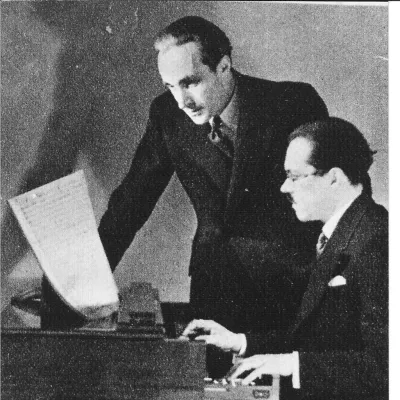
Photo: Wikimedia Commons
Maurice Martenot
Human Design Chart
Biography
He is best known for his invention of the ondes Martenot, an instrument he first realized in 1928 and spent decades improving. He unveiled a microtonal model in 1938. He also was responsible for teaching the first generation of ondes Martenot performers, including Karel Goeyvaerts, Jeanne Loriod, Georges Savaria, Gilles Tremblay, and his sister Ginette Martenot.
Martenot himself performed as an 'ondist' with the Philadelphia Orchestra under Leopold Stokowski in 1930. The 1937 World's Fair in Paris awarded him "Le Grand Prix de l'Exposition Mondiale". He taught lessons at the Paris Conservatoire during the 1940s.
He died in Clichy-la-Garenne, Paris, on 8 October 1980.
Maurice Martenot — Generator with Profile 1/3
Generator 1/3 — Design at a Glance
Maurice Martenot's design inclined towards great endurance and inner drive, provided he was guided by authentic impulses. As a Generator, he had a lot of sacral energy, which made him extremely strong and durable like a workhorse when he had energy for his task. However, this power was not unleashed through his own initiative but only became effective when he responded to signals from his environment. His motto was 'not to initiate but to react.'
His most successful strategy was to wait for a life signal and then, when his sacral center gave a clear 'yes,' to respond with action. Living in harmony with this mechanism rewarded Maurice Martenot with deep satisfaction and a sense of fulfillment. Deviating from it and constantly trying to initiate things instead of reacting would likely lead him to a feeling of persistent frustration or a lack of energy sooner or later. Two stumbling blocks shaped his potential: on the one hand, persistently doing things without inner desire, which led to energy waste and burnout, and on the other hand, holding back from working on his heart project even though he still wanted to continue with full power. His design therefore required a gut reaction to constructively utilize his enormous capacity.
Sacral Authority
Maurice Martenot was a Generator whose decision-making was characterized by sacral authority. This inner guidance lay in his defined sacral center, simplifying his process since strategy and authority are identical for this type. His reactions to external stimuli were physical: a gut feeling, a surge of energy, or acoustic signals like grunting or humming. These impulses signaled whether something was energizing.
Maurice Martenot had an inexhaustible energy source when his sacral motor was engaged. He felt vital and alive, allowing him to dive into activities with great enthusiasm and without aimlessness. His design promoted joy and satisfaction throughout life by fully immersing himself in his work.
Additionally, his activated spleen center acted as a supportive authority. This gave him the ability to react particularly quickly and spontaneously. He had immediate access to his physical well-being and instinctive perception. This combination of sacral confirmation and spleen-supported intuition enabled Maurice Martenot to reliably listen to his inner signals and make decisions that aligned with his natural energy flow.
The 1/3 Profile — Investigator / Martyr
Maurice Martenot's design inclined towards a dual approach to the world: he was both the meticulous custodian of foundations and the bold experimenter. This Profile 1/3, that of the researcher and experimenter, shaped his life task. Line 1 in his design emphasized the preservation and life-sustaining attention to processes. It gave him an instinct for details to approach changes cautiously and maintain continuity. At the same time, Line 3 drove him to learn through trial and error. This line encouraged him to try everything, press buttons, and accept mistakes as a necessary part of the learning process.
For Maurice Martenot, this meant that his life revolved around learning and practical testing. Sometimes, the energy of Line 1 took control, leading to the fear of not knowing enough to proceed with implementation. Yet, Line 3 wanted to experiment and learn from mistakes. Self-earned and tested insights were central to him. When he came to a conclusion, he had thoroughly examined the matter both theoretically and practically. His design described someone who, through the combination of detailed planning and bold practice, achieved trustworthy results.
Single Definition — Defined & Open Centers
Maurice Martenot revealed himself through a reliable inner identity and a clear sense of direction, guided by his defined G Center. He had the ability to open new perspectives for others without needing their approval, as he operated from a deep sense of self-love. His actions were driven by a constant, vital energy source, his defined Sacral Center. As a Generator, he relied on external stimuli to respond; when he acted on his own initiative, he lost this powerful support and encountered frustration. He also made decisions through spontaneous, intuitive impulses, mediated by his defined Spleen Center, which gave him a secure sense of the "now" and his well-being. This intuitive instinct worked independently of rational analysis and served as a reliable warning or confirmation in the present context.
At the same time, Maurice Martenot was vulnerable to mental confusion and the pressure to find answers that did not originate with him, due to his open Head Center. He tended to get caught up in the thoughts of others rather than trusting his inner authority. While his open Ajna Center allowed for a flexible mind that absorbed ideas from the environment, it also led to the risk of misinterpreting foreign concepts as his own truth or feeling uncertain when he lacked clear answers. In communication, he suffered from the pressure to attract attention, as his Throat Center was open; he often sought ways to be heard rather than waiting for an invitation. Additionally, he lacked the steady energy for willpower and promises, which affected his open Heart Center. He often tried to prove his worth through performance, which ended in a cycle of promises and disappointment. Emotionally, he was a mirror of his environment; his open Solar Plexus absorbed foreign moods, leading him to avoid conflicts and personalize emotions that belonged to others.
Channels for intuitive power, discovery, transformation and maturation.
Maurice Martenot revealed himself as someone who delved deeply into experiences to gain insights that could change collective understanding. This was marked by the Discovery Channel 29-46. He combined the enduring life force of the Sacral Center with the intuitive orientation of the G Center. Rather than holding expectations, he immersed himself in the depth of his processes. Through this unwavering dedication, he found his confirmation at the right time and place. His discoveries only revealed themselves at the end of long cycles, once he had fully gone through the experience.
His ambition and drive for social recognition flowed through the Transformation Channel 54-32. This channel connected the pressure of the Root Center with the instinctive perception of the Spleen. He was motivated to rise through persistent effort and competence. His talents were recognized and supported by the "tribe," his community or environment. This exchange created a healthy dependence: he proved his worth through hard work and received the confirmation that fed his ambitions and secured his position.
At the same time, he possessed a sharp, intuitive awareness carried by the Power Channel 34-57. This connection between the Sacral and Spleen Centers gave him the ability to react immediately to dangers or disruptions. It was a defensive intelligence aimed at survival and individuality. He remained physically and energetically fit by selectively listening to his environment and acting spontaneously to preserve his own vitality and independence.
The Ripe Channel 42-53 structured his approach to new projects. He began cycles to complete them fully and draw wisdom from them. For him, it was essential to finish experiences before reflecting and sharing the lessons learned. This process of maturing through experience formed the foundation upon which he built new insights, without being driven by premature expectations.
Additionally, Gates that fostered inner truth and logical detail work were at play. Gate 61 sought the stillness and individual insight, while Gate 62 emphasized patience and pattern recognition. This combination supported his ability to unravel complex connections and formulate them precisely.
Collective Circuitry — Circuit Signature
Maurice Martenot revealed himself through a design that combined emotional processing and practical resource conservation. His Simple Definition created a continuous energetic flow between the Sacral, Identity, Spleen, and Root Centers. This shaped a personality that linked inner strength with intuitive perception.
The Meaning-Finding Circuit connected his Identity, Sacral, and Root Centers. This promoted a cyclical nature: emotions and experiences from the past were processed to draw insights that were shared with others. The energy flowed in wave-like patterns, with clear beginnings and endings, allowing for a deep, felt reflection.
Parallel to this, the Ego Circuit, connecting the Spleen and Root Centers, was at work. This was about cooperation and the exchange of resources. Since there was no direct connection to the Sacral Center, this dynamic required necessary pauses to gather energy for collective creation. It was a traditional give-and-take.
Additionally, the Integration Circuit connected the Sacral and Spleen Centers. This supported survival through intuitive reactions to life. Strength was drawn from the immediate environment and guided by proper behavior in the present moment. This combination of emotional depth, resource-oriented cooperation, and intuitive adaptability characterized Maurice Martenot's energetic alignment.
Right Angle Cross of Maya 3
Maurice Martenot's Human Design profile carried the signature of the right Maya 3 Cross. This configuration sets a specific life direction: the search for meaning behind things and the passing on of this understanding to others. It was not just knowledge, but a deeper, often spiritual or philosophical truth that he sought to understand and communicate.
In Human Design, the right Maya 3 Cross marks a life task where the individual is called to uncover hidden connections and convey them in a way that can be accepted by the community. The number 3 represents the process of learning through experience and the necessity of making mistakes to attain wisdom. Maurice Martenot followed this pattern by not keeping his insights to himself, but rather sharing them externally. His path was characterized by the dynamics of swinging between private understanding and public participation. The mechanics of this cross require patience and the willingness to work through obstacles to ultimately formulate a message that serves others. Maurice Martenot lived this structure by shaping his inner perceptions into a form that was accessible and meaningful to others.
Saturn Return · Uranus Opposition · Chiron Return · 2nd Saturn Return — Life Cycles
Maurice Martenot's design indicated a tendency towards structural anchoring and later public recognition. His first Saturn Return marked the transition from internal work to external consolidation. In 1928, at the age of 30, he received the first patent for the Ondes Martenot. This step condensed years of preliminary work into a legally protected, solid result, typical of Saturn energy, which creates stability and durability.
The Uranus Opposition then brought a breakthrough into the spotlight. In 1937, at 39 years old, he received the Grand Prix de l’Exposition Mondiale at the World's Fair in Paris. This configuration often promotes sudden visibility and innovation, breaking through established structures and paving new paths. The success confirmed the technical and artistic relevance of his instrument on an international level.
The Chiron Return around the age of 50 is a fulfillment cycle where the personal life purpose increasingly unfolds. In 1949, at 51 years old, Maurice Martenot was knighted in the Legion of Honour. This recognition was not just a title, but a late, official confirmation of his life task. It showed that his contribution to music and technology had found its deepest meaning and societal recognition. The mechanics of his design thus moved from foundation through breakthrough to full confirmation of his purpose.
Generator · Sacral Authority — Synthesis
Maurice Martenot was a Generator whose life was marked by a deep drive for experience and the resulting learning. The sacral authority that guided him through gut feelings and physical reactions (Sacral Center) nourished his ability to immerse himself in activities that brought him joy and energized him. This principle of reacting to the moment, combined with the profile of a researcher and experimenter (Line 1/3), led to a continuous cycle of theoretical engagement and practical application – testing and verifying insights that allowed him a deep understanding. The Discovery Channel connected his deep sacral reaction with a sense of direction (G Center), suggesting that he gained authentic insights through diving into experiences.
A central paradox in his design lay in the tension between the cyclical perception-switching circuit and the drive to share insights. While he delved deeply into experiences and learned from the past, he seemed destined to share these insights with others and shape them. This was evident in documented successes tied to specific times (patent, exhibition success, honor), indicating that he lived in phases of intense work and creative unfolding, followed by phases of recognition and sharing of his results.
4 Defined Channels
Incarnation Cross - Right Angle Cross of Maya 3
Solar Return
The Solar Return shows the moment when the sun returns to its exact birth position - your personal solar year.
Life Cycles
Discover the life cycles with a detailed triple view (birth chart, cycle chart, composite).
Human Design Profile
- Type
- Generator
- Strategy
- To respond - wait for something to respond to
- Authority
- Sacral Authority
- Profile
- 1/3 - Investigator / Martyr
- Definition
- Single Definition
- Incarnation Cross
- Right Angle Cross of Maya 3
- Date of Birth
- 14.10.1898 08:00
- Place of Birth
- Paris, France
Frequently Asked Questions
What was Maurice Martenot's Human Design type?
What profile did Maurice Martenot have?
What authority did Maurice Martenot have?
What incarnation cross did Maurice Martenot have?
When was Maurice Martenot born?
Discover your own Human Design
Are you also a Generator? Find out in a personal reading how to use your sacral energy correctly and discover deep satisfaction.
More Personalities
Back to overviewAaliyah

Alexia

Alizée

Angèle

Anne-Marie

Arcángel