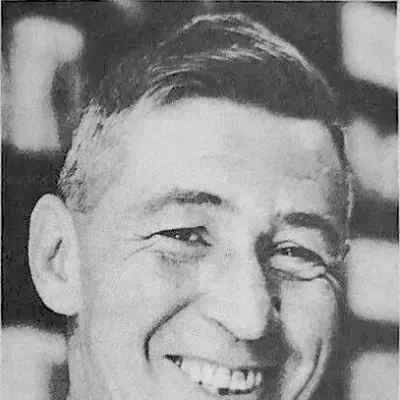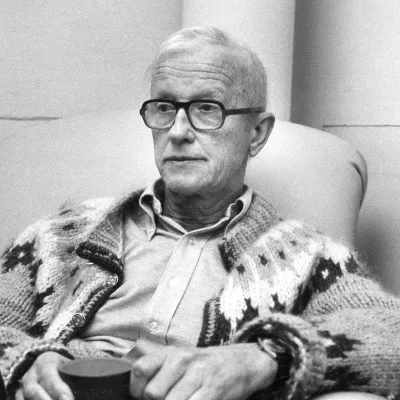
Max Delbrück
Human Design Chart
Biography
In 1937, Max left Nazi Germany for America—first California, then Tennessee—becoming a US citizen in 1945. In 1941, he married Mary Bruce. They had four children.
Delbrück's brother Justus, a lawyer, as well as his sister Emmi Bonhoeffer were active along with his brothers-in-law Klaus Bonhoeffer and Dietrich Bonhoeffer in resistance to Nazism. Found guilty by the People's Court for roles in the July 20, 1944 plot to assassinate Hitler, the three men were executed in 1945 by the RSHA.
Max Delbrück died, aged 74, on the evening of 9 March 1981 at Huntington Memorial Hospital in Pasadena, California.
What does Projector 6/2 mean for Max Delbrück?
Projector 6/2 — Design at a Glance
Max Delbrück revealed himself as a person with a dense, focused aura that directly engaged his surroundings. As a projector, he did not have a constant internal energy source but worked in intense phases followed by necessary rest periods for regeneration. His design predisposed him to immediately recognize systemic weaknesses – similar to a flashlight shining into the darkness. However, this ability to uncover errors was only effective if he didn't act directly and confrontationally. Instead, his true strength lay in an attractive presence: when he embodied harmony, others sought him out for advice. The strategy involved waiting for honest invitations from outside rather than pushing himself forward. If this path was followed, it led to success and recognition; ignoring it brought the theme of bitterness into play. His influence thus relied less on his own drive and more on guiding others once they were ready to listen.
Emotional Authority
Max Delbrück demonstrated decision-making that did not occur in moments of enthusiasm or rejection but rather through a conscious waiting period. His inner authority lay in the defined Emotional Center – a configuration that always took precedence over all other definitions in his design. This structure subjected him to an emotional wave, a permanent up and down of feelings coloring his perception of the world at any given moment. What seemed absolutely right in one moment could appear negative in another; thus, the first impression was only a snapshot, not yet the truth. Quick, spontaneous decisions from this emotional heat would often have negative consequences for him. Instead, his mechanism required patience: he let decisions mature, slept on them multiple times, and consciously delayed action. Only when intense feelings subsided and an emotional distance was gained did clarity set in. This process of calm after riding the waves was crucial for long-term life decisions. Max Delbrück used this time not only as a delay but as a necessary filter to move from fleeting emotion to deeper, more comprehensive insight before acting.
The 6/2 Profile — Role Model / Hermit
Max Delbrück's design is characterized by Profile 6/2, which clearly divides his life path into two parts. In the first three decades, Line 3 energy dominated: he experimented intensely, learned through trial and error, and withdrew after setbacks to explore new paths. This phase was marked by a strong willpower that identified and rejected inferior or unfair forces in his environment. The sun stood high for authority while the earth lay low, meaning that unjust power claims were often punished.
After turning 30, Line 6 activated metaphorically withdrawing into a 'cave' to reflect on his earlier experiments with distance. This period of intense reflection served healing and deep self-knowledge. Emerging from this phase, he appeared as a wise person whose life wisdom attracted others who sought him out for insight.
Parallel to this, the blocked creative force of Gate 35 (Line 2) generated a strong desire for change and progress coupled with fear of stagnation. Creativity followed phases of ebb and flow; if lived incorrectly, it could be brutal. The need for new experiences drove him forward while Line 2 radiated boredom in stagnant situations. The combination of the reflective wisdom from Line 6 and the pressing desire for progress from Line 2 shaped his unique approach to knowledge and community.
Triple Split Definition — Defined & Open Centers
Max Delbrück's Human Design profile indicated a tendency towards constant mental pressure to ask questions and seek answers. The definition between the Head Center and Ajna Center created a perpetual impulse for conceptual thinking; he was always caught in a mental process that formed inspiration as an unresolved question. This pressure could lead to inner concern if he tried to relieve it through hasty actions instead of waiting for the right moment to share his concepts. His thoughts were set and not easily influenced, providing others with a reliable source of inspiration even when his own ideas lacked direct energy for implementation.
Additionally, Max Delbrück was defined in G, Heart, and Solar Plexus Centers. The defined G Center gave him a stable sense of self-identity and clear direction; he knew where he belonged without forcing others to follow this path. His defined Heart Channel provided access to willpower and the ability to fulfill promises, strengthening his self-esteem as long as he respected his own limits. The defined Solar Plexus Center functioned as an emotional authority: He had to wait out the waves of his emotions to gain clarity rather than making decisions impulsively at their peaks or troughs.
In contrast, his vulnerability was revealed through undefined centers. His open Sacral Center made him sensitive to others' energy; he tended to absorb borrowed vitality and overextend himself until exhaustion because he lacked a consistent personal energy reservoir. His open Spleen Center carried a fundamental survival fear that made him vulnerable to conditioned dependencies on people with defined Spleens for feelings of security and well-being. Finally, his open Root Center absorbed external stress from the environment, leading to cycles of increased pressure and attempts to escape it through hyperactivity rather than recognizing and letting go of the adrenalized impulse as not his own.
Channels for community, logical scrutiny and quiet reflection.
Max Delbrück was characterized by an analytical mind that used skepticism as a tool. The Logic Channel 63-4 connected Head and Ajna Centers; it constantly filtered patterns for their consistency. Doubt was essential here: An answer was only considered logical if it held up in a testable, consistent pattern. There was little room for unfounded belief; fear manifested as doubt between question and proof.
Parallel to this, he gathered experiences patiently. The Lost Son Channel 13-33 connected G and Throat Centers. Gate 13 listened and stored secrets while Gate 33 withdrew to reflect on these memories. This configuration promoted the ability to see all sides of an experience retrospectively before sharing it. It was about maturation through observation: Life made sense at the end only after completing the cycle.
In interpersonal domains, he sought the right place in the whole. The Community Channel 37-40 connected Solar Plexus and Heart Centers. He waited for a personal invitation rather than impersonal offers. Gate 37 sought recognition, Gate 40 reward for work done. A good deal had to be carefully considered to benefit both sides; hierarchies receded in favor of voluntary contributions and mutual support.
Additionally, Gates like the Change Gate 35 required progress through interaction, while the Rhythm Gate 5 needed firm habits for energy building. Spiritual Innocence (Gate 25) and Leadership Patterns (Gate 7) rounded out his profile, with collective experimentation joy (Gate 16) and tribal energy (Gate 45) subtly influencing in the background.
Collective Circuitry — Circuit Signature
Max Delbrück's Human Design presented three separate, parallel functioning energetic poles. He was defined by a clear separation of cognitive analysis, emotional meaning-making, and social exchange. This triple definition did not mean fluid unity but distinct functional areas.
The Understanding Circuit connected his Head and Ajna Centers through the Logic Channel (63-4). This created an ability for focused, rational structuring of information. It was 'emotionless ratio' aimed at logically improving things and moving forward without conditioned distortion.
Parallel to this, the Meaning-Making Circuit operated. Through the Lost Son Channel (13-33), it connected Throat and Identity Centers. This was not about cool logic but sharing emotional experiences from the past. This energy followed wave-like cycles: Feelings were processed to draw collective meaning and pass on insights.
The third pole formed with the Ego Circuit through the Community Channel (40-37) between Heart and Solar Plexus Centers. This area regulated the give-and-take relationship in social groups. As there was no connection to the Sacral Center, this dynamic interaction required necessary pauses for resource regeneration for the tribe.
Max Delbrück thus lived with these three independent energy fields: analytical clarity, emotional reflection, and cooperative exchange dynamics that each followed their own laws without directly flowing into one another.
Left Angle Cross of Migration 2
Max Delbrück's Human Design profile indicated a tendency towards strategic endurance and waiting for the right moment to act. He was not characterized by impulsive behavior but rather by the ability to observe processes and wait until circumstances resolved themselves naturally. This approach stemmed from the configuration of the "left cross of Projection 2."
This specific structure in the Human Design system describes an energy that does not push for immediate results. Instead, it fosters inner patience and trust in the natural unfolding of events. Max Delbrück lived with the belief that constant pushing often has counterproductive effects. His strategy involved holding back and letting situations mature. This did not mean passivity in the sense of indifference but a conscious decision to reduce his own influence to create space for spontaneous solutions.
The mechanics of this cross emphasize that true effectiveness often lies in not swimming against the current. Max Delbrück used this quality to gain clarity in complex situations by waiting until essential elements fell into place naturally. His approach was to accompany events without needlessly accelerating or forcing them. This ability for strategic projection allowed him to maintain long-term perspectives and not get lost in short-term crises. He understood that some problems can only be solved when given the necessary time to reveal themselves.
Saturn Return · Uranus Opposition · Chiron Return · 2nd Saturn Return — Life Cycles
Max Delbrück's Human Design indicated a tendency towards structured, fact-based analysis. He demonstrated himself as someone who not only recognized complex relationships but translated them into tangible, verifiable models. This attitude became evident with his first Saturn return in 1935 at the age of 29: Delbrück published work on gene mutations alongside Nikolai Timofejew-Ressowski and Karl Günter Zimmer. For his design, this was a typical moment of condensation. The first Saturn return often marks the point where years of perhaps still inconspicuous groundwork condenses into a solid, public result. This was not about spontaneous inspiration but rather the maturity to present learned and explored knowledge in a form that stood up to scrutiny. This publication proved that his internal structure was now strong enough to share knowledge publicly as a solid foundation for further developments. His design supported him in reducing uncertainties through clear definitions and logical sequences, which came into play during this career-defining step.
Projector · Emotional Authority — Synthesis
He was a Projector whose life was marked by a deep-seated need to recognize patterns and shed light on the unknown (Projector Type, Gate 63). This ability to identify flaws in systems (Channel of Logic) often came with mental pressure – constant questioning and scrutiny amplified by his defined Head Center. Thus, he lived a continuous search for stability and truth, driven to understand complex connections and share these insights (Understanding Circuit). This was evident in an event when he published research findings that pointed out new paths.
At the same time, his design revealed a central paradox: He possessed emotional authority, requiring time for feelings to mature and decisions to be made, while his Channel of Logic simultaneously pushed him to quickly recognize and formulate patterns (Centers, Circuit). This tension between the need for emotional clarity and mental pressure to find immediate answers shaped his path as an exemplar (6/2 Profile), which he could only unfold through intensive self-reflection.
3 Defined Channels
Incarnation Cross - Left Angle Cross of Migration 2
Solar Return
The Solar Return shows the moment when the sun returns to its exact birth position - your personal solar year.
Life Cycles
Discover the life cycles with a detailed triple view (birth chart, cycle chart, composite).
Human Design Profile
- Type
- Projector
- Strategy
- Wait for the respectful invitation
- Authority
- Emotional Authority
- Profile
- 6/2 - Role Model / Hermit
- Definition
- Triple Split
- Incarnation Cross
- Left Angle Cross of Migration 2
- Date of Birth
- 04.09.1906 12:45
- Place of Birth
- Berlin-Charlottenb., Germany
Frequently Asked Questions
What Human Design type was Max Delbrük?
What Profile did Max Delbrük have?
What Authority did Max Delbrük have?
What incarnation cross did Max Delbrük have?
When was Max Delbrük born?
Discover your own Human Design
Are you also a Projector? Find out in a personal reading how to unfold your leadership qualities and recognize the right invitations.
More Personalities
Back to overviewSissy Spacek

Alain-Fournier

Anémone

Ann-Margret

Bourvil
Hergé