Max Skladanowsky
Human Design Chart
Biography
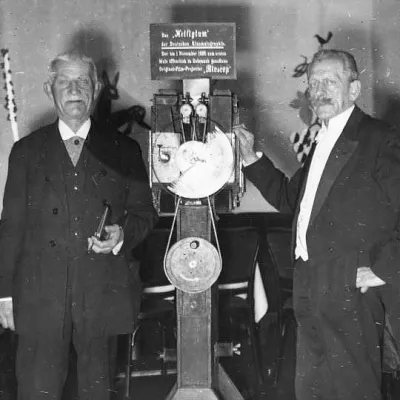
Born as the fourth child of glazier Carl Theodor Skladanowsky and Luise Auguste Ernestine Skladanowsky, Max Skladanowsky was apprenticed as a photographer and glass painter, which led to an interest in magic lanterns. He also single-handedly constructed the Bioskop projector. Partially based on the dissolving view lantern, it featured two lenses and two separate film reels, one frame being projected alternately from each. It was hand-cranked to transport 44.5mm-wide unperforated Eastman-Kodak film-stock, which was carefully cut, perforated and re-assembled by hand and coated with an emulsion developed by Max.
The Skladanowsky brothers shot several films in May 1895. Max had constructed a new camera with a Geneva drive in the autumn of 1895, and the new single-lens Bioskop-II projector in the summer of 1896. Eventually, the last Bioskop show by the Skladanosky brothers took place in Stettin on 30 March 1897.
After this Skladanowsky returned to his former photographic activities including the production of flip books and further magic lantern shows. Between the years 1895 and 1905, the brothers directed at least 25 to 30 short movies.
Max Skladanowsky died on 30 November 1939 in Berlin at age 76. His brother Emil died in 1945.
In 1995, the German filmmaker Wim Wenders directed a drama documentary film Die Gebrüder Skladanowsky (The Skladanowsky Brothers) in collaboration with students of the Munich Academy for Television and Film.
Max Skladanowsky — Generator with Profile 2/4
Generator 2/4 — Design at a Glance
Max Skladanowskys design points to a tendency towards great endurance, comparable to a workhorse generating power. As a Generator, he had plenty of sacral energy but did not release it through self-initiated actions. His strategy was to react to life signals and act only when his inner voice gave a clear 'yes'. This reactive stance contrasted with the urge to create opportunities independently.
Living in harmony with this principle, he responded to internal impulses with action and was rewarded with deep satisfaction. Deviations from this strategy often led to frustration or a lack of energy. Particularly dangerous were two pitfalls: either spending his power on tasks that did not bring joy, leading towards burnout, or being hindered from continuing work on his heart project despite having inner strength available. His success depended on directing this energy from the gut and not fighting against resistance but waiting for real resonance to remain action-ready.
Emotional Authority
Max Skladanowskys design points to an emotional wave movement that significantly influenced his decision-making process. As a Carrier of Emotional Authority, he was subject to constant mood swings affecting his perception of the world through current emotions. What appeared as an exciting opportunity in one moment could seem negative in the next; this first impression was merely a snapshot and not necessarily the truth. Quick, spontaneous decisions based on fleeting emotional impulses often had negative consequences for him.
The mechanics of his inner authority required patience and time to gain clarity. By letting decisions mature and sleeping multiple nights, intense feelings subsided and calmness set in. This process was essential for long-term life decisions with significant influence on his career path. Only through this delay could he gain the emotional distance needed to recognize deeper connections rather than reacting superficially. His inner guidance lay thus in waiting for emotional tranquility before acting.
The 2/4 Profile — Hermit / Opportunist
Max Skladanowskys design points to a fundamental tension between the need for withdrawal and the attraction of social networks. As someone with Profile 2/4, he constantly oscillated between two poles: Line 2, which demanded solitude and deep immersion in internal processes, and Line 4, which sought community and exchange with familiar people. This configuration required him to communicate clearly externally to maintain his boundaries – when he needed company and when he wanted to be undisturbed.
During his 'Me-Time', Max Skladanowsky used the solitude of Line 2 to rest and gain clarity. Gate 24 in this position projected new things without internal reflection; adaptation happened spontaneously upon request. Once this need for withdrawal was satisfied, he emerged from his 'cave'. Then, Line 4 activated through Gate 19, which drew mutual dependence and teamwork. Here, his energy worked within a team as long as others kept up. This dynamic allowed him to reflect on the knowledge of his network during solitary times, evaluate it, and develop brilliant ideas. The tension between projection without comparison (Line 2) and expectation of quick cooperation (Line 4) shaped his interactions. Conflicts often arose when these needs were not clearly communicated or when transformation was misunderstood as personal achievement. His design described thus a rhythm of isolated processing and communal application.
Split Definition — Defined & Open Centers
Max Skladanowsky's Human Design profile indicated a tendency towards a fixed, unshakable self-identity. His defined G Center gave him a clear sense of direction and mission; he intuitively knew who he was and where his path led without needing validation from others. This inner security allowed him to support others on their own paths rather than forcing them into his mold.
As a Generator, Max Skladanowsky had a defined Sacral Center that served as the engine of constant vital energy. His life force was available when he responded to external stimuli and gave an affirmative response, leading to deep satisfaction in his activities; however, acting purely out of intellect or ignoring his inner 'no' led to stagnation and frustration.
Max Skladanowsky made decisions not impulsively but guided by his defined Solar Plexus Center. He had emotional authority that required him to ride the waves of emotions high and low until clarity emerged. This patience protected him from hasty judgments and allowed deep insights into interpersonal dynamics. Additionally, his defined Root Center shaped a consistent way of dealing with stress; it provided the necessary pressure to move forward in the material world and master existential challenges.
In contrast, his chart revealed several areas of receptivity. His open Head Center made him vulnerable to mental confusion and the pressure to find answers for others' questions that were not his own. Similarly, his open Ajna Center led him to adopt concepts and opinions from his environment rather than solidifying them as personal truths. His open Throat Center attracted attention when he waited; attempting actively to be heard caused his communication to falter.
His open Heart Center meant Max Skladanowsky could not consistently muster competitive willpower. He was vulnerable to the belief that he needed to prove his worth through promises or performance – a cycle that weakened him as he could not sustainably generate this energy. Finally, his open Spleen Center revealed sensitivity towards others' well-being; he tended to cling to people or situations that gave him a false sense of security and was cautious with spontaneous decisions, often based on conditioned fears.
Channels for rituals and mystical core principles.
Max Skladanowsky's design indicated a tendency toward a firm rhythm. The Rhythm Channel 5-15 connected his Sacral Center with the G Center, allowing him to move through inner habits and natural flow. This energy magnetically drew others into his rhythm without active solicitation; it acted as a universal attraction organizing life's current. Parallel to this, Max Skladanowsky exhibited deep sensitivity towards tribal belonging. The Synthesis Channel 19-49 connected his Root Center with the Solar Plexus and ensured he felt loyalty and emotional bonds as the foundation of well-being. He sought principles that held communities together and responded sensitively to questions about protection and resources within his social unit.
Additionally, individual Gates contributed to shaping him: Gate 44 promoted awareness and the ability to transform through interaction without preconditions. Gate 33 enabled reflection and withdrawal for processing experiences. Gate 24 steered mental mutations and recognition of new knowledge patterns in life's pulse. On a personality level, Gate 9 with its inclination towards detail work and perfection through repetition was influential. Gate 6 introduced elemental friction for further development while Gate 46 emphasized dedication to the physical process and present moment. Gate 30 helped recognize feelings and accept limitations as fate. Finally, Gate 25 conveyed a mystical stance of innocence contributing to individual centering. These configurations formed a person standing in life's flow but always keeping his group cohesion and the quality of details in view.
Collective Circuitry — Circuit Signature
Max Skladanowsky's design indicated a tendency towards structured, rhythmically aligned action. As a person with split definition, his energy consisted of two clearly separated blocks that did not directly merge. One block connected Identity and Sacral Centers via the Rhythm Channel (15-5) in the Understanding Circuit. This shaped him through an emotionless ratio: he sought logical strategies for improving the future and shared these insights focusedly, driven by constant life force.
The second independent block linked Solar Plexus and Root Center via Synthesis Channel (49-19) in the Ego Circuit. Here it was about cooperation and creating resources together within a group. Since this area lacked connection to the Sacral Center, it needed rest periods for regenerating its power to support others.
These two systems existed parallel alongside each other: once as an individual motor for rational future planning with constant energy, the other as a group-oriented impulse generator for material cooperation that built and consumed energy cyclically. Max Skladanowsky lived these separate forces without energetic bridging between them – his rational future shaping did not directly exchange with his emotional group support but operated as an independent pillar of his character.
Right Angle Cross of the Four Ways 1
Max Skladanowskys design points to a tendency towards a specific spiritual orientation marked by the configuration of the right cross of the four paths. This structure does not describe a general life philosophy but rather a very concrete focus on the essence and nature of things themselves. In Human Design, this cross marks an intensive engagement with the 'What' – that is, the material or energetic substance from which reality is composed. It was not about abstract theories about the meaning of life, but a deep interest in the concrete existence and its laws.
For Max Skladanowsky, this meant an inner orientation towards exploring the fundamental building blocks of his experiential world. The mechanics of this cross often show as a need to use or look at things not just superficially, but to understand their deeper structure and essence. It is an energy that seeks clarity about 'How' existence works, separate from moral judgments or social expectations. This configuration shaped the way he engaged with his environment: less through emotional projection, but rather through almost analytical yet still intuitive approaches to the essence of what was before him. It created a background where questions of nature and being were at the forefront without necessarily leading to public teachings or formal systems. It was a quiet inner discipline of understanding.
Saturn Return · Uranus Opposition · Chiron Return · 2nd Saturn Return — Life Cycles
Max Skladanowskys design points towards structured, results-oriented phases in which years of groundwork condensed into concrete achievements. This became evident concretely in 1892, when he turned 29 and managed to make his first film recordings with a camera. For his design, this was a typical moment of the first Saturn return: A cycle that often marks maturity and consolidation of earlier efforts. During this life phase, there was an intensification in his field of expertise, where practical implementation took precedence. The Saturn return acts here as a catalyst for sustainable achievements; it demands the integration of experience and knowledge into a solid whole. Max Skladanowsky used this energetic shift to elevate his technical skills to a new level. It was not about spontaneous inspiration but rather the result of systematic work that now bore fruit. The mechanics of this cycle support the strengthening of foundations and the achievement of measurable goals. Through this structured approach, he could translate his visions into concrete realities. His design thus promoted an attitude of persistence and precise action, which proved particularly effective in this specific life phase.
Generator · Emotional Authority — Synthesis
Max Skladanowsky was a Generator whose life seemed marked by a deep rhythm. The connection of his defined G Center (Love, Identity, and Direction) to the Sacral Center through the Rhythm Channel (Gates 5 & 15) points to a strong inner power that manifested in firm habits and a natural flow of energy. This energetic configuration nourished his endurance and ability to materialize things – an inner drive that kept him at work even when external circumstances might not have required it. Emotional authority, however, demanded time for decision-making to allow initial feelings to mature and gain clarity, which slowed the creative process but strengthened his direction.
A central paradox in his design lay in the interplay of inner security and a need for exchange. The defined G Center gave him a firm identity and direction while the Profile as a Natural Talent/Networker brought constant oscillation between solitude (Line 2) and community (Line 4). This points to an internal conflict: the necessity to dive into internal processes to find clarity versus the desire to share these insights with others and maintain relationships. A documented event at age 29 showed how this rhythm propelled him to create something new.
2 Defined Channels
Incarnation Cross - Right Angle Cross of the Four Ways 1
Solar Return
The Solar Return shows the moment when the sun returns to its exact birth position - your personal solar year.
Life Cycles
Discover the life cycles with a detailed triple view (birth chart, cycle chart, composite).
Human Design Profile
- Type
- Generator
- Strategy
- To respond - wait for something to respond to
- Authority
- Emotional Authority
- Profile
- 2/4 - Hermit / Opportunist
- Definition
- Split Definition
- Incarnation Cross
- Right Angle Cross of the Four Ways 1
- Date of Birth
- 30.04.1863 00:15
- Place of Birth
- Berlin, GER
Frequently Asked Questions
What is Max Skladanowsky's Human Design type?
Which Profile did Max Skladanowsky have in Human Design?
What Authority did Max Skladanowsky possess?
What incarnation cross did Max Skladanowsky have?
When was Max Skladanowsky born?
Discover your own Human Design
Are you also a Generator? Find out in a personal reading how to use your sacral energy correctly and discover deep satisfaction.
More Personalities
Back to overviewAaliyah

Alexia

Angèle

Anne-Marie

Arcángel

Arno