
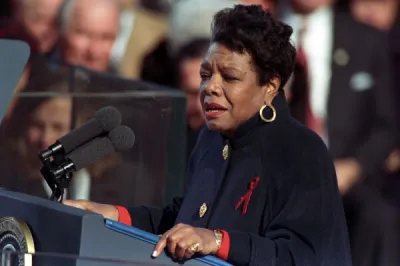
Maya Angelou
Human Design Chart
Biography
Her work conveys an indomitable spirit that had its roots in hardship, violence, and emotional turmoil. Her parents’ marriage ended when she was three, and she and her older brother were sent to her paternal grandparents’ home in the segregated town of Stamps, Arkansas. They lived in the back of their grandparents’ general store where the children were raised with discipline and care. When Maya was nearly eight, they returned to Saint Louis to visit their mom for the first time since they had left. There, on an autumn day in 1935, Maya was raped by her mother's boyfriend. Afraid that he would kill her brother as he had threatened, she could not initially talk about what had happened. But the little girl was so wounded and ill that her mom took her to the hospital where the truth ultimately came out. When the man was murdered by her uncles for his crime, the young girl felt responsible. Once more the children were sent to their grandparents’ home where Maya withdrew silently into a private, dark, and isolated world where she stayed, completely mute, for five years. The only light that shone in this space came in the guise of a kind neighbor who encouraged her to read and ultimately to end her five-year silence. So began her passionate lifelong affair with words and books.
At 13, she and Bailey went to live with their mom who married a man called Daddy Clidell. He turned out to be the first father Maya had ever known, and the family moved to San Francisco. At 16, she quite deliberately dispensed with her virginity, inviting the participation of a good-looking local boy without thinking through the possible consequences. She found herself pregnant. Her folks were supportive, and in the summer of 1944 she gave birth to a son, Guy.
What does Manifestor 6/2 mean for Maya Angelou?
Manifestor 6/2 — Design at a Glance
Maya Angelou was designed as a Manifestor, which bestowed upon her the role of a trailblazer and visionary. Her design inclined her to act like an emperor in ancient Rome: she had the foresight for great goals but did not lead the necessary battles herself; instead, she sent others out to realize her visions in the world. This superior perspective was also her greatest challenge. Because she often thought further ahead than her surroundings, Maya Angelou was frequently misunderstood and polarized people. While some loved her big dreams and followed her, others rejected or even hated her precisely because of this radical viewpoint.
To resolve this conflict, informing was crucial to her strategy. By communicating her intentions and visions in a timely and precise manner, she enabled the right followers to find her and follow her lead. This communication served not only clarity but also created the necessary foundation for effective leadership. If Maya Angelou lived true to this strategy of informing, she was rewarded with a deep sense of inner peace. However, if she deviated from her design or failed to clearly announce her steps, it resulted in an enduring, deep anger within her. Her path therefore lay in minimizing polarization through transparent communication and preserving the peace that arose from doing the right thing.
Splenic Authority
Maya Angelou showed a fundamental dependence on immediate presence for her decisions. Her design carried inner authority in the defined Spleen Center, which endowed her with specific survival intelligence. This functioned as a fine alarm system: A spontaneous inner knowledge signaled to her immediately whether a situation or environment was healthy and right for her.
For this authority to work, her Emotional and Sacral Centers were open, typical of Projectors or Manifestors. The first impulse of her instinct served directly her physical well-being. Maya Angelou therefore had to act in the moment; only this spontaneous trigger guaranteed protection from harmful influences and enabled rigorous boundary setting.
The challenge lay in the subtlety of this signal. The Spleen voice was a unique, fine impulse that could easily be ignored or drowned out by external advice. This required high vigilance from her and often a short retreat to hear her own intuition clearly. Since she only knew what was right in the present moment, long-term plans proved obstructive. Her design preferred flexibility and freedom over firm commitments. Spontaneous actions thus stood above prearranged decisions, as these would have limited the necessary adaptability of her survival instinct.
The 6/2 Profile — Role Model / Hermit
Maya Angelou followed a clear three-phase life path that emerged from her Profile configuration as an Archetype and Natural Talent. In the first three decades of her life, an experimental spirit prevailed. She learned through direct experience, marked by trial and error. This early phase served to gather many personal experiences, with mistakes being considered a necessary part of the process.
After turning 30, a structural shift occurred. The energy of Line Six became active, prompting Maya Angelou to withdraw metaphorically into a 'cave on the mountain' for distance. This period was not a pause but an intense phase of reflection and healing. Here she evaluated her earlier experiments with inner order and learned that ineffective action leads to chaos. This time of self-discovery allowed her to develop wisdom in dealing with her spiritual ego.
Once this internal clarification was complete, she returned to public life. She now appeared as a wise person who taught through effective action and clear introspection. Others sought her proximity to benefit from the life wisdom she had worked out. Her second line promoted discretion and restraint; she chose her words and actions with care to maintain loyalty and intelligence rather than repeating unnecessary conflicts from earlier interactions. This path from chaotic learning to orderly effectiveness shaped her entire existence.
Single Definition — Defined & Open Centers
Maya Angelou had a stable internal foundation shaped by her defined centers. Her defined Throat Center allowed for a reliable, clear expression that served as an anchor point for messages from her entire design. This voice spoke not from fleeting thoughts but from her deep identity, supported by her defined G Center, which gave her a firm sense of self-worth and a clear inner direction. Her willpower, rooted in the defined Heart Center, allowed her to keep promises and use her resources autonomously while her open Spleen Center endowed her with spontaneous, intuitive body intelligence that acted in the moment.
This stable core was in tension with her high permeability in other areas. Her open Head and Ajna Centers meant mental inspiration and concepts were situational; she tended to absorb questions and confusion from the environment rather than generating consistent internal answers. Similarly, her Sacral Center was open, making her vital energy dependent on external influences and vulnerable to overexertion through borrowed energies of others. Her emotional centers, Solar Plexus and Root, were also open, leading her to absorb and amplify foreign emotions and stress instead of regulating them herself. The challenge lay in not identifying these absorbed states as her own but relying on her defined authority – voice, identity, will, and intuition – to maintain clarity in the environment.
Channels for intuition, competitive drive and spiritual beauty.
Maya Angelou demonstrated a blend of intuitive depth with technical mastery. Her design inclined toward transforming repeated practice into recognized talent through Channel 48-16. Gate 48 sought vital information while Gate 16 experimented with new possibilities and perfected skills. This connection between Spleen and Throat Centers required external resources and recognition to further develop her talent.
Parallel to this, the Line of Wealth Channel 21-45 operated by connecting Heart and Throat Centers through Gate 21 (Hunter) and Gate 45 (Collector). This showed a strong will for control over material resources and work rhythms. Maya Angelou sought independence to be her own boss and generated prosperity through hard work. Gate 45 demanded the final word regarding resources, while Gate 21 served but needed to retain control to ensure rest.
The Initiation Channel 51-25 added competitive energy. Through Gate 51 (Shock) and Gate 25 (Spirit of Self), she aimed to initiate individual consciousness levels through challenges. This channel fostered courage in herself and others by supporting the leap from collective to individuation.
Additionally, prioritized gates shaped her profile: Gate 54 connected worldly success with mystical insight, supported by a partner's development. Gate 53 allowed her as a pioneer to start new cycles and leave old ones behind. Gate 56 enabled abstraction of mental processes into figurative storytelling, crucial for collective narratives. Gate 26 helped anchor innovations in the tribe by focusing ego on perception.
Collective Circuitry — Circuit Signature
Maya Angelou was shown as a person with a strong inner core whose design placed her own individuality and self-worth at the center. The Centering Circuit connected her Identity and Heart Centers directly, fostering resilient, courageous personalities who lived their uniqueness and encouraged others to do so. However, without a connection to Throat Center, it often proved difficult for Maya Angelou to precisely verbalize these firm inner convictions; the power remained more internally effective than outwardly communicated.
Parallel to this, the Understanding Circuit connected her Spleen with Throat Centers in Maya Angelou, directing her energy toward rational insight and future-oriented structure. She sought logical connections free from emotional coloring to improve things or lead into a better future. This focus on 'emotionless ratio' enabled strategic foresight and clear structuring of insights, even if the emotional depth of the heart was anchored elsewhere.
In the material realm, cooperation and resource management shaped her interactions. The Ego Circuit connected Maya Angelou's Heart and Throat Centers through the Resource Accumulation Channel. This underscored a theme of mutual support in collectively creating prosperity. Since this circuit lacked a connection to Sacral Center, there was no constant life force for uninterrupted action. Maya Angelou therefore needed sufficient rest periods to generate new energy and sustainably cooperate. These separate but defined areas created a tension field between inner constancy, rational future vision, and resource-oriented cooperation.
Left Angle Cross of Endeavour 1
Maya Angelou revealed herself as someone whose actions were marked by a profound, often unspoken effort. Her design suggested an underlying attitude where progress was not seen as effortless but rather as conscious and continuous work. This stemmed from the influence of the left cross of Effort 1, a configuration that defines life as a process of active shaping and struggle for form.
For Maya Angelou, this meant that her energy did not passively wait on opportunities but unfolded in overcoming obstacles. The mechanics of this cross describe an architecture where self is affirmed through action and the associated effort. She was less concerned with mere results than with the integrity of the path itself. Every act bore the stamp of this fundamental life task: asserting herself through effort and bringing structure to the chaos of existence.
This configuration conveyed no sense of ease but rather a sense of responsibility towards her own potential. Maya Angelou lived in a dynamic that required her to use her strength purposefully to bring about change. The left cross of Effort 1 marked the framework within which her identity was shaped through persistent striving for significance and fulfillment. It was an attitude of active engagement that defined her existence as continuous achievement.
Saturn Return · Uranus Opposition · Chiron Return · 2nd Saturn Return — Life Cycles
Maya Angelou was profoundly influenced by two prominent astronomical cycles around the years 1970 and 1980. Her first book, 'I Know Why the Caged Bird Sings,' was published in 1970 when she was 42 years old, making her internationally known. This coincided with her Uranus opposition, a period of radical change and breaking free from old structures, often leading to unexpected breakthroughs.
Ten years later, in 1980 at the age of 52, the first part of her autobiography was published in German under the title 'Ich weiß, dass der gefangene Vogel singt.' This marked her Chiron return, a fulfillment cycle where one's Incarnation Cross unfolds and meaning becomes experiential – provided that one lives according to their strategy and authority. It was not about healing old wounds in a mythological sense but rather the blossoming of her life task through literary creation. These two events defined the cyclical nature of her life: from sudden international recognition through Uranus influence to deeper processing and sharing of experiences during the Chiron cycle. Her design pointed towards such phases of transformation where inner processes came to light and found broad resonance.
Manifestor · Splenic Authority — Synthesis
Maya Angelou's design reveals a central thread of deeply rooted self-responsibility and an ability to absorb and transform the energy of others. The defined Throat, Heart, and G Centers signal a strong internal voice and identity, yet these are expanded by open centers like Solar Plexus, Root, and Ajna. She took on the emotions and stress from her environment (Spleen and Root), processed them in her heart, and then articulated them through her throat – a process that was both formative and challenging. Channel 21/45 points to a natural ability to mobilize resources and lead others, while Channel 56 (Gate 26) connects this power with a deep sensitivity for the needs of others.
A central paradox lies in the tension between the need for inner autonomy and simultaneous openness to external influences. The defined G Center stands for a firm self-identity, yet open centers make her vulnerable to conditioning and emotional turbulence. This dynamic led to a way of life where it was about recognizing and setting boundaries with foreign energy while maintaining the ability to deeply resonate with others and tell their stories.
3 Defined Channels
Incarnation Cross - Left Angle Cross of Endeavour 1
Solar Return
The Solar Return shows the moment when the sun returns to its exact birth position - your personal solar year.
Life Cycles
Discover the life cycles with a detailed triple view (birth chart, cycle chart, composite).
Human Design Profile
- Type
- Manifestor
- Strategy
- To inform others before acting
- Authority
- Splenic Authority
- Profile
- 6/2 - Role Model / Hermit
- Definition
- Single Definition
- Incarnation Cross
- Left Angle Cross of Endeavour 1
- Date of Birth
- 04.04.1928 14:10
- Place of Birth
- Saint Louis, MO, United States
Frequently Asked Questions
What was Maya Angelou's Human Design type?
What Profile did Maya Angelou have in Human Design?
What Authority did Maya Angelou have?
When was Maya Angelou born?
Discover your own Human Design
Are you also a Manifestor? Find out in a personal reading how to use your initiation power peacefully and dissolve resistance.
More Personalities
Back to overviewSissy Spacek
Anémone
Ann-Margret

Arletty

Arno

Artus
