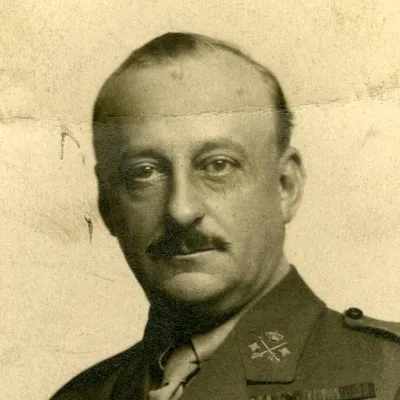
Miguel Primo de Rivera
Human Design Chart
Biography
Primo de Rivera died of diabetes in Paris on 16 March 1930.
Human Design Analysis: Miguel Primo de Rivera as Generator 3/5
Generator 3/5 — Design at a Glance
Miguel Primo de Rivera revealed himself as someone with considerable endurance and inner reserves of strength. His design as a Generator established a fundamental approach that was based on reacting rather than initiating independently. His energy source lay in his sacral center, which provided enormous power comparable to that of a workhorse – but only when responding to external signals.
His life strategy involved waiting for impulses from the environment and then acting upon them once his inner self gave a clear "yes." This reactive approach was crucial for his functionality. When he acted in harmony with these internal responses, it led to a deep sense of satisfaction and fulfillment.
Conversely, a specific vulnerability became apparent: when Miguel Primo de Rivera did things that did not intrinsically bring him joy or if he was prevented from engaging in tasks he wanted to do against his will, his energy was at risk. Such phases of non-resonance with his heart's project tended to lead to frustration and a lack of strength. His design called on him not to anticipate or force things but rather to wait and then react powerfully from the gut to fully realize his potential and avoid exhaustion.
Sacral Authority
Miguel Primo de Riveras Design inclines towards spontaneous, physically carried reactions. As a Generator, he possessed sacral authority as an inner guiding structure – a mechanism exclusive to this type and whose strategy also served as his decision-making instance. This simplified his process: He did not need long analysis but reacted immediately to external stimuli.
His authority manifested in a "gut feeling" or sudden surge of energy. These signals appeared as physical sounds – grunting, humming, or a loud "mm-hm" when agreeing. Such positive resonance gave him vitality and an almost inexhaustible flow of energy. He lived with great enthusiasm for his tasks without having to search for a higher purpose; the joy in doing was enough.
Additionally, his activated Spleen Center acted as a supportive instance to sacral authority. This connection allowed him to make lightning-fast, spontaneous decisions and have direct access to instinctive perception and physical well-being. Miguel Primo de Rivera reliably followed these inner impulses, which enabled him to immerse himself fully in his tasks and experience natural satisfaction. His energy was not goal-bound but sprang from pure joy in action.
The 3/5 Profile — Martyr / Heretic
Miguel Primo de Riveras design inclines towards heroic experimentation. As a 3/5 profile "Explorer/Hero and Saviour", he demonstrated himself as someone who first had to try everything personally before believing it. He learned from these practical experiences – and also the failures that came with them – to later solve problems for others. This experiential knowledge gave him strong appeal; others enjoyed learning from his insights. This heroic role flattered his ego, but became painful when public attempts failed.
The mechanics behind this stance lay in the combination of the third line of the Adventurer with the fifth line of the Hero. Gate 54 (Line 3) strengthened his ambition through secret interactions and the use of hidden means, especially when official routes were blocked. Simultaneously, there was a persistent attraction that should overcome obstacles. This was complemented by Gate 57 (Line 5), which highlighted the further development of intuition in crisis situations. Miguel Primo de Rivera developed individual mutations and new forms to protect against threats. The establishment of these new structures served to enhance survival capabilities and should be generalizable. In crisis situations, his intuition could indeed become overwhelmed, but this drove an independent development that was meant to strengthen the collective.
Split Definition — Defined & Open Centers
Miguel Primo de Rivera was someone with an unshakable inner structure and clear self-determination. His design featured defined centers that endowed him with a steady mental function (Ajna Center), reliable willpower (Heart Center), deep identity (G Center) as well as vital energy (Sacral Center). This combination allowed him to develop concepts and bring them into the world with determination, without losing sight of his own center. His communication (defined Throat Center) served as a direct expression of this inner authority; he spoke what he thought and wanted, giving his words weight and authenticity.
At the same time, Miguel Primo de Rivera was vulnerable to external influences through open centers. His open Head Center left him exposed to mental pressures and doubts that did not originate from within himself; he tended to wonder if he had to find inspiring answers to escape confusion. His open Solar Plexus absorbed the emotions of his environment, which could lead him to experience foreign moods as his own and recoil from emotional confrontations to avoid rejection. Furthermore, his open Spleen Center was marked by a fundamental survival fear; he instinctively sought security with others, increasing the risk of unhealthy dependencies if he acted impulsively. Finally, his open Root Center took on external stress that could drive him into cycles of hyperactivity and exhaustion as he tried to release pressure not generated by himself. These opennesses required him to always distinguish between what was his own truth and what was merely a conditioned reaction to the environment.
Channels for curiosity, rhythm and spiritual breakthrough.
Miguel Primo de Riveras design inclined towards innovative leadership based on the ability to skillfully use material resources to force new directions. This trait stemmed from Channel Beat 14-2, which connected the Sacral Center with the G Center. Through Gate 14, he possessed the competence to use power and material wealth for mutation, while Gate 2 provided higher knowledge for identity and direction. Together they generated a powerful energy source that enabled him to translate innovative impulses into reality by confidently responding to his sacral center and helping others find their own alignment.
Parallel to this, his nature as a storyteller and idea generator was evident. The Channel Curiosity 11-56 connected the Ajna Center with the Throat Center. Here Gate 11 drove the search for new ideas while Gate 56 transformed these into compelling narratives. This configuration enabled him to transform complex philosophical considerations into stories that taught or entertained others, less through dry facts than through the magic of storytelling and imagination.
Another defining aspect was his competitive drive towards individualization. The Channel Initiation 51-25 connected the Heart Center with Shock Gate (51) and Self Mind Gate (25). This endowed him with a natural competitiveness aimed at initiating others into progress via 'shock'. His goal was not only to be at the forefront himself but also to recognize potential in others and encourage them towards developing their uniqueness, provided there was an invitation.
Additionally, individual gates like Gate 54, which linked worldly success with spiritual insight, as well as Gate 53, standing for a pioneer of new cycles, played roles. Gate 24 promoted mental renewal in the rhythm of the pulse while Gate 57 offered intuitive clarity. On the design side, Gate 31 supported the transmission of leadership and Gate 23 facilitated the assimilation of new perspectives through explanation. Gate 5 secured the basic rhythm for energy build-up, and Gate 62 ensured logical structure and pattern recognition in his actions.
Individual Circuitry — Circuit Signature
Miguel Primo de Riveras design inclined towards inner strength and a pulsating individual expression. He defined himself as someone who shaped his identity through personal rhythms and deeply rooted convictions, though these forces acted separately from each other.
In him there was a Shared Definition: Two independent energetic groups existed parallel without direct exchange between them. The first group connected the Identity-, Sacral- and Heart Center. Here the Knowledge Circuit worked over Channel 'The Beat' (Gates 2–14). This created a connection between identity and life energy, showing as an independent acoustic rhythm – an inner beat that shaped his actions in the present moment. Parallel to this, the Centering Circuit worked over Channel 'Initiation' (Gates 25–51) within the same cluster. This connected Identity directly with Heart Center, giving him a fortified, courageous personality with strong individual convictions. These two circuits colored his inner self through reinforcement and creativity but remained confined to central centers.
The second completely separate group included Ajna- and Throat Centers, linked by the Meaning-Finding Circuit and Channel 'Curiosity' (Gates 11–56). Here it was about emotional processing of the past. Miguel Primo de Rivera reflected on past experiences in wave-like patterns – with beginning, middle, and end – seeking their meaning. He expressed these insights through Throat Center to share them with others. Since this group was not connected to the first cluster, the emotional reflection of the past remained energetically separate from his identity-forming life energy and strong convictions in Heart.
Right Angle Cross of Penetration 4
Miguel Primo de Rivera's Human Design profile indicated a tendency towards a penetrating, right-handed intuition. This configuration, the right cross of penetration four, described an inner architecture aimed at recognizing profound truths or principles with relentless clarity and conveying these insights directly into the external world. It was not about gentle discovery but rather an active, often cutting process of piercing through illusions or established structures. The mechanics of this cross implied a life task where it was necessary to penetrate certain truths and articulate or act upon them in such a way that their impact could not be missed. Miguel Primo de Rivera demonstrated someone who utilized this energy to reduce complex connections to the core and communicate or decide with a certain immediacy. The 'right' orientation emphasized the connection to external reality and action within social contexts, while the element of 'penetration' suggested that superficial solutions were unsatisfactory for him. His design demanded a presence that could see through where others only saw appearance and demand these insights with a certain sharpness. It was an energy of clear lines, leaving little room for ambivalence and instead targeting the essential to make it visible and effective.
Saturn Return · Uranus Opposition · Chiron Return · 2nd Saturn Return — Life Cycles
Miguel Primo de Riveras Human Design profile indicated a tendency towards structural consolidation and dealing with heavy burdens that were particularly evident in his life phases under increased pressure. This configuration described a mechanism where external demands called for internal discipline to maintain stability or integrate losses.
In 1898, at the age of 28, he fought against the Philippine Revolution and in the Spanish-American War on the Philippines. For his design, this was a typical moment of the first Saturn return: In this phase, years of groundwork often condensed into a solid but hard result. The experience of conflicts served here to build an inner armor necessary to stabilize one's path in life and take responsibility.
The second Saturn return marked 1930, at age 60, the end of this cycle. Miguel Primo de Rivera died from diabetes in Paris. This point concluded a long arc of structural development. Where the first return laid the foundation, the second ended the active phase of building and led to the dissolution of the physical body. The mechanics here did not show as a sudden break but rather as the natural waning of a life task marked by discipline and hardness. His death in Paris thus aligned with the cycle leading after decades of strain to final release.
Generator · Sacral Authority — Synthesis
He was a Generator whose life was characterized by a deep-rooted drive towards activity and the need to set energy into motion (sacral energy). The profile of the experimenter and hero indicates that he learned through personal experiences and made this knowledge accessible to others. His defined mental center allowed him to consistently develop concepts and influence others with his ideas – a skill enhanced by physical reactions to external stimuli in line with sacral authority (the sacral center as inner authority). This process of testing, experiencing, and passing on formed a red thread running through his life phases, from early experiences in the military field to his later death.
A central paradox lay in the connection between his generative energy and the knowledge circuit. On one hand, he was an enduring Generator who acted upon the impulses of stimuli (the Beat channel). On the other hand, the impulses of the knowledge circuit drove him towards innovation and change – a combination that released creative power but also accompanied by melancholy and a constant desire for newness. This tension between the need to let energy flow in established channels and the urge for mutation shaped his decisions and actions.
3 Defined Channels
Incarnation Cross - Right Angle Cross of Penetration 4
Solar Return
The Solar Return shows the moment when the sun returns to its exact birth position - your personal solar year.
Life Cycles
Discover the life cycles with a detailed triple view (birth chart, cycle chart, composite).
Human Design Profile
- Type
- Generator
- Strategy
- To respond - wait for something to respond to
- Authority
- Sacral Authority
- Profile
- 3/5 - Martyr / Heretic
- Definition
- Split Definition
- Incarnation Cross
- Right Angle Cross of Penetration 4
- Date of Birth
- 08.01.1870 03:00
- Place of Birth
- Jerez de la Frontera, Spain
Frequently Asked Questions
What is Miguel Primo de Rivera's Human Design type?
What Profile did Miguel Primo de Rivera have in Human Design?
What Authority did Miguel Primo de Rivera possess?
What incarnation cross defined Miguel Primo de Rivera?
When was Miguel Primo de Rivera born?
Discover your own Human Design
Are you also a Generator? Find out in a personal reading how to use your sacral energy correctly and discover deep satisfaction.
More Personalities
Back to overviewAaliyah

Alexia

Angèle

Anne-Marie

Arcángel

Arno